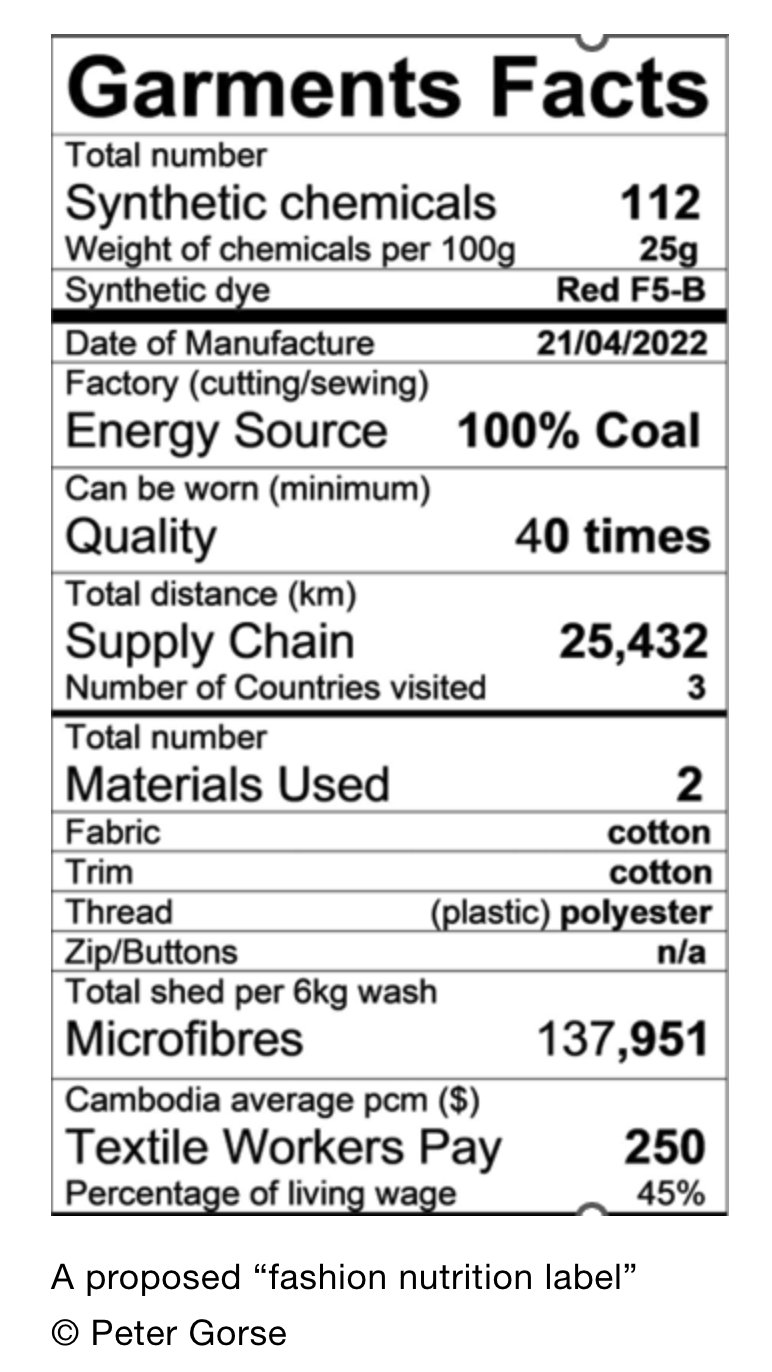
Garment Facts Label
A garment label can make a claim; it can’t prove one. A Label For Pressing Sustainability And Social Issues is credible only when each statement about a garment can be traced to reviewable product evidence, not just a supplier declaration or a polished marketing message. That distinction matters as EmpCo rules have applied since 27 September 2026, and buyers face commercial and compliance risks when evidence is missing or fragmented.
Brands and retail buyers already know the problem: product information is spread across supplier tiers, documents and formats, while purchase-order decisions still need to be made. A label can help communicate relevant environmental and social information, but it has limits. Without records that support the claims at product level, it may simply make an unsupported assertion more visible.
This article explains what a garment facts label can and can’t establish, how to connect disclosures to traceable evidence, and what brands and retailers can review before market or purchase-order decisions. From fibre-origin records to evidence of worker welfare, the focus is practical: identify what a claim requires, locate its source and assess whether the supporting information stands up to scrutiny.
Key Takeaways
- Separate a garment label’s communication role from the underlying records needed to support each disclosure.
- Match fibre, origin, environmental and social statements to evidence that fits the specific product and claim.
- Use the test for A Label For Pressing Sustainability And Social Issues: is each statement precise, properly scoped and supported?
- Build disclosures through a controlled workflow: define the claim, map its source, retrieve and verify evidence, then approve the wording.
- Retail buyers can use Symolem-ID to identify per-SKU evidence gaps or compliance blocks before committing to a purchase order.
Table of Contents
- What Is a Garment Facts Label, and What Should It Actually Do?
- Which Sustainability and Social Issues Can a Garment Label Communicate?
- How Can Buyers Tell Useful Disclosure from an Unsupported Label Claim?
- How to Build a Garment Disclosure from Verified Product Records
- How Symolem Supports Evidence-Backed Garment Disclosures Before the PO
What Is a Garment Facts Label, and What Should It Actually Do?
A garment facts label presents selected information about a specific clothing product in a clear, usable form. It might communicate fibre composition, origin or a carefully defined environmental or social attribute. There is no single universal format implied by the term: the label is a communication tool, not proof that its statements are correct.
An evidence-backed garment disclosure is a clear, product-specific statement whose scope can be checked against traceable records. That distinction matters commercially. If a retailer places a claim on a product page or hang tag, the wording may shape a purchase decision; if the business cannot show what supports it, broad language can create substantiation and interpretation risks. “Responsible” or “sustainable”, for example, leaves the reader to infer which product attribute is meant and what evidence supports it.
A Label For Pressing Sustainability And Social Issues should therefore make information more precise, not simply make a claim more prominent. The disclosure should identify what is being asserted, which product it concerns and the limits of the statement. The records behind it must remain available for review, even if the consumer-facing wording is brief.
How a garment facts label differs from a care label
A care label serves a practical function: it gives the wearer instructions for handling and maintaining a garment. Those instructions don’t, by themselves, verify where fibres were grown, how fabric was processed or whether a social claim is supported. Garment facts are additional product information, not a substitute for care instructions or other mandatory product labelling.
The content a business must provide depends on the product and the rules applying in the relevant market. A general overview of mandatory labelling laws can help explain the broader concept, but it isn’t a substitute for checking the applicable requirements for a particular product. Keep the distinction clear: required label content and voluntary claims have different purposes, and neither should be treated as evidence for the other.
Why labels cannot carry the whole supply-chain record
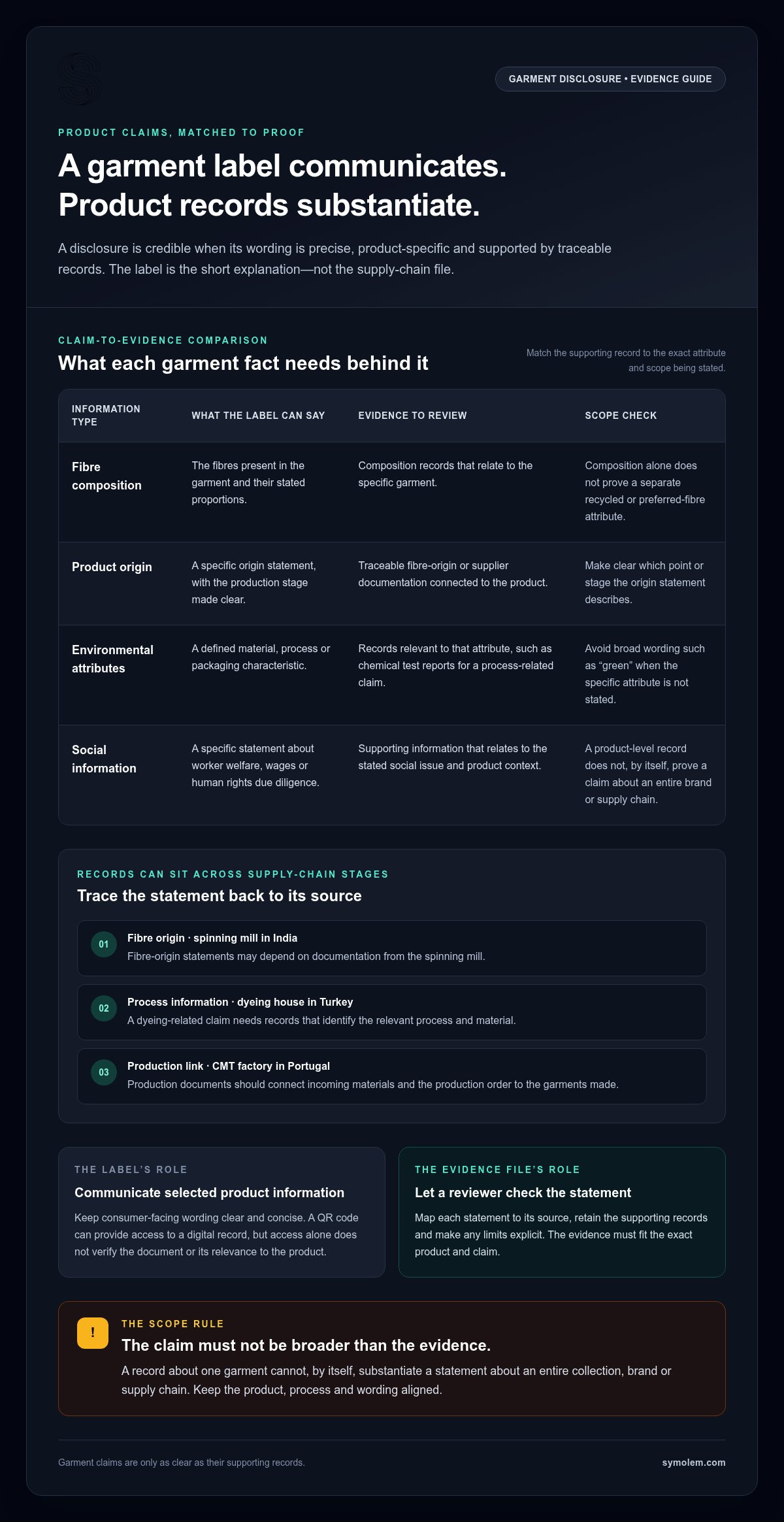
Consumer-facing information must be concise. Verification is not. A fibre-origin statement may depend on documentation from a spinning mill in India, while a claim about dyeing may need records from a dyeing house in Turkey. Those documents need to identify the relevant material, process and product clearly enough for a reviewer to assess whether they support the exact wording.
A QR code can connect a garment to a digital record, but it only provides access. It doesn’t establish who created the underlying document, whether that document relates to the product being sold or whether its scope supports the claim. Keep the disclosure readable and the evidence auditable: map each statement to its source, retain the supporting records and make any limits explicit. That separation lets a label inform the buyer without pretending to contain the entire supply-chain file.
Which Sustainability and Social Issues Can a Garment Label Communicate?
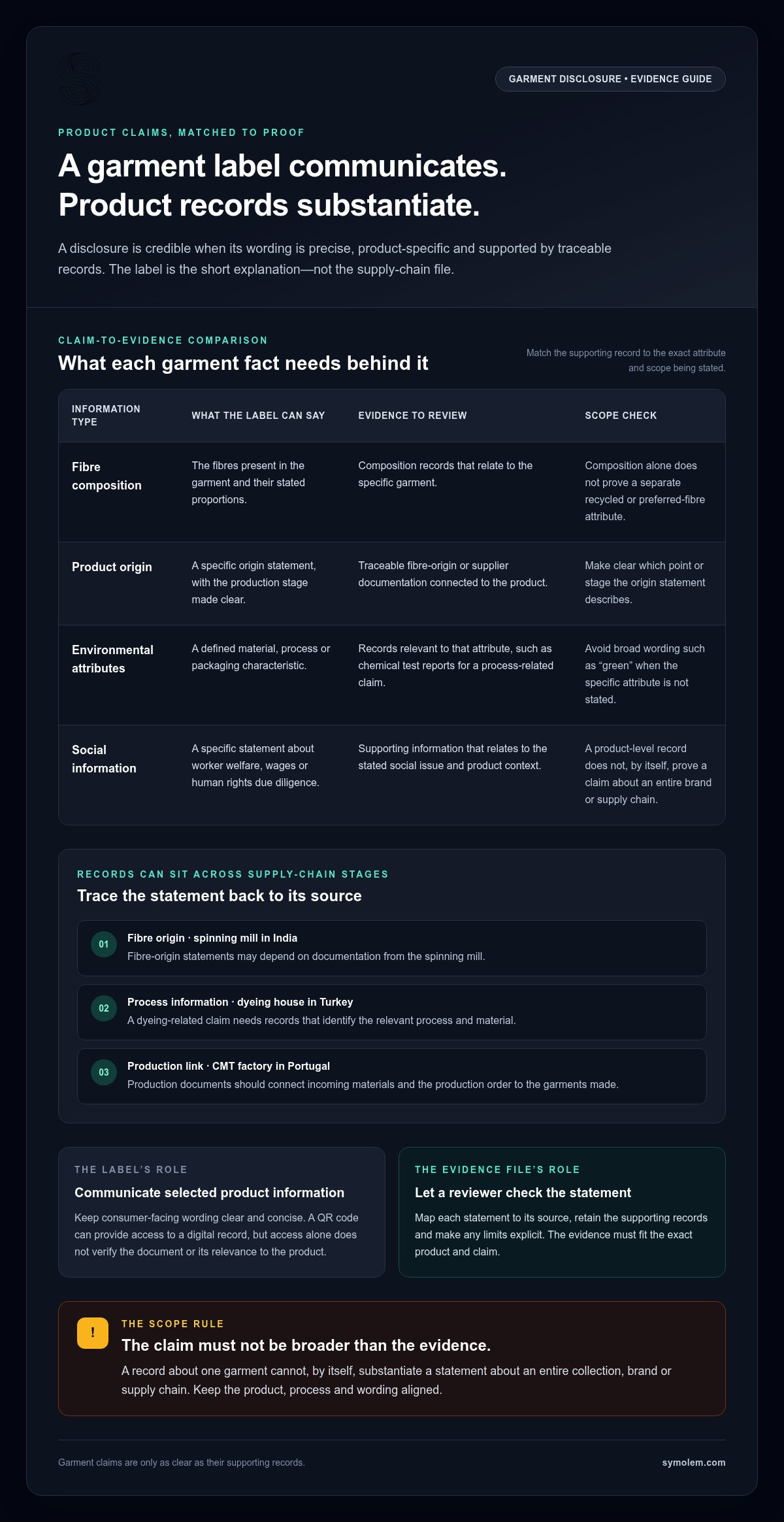
A garment disclosure can cover several distinct product attributes, but they are not interchangeable. Fibre composition describes what the garment is made from; origin identifies a stated point or stage in production; environmental information concerns a defined impact or process; social information relates to conditions affecting workers. Each statement needs evidence appropriate to the product and to the precise wording used.
Useful disclosure categories include:
- Fibre composition: the fibres present in the garment and their stated proportions.
- Product origin: a specific origin statement, with its meaning and production stage made clear.
- Environmental attributes: a defined material, process or packaging characteristic, rather than an unqualified claim that a product is “green”.
- Social information: a specific, supportable statement about worker welfare, wages or human rights due diligence.
A product fact is not automatically evidence for a wider corporate claim. A record relating to one garment cannot, by itself, substantiate a statement about an entire collection, brand or supply chain. The scope of a claim must never exceed the scope of the evidence supporting it. This is central to transparency and traceability in sustainable fashion: information must connect to the product and supply-chain stage it describes, not merely share a supplier name or material category.
Fibre, origin, and material information
Fibre composition and material claims require different support. A composition record may establish the stated fibre content, while a claim that a fibre is recycled or otherwise preferred needs evidence relevant to that attribute. Fibre-origin documentation can connect a product statement to supplier records; those records must remain traceable through processing and assembly. For example, a Portugal CMT factory’s production documents should relate the incoming materials and production order to the garments made, rather than being treated as proof of an unrelated material claim.
Environmental and social information
Environmental disclosures should identify the attribute being asserted and the product or process it covers. Chemical test reports, transaction certificates and packaging weights can each support particular questions, but none automatically validates every claim about a garment. Their relevance depends on the document’s scope, the material or shipment it covers and its connection to the product under review.
Social statements need the same discipline. A fair-wage assertion calls for auditable information relevant to wages and the workers or facilities covered; a worker-welfare statement needs evidence that addresses the conditions it describes. An audit or certificate may inform a specific assessment, but it shouldn’t be presented as universal proof of all social or environmental performance. To structure disclosures against traceable product records, product compliance intelligence can help connect claims, evidence and product scope.
How Can Buyers Tell Useful Disclosure from an Unsupported Label Claim?
Look past the design. A label, QR code or polished product graphic can make a statement visible, but none demonstrates that the statement is accurate. Buyers need to assess the wording, its scope and the records behind it before treating a disclosure as decision-ready.
Visibility is a property of the disclosure; evidence quality is a property of the records that substantiate it. Use that distinction when reviewing a range. The phrase A Label For Pressing Sustainability And Social Issues should prompt a practical question: can each social or environmental statement be traced to evidence relevant to this garment?
| Useful disclosure | Unsupported claim |
|---|---|
| A specific statement identifies the product attribute and makes its scope clear. | Broad terms such as “green” or “responsible” leave the attribute and limits unclear. |
| Identifiable product and supplier records support the wording. | A graphic, QR code or general company statement is presented without product-level evidence. |
| The evidence relates to the garment, material or process named. | Evidence from one product, site or supplier is used to imply performance across a whole range or supply chain. |
EmpCo, Directive (EU) 2024/825, has applied since 27 September 2026. It addresses misleading environmental claims, including generic claims and sustainability labels that lack an appropriate certification basis or public-authority establishment. The precise assessment depends on the claim, context and applicable national law. Before publication or purchase approval, check the wording against the directive and relevant primary legal sources rather than treating every environmental statement as subject to one blanket rule.
What evidence makes a claim reviewable?
Connect each statement to identifiable product and supplier records. A precise fibre claim can still be weak if Tier 1-3 documentation is missing, mismatched to the relevant material or disconnected from the garment’s production records. Buyers should be able to establish what the document covers, which supplier issued it and how it relates to the product being considered.
A Verification ID and structured compliance record support the organisation and transfer of verified product information; they are not themselves a consumer-facing Digital Product Passport. Nor does a digital record replace scrutiny of the evidence it contains.
What should trigger scrutiny before a purchase order?
Pause when a claim uses absolute language, leaves its scope undefined or lacks product-level records. In pre-PO screening, a Missing Evidence status identifies information that has not been supplied for review; Blocked indicates a compliance issue requiring resolution. Neither should be treated as a minor paperwork gap when a buyer is deciding whether to commit to a range.
These statuses help direct follow-up before a purchase order is signed. They don’t replace claim-specific legal review, but they make evidence gaps and identified barriers visible while the buying decision can still respond.
How to Build a Garment Disclosure from Verified Product Records
Build from the records, not from the wording a marketing team wants to use. Start with the product and intended market, then identify the information relevant to the disclosure and the people or suppliers who own its source records. This prevents a claim drafted for one product or market from being applied too broadly to a range with different materials, production routes or evidence.
Use a controlled sequence:
- Define the claim. State the specific product attribute in plain language and decide exactly which product it concerns.
- Map its data source. Identify the supplier, production stage and record expected to support the statement.
- Retrieve the evidence. Request the relevant documents across Tier 1-3 rather than assuming they are complete or already held centrally.
- Verify the scope. Check that the records relate to the product, material, process and claim wording, and note any limitations.
- Approve the disclosure. Release wording only when the responsible reviewer can trace it to suitable evidence.
For a digital information system, the fields and relationships that need to be organised will depend on the product and intended use. A guide to textile DPP data requirements can help teams consider how product information is categorised and prepared for review.
Map each proposed statement to its source record
A claim-to-evidence table makes the decision auditable. It should identify the product, the statement’s scope, the source record and its review status, so missing documentation cannot disappear inside a general supplier folder.
| Product identifier | Claim scope | Source record | Review status |
|---|---|---|---|
| Garment or SKU reference | Fibre-origin statement for the specified material | Fibre-origin documentation from the relevant supplier | Received, under review or missing |
| Garment or SKU reference | Chemical-related statement for the specified product or process | Relevant chemical laboratory test report | Scope checked, gap identified or further review required |
If a Tier 2 record has not been retrieved, record the gap. Don’t translate incomplete supplier evidence into confident consumer wording. A missing document is a decision point: retrieve it, narrow the claim to what can be substantiated, or withhold the statement.
Structure records for review and onward use
Once reviewed, product records can be structured for transfer to a selected DPP provider or retail onboarding system. Symolem audits, verifies and structures product compliance records, assigning a Verification ID; it doesn’t issue consumer-facing passports. The Digital Product Passport implementation framework provides further context on preparing textile information for onward use.
For brands and buyers managing fragmented documentation, structure product evidence for review before approving a disclosure or committing to a purchase order.
How Symolem Supports Evidence-Backed Garment Disclosures Before the PO
A garment disclosure is only as dependable as the product records behind it. Symolem is a product compliance intelligence platform and evidence advisory for fashion, footwear and textiles. It doesn’t design labels; it helps retailers and brands assess product information, locate evidence gaps and structure records for review before commercial decisions are made.
This distinction matters before a purchase order is signed. A buyer needs more than a persuasive statement: they need visibility of the evidence available for each product and whether it has been reviewed against relevant requirements. For brands, the task is often to retrieve fragmented records from suppliers and connect them to the claims they are expected to substantiate.
For retailers and marketplaces: screen before signing
Symolem-ID screens third-party brand ranges against 50+ global textile regulations in seconds and assigns each SKU a status: Cleared, Blocked or Missing Evidence. These outcomes help buying, merchandising and compliance teams distinguish products with reviewed records from those requiring resolution or further documentation.
The status is operational, not cosmetic. A Missing Evidence result can flag an information gap before a buyer commits to a range, while a Blocked status makes an identified compliance issue visible for follow-up. Screening at SKU level gives retailers a structured view of product records across brands they may not manufacture, supporting more informed pre-PO decisions.
Screen third-party brand compliance before signing the PO. Explore Symolem-ID or run a free product scan.
For fashion brands: retrieve and substantiate records
Brands may have to assemble evidence dispersed across Tier 1-3 suppliers. Symolem’s advisory work retrieves records such as chemical test reports, fibre-origin documentation, transaction certificates and packaging weights, then helps connect them to the relevant product information. The aim is to make supplier evidence traceable and reviewable, not to turn a document into a broader claim than it supports.
Social information demands the same evidential discipline. Auditable social accounting can address worker welfare, fair wages and human rights due diligence, with records organised to show what was assessed and the scope covered. This helps brands respond to stockist requests with substantiated information rather than unsupported assurances.
A Label For Pressing Sustainability And Social Issues cannot resolve fragmented records on its own. Symolem’s role is to audit, verify and structure product compliance records, assigning a Verification ID for transfer to a chosen Digital Product Passport provider or retail onboarding system. It does not issue consumer-facing passports.
Need to retrieve missing Tier 1-3 supplier evidence or substantiate social accounting for retail stockists? Take the 5-minute Free Assessment or Book an Advisory Consultation.
Make Evidence Review Part of the Buying Decision
The next step is operational: assign ownership for each product claim, define what records must support it and make evidence review part of the decision process before disclosure or purchase approval. A Label For Pressing Sustainability And Social Issues can only serve buyers and consumers when the statement remains connected to records that can be examined.
For retailers and marketplaces, that means resolving evidence gaps before committing to a third-party range. For fashion brands, it means treating supplier documentation and social accounting as substantiation, not as paperwork to assemble after a challenge. Put product evidence review into practice and make the next disclosure defensible from the outset.
Screen third-party brand compliance before signing the PO. Explore Symolem-ID or run a free product scan.
Need to retrieve missing Tier 1-3 supplier evidence or substantiate social accounting for retail stockists? Take the 5-minute Free Assessment or Book an Advisory Consultation. A more rigorous disclosure process is achievable, one traceable product record at a time.
Frequently Asked Questions
Does every garment need a QR code or digital label?
No, there isn’t a general requirement that every garment carry a QR code or digital label. Requirements depend on the product, market and rules in force, so brands should assess their obligations rather than assume a digital link is mandatory. A retailer may also request digital product information as part of onboarding. That commercial request is distinct from a statutory requirement and should be tracked separately.
Can a garment label include social information about how it was made?
Yes, a label or linked product page can communicate a specific social statement if the business can substantiate it. For example, a claim about fair wages should identify the relevant workers or facilities and be supported by records that address wages for that scope. A garment facts label, including one described as A Label For Pressing Sustainability And Social Issues, should avoid implying that one assessed factory represents every tier.
Who is responsible for the accuracy of garment information?
Responsibility depends on who creates, approves, supplies and publishes the information, and on their role in the transaction and applicable law. Operationally, a brand should assign an owner to each product statement, require suppliers to identify source records and retain the approval trail. A retailer reviewing a third-party range should also establish which claims and evidence have been checked before accepting product information for its own channels.
How often should garment disclosure information be reviewed?
Review it whenever a change could affect whether the statement remains accurate, rather than relying only on a fixed calendar cycle. Triggers include a revised bill of materials, a new production site, a supplier change, an altered process or updated supporting documentation. If a claim is tied to a specific certification or test report, record its coverage and validity period, then reassess the wording when that basis changes.
Can a product claim be used if one supplier record is missing?
Only if the available evidence still supports the claim as written and the missing record doesn’t concern a necessary part of its scope. For instance, a gap in packaging weights may not affect a separately substantiated fibre-content statement, but it would prevent relying on those weights for a packaging disclosure. Log the gap, assess its relevance and narrow or withhold the affected claim until the basis is clear.
What is the difference between a product record and a consumer-facing Digital Product Passport?
A product record is the structured information and supporting evidence held for review and onward transfer. A consumer-facing Digital Product Passport is how relevant information may be presented or accessed through a chosen provider or interface. A record can be verified and assigned a Verification ID without Symolem issuing a consumer passport. The key operational point is to establish the data’s accuracy and structure before deciding how it will be presented.