How the GS1 Digital Link DPP Resolver Ensures Compliance
A product link can work perfectly and still lead to a passport record that cannot withstand scrutiny. A GS1 Digital Link DPP resolver routes a request from a product identifier to an online destination; it doesn’t verify the destination’s evidence or establish that the passport meets regulatory requirements. Confusing routing with compliance creates a costly blind spot: the QR code scans, but the product record may still be incomplete or unsupported.
It’s understandable that teams focus first on making product information accessible. But the identifier, the resolver and the passport data perform different jobs, and each needs clear ownership. This article explains how a resolver handles requests, where it sits in a Digital Product Passport system and what its limits mean for retailers and fashion brands. It also sets out the decisions to make before linking identifiers to records, from checking evidence retrieved across supplier tiers to aligning verification with retail onboarding. The principle is straightforward: routing gets a request to the record; verified evidence makes that record defensible.
Key Takeaways
- Distinguish the identifier, Digital Link URI, data carrier, resolver and passport record before assigning responsibilities.
- The GS1 Digital Link DPP resolver directs product requests to a resource; it does not verify the record or prove compliance.
- Map product and batch identifiers to clearly owned records, then check that supplier evidence is current and traceable.
- Test how the resolver handles both people’s scans and system queries, and confirm each route reaches the intended resource.
- Use verified, structured product records to support DPP data transfer and retailer screening before purchase orders are signed.
Table of Contents
- What a GS1 Digital Link DPP Resolver Does, and What It Does Not
- How GS1 Digital Link Resolution Routes a Product Request
- GS1 Digital Link, Resolver and DPP: Compare the Layers Before Choosing
- Prepare Textile Product Records Before Connecting a Resolver
- Connect Resolver Architecture to Verified Records and Retail Screening
What a GS1 Digital Link DPP Resolver Does, and What It Does Not
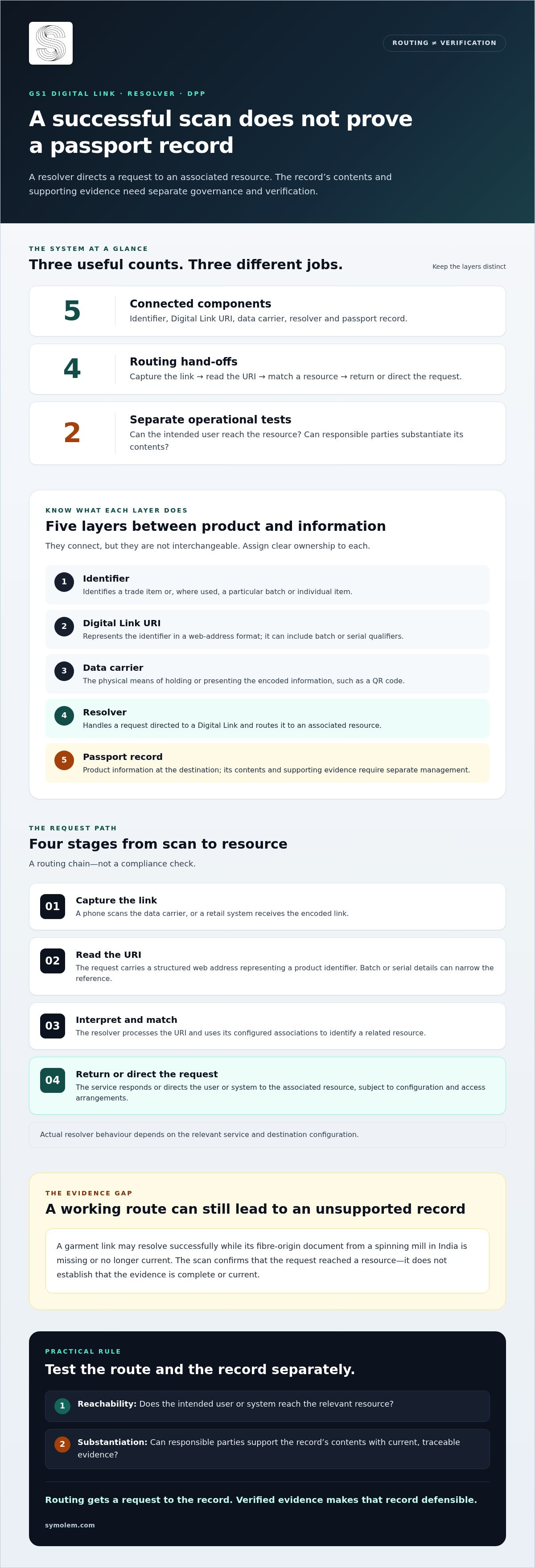
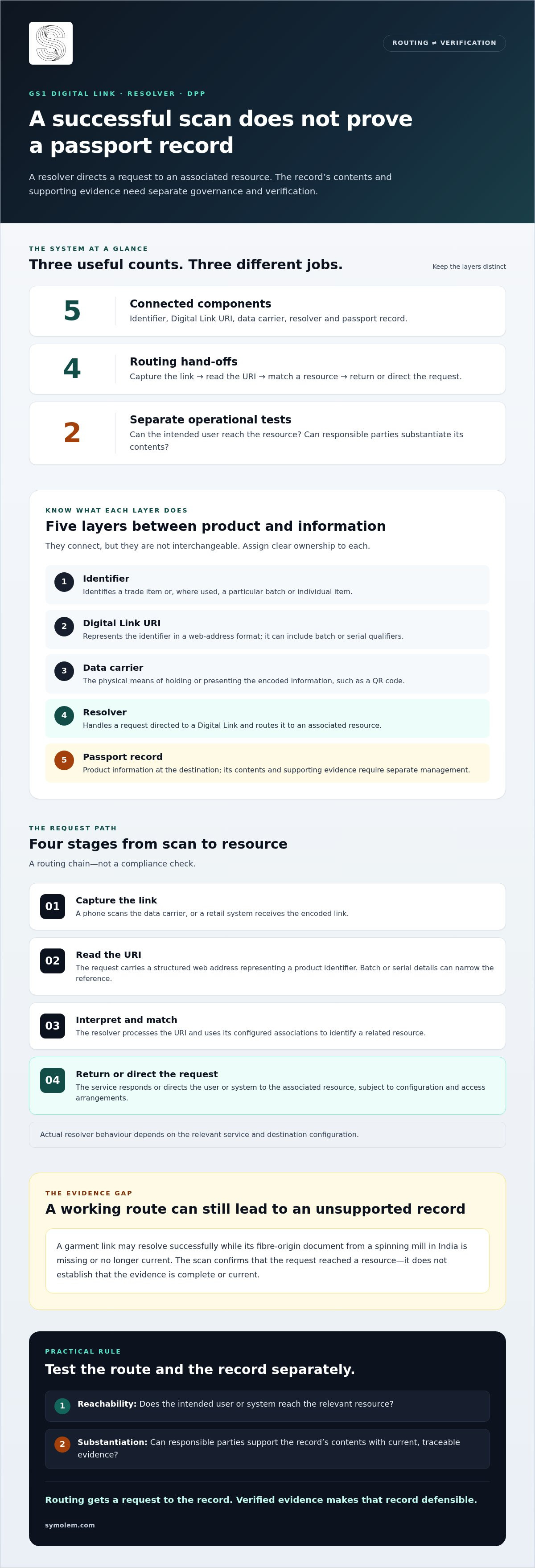
A GS1 Digital Link DPP resolver receives a request made through a Digital Link and directs it to an associated online resource. It handles the route, not the product evidence at the destination. That distinction matters: a browser reaching a product page, or a system receiving a response, tells you the request was directed somewhere. It does not tell you whether the record is fit for regulatory or commercial use.
Keep the components separate. Each has a distinct function and decision point:
- Identifier: A code that identifies a trade item, or, where used, a particular batch or individual item.
- Digital Link URI: A web-address format that represents the identifier and can include qualifying information such as a batch or serial number.
- Data carrier: The physical means of holding or presenting the encoded information, such as a QR code.
- Resolver: The web service that handles a request directed to a Digital Link and routes it to an associated resource.
- Passport record: The product information made available at the destination. Its contents and supporting evidence must be managed separately from the routing service.
These layers are connected, but they are not interchangeable. A retailer may scan a code on a garment, while a brand manages the underlying identifier and product record, and a resolver service directs the request. If ownership of any layer is unclear, teams can mistake a working technical connection for a controlled, substantiated record.
How is a GS1 Digital Link resolver different from a QR code?
A QR code is a data carrier: it holds encoded information that a compatible device can read. If that information is a GS1 Digital Link, the link represents an identifier in a web-address route. The resolver is the service that handles a request to that address and directs it onwards. Not every QR code contains a GS1 Digital Link, and not every QR-based product information system uses the same resolver arrangement.
For a textile product, the code might carry a link representing a garment’s identifier. The route may take a user or system towards a product resource, but the code itself does not contain proof that fibre-origin documents, chemical test reports or other relevant records are complete. Those records need their own governance and verification.
What does the resolver not verify?
Routing delivers a resource; validation assesses what that resource contains and whether its claims are supported. A resolver does not, by that function alone, confirm record completeness, check the provenance or currency of source evidence, or establish who is accountable for maintaining the information. Those are separate operational controls involving brands, suppliers and retail teams.
Consider a garment record linked through a code, while its fibre-origin document from a spinning mill in India is missing or no longer current. The link may still resolve successfully. A buyer who treats that response as proof of compliance risks overlooking an evidence gap before committing to an order.
Statutory obligations depend on the applicable rules and the roles of the businesses involved, not simply on whether a link resolves. The practical test is therefore twofold: can the intended user reach the relevant resource, and can the responsible parties substantiate the record’s contents?
A resolver routes a product request; only evidence verification can establish whether the destination record is complete, supported and fit for its intended compliance use.
How GS1 Digital Link Resolution Routes a Product Request
Resolution is a chain of hand-offs, not a compliance check. A retailer’s system or a person scanning a garment’s code makes a request; the resolver interprets the Digital Link URI and uses its configured associations to direct that request to a related resource. The GS1 Digital Link DPP resolver connects product identity with an online destination, while the destination’s records and evidence remain subject to separate governance.
A typical request can be understood in four stages:
- Capture the link. A phone scans a data carrier, or a retail system receives the encoded link through its own process.
- Read the URI. The request carries a structured web address representing a product identifier. Where included, qualifiers such as batch or serial information can narrow the reference to a particular production batch or item.
- Interpret and match. The resolver processes the URI and checks its configured associations to determine which resource is linked to that identifier and request.
- Return or direct the request. The service provides a response or directs the requesting user or system to the associated resource, subject to the chosen system’s configuration and access arrangements.
This sequence describes the routing logic, not a universal technical implementation. The GS1 Digital Link Standard explains how GS1 identifiers can be represented in web-address form; the resolver’s actual behaviour depends on how the relevant service and destination are configured.
What happens between scanning and opening a product resource?
The scan or system query produces a request containing the Digital Link URI. The resolver interprets the URI, uses its associations to identify a relevant resource, then returns or directs the request accordingly. A retailer should test the real product links used in its workflow, because the destination and response depend on the configuration in place, not merely on the fact that a code scans.
For example, a retailer requests a garment record that brings together information linked to its identifier. That record may draw on supplier documentation from several tiers: fibre-origin material from a spinning mill in India, processing information from a dyeing house in Turkey, and production records from a CMT factory in Portugal. Resolution can help a request reach the relevant record; it does not reconcile supplier evidence or establish that the record is complete.
Why separate a product identifier from its data location?
A product identifier and the location of online information solve different problems. The identifier refers to the product; the data location tells a system where associated information can currently be accessed. Keeping those roles distinct can support changes to hosting or data arrangements without changing the product’s identity, but continuity depends on maintaining identifier mappings, resolver configuration and destination records.
A stable identifier names the product; a changeable data location tells a request where its information is held. If a brand changes its record-hosting arrangement, it must ensure the resolver’s associations and destination records are updated and tested. Otherwise, a valid identifier may lead to an unavailable or obsolete resource. For apparel teams, link maintenance belongs alongside record ownership and evidence controls, not in a separate technical silo.
Before activating a new destination, document who approves the change, who updates the association and who confirms that the replacement resource serves the intended product record. That change-control step helps prevent routing updates from being treated as evidence review or record approval.
GS1 Digital Link, Resolver and DPP: Compare the Layers Before Choosing
Choosing a link format is not the same decision as choosing who maintains a passport record or verifies its evidence. A DPP system depends on connected components, but each answers a different operational question: what product is being referenced, where should a request go, and who is accountable for the information provided?
| Component | Function | Decision owner | Limitation |
|---|---|---|---|
| GS1 Digital Link | Represents GS1 identifiers in a web-address format. | Brand or identifier owner, in coordination with its system partners. | Does not itself host or verify passport information. |
| Resolver service | Uses configured associations to direct requests to related resources. | Resolver operator and the organisation managing its configuration. | Routing does not establish the quality or compliance of the destination. |
| Data carrier | Holds or presents encoded information for scanning or machine reading. | Brand or product operator responsible for placing and maintaining it. | A readable carrier does not guarantee a valid link or current record. |
| DPP platform | Stores, manages or presents passport information, depending on its design. | Brand and chosen platform provider, under their agreed responsibilities. | A platform cannot make unsupported source evidence reliable merely by displaying it. |
| Verified product record | Organises product information and its supporting evidence for use or transfer. | Record owner, with verification responsibilities assigned to relevant parties. | Verification has a defined scope; it does not replace applicable legal assessment. |
These are functional distinctions, not a universal allocation of legal responsibility. The GS1 Digital Link DPP resolver is one part of the architecture; it should not be treated as the DPP platform, the evidence file or the party accountable for every data point.
Is GS1 Digital Link itself a Digital Product Passport?
No. A Digital Link can connect a product identifier to online resources, but it is not the complete product record. The identifier and link support identification and access; passport content, supporting evidence and platform functions sit elsewhere in the system. A technical format can help structure a connection, but no format alone guarantees that a product meets applicable requirements.
For regulatory decisions, distinguish the general ESPR framework from product-specific requirements and confirm the applicable obligations against current EU primary sources. GS1 Digital Link is an implementation option, not an ESPR-named mandate. Requirements may depend on the relevant legislation and product rules, so avoid treating adoption of a particular link format as proof of compliance.
Who controls the resolver and the linked product information?
Responsibilities can be distributed. A brand may own product identifiers and source records, a resolver operator may maintain routing associations, a DPP provider may manage the information service, and a retailer may set onboarding or evidence conditions. The parties must define these roles rather than assume a standard allocation.
Consider a garment whose fibre information originates at a spinning mill in India and processing records at a dyeing house in Turkey. If the brand cannot obtain or trace those upstream documents, the product record may have an evidence gap even while the resolver points reliably to it. If no party owns link maintenance, a supplier or hosting change may also leave the destination stale or inaccessible. Assign ownership for identifiers, routing configuration, record updates and evidence follow-up before connecting systems.
Prepare Textile Product Records Before Connecting a Resolver
Configure the route after the record has an owner and a defensible evidence base. A destination can be technically reachable yet commercially weak if the information is incomplete, out of date or impossible to trace to its source. For fashion brands, that weakness often starts upstream, where product details and supporting documents sit across different supplier tiers.
Before connecting a GS1 Digital Link DPP resolver, organise the preparation work around five controls:
- Record ownership: Assign responsibility for maintaining product information, following up suppliers and approving updates.
- Identifier mapping: Map each identifier to the correct product record and, where relevant, the batch or item reference used in internal systems.
- Evidence retrieval: Match required documents to the product claims or data fields they support, recording their source and status.
- Access decisions: Determine which users or systems need the record and what information should be available through each route.
- Testing: Check that expected requests reach the intended destination and that failures, such as a missing association, are visible to the teams responsible for fixing them.
Testing confirms that configured requests behave as expected. It is not a complete compliance audit, and it cannot remedy unsupported product information.
Which operational checks should precede resolver configuration?
Start with an identifier-to-record map that reflects how the business manages products, batches and individual items. Then assign named owners for resolver associations, destination changes, record updates and supplier evidence follow-up. Test representative requests, including cases where a destination is unavailable or a reference does not match a record, so operational teams know how an exception is surfaced and resolved.
Field-level planning matters too. Use the Textile DPP Data Requirements article alongside the product record to identify relevant information and expose gaps before linking the destination. A broad DPP implementation plan can also help put the work in sequence, but neither resource replaces the need to confirm the evidence behind each textile product record.
How should a brand handle missing Tier 1-3 evidence?
Record gaps explicitly rather than treating an empty field as a completed control. Identify missing chemical test reports, fibre-origin documents, transaction certificates and packaging weights, then trace each item to the supplier or tier that can substantiate it.
For example, a dyeing house in Turkey may hold processing documentation, while a CMT factory in Portugal may have records tied to garment assembly. If one source document is absent, outdated or cannot be linked to the relevant product, the destination may still open, but the record remains difficult to defend. Retrieve and verify the supporting material, preserve its connection to the product record, and resolve material gaps before the information is shared with a retailer or DPP provider.
Brands preparing records for transfer can use DPP evidence verification to structure product information and supporting evidence before retail onboarding.
Connect Resolver Architecture to Verified Records and Retail Screening
Routing infrastructure is only useful when the records behind its destinations are governed and supportable. Symolem is a product compliance intelligence platform and evidence advisory for fashion, footwear, apparel and textiles. It audits, verifies and structures product compliance records, then assigns a Verification ID so those records can be transferred to a chosen DPP provider or retail onboarding system.
This is a distinct function from operating a resolver or issuing a passport. Symolem does not build, design or issue consumer-facing Digital Product Passports. A Verification ID supports the transfer of a verified record; it does not replace the source evidence, the responsibilities of the businesses involved or the functions of the selected DPP provider.
How do verified records fit beside a DPP provider?
Think of verification as a control before data is handed into another system. The record is reviewed and structured with its supporting material, then prepared for transfer. The chosen provider or retailer system remains responsible for its own platform functions, while the parties responsible for the product must maintain the underlying information and meet applicable obligations.
That separation matters when supplier evidence is distributed across tiers. A fibre-origin document, chemical test report or transaction certificate must be traceable to the relevant product record, not merely present somewhere in a shared folder. If a retailer’s onboarding process receives a linked record with a missing document, the technical connection has not resolved the underlying evidence gap.
Why screen third-party brand ranges before signing the PO?
Retailers and marketplaces may need to make commercial decisions about apparel ranges they do not manufacture. Symolem-ID screens third-party brand ranges against 50+ global textile regulations in seconds and provides per-SKU status before purchase orders are signed: Cleared, Blocked or Missing Evidence. That gives buying and compliance teams a defined signal to investigate before committing to stock, rather than relying on a working link as a proxy for product readiness.
For brands, a Missing Evidence status can point to the work that still needs to happen upstream. Evidence advisory retrieves missing Tier 1-3 documentation, including chemical lab tests, fibre-origin records, transaction certificates and packaging weights; social accounting and due diligence work supports auditable records on worker welfare, fair wages and human rights. These controls address the information behind a destination, while resolver configuration determines how a request reaches it.
Use the separation deliberately: maintain the route, verify the record, and screen the range before commercial commitment. Each task needs an owner, and none should be treated as a substitute for the others.
Screen third-party brand compliance before signing the PO. Explore Symolem-ID or run a free product scan.
Need to retrieve missing Tier 1-3 supplier evidence or substantiate social accounting for retail stockists? Take the 5-minute Free Assessment or Book an Advisory Consultation.
Make the Next Decision Before the Next Order
Product information systems will change as business processes, supplier relationships and applicable requirements evolve. Treat governance as an ongoing operational discipline, not a one-off implementation task. Set a review point for the assumptions behind each record and route, and revisit them when sourcing or product specifications change.
The practical next step is to bring product, sourcing, compliance and technology teams into the same decision process. Agree how changes are recorded, escalated and approved, so that the information supporting a commercial decision remains connected to the product it describes. This creates a stronger basis for adapting systems without losing accountability.
Build that discipline into routine product and supplier reviews. Clear ownership now gives teams a more reliable foundation for future requirements and better-informed decisions across the textile value chain.
Frequently Asked Questions
What is a GS1 Digital Link DPP resolver?
A GS1 Digital Link DPP resolver is a service that handles a request made through a GS1 Digital Link and directs it to an associated online resource. The URI represents product identification in a web-address format; the resolver handles the routing. For example, a scan may reach a product page, but that response alone doesn’t confirm that the information is current or supported by supplier documents.
Is GS1 Digital Link the same as a Digital Product Passport?
No. GS1 Digital Link represents product identification in a web-address format and can connect a request to an online resource. A Digital Product Passport concerns the product information made available through an appropriate system. A garment’s link might open a record containing product details, while evidence files and the processes for managing that information sit behind it. Neither a link nor resolver alone is a complete passport or proof of compliance.
Does ESPR require brands to use a GS1 Digital Link resolver?
Don’t assume it does. A particular link format or resolver arrangement is a technical implementation choice unless the applicable legal or product-specific requirements state otherwise. Before treating it as mandatory, check current EU primary sources for the relevant product rules, data-carrier provisions and applicable standards. Record the basis for your decision, and distinguish a preferred architecture from a legal obligation that applies to your product and business role.
Can one GS1 Digital Link direct different users to different product information?
It may be possible for a resolver configuration to direct requests to associated resources for different audiences, but this depends on the chosen system and its settings. A brand should define which product details a consumer, retailer or supply-chain system needs, then agree how records are maintained and access is managed. Test each intended user journey; don’t assume one code will automatically produce the right information for every scanner.
What happens if the product information moves to a new platform?
A change of hosting may be managed by updating the relevant resolver configuration while retaining the product identifier, but continuity isn’t automatic. For example, if a brand moves garment records to a new provider, it needs to maintain the identifier-to-destination association and check that the new destination works. Test representative links before retiring the old resource, and assign responsibility for correcting broken or outdated routes.
Does a working resolver prove that textile supplier evidence is valid?
No. The GS1 Digital Link DPP resolver can direct a request to a resource, but it doesn’t establish whether a chemical test report is genuine, current or relevant to the garment in question. Brands should link each supporting document to the correct product and retain enough source information to trace it back to the supplier. Retailers can then assess evidence gaps separately from whether a product link opens.
Should a fashion brand configure a resolver before collecting supplier data?
A brand can plan routing and collect evidence in parallel, but it should not treat a configured link as a finished product record. For a garment made through several supplier tiers, map the identifier to the correct record, identify required documents and assign owners for follow-up. Then test the route against the information it is meant to serve. This helps teams expose missing records before onboarding or retail review.