
Nachhaltigkeits-Compliance entscheidet jetzt den Marktzugang in Fashion.
EPR, ESPR und Digitale Produktpässe kommen Markt für Markt. Wir helfen Marken und Händlern, die dafür nötigen Produktdaten aufzubauen.
Our Digital Product Passport code was accepted by the EU registry on the day it opened — 20 July 2026.


Inaugural conference · Free to attend
What do your clothes really cost?
Product compliance is a decision about a product, not a report about a company.
Sustainability for fashion is product compliance. It means knowing what each garment is made of, where it comes from, and what you can prove.
What product compliance intelligence is
A garment is either legal to sell in a market or it is not. That turns on what it is made of, where it came from, what is printed on the label and the product page, and what you can prove when someone asks. The decision attaches to the SKU, and it is made again for every market the product enters.
What product compliance intelligence is not
It is not ESG reporting, which describes the company. It is not a factory audit, which describes the site. Both feed it. Neither answers whether this dress can be listed in Germany next season.
What compliance intelligence means
The three things that decide it are held together and kept current: the rules in each market, the evidence you hold, and the product record they attach to. The output is a status per product, per market — cleared, action needed or blocked — and the file behind it.
product level evidence
A Digital Product Passport is a data carrier.
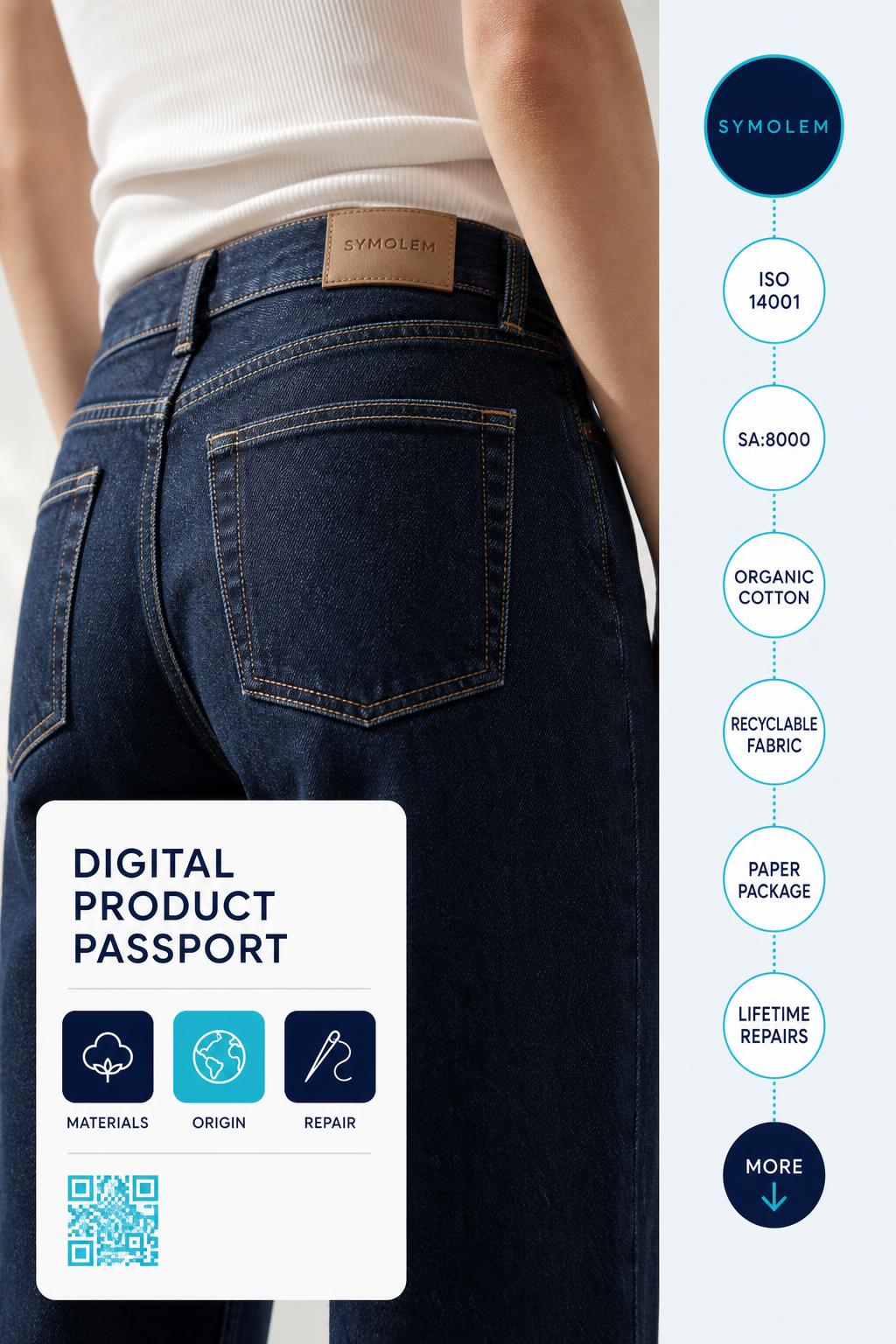
The QR code on the label is not the passport. It is the carrier: scanning it resolves to a structured record held against a unique product identifier. The picture shows what a shopper, an auditor or a market surveillance officer sees when they scan a garment — the same file, read at different depths.
Under ESPR the delegated act for textiles sets which fields must be carried, who is accountable for each one, and how long the record must stay available. Badges on a product page are marketing. A Digital Product Passport is a regulated data set with an owner, a date and a source behind every line — and from 2027 it decides whether the product can be placed on the EU market at all.
The passport data behind the code
Select a data group to see the kind of entries we collect and hold for it.
example passport entries · Product identity
- GTIN 05012345678900 · GS1 Digital Link
- Model: Wide-leg denim, style DN-402
- Batch 2026-07-WK29 · EU registry ID issued
- Economic operator: brand legal entity and EORI
Market access depends on the product, not just the company.
We track the rules so your product and sourcing teams don't have to.
Great Britain
No ESPR equivalent yet, but the CMA can act directly on misleading environmental claims under the Digital Markets, Competition and Consumers Act.
United States
No federal regime — obligations are set state by state, including California's SB 707 textile EPR, the FTC Green Guides, and Proposition 65 chemical disclosure.
EEA / EFTA
Norway, Iceland and Liechtenstein take EU acts through the EEA Joint Committee on a different timetable; Switzerland is EFTA but not EEA.
Built on the UN/CEFACT UN Transparency Protocol.
Symolem holds a seat on the UN/CEFACT working group developing the UN Transparency Protocol (UNTP), the open standard for verifiable product and sustainability data, and contributed to its public review.

ESPR-Leistungen
Von Exposition zu Readiness.
In vier Phasen.
Jede Zusammenarbeit beginnt mit dem Assessment. Sind die Lücken erkannt, schließt das vierphasige Symolem-Programm – eine strukturierte 13-Wochen-Arbeit – diese systematisch. Jede Phase baut auf der vorherigen auf und führt Ihr Unternehmen von regulatorischer Unsicherheit zu belastbarer, prüfbarer Compliance.
ESPR ist der Anker – jede Fashion-Marke, die in die EU verkauft, muss sich zuerst darauf vorbereiten. Aber sie kommt nicht allein. Wir verfolgen 50 Fashion- und Textilregulierungen in 14 Jurisdiktionen – PFAS-Verbote, EPR-Systeme, Greenwashing-Durchsetzung, Zwangsarbeit-Regeln, Abfallexportbeschränkungen – damit Kunden das ganze Brett sehen, nicht nur die größte Figur darauf.
ESPR-Gap-Analyse & Compliance-Roadmap
Wir mappen den aktuellen Stand Ihrer Marke auf die ESPR-Pflichten, identifizieren die risikoreichsten Lücken und bauen eine priorisierte Compliance-Roadmap mit klaren Meilensteinen bis 2028.
Digital-Product-Passport-Readiness
Wir bewerten Ihre Dateninfrastruktur, gleichen Ihre Produkte mit dem UNTP-Passschema und dem vom EU-DPP-Register akzeptierten Muster ab, identifizieren Datenlücken in Ihrer Lieferkette und definieren die technische Architektur, die Ihre Marke braucht.
Lieferketten-Transparenz & ESPR-Daten
Mehrstufiges Lieferanten-Mapping, Kreislauf-Audits und produktbezogene Scope-3-Berechnungen, die die Evidenzbasis Ihres DPP unter EU-Verordnung 2024/1781 bilden. Wir analysieren zusätzlich die DPP-Dienstleister, mit denen Sie arbeiten, und prüfen deren Outputs gegen EU-Recht – denn Compliance, die nicht unabhängig prüfbar ist, ist keine Compliance.
Regulatorische Wirkungsmessung HIE®
Mit unserem eigenen Human Impact Equivalence Framework® verwandeln wir Ihre ESPR-Compliance-Daten in strukturierte, auditierbare Wirkungsbelege – quantifiziert nach dem Standard, den Regulierer, Investoren und institutionelle Gegenparteien verlangen. Nicht mehr, als das Gesetz verlangt. Genau so viel, wie es fordert.
Assessments werden nach einer strukturierten 100-Punkte-Methodik bewertet, ausgelegt auf Konsistenz und Vergleichbarkeit.
Where it goes wrong
Four ESPR questions a buyer, a marketer or an auditor will ask before you are ready.
Do we have market access for this product?
Third-party brands arrive with claims and passports you did not make and now share liability for. We give buying and merchandising a status per SKU before the PO is signed: cleared, blocked, or can't determine, with the missing evidence named.
Can we prove the green claim under EmpCo?
"Responsibly sourced" is marketing until it points at a transaction certificate. Under EmpCo and the UK DMCC it is a liability. Every claim sits in a register tied to its evidence, owner and expiry, and is flagged before it is bought, listed or reprinted.
We have traceability data. Why isn't it a passport?
Tier maps and audit PDFs are not a Digital Product Passport and do not tell you whether a silk blend clears AGEC, PPWR or the textile delegated act. We take the outputs you already hold, map them to the passport fields and the rules, and issue the record and the proof pack.
An ESPR finding came back red. What now?
A red flag with no remediation path is a stock dropout, a withdrawn claim or a blocked listing. We run a corrective action plan with the supplier, keep the product under containment while it is fixed, and upload the verified resolution back into the platform that raised it.
Plain English
The ESPR and EmpCo questions we get asked most
Short answers, no jargon. If yours is not here, ask us directly and we will answer it the same way.

Sprechen wir über IhreWirkung.
Ob Sie regulatorische Veränderungen navigieren, reale Wirkung messen oder eine Methodik aufbauen, die einer Prüfung standhält – ein 30-minütiges Gespräch ist der beste Ausgangspunkt.