
La conformité durabilité conditionne désormais l'accès au marché en mode.
EPR, ESPR et les Passeports Numériques de Produit arrivent marché par marché. Nous aidons marques et distributeurs à bâtir les données produit nécessaires.
Our Digital Product Passport code was accepted by the EU registry on the day it opened — 20 July 2026.


Inaugural conference · Free to attend
What do your clothes really cost?
Product compliance is a decision about a product, not a report about a company.
Sustainability for fashion is product compliance. It means knowing what each garment is made of, where it comes from, and what you can prove.
What product compliance intelligence is
A garment is either legal to sell in a market or it is not. That turns on what it is made of, where it came from, what is printed on the label and the product page, and what you can prove when someone asks. The decision attaches to the SKU, and it is made again for every market the product enters.
What product compliance intelligence is not
It is not ESG reporting, which describes the company. It is not a factory audit, which describes the site. Both feed it. Neither answers whether this dress can be listed in Germany next season.
What compliance intelligence means
The three things that decide it are held together and kept current: the rules in each market, the evidence you hold, and the product record they attach to. The output is a status per product, per market — cleared, action needed or blocked — and the file behind it.
Product Relationship Management
The easiest way to think of it: Product · Regulations · Markets. For every product you sell, we connect what it is, what the law demands, and where you sell it — so nothing you put in front of a customer is left unproven.
Product
Every SKU, feed, claim and care label
Regulations
ESPR, EmpCo, UFLPA, packaging EPR
Markets
UK, EU, US and everywhere you sell
Pre-PO screening with Symolem-ID
Check hundreds of SKUs against 50+ regulations in seconds, before you sign the PO or clear customs. See blocked lines, unproven claims and missing test certificates before stock is made or shipped.
Evidence retrieval across Tier 1–3
Software portals stall in fashion because spinning mills and dye houses do not log into client dashboards. Our specialists chase and verify lab tests, transaction certificates and fibre origins directly from source factories.
Audit-ready human-rights due diligence
Worker welfare, wage verification and grievance data compiled into auditable evidence packs that satisfy EU CSDDD, German LkSG and US forced-labour enforcement, not generic policy PDFs.
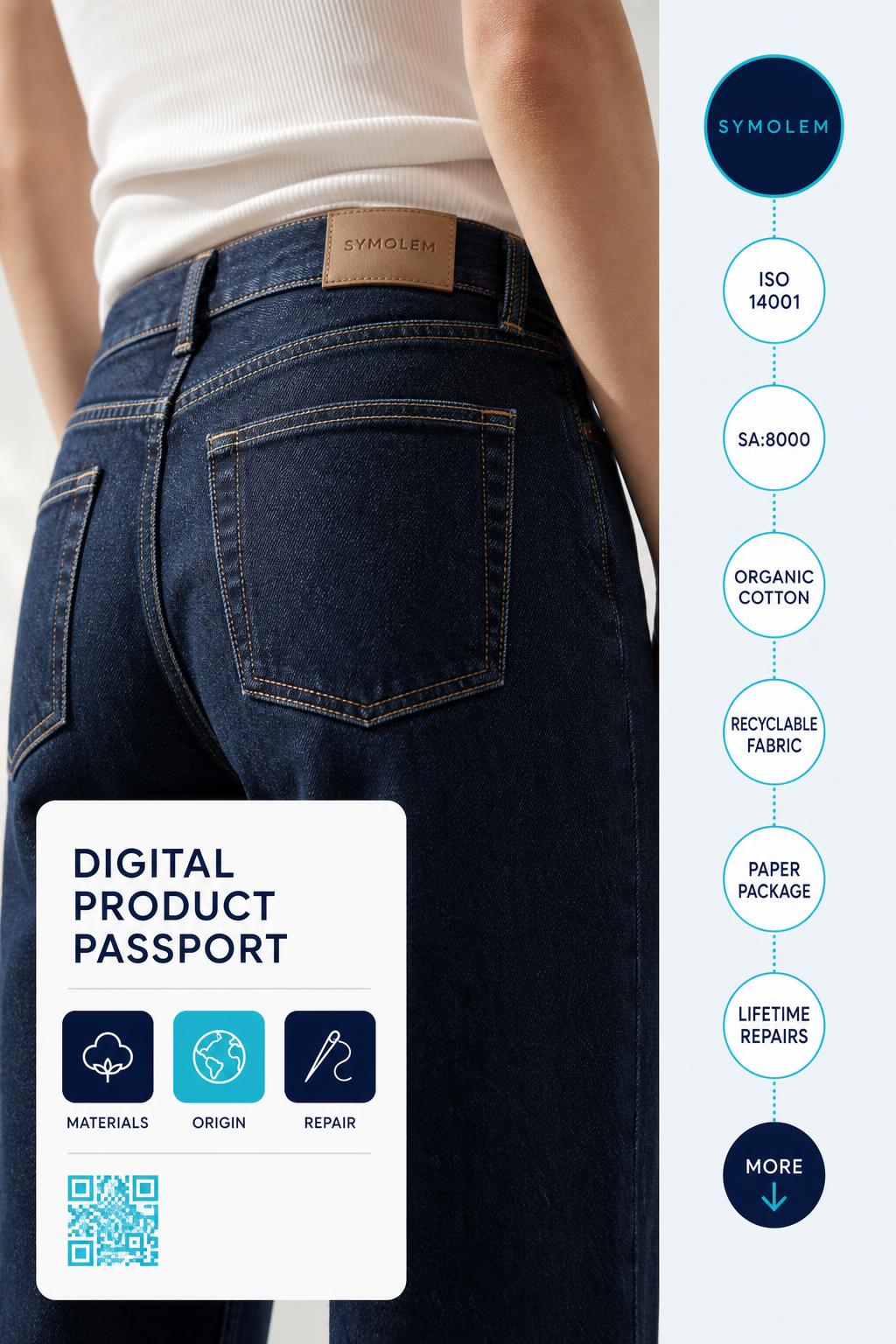
Ecodesign for Sustainable Products Regulation
Every product inspected against 50+ regulations, not just ESPR
Symolem prepares your product data and audits your evidence against global requirements, starting with the EU ESPR. Fibre composition, certificates, named Tier 1 and Tier 2 sites and every green claim, checked and owned before they go anywhere near a purchase order.
- 50+regulations checked
- Secondsper product
- 1Verification ID
Whichever Digital Product Passport provider you choose, the passport is only as good as the data behind it. The ESPR textile delegated act will set which fields must be carried and who is accountable for each one. We make sure your suppliers will be ready to answer for them. Start with our ESPR Digital Product Passport checklist.
What evidence we check
Select a data group to see the kind of entries we inspect and verify against the evidence.
inspection record · Product identity
- GTIN 05012345678900 · GS1 Digital Link
- Model: Wide-leg denim, style DN-402
- Batch 2026-07-WK29 · EU registry identity verified
- Economic operator: brand legal entity and EORI
Market access depends on the product, not just the company.
We track the rules so your product and sourcing teams don't have to.
Great Britain
No ESPR equivalent yet, but the CMA can act directly on misleading environmental claims under the Digital Markets, Competition and Consumers Act.
United States
No federal regime — obligations are set state by state, including California's SB 707 textile EPR, the FTC Green Guides, and Proposition 65 chemical disclosure.
EEA / EFTA
Norway, Iceland and Liechtenstein take EU acts through the EEA Joint Committee on a different timetable; Switzerland is EFTA but not EEA.
Built on the UN/CEFACT UN Transparency Protocol.
Symolem holds a seat on the UN/CEFACT working group developing the UN Transparency Protocol (UNTP), the open standard for verifiable product and sustainability data, and contributed to its public review.
Services ESPR
De l'exposition à la préparation.
En quatre étapes.
Chaque collaboration commence par l'Évaluation. Lorsque des écarts sont identifiés, le Programme Symolem en quatre étapes — un engagement structuré sur 13 semaines — les comble. Chaque étape s'appuie sur la précédente, pour faire passer votre entreprise de l'incertitude réglementaire à une position de conformité vérifiée et défendable.
L'ESPR est l'ancre — la réglementation à laquelle toute entreprise de mode vendant dans l'UE doit se préparer en premier. Mais elle ne vient pas seule. Nous suivons 50 réglementations mode et textile dans 14 juridictions — interdictions de PFAS, dispositifs REP, application des allégations environnementales, règles contre le travail forcé, contrôles à l'exportation des déchets — pour que nos clients voient l'échiquier complet, et pas seulement la pièce la plus grosse.
Analyse des écarts ESPR et feuille de route de conformité
Nous cartographions la position actuelle de votre marque au regard des obligations ESPR, identifions les écarts à plus haut risque et construisons une feuille de route de conformité priorisée, avec des jalons clairs jusqu'en 2028.
Préparation au Passeport Numérique de Produit
Nous évaluons votre infrastructure de données, comparons vos produits au schéma de passeport UNTP et à l'échantillon accepté par le registre DPP de l'UE, identifions les écarts de données dans votre chaîne d'approvisionnement et définissons l'architecture technique dont votre marque a besoin.
Transparence de la chaîne d'approvisionnement et données ESPR
Cartographie multiniveaux des fournisseurs, audit de circularité et calcul Scope 3 au niveau du produit pour bâtir la base de preuves dont votre DPP aura besoin au titre du Règlement ESPR 2024/1781. Nous examinons également les prestataires DPP avec lesquels vous travaillez déjà, en vérifiant leurs livrables face à la législation européenne — parce qu'une conformité qui ne peut être vérifiée de manière indépendante n'est pas une conformité.
Mesure d'impact réglementaire, HIE®
Avec notre cadre propriétaire Human Impact Equivalence®, nous traduisons vos données de conformité ESPR en preuves d'impact structurées et auditables, quantifiées au niveau exigé par les régulateurs, les investisseurs et les contreparties institutionnelles. Pas au-delà de ce que la loi demande. Exactement ce qu'elle exige.
Les évaluations sont notées selon une méthodologie structurée sur 100 points, conçue pour garantir la cohérence et la comparabilité.
Where it goes wrong
Four ESPR questions a buyer, a marketer or an auditor will ask before you are ready.
The pre-PO compliance firewall for fashion retailers
Under EU ESPR, EmpCo and the UK DMCC, retailers share liability for the third-party brands they list. Symolem-ID screens a brand's line sheet in seconds and gives buying and legal teams a status per SKU before intake: cleared, blocked or missing evidence, with the gap named.
Tier 1–3 evidence retrieval and audit-ready social accounting
Stockists and customs are asking for proof you do not have on file. We chase your suppliers for the missing lab tests and transaction certificates, and tie every green claim to its evidence, so wholesale orders are not delayed and claims hold up under EmpCo and the UK DMCC.
We have traceability data. Why isn't it a passport?
Tier maps and audit PDFs are not a Digital Product Passport and do not tell you whether a silk blend clears AGEC, PPWR or the textile delegated act. We take the outputs you already hold, map them to the passport fields and the rules, and audit the record, then hand one Verification ID to whichever DPP provider you choose, with the proof pack.
An ESPR finding came back red. What now?
A red flag with no remediation path is a stock dropout, a withdrawn claim or a blocked listing. We investigate the supplier data gap, run the social accounting and corrective action plan with the supplier, and upload the verified resolution back into the platform that raised it.
Plain English
The ESPR and EmpCo questions we get asked most
Short answers, no jargon. If yours is not here, ask us directly and we will answer it the same way.

Parlons de votre impact.
Que vous traversiez un changement réglementaire, mesuriez un impact réel ou construisiez une méthodologie qui résiste à l'examen — une conversation de 30 minutes est le bon point de départ.