
Fashion · Manufacturers
Manufacturers hold the data the passport requires
Fibre content, mill and facility records, dye and finishing chemistry, energy and water use, audit status, certification scope. The information brands and retailers now need for Digital Product Passports mostly originates on your floor, not theirs.
The problem is not that you lack the data. It is that fifteen customers are asking for it fifteen different ways.
One dataset, many customer formats
A German customer sends a supply chain due diligence questionnaire under LkSG. A French one asks for AGEC and eco-modulation data. A UK retailer sends its own supplier sustainability template. Another wants Higg FEM and FSLM completed by a deadline. A US buyer needs traceability documentation sufficient to survive a UFLPA detention. Each arrives in a different spreadsheet, with different definitions, on a different schedule.
You answer all of them from the same underlying facts. The cost is not the data. It is the fifteen translations of it.
We build the dataset once, structured to the standards the regulation is converging on, so each customer request becomes an export rather than a project.
Position in the chain determines the data request
Cut-make-trim operations are asked for facility, labour and process data. Full-package suppliers are asked for that plus material origin, fibre content and chemistry. Vertically integrated groups running spinning, weaving, knitting, dyeing and finishing are asked for all of it, and are increasingly asked to evidence tier 2 and tier 3 on behalf of customers who cannot see that far.
The deeper into the chain the request goes, the more valuable your ability to answer it becomes.
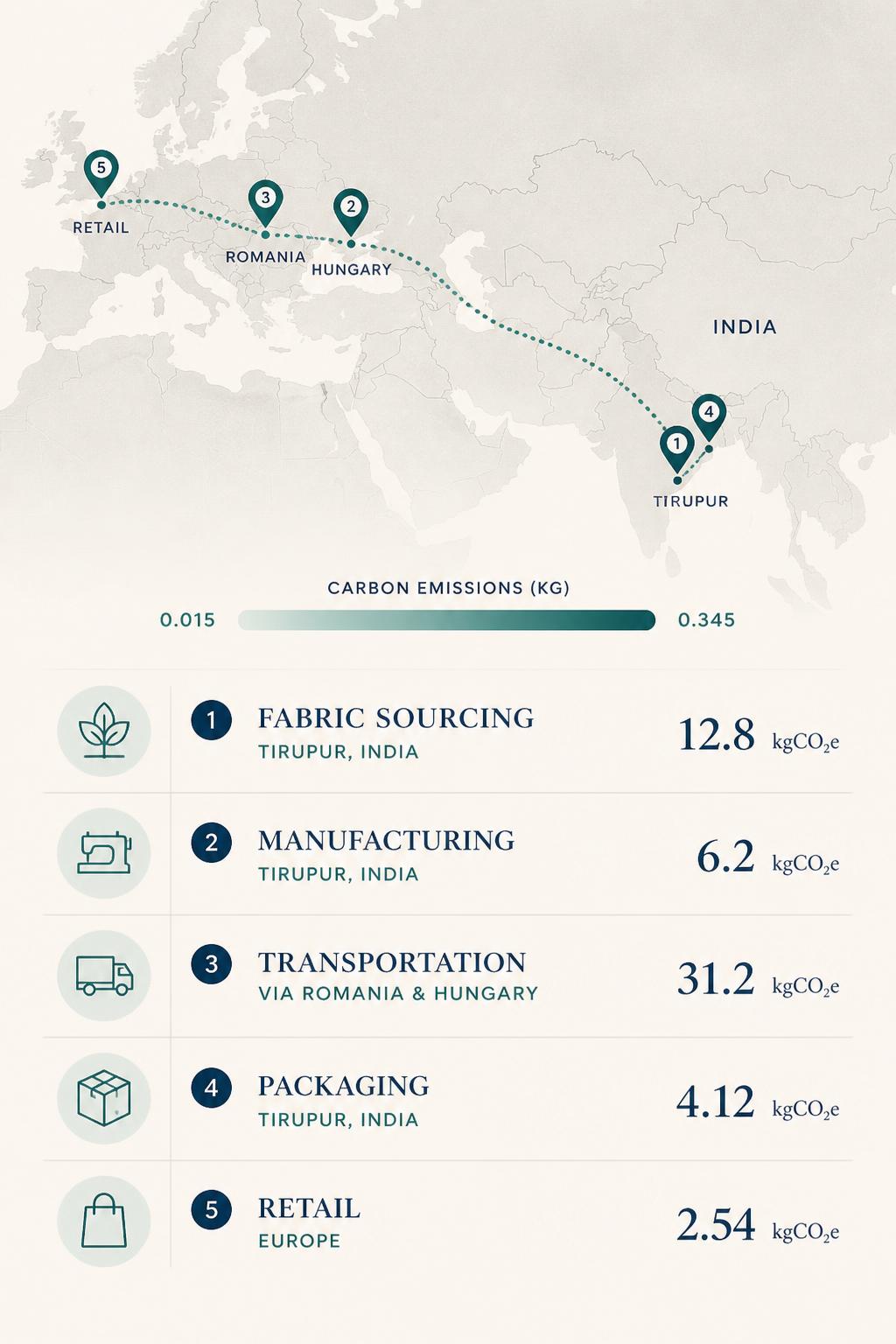
The journey
Illustrative passport journey view. Every stage shown here is data that originates on a factory floor.
Converging requirements across manufacturing geographies
We work with manufacturers in the United Kingdom, Portugal, Italy and Turkey supplying European brands on short lead times; across Pakistan, India, Bangladesh and Sri Lanka in spinning, weaving and wet processing; in Vietnam, Cambodia, Indonesia and China on cut-make-trim and full-package production; and in Morocco, Tunisia, Ethiopia and Kenya as nearshoring and African sourcing expand.
The regulation follows the goods, not the factory. A mill in Faisalabad, a knitter in Ho Chi Minh City and a finisher in Leicester face the same underlying question from the same European buyers: can you evidence it?
UK manufacturers face a particular version. Selling into the EU makes you a third-country operator, while the UK builds its own regime under the Product Regulation and Metrology Act 2025. Domestic production is not a shortcut through either.
Infrastructure
Evidence continuity depends on the infrastructure underneath the factory
The regulation follows the goods. Whether a supplier can keep producing evidence, season after season, depends on conditions well below the sewing floor: power, fuel, water treatment, port access, and how much of the upstream input is imported.
Bangladesh runs some of the world's strongest knit spinning alongside heavy woven and wet-processing capacity that is repeatedly constrained by gas supply, and without a deep-water port both production and shipment sit behind feeder vessels and yard congestion.
Pakistan holds a genuinely world-class cotton spinning and weaving base on top of an industrial grid with structural cost and supply volatility, which is why so many groups there have invested in their own generation.
Turkey is the upstream engine for the Mediterranean basin. Without Turkish yarn and fabric, nearshoring into Morocco or Egypt is Asian material arriving by a longer route, carrying the origin questions that come with it.
None of this is a ranking. It is the reason two suppliers holding identical certifications can have very different capacity to answer the same buyer, repeatedly, on time. A supplier who can name that constraint and show how they work around it is easier to buy from than one who cannot.
Jurisdiction
Chinese supply chain regulation and data collection
China's Provisions on the Security of Industrial and Supply Chains, State Council Order No. 834, took effect on 31 March 2026. Article 13 restricts foreign entities from investigating or collecting information about Chinese supply chains. Supplier due diligence, audits, questionnaires and on-site inspections are all named, and it does not matter which foreign law requires them.
That is a direct collision with ESPR. The material composition, facility identity, chemistry and tier 2 and tier 3 records a European buyer needs for a Digital Product Passport are exactly the information Article 13 covers. The same applies to due diligence under CSDDD and traceability under UFLPA.
The regulation does not ban due diligence. It ties supply chain information collection back to China's existing data security and national security law, and raises the risk where collection is done carelessly. The exposure falls on people inside China as much as on the buyer abroad.
The practical answer is to stop exporting raw evidence. A signed attestation, stating that a fabric is eighty per cent recycled polyester or that a facility holds current GRS scope, can be verified by a European customer without the underlying certificates, audit reports or production records ever leaving your systems. The buyer checks the signature. The evidence stays with you.
For a manufacturer this is an advantage. A supplier who can satisfy a European passport requirement without creating a jurisdictional problem is a lower-risk supplier to buy from.
This is regulatory analysis, not legal advice. Positions under Decree 834 should be confirmed with qualified PRC counsel.
Ownership
The question is who owns the mill, not where it stands
A large share of Vietnam's synthetic fabric supply, and of its tier 2 dyeing and finishing capacity, is owned or controlled by mainland Chinese textile groups. The same pattern runs through industrial parks elsewhere in Southeast Asia.
That matters twice over. A brand that has moved assembly out of China has frequently not moved its material dependency, so the origin questions follow the yarn rather than the sewing.
It also raises a question worth asking early: where the tier 2 records a European buyer needs are held in China, or by a China-based parent, the information-collection constraints described above may still be engaged even though the factory itself is elsewhere. That is a question for counsel in each case, not a general rule.
Relocating cut-make-trim is not the same as relocating the evidence base. The audit that matters is of the ownership structure behind the mill, not the address on the packing list.
This is regulatory analysis, not legal advice. Positions under Decree 834 should be confirmed with qualified PRC counsel.
What you get
Deliverables
Data readiness assessment
What you already hold, in what form, and what the incoming Digital Product Passport requirements will ask for that you do not yet capture.
One structured dataset
Your product, facility and material data organised to UNTP, GS1 and Verifiable Credentials standards, so it can be exported to any customer format without rebuilding.
Certification and audit alignment
GOTS, GRS, OEKO-TEX, RWS, LWG, ZDHC, SMETA, BSCI and Higg mapped against each other, so one evidence pack serves multiple schemes.
Customer response pack
A standard answer to buyer sustainability questionnaires, due diligence requests and traceability demands, ready before the next one arrives.
Data readiness as a commercial position
European buyers are beginning to include Digital Product Passport readiness in supplier qualification, typically six to twelve months ahead of the formal compliance dates. Suppliers who can answer are shortlisted. Suppliers who cannot are quietly replaced, without ever being told why.
Manufacturers who can hand a brand a complete, verifiable product record are solving that brand's hardest problem. That is a commercial position, not a compliance cost.
Who we work with
Cut-make-trim and full-package garment manufacturers supplying UK and EU brands.
Vertically integrated mills and textile groups across South Asia and Southeast Asia.
European and UK manufacturers supplying short-lead-time and nearshore programmes.
Sourcing offices and agents coordinating multi-country supplier bases.
Building the response once
A short conversation covering what your customers are currently asking for, what you already hold, and what it would take to answer every request from one dataset.
20 minutes on your products and the rules that apply to them.Further reading
Read more on this


Led by Lavinia Fernandes, a UN/CEFACT UNTP Supply Chain Working Group member.
Who we help
Where to go next
Plain-English pages on the rules that apply to you, the evidence you need, and the people who do the work.
Looking for something specific? See every page on the site.