De-risking Textile Supply Chains: Control Risk Before the PO
A purchase order can turn an unresolved evidence gap into a commercial commitment. De-risking textile supply chains means making that risk visible before the commitment is made, not discovering after shipment that product records are incomplete, inconsistent or difficult to retrieve.
Retail and brand teams already know that supplier documentation can be fragmented across products and tiers. The harder question is how to decide what matters most, who must close each gap, and whether a product is ready to buy. This article sets out a practical pre-PO framework to prioritise risk by product, supplier, evidence gap and purchasing decision, then assign clear ownership for screening, follow-up and escalation.
It also explains why a third-party product approval needs traceable, product-level evidence rather than a general supplier assurance. Symolem-ID screens brand ranges against textile regulations and assigns each SKU a status of Cleared, Blocked or Missing Evidence before orders are signed; where records are absent, evidence retrieval can address gaps across Tier 1-3 suppliers. The result is a more disciplined decision process, built around what the evidence supports and what still needs resolution.
Key Takeaways
- De-risking textile supply chains starts by linking each material risk to the product, supplier tier, evidence owner and purchasing decision it affects.
- Separate verified records from supplier declarations and claims that need further evidence assessment before relying on them.
- Use automated screening to classify available product records, then assign human follow-up where supplier documentation or social due diligence remains incomplete.
- Build a pre-PO workflow with named owners for product data, supplier follow-up, compliance review and purchase order release.
- Connect screening and evidence retrieval operationally, while keeping each control clear about what it can resolve and what still requires investigation.
Table of Contents
Why de-risking textile supply chains must start before the purchase order
A purchase order is a decision point, not a substitute for due diligence. De-risking textile supply chains means identifying material exposure, establishing what evidence supports the relevant product details, and applying controls before a commercial commitment is made. The aim is not to assume every gap signals a breach. It is to make clear what is known, what remains unverified and what decision follows.
Textile product risk is not one category. A garment may raise product-level compliance questions, while its supplier structure, fibre origin, chemical processing or social conditions create separate evidence risks. These dimensions can intersect, but a supplier declaration about one does not automatically verify the others. The Textile industry overview illustrates the breadth of processes and global links that make product-level traceability a practical challenge.
The relationship between production decisions and factory continuity is also examined in this discussion:
Where textile supply chain exposure accumulates
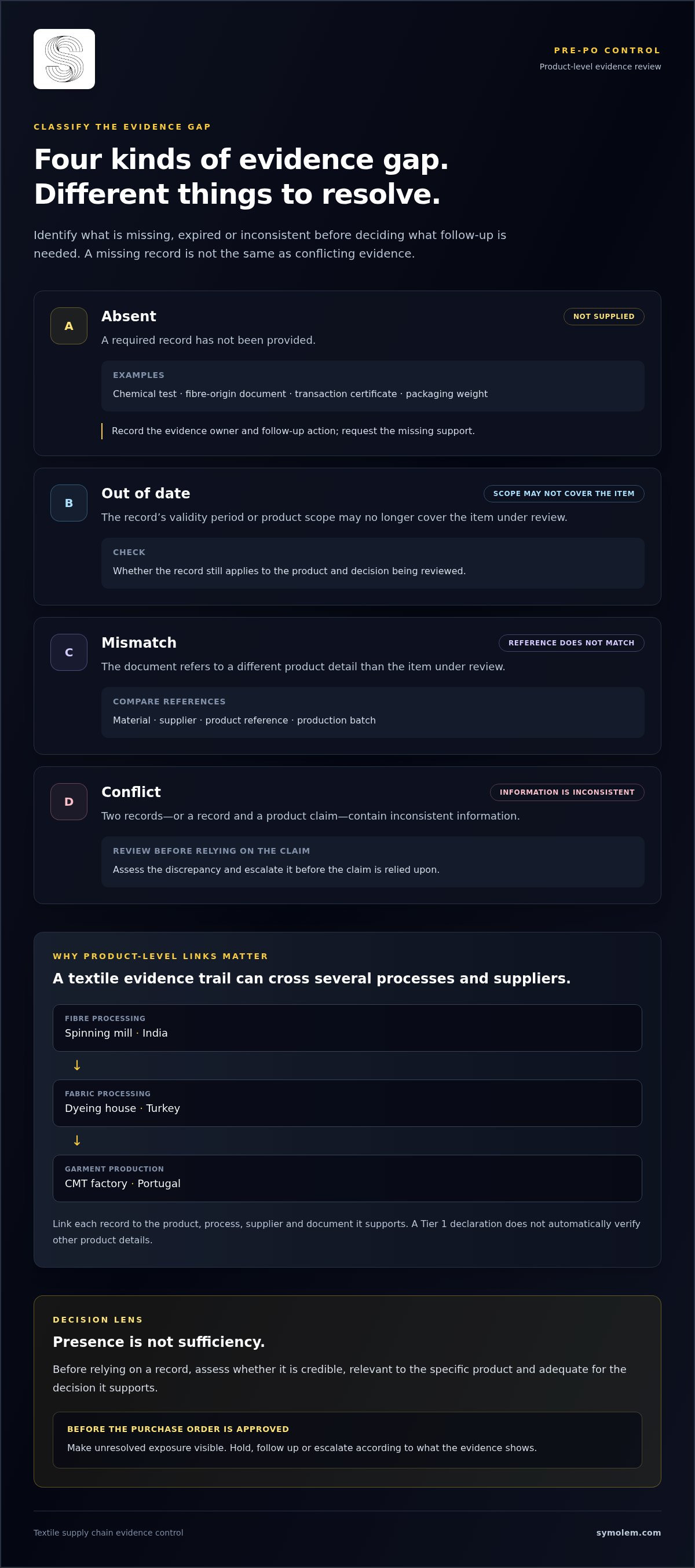
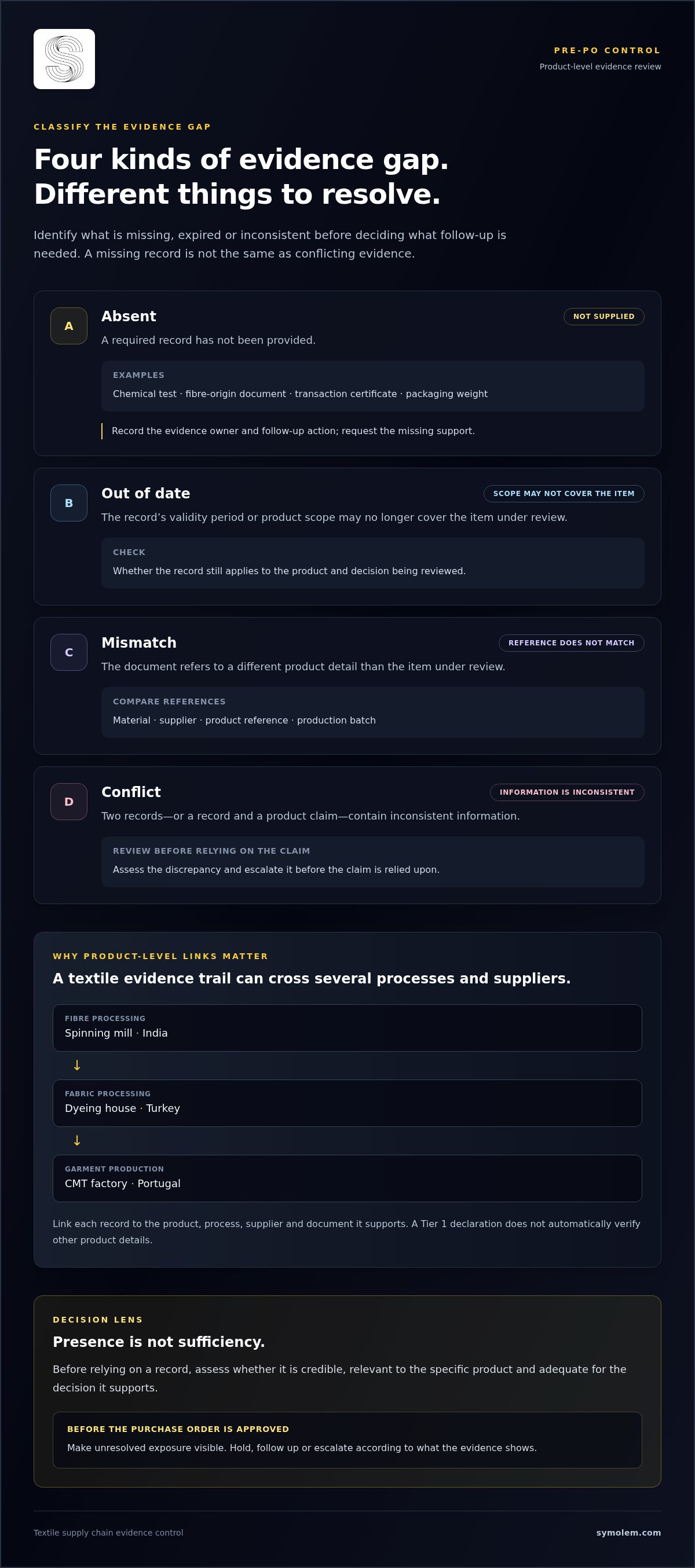
A garment’s evidence trail can cross several processes and businesses. Fibre may be spun at a mill in India, fabric dyed at a house in Turkey, then cut, made and trimmed at a CMT factory in Portugal. Each stage can hold records relevant to a different product detail, from fibre composition to processing or manufacturing location.
Subcontracting can extend that chain beyond the supplier named in a buying file. The buyer may receive a finished-goods declaration from Tier 1 while source records sit with a mill or processor further upstream. Without a mapped relationship between product, process, supplier and document, a file can appear complete while key details remain unsupported.
Why the purchase order is a critical control point
Pre-commitment review gives buying and compliance teams a chance to resolve evidence issues while the purchasing decision is still open. Reactive collection begins after a decision has been made, when onboarding steps, delivery planning or product availability may need to be reconsidered if records are incomplete. These are possible operational consequences, not automatic outcomes.
Pre-PO screening links available product evidence to a purchasing decision, so unresolved exposure can be held, followed up or escalated before commitment. A missing record is not the same as contradictory evidence: the first indicates that support has not been provided, while the second means available information conflicts with a product detail or claim. The distinction matters. Teams can assign a document request for a gap, but conflicting evidence needs assessment and escalation before the claim is relied upon.
Set the decision rule before the order is approved. If required support is absent, record the evidence owner and follow-up action; if documents conflict, define who reviews the discrepancy and who can authorise release. That turns uncertainty into a controlled purchasing decision rather than an assumption carried forward into onboarding or sale.
Map textile risks to products, suppliers and evidence
A risk register is useful only if it connects a concern to a decision. For each product, record the SKU, material, supplier tier, relevant claim or product detail, evidence owner and date by which a purchasing decision is required. This structure lets buying and compliance teams distinguish a product-specific gap from a broader supplier issue, then direct follow-up to the party able to resolve it.
Classify the information rather than treating every file as proof. A laboratory report, a supplier declaration and a fibre-origin claim carry different evidential weight; a claim may need further evidence assessment before it can support a decision. Evidence presence is not evidence sufficiency: a record must be credible, relevant to the specific product and adequate for the decision it is being used to support.
Build a tiered map from product to source
Start with the bill of materials and connect each component or material to its named supplier and processing stage. For every record, capture its source, the organisation that controls it, the products it covers and any limitations on its scope. A document held by a Tier 1 supplier may relate to a particular fabric batch, not every product made by that supplier.
Flag breaks in the chain explicitly. If a product record names a fabric supplier but doesn’t identify the upstream source relevant to a fibre-origin detail, mark that connection as unresolved rather than assuming the Tier 1 record proves it. This map helps teams request the right evidence from the right tier and identify which SKUs depend on the same missing record.
Classify evidence gaps by decision consequence
Not all gaps are equivalent. Categorise them so the response fits the problem:
- Absent: a required chemical test, fibre-origin document, transaction certificate or packaging weight hasn’t been supplied.
- Out of date: a record’s validity period or product scope may no longer cover the item under review.
- Mismatch: the document refers to a different material, supplier, product reference or production batch.
- Conflict: two records, or a record and a product claim, contain inconsistent information.
Then assess each gap against the intended purchase, claim or onboarding decision. A missing packaging weight may affect one evidence requirement, while a mismatch in fibre composition could undermine the basis for a product description. Set an owner and next action, such as supplier follow-up, compliance review or escalation before release.
Use Missing Evidence as a status that identifies an unresolved record gap, not as a conclusion that a legal breach has occurred. That distinction preserves accuracy while making the next action visible. A structured product compliance intelligence approach can connect product records to supplier evidence and clarify which gaps need human follow-up before purchasing decisions proceed.
Compare screening, supplier chasing and audit controls
These controls address different failure points. Automated screening classifies available product records; it cannot retrieve a missing laboratory report or establish worker conditions from an unsupported declaration. De-risking textile supply chains therefore depends on matching each unresolved risk to the control that can actually address it, with retailers focused on the ranges they buy and brands responsible for evidence across their supplier networks.
| Control | Purpose | Input | Output | Owner | Limitation |
|---|---|---|---|---|---|
| Automated pre-PO screening | Identify product-level compliance gaps before purchase | Third-party brand and product records | Per-SKU status: Cleared, Blocked or Missing Evidence | Retailer or marketplace compliance and buying teams | Classifies available records; does not retrieve absent source documents |
| Forensic evidence retrieval | Obtain and connect missing supplier documentation | Product references, supplier details and evidence requests | Retrieved records, such as chemical tests and fibre-origin documents | Brand sourcing, production or evidence advisory teams | Requires supplier follow-up; a document still needs review for scope and relevance |
| Social accounting and due diligence | Build auditable evidence on worker welfare and related conditions | Supplier information and due diligence records | Human-led assessment and evidence pack | Brand teams and social due diligence specialists | A supplier declaration alone may not substantiate the matter being assessed |
What automated pre-PO screening can establish
Symolem-ID screens third-party brand ranges against 50+ global textile regulations and assigns a status to each SKU. Cleared indicates that the available records support screening clearance; Blocked flags a product requiring intervention; Missing Evidence identifies an evidence gap that remains unresolved. For retailers managing large external ranges, these distinctions create a consistent basis for routing products to approval, hold or follow-up.
Screening is a control over the records available for review, not a substitute for retrieving source documents or obtaining legal advice. A status doesn’t create evidence that hasn’t been supplied, nor does it determine every legal question arising from a product or transaction.
When human evidence retrieval or social accounting is needed
Brands need supplier-level follow-up when supporting records sit beyond their immediate production contact. Human-led retrieval can pursue chemical laboratory tests, fibre-origin documents, transaction certificates and packaging weights across Tier 1-3, then connect records to the relevant products. Where the concern relates to worker welfare, fair wages or human rights due diligence, social accounting requires a distinct assessment and auditable evidence.
The division of responsibility is practical: retailers screen products and decide whether a range can proceed through their purchasing controls; brands map supplier tiers and pursue the evidence needed to substantiate product details. If a record is absent, request it. If it conflicts with a claim or product reference, escalate it for review rather than treating collection alone as resolution.
Set up a pre-PO textile risk control process
A control process must do more than collect files. It needs to connect product records to review, assign responsibility for unresolved evidence and preserve the rationale for the purchasing decision. This makes de-risking textile supply chains an operating procedure, rather than a last-minute document chase.
Build the evidence gate into buying operations
At range intake, capture each SKU, brand, composition, supplier details and available supporting records. Screen each product before approval, route unresolved statuses to a named owner and retain the evidence version reviewed. Keep the decision rationale with the buying record so teams can trace what supported release, what remained open and who authorised the outcome.
Use an ordered workflow:
- Receive the range: gather product identifiers, composition, supplier details and existing records.
- Screen each SKU: identify products that can proceed and those needing further review.
- Assign follow-up: name an owner for each missing, inconsistent or product-mismatched record.
- Review the response: assess whether new evidence relates to the correct material, supplier and product.
- Record the decision: document the rationale, evidence version, escalation and PO release or hold.
Ownership should be explicit. Product data has a responsible owner; supplier follow-up sits with the person able to obtain the records; compliance review assesses gaps and discrepancies; and PO release remains with the authorised buying decision-maker. Define escalation where evidence is absent, conflicting or tied to a different product, rather than relying on informal judgement or inventing universal response deadlines.
Manage supplier follow-up without losing the audit trail
Requests should identify the exact document required, the product or material it must support and the supplier tier expected to hold it. For example, request a chemical test for the relevant material from the processing supplier, rather than asking generally for “compliance documents”. Log the request, recipient, response, discrepancies, owner and resolution status so follow-up creates a traceable record.
Where a record supports an environmental or other product claim, distinguish compliance evidence from the evidence needed to substantiate that claim. Keep the claim, its supporting material and review outcome linked to the relevant product; broader ESPR readiness work can sit alongside this PO-level control, while textile impact measurement and MRV analysis should be assessed on their own evidence basis. Symolem’s ESPR readiness diagnostic provides broader readiness context without replacing the product-level purchasing gate.
Apply a structured pre-PO textile compliance screening process to make responsibilities, evidence gaps and release decisions traceable across buying operations.
Make de-risking textile supply chains an operating capability
Risk control becomes reliable when product screening and supplier evidence work as connected, distinct functions. Screening helps retailers assess submitted product information at range level; it doesn’t retrieve missing source records or establish workplace conditions. Symolem combines product compliance intelligence with evidence advisory so teams can connect review outcomes to appropriate follow-up and keep purchasing decisions grounded in available evidence.
For retailers and marketplaces managing third-party ranges
Retailers need a consistent way to assess products submitted by brands before purchase. Symolem-ID supports this pre-PO gate by bringing product-level review into the buying decision, helping teams identify which items can progress and which require attention. The decision remains with the retailer, which can apply its own approval and escalation process to the information presented.
For wider preparation beyond the PO gate, the existing ESPR readiness diagnostic article provides broader readiness context alongside product-level screening. This keeps operational range decisions distinct from broader preparation work, while helping teams understand where product records may need further attention.
For brands and manufacturers facing supplier evidence gaps
Brands need to connect evidence requests to the suppliers and production stages that hold relevant records. Symolem Advisory supports forensic retrieval across supplier tiers and human-led work to build auditable social accounting evidence. These activities address different needs, from tracing product documentation to substantiating matters related to worker welfare, fair wages and human rights due diligence.
Once verified and structured, product compliance records can support retail onboarding or feed a chosen Digital Product Passport provider. Symolem audits and verifies the evidence, then assigns a Verification ID for transfer; it doesn’t issue consumer passports.
That is the operating logic of de-risking textile supply chains: make review outcomes actionable, route evidence gaps to accountable owners and preserve the basis for each decision. Retailers can strengthen control over third-party ranges, while brands can organise their supplier evidence for stockist review and downstream product records.
For Retailers & Marketplaces: Screen third-party brand compliance before signing the PO. Explore Symolem-ID or run a free product scan.
For Fashion Brands: Need to retrieve missing Tier 1-3 supplier evidence or substantiate social accounting for retail stockists? Take the 5-minute Free Assessment or Book an Advisory Consultation.
Make the next purchasing decision more controlled
Make the next range review the point at which evidence expectations become operational: define who can approve a product, what unresolved information requires escalation and how the decision will be recorded. That gives buying teams a repeatable basis for action as products and supplier records change.
Retailers and marketplaces can apply a pre-PO control to third-party brand submissions. Fashion brands can address supplier evidence gaps and prepare auditable support for retail stockists. Choose the next step that fits your role.
For Retailers & Marketplaces: Screen third-party brand compliance before signing the PO. Explore Symolem-ID or run a free product scan.
For Fashion Brands: Need to retrieve missing Tier 1-3 supplier evidence or substantiate social accounting for retail stockists? Take the 5-minute Free Assessment or Book an Advisory Consultation.
Frequently Asked Questions
What does de-risking a textile supply chain mean?
It means governing how textile-related uncertainties are identified, assessed and acted upon, rather than treating a completed supplier form as the end of review. A practical programme also defines what triggers reassessment: a changed material, production site, supplier or product claim can make previously reviewed information less relevant. Recording those changes helps teams decide when an existing assessment still applies and when a fresh review is needed.
How can retailers reduce risk when buying third-party apparel brands?
Set clear evidence requirements for range submissions and apply them consistently when product details change. For example, if a brand revises a garment’s composition or manufacturing specification after initial review, the retailer should identify which records and approvals depend on the changed information. Keep the submitted version and subsequent updates distinguishable, so a later buyer or compliance reviewer can tell which product information was assessed at the time of the decision.
Can automated compliance screening replace supplier audits?
No. Screening and audits examine different evidence. A system can assess submitted product information, but it cannot observe how workers are treated at a production site or determine whether workplace records reflect actual conditions. For instance, a complete product file may coexist with unanswered questions about worker welfare. A human-led assessment is needed where the risk concerns practices, conditions or records that cannot be established from product data alone.
What supplier documents matter when assessing textile supply chain risk?
Beyond the document type, check whether its source, date, scope and product reference are clear enough for the intended review. A record should identify what it covers and allow a reviewer to connect it to the relevant supplier, material or production period. Preserve the original file and any explanatory correspondence, rather than relying only on a summary field in a spreadsheet. This gives reviewers context if the record is later challenged or superseded.
What should a buyer do when a supplier cannot provide evidence before a PO?
Don’t treat an unanswered request as confirmation that a product detail is accurate. Apply the organisation’s documented purchasing rule to the specific uncertainty, and record whether the affected claim or product can proceed without that support. If the decision is to proceed, make the limitation visible to the relevant approver and downstream teams; if the evidence is essential to the decision, keep the issue open rather than marking it resolved.
How do retailers and fashion brands differ in managing textile supply chain risk?
They often need a defined handover point. Retailers can state the evidence format and product identifiers required for intake; brands can align supplier requests and internal records to those requirements. Agreeing consistent references, such as a shared product code and material description, reduces avoidable reconciliation when records move between organisations. Neither party should assume that sending a file transfers responsibility for reviewing what it supports.
Does a Digital Product Passport remove textile supply chain risk?
No. A passport is only as dependable as its underlying information and maintenance process. Teams should consider how source records are linked, who can correct an error, and how an update is reflected in the product information presented downstream. If an origin detail changes but the passport data remains unchanged, the digital format can preserve outdated information. Strong governance therefore includes version control and a process for handling corrections.