ESPR Obligations for Own-Label Retailers: Compliance Guide
A retailer can become the legally accountable manufacturer without owning a factory. Under the ESPR, an entity that has a product designed or manufactured and markets it under its own name or trademark may carry manufacturer-level responsibilities. That makes ESPR obligations for own-label retailers a product-by-product role-mapping question, not simply a matter of who made the goods. Supplier assurances alone may not be enough.
The ESPR framework is in force, but detailed ecodesign requirements are introduced through product-specific delegated acts. Retailers need to distinguish duties that apply now from requirements that depend on future product rules, while preventing fragmented supplier and material data from becoming a compliance bottleneck. This guide explains how branding and control shape a retailer’s role for each product and market, which governance and data controls to establish, and how to build a proportionate readiness plan. It also explains how to prepare for Digital Product Passport requirements while treating the textile delegated act, scheduled for 2027, as a future development rather than final product-specific law.
Key Takeaways
- Classify each product and market by examining who designs or commissions the product, whose name or trademark appears on it, and how it is placed on the market.
- Separate ESPR framework duties from product-specific requirements that depend on applicable delegated acts. Don’t treat future measures as final rules.
- Map product identity, supplier relationships, design control, and supporting records to identify evidence gaps and overlapping operator roles.
- Build a five-step readiness workflow: classify roles, scope products, map evidence, assign controls, and review changes across relevant teams.
- Use an ESPR readiness diagnostic to turn role mapping into prioritized actions for supplier coordination, data governance, and implementation of ESPR obligations for own-label retailers.
Table of Contents
- When does an own-label retailer become an ESPR manufacturer?
- Which ESPR obligations apply now, and which depend on product rules?
- What own-label retailers should assess across products and supplier data
- How to build an ESPR readiness workflow for an own-label range
- How Symolem supports own-label retailers from role mapping to implementation
When does an own-label retailer become an ESPR manufacturer?
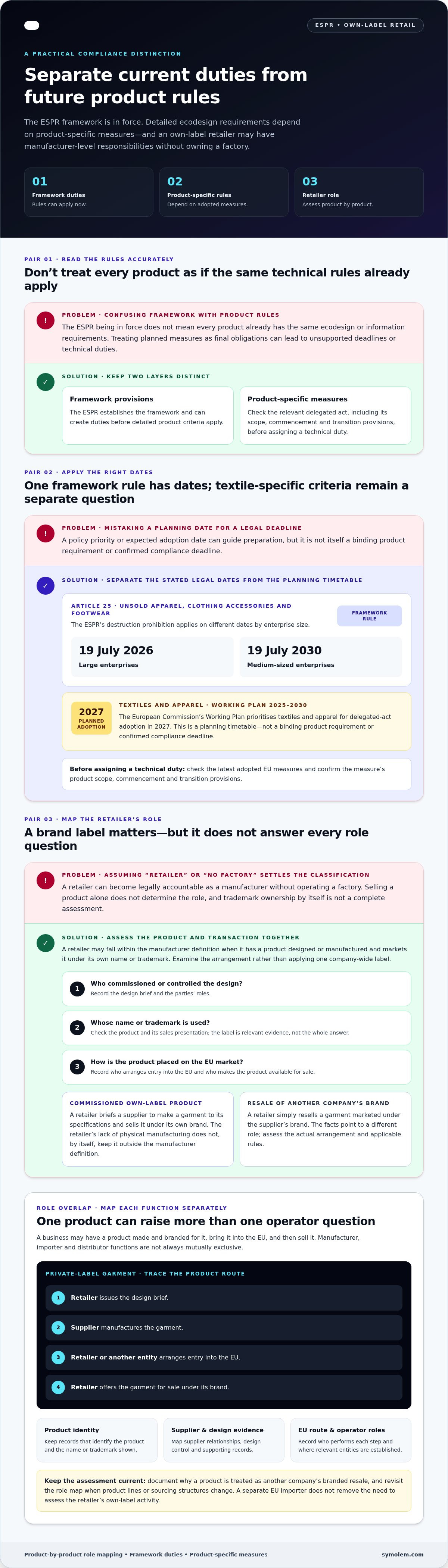
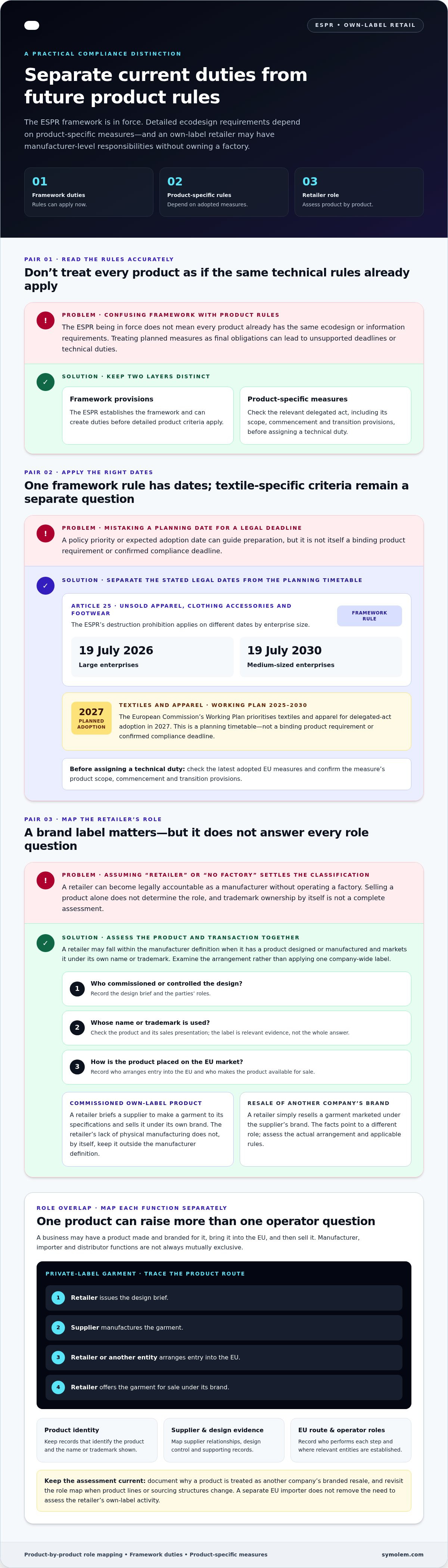
Selling a product doesn’t, by itself, determine a retailer’s role under the ESPR. The key question is whether the retailer has the product designed or manufactured and markets it under its own name or trademark. The Regulation’s manufacturer definition can therefore cover a business that never operates a factory.
This changes how compliance needs to be assessed. A retailer selling another company’s branded product may act as a distributor. A retailer commissioning a product for sale under its own brand may fall within the manufacturer definition. The label is relevant evidence, but it doesn’t settle the classification on its own. Assess the product and transaction rather than applying one rule to everything the business sells. This product-level distinction is central to the ESPR obligations for own-label retailers.
What own-label activity changes in the role assessment
The brand shown on a product can connect the retailer to the manufacturer definition, even when a supplier controls the factory and production line. But trademark ownership alone isn’t a complete role assessment. Establish who commissioned or controlled the product’s design, who markets it under which name, and which entity makes it available in the EU.
Hypothetical example: A retailer briefs a supplier to produce a garment to its specifications, then sells it under its own brand. If those assumptions are accurate, the retailer’s lack of physical manufacturing does not, by itself, keep it outside the ESPR manufacturer definition. By contrast, if the retailer simply resells a garment marketed under the supplier’s brand, the facts point to a different role. The outcome depends on the actual arrangement and applicable rules.
How manufacturing, importing, and distribution can overlap
Economic-operator functions aren’t always mutually exclusive. One business may have a product made and branded for it, bring that product into the EU from outside the EU, and then sell it to customers. Those activities can raise manufacturer, importer, and distributor questions for the same product. Map each function separately rather than assuming one label resolves them all.
Trace a private-label garment from the start: the retailer issues the design brief; a supplier manufactures it; the retailer or another entity arranges its entry into the EU; and the retailer offers it for sale under its brand. Record who performs each step, where the relevant entities are established, and which name or trademark appears on the product and sales materials. If a separate EU entity imports the garment, include that in the role map. It doesn’t remove the need to assess the retailer’s own-label activity.
A retailer acting solely as a distributor of another company’s branded product should document the basis for that classification, including product identity and supplier records. Those records help distinguish resale from a commissioned own-label arrangement and support a defensible assessment when product lines or sourcing structures change. For broader role definitions, see the ESPR responsible operator guide.
The practical rule is to assess each product, brand presentation, design arrangement, and route into the EU. A company-wide label such as “retailer” is not a substitute for that analysis.
Which ESPR obligations apply now, and which depend on product rules?
The ESPR is in force, but that doesn’t mean every product already faces the same ecodesign or information requirements. Regulation (EU) 2024/1781 establishes the framework. Detailed requirements for particular product groups are introduced through product-specific measures, principally delegated acts. For retailers, the distinction matters: the framework can create obligations while technical criteria for a product category remain dependent on later measures.
Framework duties versus textile-specific requirements
Start with the regulation’s text, not a projected compliance calendar. Framework-level provisions include the ESPR’s rules on the destruction of unsold apparel, clothing accessories, and footwear. Under Article 25, the prohibition applies to large enterprises from 19 July 2026 and to medium-sized enterprises from 19 July 2030. These dates are set in the regulation; they are not estimates for a future textile ecodesign rule.
By contrast, detailed requirements such as product performance criteria depend on the relevant product-specific measure, including its scope, commencement, and transition provisions. The European Commission’s 2025-2030 Working Plan prioritises textiles and apparel for delegated-act adoption in 2027. That is a planning timetable, not itself a binding product requirement or a confirmed compliance deadline. Check the latest adopted EU measures before assigning a specific technical duty to a textile range.
This distinction keeps ESPR obligations for own-label retailers grounded in law rather than assumption. A policy priority, draft, or expected date can signal where readiness work is prudent, but it should not be recorded as a final obligation unless the relevant measure has been adopted and its provisions apply to the product and operator concerned.
How to read dates, scope, and transition periods
Check each measure against four questions: what product category does it cover, which operator roles does it address, what is its legal status, and when do its requirements apply? Keep the milestones distinct. Adoption establishes the measure’s final text; entry into force marks when it becomes legally effective; the application date determines when provisions must be followed; and a transition period may allow additional time for specified requirements. These dates are not interchangeable.
For a textile product, verify whether a textile-specific delegated act has actually been adopted, then examine its published scope and application provisions. Don’t infer an obligation from a Working Plan date alone. The EU regulatory landscape for textiles provides wider policy context, while current legal texts remain the basis for decisions.
Keep adjacent regimes separate. Textile extended producer responsibility (EPR) and rules governing consumer-facing environmental claims have their own legal bases and applicability conditions. They may affect the same product or marketing process, but they are not substitutes for ESPR analysis. ESPR readiness does not automatically establish compliance with them.
A defensible register should label each item as an enacted framework provision, an applicable product-specific requirement, or a policy development to monitor. An ESPR readiness diagnostic can help translate that distinction into a proportionate view of product scope, evidence gaps, and next steps.
What own-label retailers should assess across products and supplier data
A role conclusion is only useful when it can be traced to product and transaction evidence. Build the assessment at product or clearly defined product-group level, then connect each conclusion to the documents and people that support it. A retailer-wide label such as “distributor” can conceal different arrangements across brands, suppliers, and destination markets.
Create a product-level role and evidence map
Group products by brand, sourcing model, manufacturing arrangement, and market destination. For each group, record who sets or approves specifications, authorises design or material changes, commissions production, imports the goods, and places them on the EU market. Capture the legal entity involved at each step, not just the trading name. Mark unresolved facts as assumptions, assign an owner, and route material classification questions for documented legal review.
| Scenario | Role to assess | Evidence to map |
|---|---|---|
| Product made or commissioned for sale under the retailer’s name or trademark | Manufacturer may apply under the ESPR definition. If the product is sourced from outside the EU, assess whether the retailer also acts as importer. | Brand presentation, design brief, specifications, manufacturing agreement, approval records, and EU sales or import documentation. |
| Product made outside the EU and placed on the EU market by an EU-based business | Assess the importer function, while separately checking whether own-brand activity also makes the business a manufacturer. | Supplier identity and location, import records, product identifiers, and documents showing which entity first places the product on the EU market. |
| Another company’s branded product resold by the retailer | Distributor may apply where the retailer makes a product available without manufacturing or importing it. Confirm the facts and any other role the business performs. | Brand and supplier records, purchase and sales documentation, and evidence of the retailer’s role in the supply chain. |
These are assessment prompts, not automatic classifications. Roles can overlap, and the same retailer may have different roles for different products or transactions.
Prepare supplier data without overclaiming DPP requirements
Inventory information already held, even if it is spread across product systems, sourcing files, and supplier documents. Start with product identifiers, materials and components, production information, supplier and facility records, and the source documents supporting each data point. Don’t assume every field will be required in a future Digital Product Passport. Instead, test whether relevant information can be located, linked to the correct product, and refreshed.
- Assign ownership: identify the internal team and supplier responsible for each dataset.
- Record provenance: note the source document, date received, and verification status.
- Flag defects: identify missing, conflicting, outdated, or untraceable information and assign an owner to resolve it.
Keep readiness distinct from a final DPP specification. Data governance established now can support later implementation, while applicable product rules determine the actual information requirements. For products sold across jurisdictions, the UK and EU Digital Product Passport comparison helps frame the market boundary without treating the two regimes as interchangeable.
This evidence map turns ESPR obligations for own-label retailers into a traceable assessment: each role has a rationale, each data point has a source, and each gap has an owner.
How to build an ESPR readiness workflow for an own-label range
Readiness needs an operating rhythm, not a one-off legal memo. Connect role decisions to product records, accountable teams, and scheduled reviews so a change in sourcing or regulation doesn’t leave the compliance position out of date.
Use a five-step sequence for each product group:
- Classify roles. Record the basis for each relevant operator role and identify who is responsible for the product in each market.
- Scope products. Define the products, brands, sourcing arrangements, and destination markets covered. Keep materially different arrangements distinct.
- Map evidence. Connect each product group to available records, supplier information, and unresolved data gaps.
- Assign controls. Name owners for actions, evidence streams, approvals, and escalation.
- Review changes. Reassess the position when products, suppliers, markets, or applicable legal measures change.
Prioritise work using four lenses: potential regulatory exposure, criticality of the underlying data, the product group’s scale or volume, and the readiness of applicable product-specific measures. This prevents teams from treating every gap as equally urgent, while avoiding the opposite mistake of neglecting foundational records because a detailed product rule has not yet applied.
Turn role findings into accountable controls
Assign a named internal owner to each obligation, product group, and evidence stream. Legal should interpret requirements and document role decisions; product teams should control specifications and change approvals; sourcing should coordinate supplier evidence; sustainability should align relevant product and circularity information; and data teams should maintain traceability and access. Define escalation routes before a supplier or specification change occurs, not after records diverge.
Keep versioned records that connect decisions to their supporting evidence. A useful entry identifies the product group, decision date, responsible owner, source documents, applicable legal text, assumptions, and any open action. That structure lets reviewers see not only what was decided, but why and on what basis.
Keep the readiness plan current as rules develop
Set review triggers for new or amended product measures, redesigns, supplier changes, and entry into another market. Separate immediate work, such as correcting inconsistent product identifiers or assigning data owners, from controls that depend on future product-specific requirements. Review the legal sources used for each decision and record whether the position changed, remains valid, or needs further assessment.
The result is a controlled readiness plan rather than a speculative checklist. It makes ESPR obligations for own-label retailers operational by connecting legal interpretation, supplier coordination, and product data to clear accountability. For support translating role findings into prioritized actions, see Symolem’s ESPR readiness advisory.
How Symolem supports own-label retailers from role mapping to implementation
Legal interpretation is only the starting point. Retailers also need a defensible way to connect product roles to evidence, decision-making, and implementation across teams. Symolem’s ESPR readiness diagnostic structures that work by mapping operator roles, product groups, evidence gaps, and priority actions. This helps leaders see where responsibility sits and what needs attention first.
This matters when product data is spread across sourcing, product development, suppliers, and internal systems. A role assessment that isn’t connected to those operational realities may identify exposure without giving the business a workable path to address it. Symolem links regulatory analysis with data governance, supplier coordination, and implementation planning, making readiness a managed programme rather than an isolated legal exercise.
From regulatory interpretation to an actionable roadmap
Role mapping provides the foundation for a sequenced plan. Symolem’s policy and regulatory advisory helps distinguish binding ESPR requirements from developing measures, then connect each relevant obligation to the products, records, and teams involved. Businesses need to act on requirements that apply while monitoring developing rules without treating policy priorities as final law.
The resulting roadmap can identify governance decisions, product controls, data improvements, and internal owners in a proportionate order. Priorities should reflect the retailer’s product range, operating model, market exposure, and the status of applicable measures. A business with established product records but unclear internal accountability may need a different sequence from one whose supplier information is incomplete or difficult to trace.
Recommendations should be usable by the functions responsible for carrying them out. Legal teams can anchor interpretation; product and sourcing teams can embed controls into specifications and supplier processes; sustainability and data teams can support evidence integrity and reporting needs. The objective is a coherent control structure, not a separate compliance process that sits outside commercial operations.
Build readiness across the value chain
Supplier coordination is a governance and data-quality challenge, not simply a request to collect documents. Information needs clear owners, consistent product links, source records, and a process for resolving gaps or changes. Symolem’s Digital Product Passport frameworks support readiness by mapping technical data fields and considering how product information can be structured and governed.
Product information can also inform broader strategy. Where relevant, Symolem connects ESPR readiness with circular economy strategy development and impact measurement, helping teams consider how product design, material choices, and data practices relate to wider objectives. These connections should be grounded in evidence and applicable requirements, not unsupported environmental claims.
For retailers seeking a proportionate route from role analysis to implementation, Symolem can tailor an engagement around the products, operating model, and evidence gaps in scope. Discuss ESPR readiness with Symolem to define next steps for your own-label range.
Make your next compliance decision deliberate
ESPR readiness doesn’t require waiting for every product rule to settle. It begins with a clear account of which products carry exposure, who owns the relevant decisions, and whether the evidence behind those decisions can be traced and maintained. For own-label teams, that discipline turns uncertainty about ESPR obligations for own-label retailers into a manageable sequence of governance and implementation choices.
Symolem is an independent advisory firm focused on textile circularity, sustainability, climate impact, and policy, with work across global textile value chains. Its ESPR readiness diagnostics, regulatory advisory, and Digital Product Passport frameworks connect legal interpretation with the product data and cross-functional controls needed to put decisions into practice. The next step is to identify where role mapping, supplier information, or internal ownership needs a stronger foundation.
Plan your own-label ESPR readiness with Symolem and move forward with a proportionate, evidence-based path.
Frequently Asked Questions
Does ESPR apply to retailers selling products under their own label?
Yes, an own-label retailer can have manufacturer responsibilities under the ESPR when it has a product designed or manufactured and markets it under its own name or trademark. The regulation provides a framework for ecodesign requirements covering most physical goods placed on the EU market, but detailed product rules depend on applicable measures. The ESPR obligations for own-label retailers therefore depend on the product, market, and retailer’s role, not simply its status as a retailer.
Are own-label retailers automatically manufacturers under ESPR?
No, the retailer label alone doesn’t settle the question. The ESPR manufacturer definition focuses on whether an entity has a product designed or manufactured and markets it under its name or trademark. Assess the facts for each product arrangement, including how the product is presented and the retailer’s involvement in commissioning or design. A retailer reselling another company’s branded goods may have a different role for those products.
What records should an own-label retailer gather for ESPR readiness?
Gather records that show how each product is created, identified, and placed on the market. Useful examples include supplier agreements, design and specification approvals, product identification records, material or component information, supplier declarations, and import or sales documents. Preserve versions and dates so a reviewer can see which information supported a decision at the time. Flag documents that refer to a different product variant or cannot be traced to a supplier source.
Does ESPR require every own-label retailer to create a Digital Product Passport now?
No. The ESPR doesn’t impose one immediate DPP requirement on every product or retailer. DPP requirements are introduced through applicable product-specific measures, so the obligation depends on the product category, the measure’s scope, and its application provisions. Retailers can prepare by assessing how product information is currently identified and maintained, but shouldn’t treat a potential data field or policy timetable as a binding DPP requirement without an applicable legal measure.
Does outsourcing production transfer ESPR responsibility to the supplier?
No, outsourcing manufacturing doesn’t automatically remove a retailer’s responsibility if it meets the ESPR manufacturer definition for an own-label product. The supplier’s production role and the retailer’s legal role are separate questions. Contracts can set expectations for data provision, change notification, and supporting evidence, but contractual allocation doesn’t by itself change the roles established by the regulation. Retailers should assess the product arrangement and retain evidence supporting their classification.
Does ESPR apply to a UK retailer selling own-label products in the EU?
Potentially, yes. A retailer’s UK location doesn’t by itself exclude products it places on the EU market from ESPR scope. The relevant analysis concerns the product, its EU market placement, and the roles of the retailer and any other entities in the chain. A UK business selling only within the UK shouldn’t assume EU ESPR applies solely because it uses an own label; assess the destination market and transaction structure.
How can an own-label retailer start preparing for ESPR?
Begin with a small, representative product group and establish how its design, branding, sourcing, and market route work in practice. Identify where records are held, which supplier information is difficult to verify, and who can approve changes that affect product data. Then document open legal questions and monitor measures relevant to that category. This creates a usable baseline for expanding the assessment across the range without treating future requirements as already final.