ESPR Responsible Operator: Understanding Your Obligations
Responsibility under ESPR follows a product’s legal and market pathway, not the label a company gives itself. So, who is the responsible operator under ESPR? There is no single role that carries every obligation. Duties are distributed among economic operators, and the company accountable for a particular product depends on who places it on the EU market, how the product is marketed, and which role each business performs.
That distinction can be difficult to trace across a global supply chain. A brand that sells a product under its own name may have manufacturer responsibilities even when another company makes it. Importers, authorised representatives, and distributors have different duties. A Digital Product Passport is only one part of the picture: having DPP data in place does not, by itself, establish ESPR compliance.
This article explains how to identify relevant operator roles for each product and market route, distinguish general ESPR duties from requirements set through product-specific rules, and build a responsibility map with supporting evidence. The aim is to clarify who must act, which obligations apply, and how responsibility connects to product data governance before market placement. An ESPR readiness diagnostic can help identify role-allocation and implementation gaps while they are still manageable.
Key Takeaways
- Clarify who is the responsible operator under ESPR by distinguishing this shorthand from the regulation’s defined economic operator roles.
- Separate general ESPR obligations from requirements that apply under product-specific delegated acts.
- Assess own-brand production, contract manufacturing, importing, and distribution by examining each product’s actual market route, not just commercial labels.
- Build a responsibility map that records product scope, supply-chain roles, assigned duties, and supporting evidence.
- Connect operator ownership to DPP data governance, while keeping data-platform capability distinct from regulatory interpretation and conformity assessment.
Table of Contents
- Who is the responsible operator under ESPR, and what does the term mean?
- How ESPR duties connect to manufacturers, importers, and authorised representatives
- Who carries responsibility in common fashion and textile supply-chain scenarios?
- How to identify and document the responsible operator under ESPR
- Turn ESPR operator responsibility into accountable governance
Who is the responsible operator under ESPR, and what does the term mean?
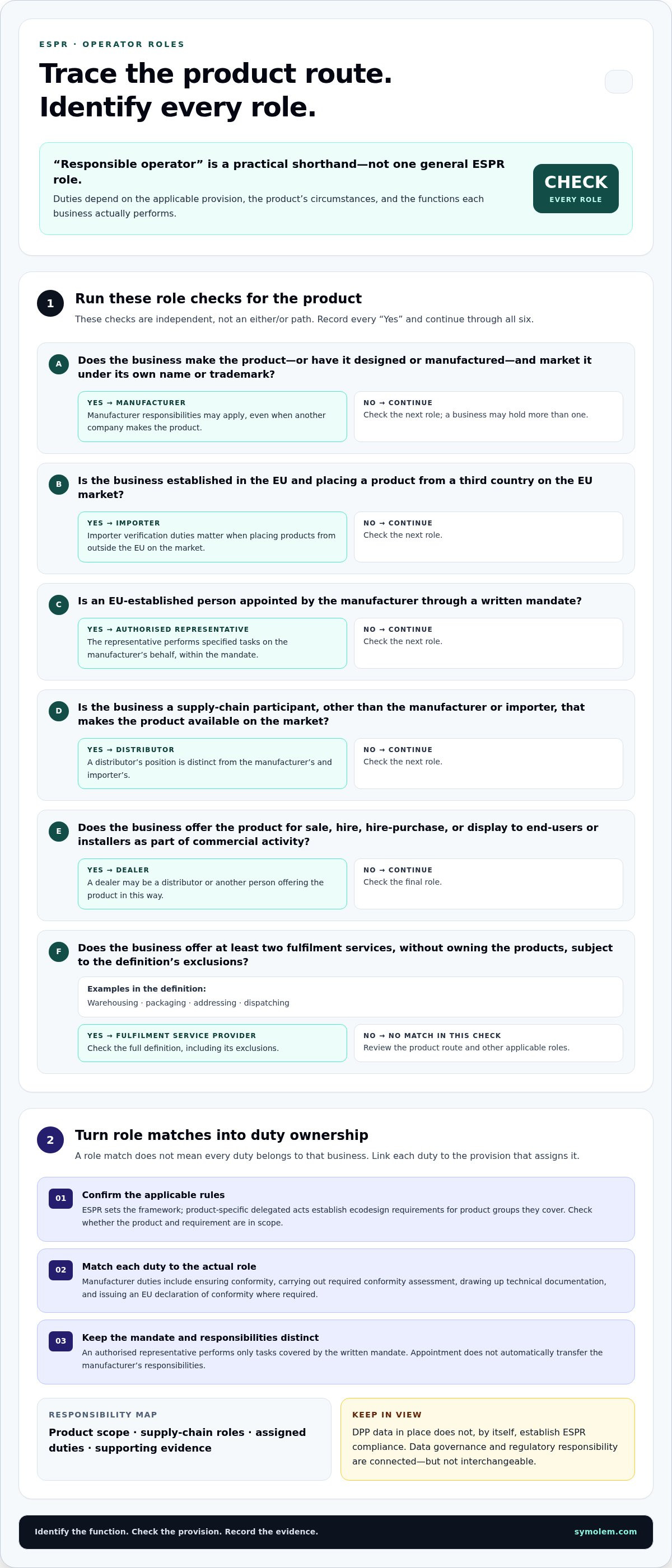
“Responsible operator” is not a single, general role defined by ESPR. It is often used as shorthand for the economic operator that must perform a particular duty for a product on a particular market route. The answer to “who is the responsible operator under ESPR” depends on the relevant provision, the product’s circumstances, and the roles businesses actually perform, not simply on a company’s preferred title.
Article 2 of Regulation (EU) 2024/1781 defines “economic operator” to include a manufacturer, authorised representative, importer, distributor, dealer, fulfilment service provider, or another natural or legal person subject to obligations under the Regulation. This identifies a broad set of potential duty-holders; it does not make their obligations interchangeable. To assess a role, identify the applicable ESPR provision and any relevant product-specific legislation, then match each duty to the entity performing the relevant function.
Is “responsible operator” a formal ESPR role?
No. Treat it as a practical label, not a statutory designation that automatically assigns every ESPR obligation to one company. A related concept appears in Article 4 of Regulation (EU) 2019/1020, which establishes a responsible economic operator framework for products covered by specified Union harmonisation legislation. Whether and how that framework applies must be assessed against the legislation governing the product; it should not be assumed to replace ESPR’s role-specific provisions. The separate concept of Extended Producer Responsibility (EPR) concerns producer responsibility for product impacts and end-of-life management, not a universal ESPR compliance contact.
Which economic operator roles does ESPR recognise?
The statutory terms describe different positions in the product chain:
- Manufacturer: Makes a product, or has it designed or manufactured, and markets it under its own name or trademark.
- Authorised representative: An EU-established person appointed by a manufacturer through a written mandate to perform specified tasks on its behalf.
- Importer: An EU-established person that places a product from a third country on the EU market.
- Distributor: A supply-chain participant, other than the manufacturer or importer, that makes a product available on the market.
- Dealer: A distributor or other person offering a product for sale, hire, hire-purchase, or display to end-users or installers as part of commercial activity.
- Fulfilment service provider: A person offering at least two services such as warehousing, packaging, addressing, or dispatching, without owning the products, subject to the definition’s exclusions.
One business can occupy multiple roles in a transaction, but each role does not carry the same duties. For a useful assessment, identify the entity performing each legally relevant function, then identify the provision that attaches an obligation to that function. This is more precise than assigning every duty to a single “responsible” company.
How ESPR duties connect to manufacturers, importers, and authorised representatives
ESPR responsibility is layered. The Regulation sets the framework, while product-specific delegated acts establish ecodesign requirements for the product groups they cover. A company’s obligations depend on whether the relevant product and requirement are in scope, as well as the role the company performs. Article 27 of Regulation (EU) 2024/1781 (ESPR) sets out manufacturer obligations. Read those duties alongside the applicable provisions and product-specific rules.
In short: manufacturers establish and document conformity; importers have verification duties when placing products from outside the EU on the market; authorised representatives perform only the tasks covered by their written mandate. These roles can intersect, but appointing a representative does not automatically transfer the manufacturer’s responsibilities.
What does the manufacturer remain responsible for?
Where a product is subject to applicable ecodesign requirements, the manufacturer must ensure it is designed and manufactured in conformity with them, carry out the required conformity assessment, draw up technical documentation, and issue the EU declaration of conformity where required. The documentation and declaration provide evidence of conformity. They do not replace the need to meet the requirements in practice.
Contracting a factory to produce an item does not, by itself, determine who is the legal manufacturer. Under ESPR’s definition, a business that has a product designed or manufactured and markets it under its own name or trademark may be the manufacturer. Look at the contractual arrangements and the market-facing facts together. This is why “who is the responsible operator under ESPR” must be answered by tracing the product’s actual commercial and legal pathway, rather than relying on a supplier’s label.
When do importer and authorised representative duties matter?
An importer is an EU-established operator that places a product from a third country on the EU market. Article 29 requires the importer, where applicable, to verify that the manufacturer has met relevant conformity obligations and that required documentation and markings are in place. This verification role does not make the importer the manufacturer unless the facts also meet the manufacturer definition, such as when the product is placed on the market under the importer’s own name.
An authorised representative acts under a written mandate from the manufacturer. Article 28 requires the mandate to cover specified tasks and, at minimum, to enable the representative to keep the EU declaration of conformity and technical documentation available for authorities, provide requested information, and cooperate on action to address product risks. The mandate does not transfer every manufacturer duty.
For wider policy context, see the EU regulatory landscape for textiles. A structured ESPR readiness diagnostic can help teams map roles, evidence, and implementation gaps across product flows.
Who carries responsibility in common fashion and textile supply-chain scenarios?
The same garment can pass through several businesses, but commercial descriptions such as “brand,” “factory,” or “seller” do not settle each party’s legal role. To answer who is the responsible operator under ESPR, trace who designs or commissions the product, whose name it is marketed under, who places it on the EU market, and what each participant does in the distribution chain. Use the examples below to frame the assessment, then check product scope and applicable rules for the specific route.
| Scenario | What to examine | Potential role analysis |
|---|---|---|
| Own-brand production | A brand commissions a factory and sells garments under its own name or trademark. | The brand may meet ESPR’s manufacturer definition, even if it does not operate the factory. The factory’s production role alone does not establish that it is the legal manufacturer. |
| Contract manufacturing | A supplier makes a finished product, then sells it under its own name rather than the buyer’s. | Assess who markets the product under whose name and who arranged its design or manufacture. Contract terms are relevant evidence, but the commercial facts and legal definition determine the role. |
| EU import | A product made outside the EU is first placed on the EU market by an EU-established business. | That business may be the importer. Separately assess whether the brand is the manufacturer and whether any other EU-established operator is required under the applicable rules. |
| Distribution | A retailer or wholesaler obtains a product already placed on the EU market and makes it available onward. | It may act as a distributor or dealer, with duties tied to that role. Selling the product does not automatically make the business its manufacturer or importer. |
Does an own-label fashion brand become the manufacturer?
Sometimes. A retailer that commissions a product and markets it under its own brand may fit the manufacturer definition; a supplier’s “private-label” description does not decide the legal outcome. A supplier selling an existing finished product under its own name may have a different role. Before drawing a conclusion, map who arranged the design, whose name or trademark is used, what the contracts say, and which entity places the item on the market.
What changes when a non-EU business sells into the EU?
Separate two questions: who is the importer for the particular market route, and whether applicable legislation requires an EU-established economic operator to perform specified tasks. A non-EU brand selling directly online, through an EU subsidiary, or via an independent importer may have different role configurations. A supply contract alone cannot settle the regulatory analysis. Record the product scope, first EU market placement, each party’s actual functions, and any written representative mandate. Keep the reasoning and evidence for each route, then review the map when the sales model or product changes.
How to identify and document the responsible operator under ESPR
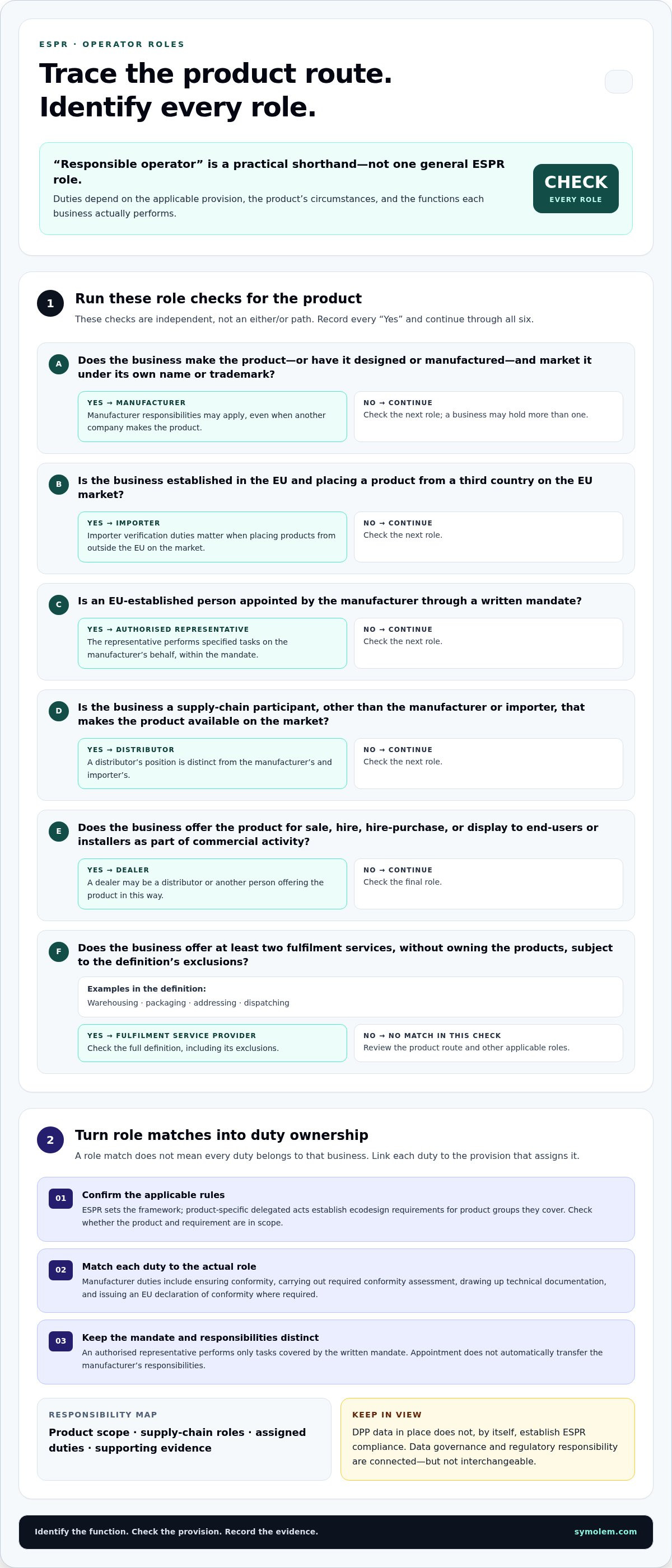
A role map is useful only when it connects a product to its market route, legal entities, duties, and supporting evidence. Start with the practical question: who is the responsible operator under ESPR for this product flow? Then test the answer against the product’s scope and applicable rules, rather than relying on a supplier label or an internal assumption.
- Define product scope. Identify the product and determine whether it falls within ESPR and any relevant product-specific requirements. Record the basis for the assessment, including unresolved scope questions.
- Map each market route. Trace how the product reaches the EU, including brand ownership, manufacturing, importing, distribution, and fulfilment. Document routes separately when they differ by sales channel or destination.
- Assign roles by entity and activity. For every route, identify the legal entities and assess which economic operator roles they perform. A single company may hold multiple roles, while different entities may hold roles for the same product.
- Test the duties. Compare each assigned role with the relevant ESPR provisions and applicable delegated requirements. Check whether EU-established representation or other responsible-operator requirements apply to the product and route.
- Retain evidence and review. Keep the reasoning, source documents, open issues, accountable decision owner, and review date together. Reassess the map when product design, branding, suppliers, contracts, or market routes change.
What evidence should a responsibility map capture?
Make the record auditable. Include product identifiers, relevant legal entities, market routes, contracts, written mandates, and the internal teams accountable for decisions. Link applicable conformity records and technical documentation to the relevant product and role. For product data, record each field’s source, owner, and verification status, including information intended for a Digital Product Passport where applicable. A passport or data platform can support evidence management; neither alone determines legal responsibility or proves conformity. Flag conflicting role assessments clearly, then assign each issue an owner and review date.
How should brands test role allocation before market placement?
Run the proposed map against the current ESPR text and any applicable product-specific requirements before the product enters the EU market. Confirm the market route and the functions each entity actually performs, then check whether an EU-established representative or other operator arrangement is required. Record assumptions and the evidence supporting them. If statutory interpretation remains uncertain, escalate the issue for qualified legal interpretation rather than treating an operational assumption as settled.
An ESPR readiness diagnostic can help identify role-allocation, evidence, and implementation gaps. Use the findings to structure a review across legal, product, and supply-chain teams, then maintain the responsibility map as a controlled governance record. Strengthen your ESPR responsibility mapping with a focused readiness review.
Turn ESPR operator responsibility into accountable governance
A role map is not governance until someone owns it. Make it operational by assigning a decision owner for each product pathway, defining how unresolved role questions move between legal, product, sourcing, and compliance teams, and setting review points for changes to products or market routes. This turns “who is the responsible operator under ESPR” from a one-time question into a controlled process supported by evidence.
What governance failures create avoidable exposure?
Responsibility gaps often form between systems and teams. Supplier records may identify different entities as the manufacturer. A representative’s mandate may not match the tasks internal teams assume it covers. Product data may sit across disconnected files, with no one assigned to resolve conflicts. A brand or importer may appear accountable in a spreadsheet even though the underlying facts have not been assessed or documented.
Controls matter more than labels. Keep a versioned record of role decisions, evidence sources, approvals, and changes. Assign an owner to each material data set and define who verifies it before use. Where impact or product information supports compliance evidence, the textile impact measurement and MRV framework illustrates why evidence ownership and verification discipline need to be explicit. A data platform can organise records and workflows, but it cannot independently interpret legal provisions, perform a conformity assessment, or establish that evidence is sufficient.
How can an ESPR readiness diagnostic support the next step?
A structured diagnostic can test the role map against relevant product pathways, identify which obligations and information flows attach to each entity, and expose gaps between current processes and implementation needs. This includes tracing how product data, technical documentation, mandates, and internal approvals connect, and identifying where they do not. The outcome is a clearer sequence of decisions and accountable actions, not an automatic compliance determination.
Symolem’s ESPR readiness and regulatory advisory work supports responsibility mapping and implementation planning across fashion and textile value chains. It helps teams make ownership visible, surface unresolved interpretations, and establish a traceable evidence process. Legal interpretation and any formal conformity assessment remain distinct activities for the appropriate accountable functions.
Move from assumptions to an evidence-based role map. Strengthen your evidence and verification framework as part of a structured ESPR responsibility assessment.
Make operator accountability part of your ESPR readiness
ESPR does not assign every obligation to one universal “responsible operator.” The relevant role depends on the product, the applicable provision, and how it reaches the EU market. To establish who is the responsible operator under ESPR, map the entities involved, distinguish manufacturer, importer, representative, and distribution duties, then record the evidence behind each role decision.
That map must work beyond a spreadsheet. Name internal owners, document mandates and information flows, and set review triggers for changes to products, suppliers, or sales routes. Digital Product Passport data can support readiness, but a platform alone does not allocate legal duties or demonstrate conformity.
Symolem is an independent advisory firm focused on textiles, circularity, sustainability, climate impact, and policy. Its global advisory work supports ESPR readiness and Digital Product Passport frameworks, helping teams connect regulatory interpretation with responsibility mapping and implementation planning.
Build a clearer, evidence-based view of your product pathways. Map your ESPR responsibilities with a structured readiness diagnostic and move forward with stronger governance and clearer accountability.
Frequently Asked Questions
Who is the responsible operator under ESPR?
ESPR does not define one universal “responsible operator” for every product. The phrase is commonly used as shorthand for the economic operator responsible for a specific obligation. Depending on the product and market route, that may be a manufacturer, importer, authorised representative, distributor, dealer, or fulfilment service provider. To identify who is the responsible operator under ESPR, match the relevant legal provision to the roles each entity actually performs.
Is the responsible operator the same as the manufacturer under ESPR?
No. “Responsible operator” is general shorthand, while “manufacturer” is a defined economic operator role with specific obligations. A manufacturer may be responsible for duties such as conformity assessment and technical documentation where the applicable rules require them, but other obligations may fall to importers or other operators. A brand that has a product made and markets it under its own name may qualify as manufacturer, even if production is outsourced.
Can a non-EU fashion brand be the responsible operator under ESPR?
Yes. A non-EU brand can have obligations under ESPR, including potentially acting as the manufacturer if it meets the legal definition. Its location does not automatically transfer all responsibility to an EU importer or representative. The brand should assess the product’s scope, its role, and the route into the EU, then determine whether the applicable legislation requires an EU-established operator to perform specific tasks. The answer depends on the relevant provisions and product rules.
Does the EU importer automatically become responsible for ESPR compliance?
No. An EU-established business importing a product from outside the EU may have importer obligations, but that does not automatically make it responsible for every manufacturer duty or all aspects of compliance. The manufacturer may remain responsible for its own obligations. Assess who places the product on the EU market, whose name appears on it, and whether the importer’s actions also give it another role, such as manufacturer.
What happens if a product has no responsible operator established in the EU?
There is no single answer for every product. Check whether ESPR or other legislation applicable to that product requires an EU-established operator, and whether a framework such as Article 4 of Regulation (EU) 2019/1020 applies. If an applicable rule requires such an operator, having no qualifying entity identified creates a regulatory gap to resolve before market placement. Do not assume the requirement applies universally or that an informal contact arrangement is sufficient.
Does a Digital Product Passport make a brand ESPR-compliant?
No. A Digital Product Passport can provide product information where required, but creating one does not by itself establish that the product meets applicable ecodesign requirements or that each operator has fulfilled its duties. Brands also need to determine the relevant roles, assess conformity where required, and maintain supporting evidence. Treat DPP readiness as part of a broader compliance and data-governance system, not as a substitute for role allocation or conformity assessment.
How should a fashion brand identify its ESPR economic operator roles?
Start by defining the product and checking which ESPR provisions and product-specific requirements apply. Then map each route into the EU, recording who owns the brand, designs or manufactures the item, imports it, distributes or sells it, and handles fulfilment. Assign roles based on the legal definitions and actual activities, not contract labels alone. Keep supporting records, document unresolved questions, and review the map when products, suppliers, or sales routes change.