EU Regulatory Landscape for Textiles: Navigating the 2026-2030 Compliance Mandate
The era of discretionary sustainability is dead. As of July 19, 2026, the ban on destroying unsold textiles for large enterprises signaled a permanent shift from aspirational marketing to hard-coded legal mandates. Navigating the EU regulatory landscape for textiles is no longer a peripheral concern for sustainability teams; it's a core requirement for executive survival. You're likely grappling with the fragmentation of national EPR schemes, the technical burden of mapping hundreds of data fields for the 2027 Digital Product Passport, and the very real threat of litigation under the Green Claims Directive.
We recognize that the transition from voluntary circularity to a regulated, systemic infrastructure feels like an insurmountable diagnostic challenge. This article provides a definitive strategic analysis of how to manage this mandatory shift with clinical precision. We'll unpack the mandatory compliance roadmap through 2030, define the critical "Responsible Operator" role, and establish a technical framework for integrating circularity into your fundamental business model before the medium-sized enterprise ban takes effect in July 2030.
Key Takeaways
- Recognize that the 2026 ESPR mandates represent a permanent shift from aspirational sustainability to hard-coded legal architecture, effectively ending the era of voluntary corporate reporting.
- Map the critical compliance milestones within the evolving EU regulatory landscape for textiles, specifically the 2027 Digital Product Passport requirements and the 2030 ban on destroying unsold goods for medium-sized enterprises.
- Analyze the financial impact of Extended Producer Responsibility (EPR) and how eco-modulated fees will penalize linear production while rewarding systemic durability and repairability.
- Identify your specific legal liabilities as a Responsible Operator under Article 14 to mitigate the risks of greenwashing litigation and ensure uninterrupted market access.
- Adopt a clinical diagnostic approach to audit technical data fields and rebuild supply chain infrastructure for a regulated circular economy.
Table of Contents
- The 2026 Inflection Point: From Voluntary Pledges to Mandatory Architecture
- ESPR and the Digital Product Passport: Structural Transparency Requirements
- Extended Producer Responsibility (EPR) and the Economics of Recovery
- The Responsible Operator: Global Contagion and the UK Position
- Strategic Readiness: The Symolem Framework for Regulatory Transition
The 2026 Inflection Point: From Voluntary Pledges to Mandatory Architecture
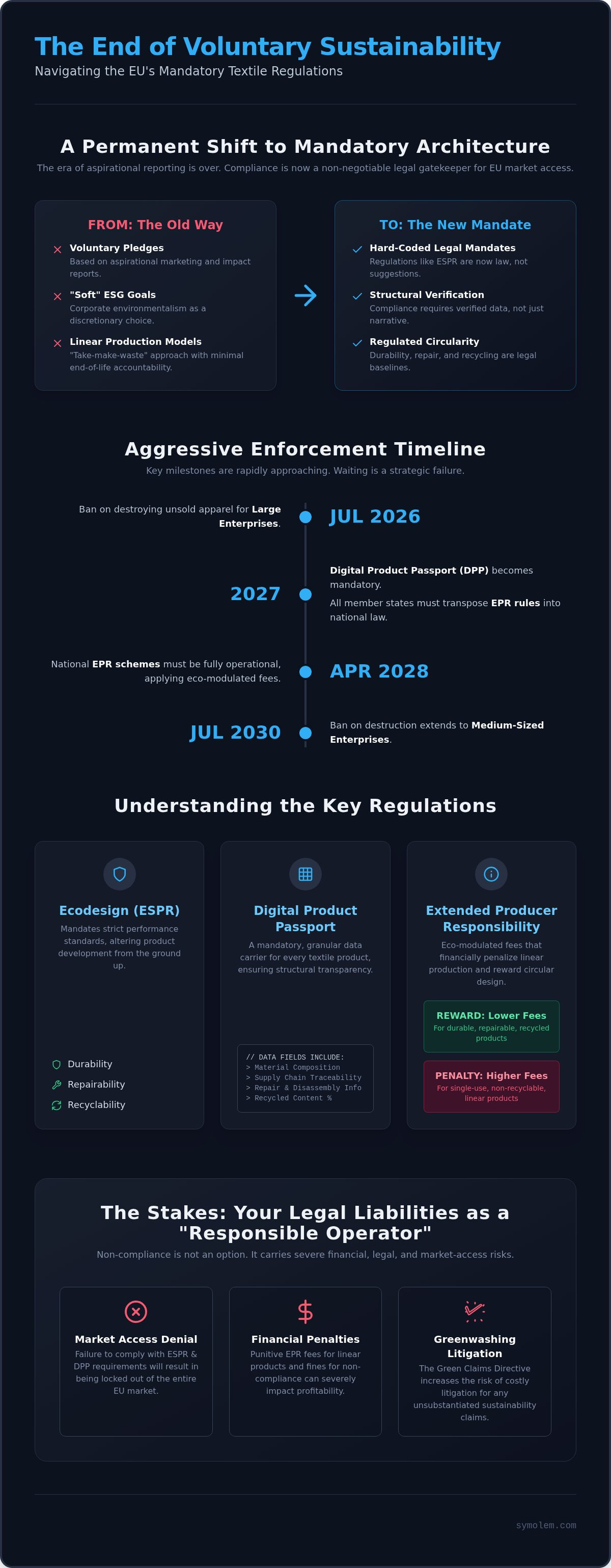
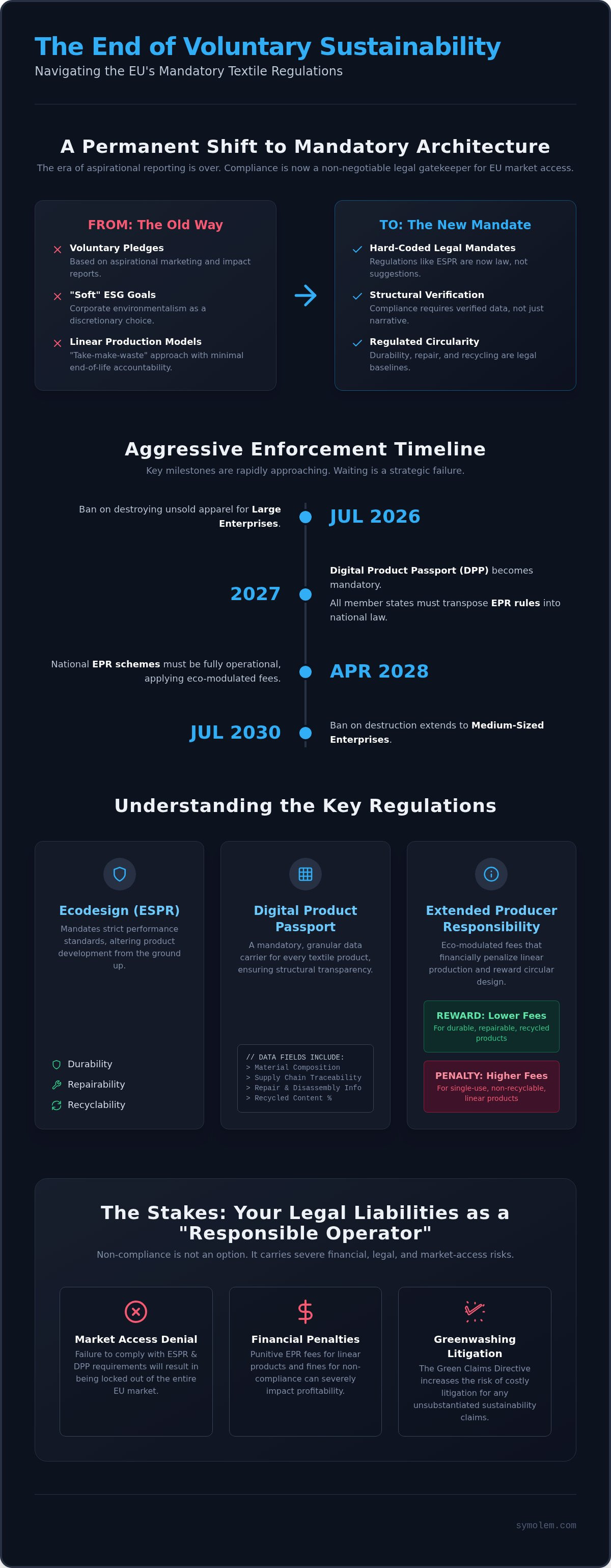
The era of discretionary sustainability is over. On July 19, 2026, the European Union effectively terminated the voluntary phase of corporate environmentalism by activating the Ecodesign for Sustainable Products Regulation (ESPR). This wasn't a minor policy update. It was a systemic pivot that transformed the EU regulatory landscape for textiles from a collection of "soft" ESG goals into a hard-coded legal gatekeeper for market access. Brands that previously relied on glossy impact reports now face a clinical reality: compliance is no longer about narrative, it's about structural verification.
The EU Strategy for Sustainable and Circular Textiles now serves as the master framework for all operations within the single market. Business as usual currently constitutes a terminal legal risk for global fashion entities. Those failing to transition from linear production to regulated circularity will find themselves locked out of the world’s most lucrative consumer base. The shift is absolute. The transition is mandatory. The stakes are existential.
The European Green Deal and the Circular Economy Action Plan
The European Green Deal isn't just a political vision; it's a total economic reconfiguration. At its core, the Circular Economy Action Plan (CEAP) identifies textiles as a priority sector where the "take-make-waste" model must be dismantled. This framework dictates the future of material selection by mandating durability and repairability as baseline requirements. The European Industrial Strategy reinforces this by viewing textile circularity as a matter of systemic resilience. It's a move to decouple economic growth from resource consumption, forcing brands to rebuild their value chains with clinical, diagnostic precision.
Regulatory Rhythms: The 2026-2030 Enforcement Timeline
The enforcement timeline is aggressive and meticulously sequenced. Large enterprises are already prohibited from destroying unsold apparel and footwear as of July 2026, a ban that will extend to medium-sized enterprises by July 19, 2030. The "Omnibus I" package has further tightened the EU regulatory landscape for textiles by harmonizing reporting requirements under CSRD and CSDDD. Key milestones are rapidly approaching:
- June 2027: All EU member states must have transposed the new textile EPR rules into national law.
- 2027: The Digital Product Passport (DPP) becomes the mandatory data carrier for all textile products.
- April 2028: National Extended Producer Responsibility (EPR) schemes must be fully operational, with eco-modulated fees applied to every unit placed on the market.
Waiting for these deadlines is a strategic failure. The complexity of mapping hundreds of technical data fields for the DPP requires an immediate audit of current data infrastructure. Brands must move now or risk being regulated out of existence.
ESPR and the Digital Product Passport: Structural Transparency Requirements
Transparency has evolved from a narrative preference into a structural mandate. Under the Ecodesign for Sustainable Products Regulation (ESPR), the EU regulatory landscape for textiles now demands clinical accountability at the individual product level. This regulation isn't merely a set of guidelines; it's a rigid market entry gatekeeper that prioritizes systemic integrity over superficial branding. For global fashion entities, the transition requires moving beyond high-level disclosure toward a granular, verifiable data architecture that covers the entire lifecycle of a garment.
Ecodesign Requirements: Durability, Repairability, and Recyclability
The ESPR establishes mandatory performance standards that fundamentally alter product development cycles. It's no longer enough to design for aesthetic appeal; products must now meet strict benchmarks for durability, repairability, and recyclability. The most immediate strategic hurdle is the July 19, 2026, ban on the destruction of unsold textiles and footwear for large enterprises. This mandate forces a total reconfiguration of inventory management and end-of-life strategies. Brands can't simply write off unsold stock; they're now legally responsible for ensuring these materials remain within the circular economy through reuse or high-value recycling.
DPP Implementation: Data Governance and Supplier Mapping
The Digital Product Passport (DPP) is the technical engine of this new transparency. It's a common strategic error to view the DPP as a simple QR code. It's a complex data governance framework that requires mapping 814 distinct data fields across fragmented, global supply chains. Establishing a "single source of truth" for product environmental footprints is a massive undertaking that exposes structural failures in current data mapping processes. As the 2027 implementation deadline nears, the cost of data mapping will escalate for those who haven't secured their technical infrastructure. For a deeper framework on managing this transition, see Challenges of Digital Product Passport Implementation: A Strategic Framework for 2026.
Achieving this level of precision isn't optional. It requires a clinical audit of every tier in your supply chain to ensure data stability and verification. Developing robust Digital Product Passport (DPP) Frameworks is now a critical business imperative for any brand seeking to maintain market access within the European Union. Transparency is no longer about storytelling; it's about the technical ability to prove compliance at the point of sale.
Extended Producer Responsibility (EPR) and the Economics of Recovery
Extended Producer Responsibility (EPR) is not merely a waste management fee. It's a precise financial instrument designed to internalize the environmental costs of textile production. Within the EU regulatory landscape for textiles, the "polluter pays" principle is being codified into a mechanism that will fundamentally redefine wholesale and retail margins. By April 2028, every textile producer placing goods on the EU market must participate in an operational EPR scheme. This shift moves the financial burden of end-of-life management from municipalities to the brands themselves, forcing a total reconfiguration of supply chain economics.
The transition begins with the mandatory separate collection of textile waste, which becomes a requirement across the EU by January 2025. By June 2027, these rules must be fully transposed into national laws. This isn't a suggestion; it's a structural requirement for market participation. Brands that fail to model the true economics of textile recovery before these regulations hit will find their business models structurally insolvent under the weight of new compliance costs.
Eco-Modulation: Incentivizing Circular Design Through Fees
The core of the new EPR regime is eco-modulation. Fee structures are being designed to reward durability and recyclability while penalizing linear, low-quality production. Products manufactured from complex, non-recyclable fiber blends will face significantly higher fees, effectively acting as a tax on "fast fashion" business models. This creates a direct financial incentive for brands to invest in high-purity mono-materials and robust construction. Strategic infrastructure costing is now a prerequisite for product development. Brands must clinically evaluate the long-term fee implications of every material choice at the design stage to protect future profitability.
National Variations: Navigating the French Eco-Score and Beyond
While the EU seeks harmonization, national variations currently present a fragmented challenge for global operators. France is leading this shift with its Environmental Cost label, which becomes mandatory in October 2026 for brands making environmental claims. This system serves as a diagnostic precursor to EU-wide standards, utilizing a points-based "eco-score" to determine fee levels. Navigating these differing national implementation rules requires a sophisticated policy advisory approach to avoid costly administrative overlaps. To manage these complexities effectively, brands should consult the Navigating Textile EPR: 2026 Compliance Framework for detailed strategic guidance. The EU regulatory landscape for textiles is becoming a patchwork of high-stakes requirements that demand clinical precision in execution.
The Responsible Operator: Global Contagion and the UK Position
The EU regulatory landscape for textiles creates a legal gravity well that extends far beyond the borders of the Eurozone. Under the Ecodesign for Sustainable Products Regulation (ESPR), the designation of "Responsible Operator" is a critical legal reality for any brand seeking market access. It doesn't matter if your headquarters are in London, New York, or Hong Kong. If you place a product on the EU market, you must appoint a legal entity within the Union to carry the burden of compliance. Article 14 of the ESPR specifically targets own-label importers, making them directly liable for the technical accuracy of product data and the physical integrity of the goods sold. This is a high-stakes shift from passive distribution to active legal stewardship.
Aspirational marketing is now a liability. The Green Claims Directive effectively eliminates "soft" sustainability narratives by requiring third-party verification for every environmental statement. This move from disclosure to accountability is being mirrored globally, creating a "contagion" effect where EU standards become the de facto global baseline. Brands failing to secure their data chains now will find themselves locked out of multiple jurisdictions as these frameworks harmonize.
The UK Regulatory Landscape: EPR and Digital Records
UK-based brands face a unique "dual compliance" trap. While the UK is developing its own Extended Producer Responsibility (EPR) scheme for textiles, the timeline remains distinct from the EU's 2028 operational mandate. British entities must manage the friction between the EU Digital Product Passport (DPP) and emerging UK Digital Product Records (DPR). This isn't just an administrative hurdle; it's a structural challenge in data governance. Simultaneously, the Digital Markets, Competition and Consumers (DMCC) Act in the UK provides the Competition and Markets Authority (CMA) with enforcement powers that mirror the EU's crackdown on greenwashing. Managing these parallel tracks requires a clinical understanding of both regimes to avoid redundant infrastructure costs.
Managing Importer Liability and Due Diligence
The Corporate Sustainability Due Diligence Directive (CSDDD) has transformed supply chain audits from a best practice into a mandatory legal defense. The scope of liability is expanding into new frontiers, specifically the EU Deforestation Regulation (EUDR), which applies to large and medium operators on December 30, 2026. Verification systems must now account for complex geo-spatial data and labor rights across every tier of production. Mitigating this regulatory risk is impossible without robust, automated verification systems that provide an immutable audit trail. To navigate these complexities, brands should engage in a comprehensive Policy and Regulatory Advisory to identify their specific legal footprint and secure their market position. The cost of a compliance failure now includes not just fines, but the permanent loss of the right to trade within the single market.
Strategic Readiness: The Symolem Framework for Regulatory Transition
The era of elective sustainability has expired. Survival within the EU regulatory landscape for textiles requires a clinical pivot from marketing-led initiatives to infrastructure-led compliance. Reactive strategies are no longer viable. Brands that wait for the 2030 medium-sized enterprise ban to take effect will find themselves priced out of the market by eco-modulated fees and technical barriers. Symolem operates as a strategic architect, dismantling the structural failures of linear models and replacing them with verified, circular frameworks that ensure long-term systemic integrity.
Defensive compliance is a race to the bottom. Strategic leadership, however, views these regulations as a blueprint for economic resilience. By integrating circularity into the core business model, fashion entities can decouple growth from resource consumption while mitigating the legal risks of greenwashing litigation. This transition demands a rigorous application of Impact Measurement and MRV (Measurement, Reporting, and Verification) to establish the evidentiary basis required for the Green Claims Directive. Verification is the only defense against the increasing scrutiny of EU regulators.
The ESPR Readiness Diagnostic: Mapping the Path Forward
The first step in this transition is an uncompromising audit of existing systems. Most brands currently suffer from high-level failures in data mapping and supply chain visibility, leaving them unprepared for the up to 236 data points in the UNTP schema required by the textile Digital Product Passport. Our diagnostic identifies these compliance gaps with clinical precision. We develop a phased roadmap that aligns your internal infrastructure with the 2027 implementation deadlines, ensuring that your data architecture is stable, verified, and ready for market entry. To secure your position, start your journey with our ESPR Readiness Diagnostic: A Strategic Mandate for Textile Compliance in 2026.
Conclusion: The Economic Imperative of Circularity
The transition facing the textile industry is high-stakes and permanent. Between the 2026 ban on destroying unsold goods and the 2028 operational mandate for EPR schemes, the window for strategic adjustment is closing rapidly. Delayed action is the most expensive strategy a brand can adopt. The costs of retroactive supply chain mapping and emergency compliance will far exceed the investment in proactive Circular Economy Strategy Development.
Circularity is no longer a matter of ethical sentiment; it's a matter of economic survival. Brands must rebuild their models to favor durability, repairability, and systemic recovery or face obsolescence. Symolem provides the intellectual rigor and technical expertise necessary to navigate this complex terrain. Contact us today for expert Policy and Regulatory Advisory and implementation frameworks that turn regulatory pressure into a competitive advantage.
Mastering the Architecture of Circular Compliance
The transition from discretionary sustainability to regulated circularity is an absolute economic pivot. We've established that the EU regulatory landscape for textiles will no longer tolerate the structural failures of the linear model. Success now depends on your ability to map up to 236 data points in the UNTP schema for the 2027 Digital Product Passport and navigate the financial pressures of eco-modulated EPR fees. These aren't just administrative hurdles; they're the new parameters of market entry and brand longevity.
Symolem acts as a systemic architect, providing independent advisory with clinical diagnostic precision. We specialize in global circular infrastructure design, offering provocative clarity where others provide only aspirational narratives. By prioritizing systemic integrity over superficial reporting, you can turn these high-stakes mandates into a durable competitive advantage. The future belongs to those who build for verification today. Secure your market position with a Symolem ESPR Readiness Diagnostic and lead the industry's shift toward a resilient, regulated circular economy.
Frequently Asked Questions
Does ESPR apply to UK brands selling into the EU market?
Yes, ESPR applies to every brand placing products on the EU market, regardless of where they're headquartered. UK entities selling into the single market must appoint a legal representative within the Union to act as the Responsible Operator. This ensures that non-EU brands remain legally liable for product-level data and ecodesign performance. Failing to establish this legal footprint effectively bars access to the European consumer base.
What is the deadline for implementing the Digital Product Passport for textiles?
The requirement for a Digital Product Passport for textiles is expected to become mandatory in 2027. This timeline is aggressive, requiring brands to map approximately up to 236 data points in the UNTP schema across their global supply chains before the deadline. Early adoption is a strategic necessity. Waiting for the final enforcement date risks technical bottlenecks as brands rush to secure the "single source of truth" required for compliance.
Who is considered a "Responsible Operator" under the new EU regulations?
Under ESPR, the Responsible Operator is the legal entity established within the EU that ensures a product meets all regulatory requirements. This role typically falls to the manufacturer, the importer, or a designated authorized representative. Article 14 obligations place high stakes on own-label importers. They're directly accountable for the technical accuracy of the product's environmental footprint and its alignment with the broader EU regulatory landscape for textiles.
How much does it cost to implement a Digital Product Passport system?
Implementation costs for a Digital Product Passport vary based on the complexity of your supply chain and the existing maturity of your data infrastructure. Primary expenses include technical data mapping, supplier auditing, and the integration of MRV systems. While specific costs depend on the volume of SKUs and the number of tiers in your production network, the financial risk of non-compliance and market exclusion far outweighs the initial capital expenditure for framework development.
What are the penalties for non-compliance with the EU Green Claims Directive?
Penalties for violating the Green Claims Directive are severe, potentially including fines of at least 4% of a company's total annual turnover in the EU. Beyond financial sanctions, brands face the confiscation of revenues gained from non-compliant products and temporary exclusion from public procurement processes for up to 12 months. This enforcement mechanism eliminates aspirational marketing by mandating third-party verification for every environmental statement made to consumers.
Is the destruction of unsold textile products currently banned in the EU?
Yes, as of July 19, 2026, large enterprises are prohibited from destroying unsold textiles and footwear under the ESPR. This ban targets the environmental impact of overproduction, which results in approximately 5.6 million tonnes of CO2 emissions annually in Europe. Medium-sized enterprises must comply with this same prohibition starting July 19, 2030. This mandate forces an immediate shift toward high-stakes inventory management and circular recovery strategies.
How does EPR eco-modulation affect product pricing and margins?
Eco-modulation directly impacts margins by linking EPR fees to the environmental performance of a product. Products made from low-quality, non-recyclable fiber blends will incur significantly higher fees, effectively acting as a tax on linear production models. Conversely, durable and repairable items receive fee reductions. Brands must integrate these infrastructure costs into their pricing models now to prevent sudden margin erosion when national EPR schemes become operational in April 2028.
What is the difference between EU DPP and UK Digital Product Records?
The EU Digital Product Passport is a regulated framework under the ESPR focused on 814 technical data points for circularity. The UK's Digital Product Records (DPR) are emerging under a separate domestic trajectory. While both aim for transparency, the EU regulatory landscape for textiles demands immediate, product-level verification that's currently more prescriptive than the UK's evolving approach. Managing dual compliance requires a unified data architecture to avoid redundant administrative overhead.