Will the UK Adopt Digital Product Passports? Policy Trends
Political rhetoric has shifted. Policy has not caught up.
The question, “will the UK re-join the EU single market?” has a direct but qualified answer: there’s no official government policy to re-join, although Prime Minister Andy Burnham has opened a longer-term discussion and said rejoining could be considered. That debate doesn’t make single-market access, EU membership and a customs arrangement interchangeable, or change the rules businesses must meet today.
For fashion brands and retailers, the distinction matters. The UK is exploring a domestic framework for digital product records, while EU rules under the Ecodesign for Sustainable Products Regulation already apply to businesses placing products on the EU market. A political shift may influence future alignment, but it isn’t a sound basis for delaying compliance planning.
This article separates confirmed policy from political possibility, explains the legal and political steps any change could involve, and examines what the UK’s digital product records discussion means alongside the EU’s Digital Product Passport requirements. It also sets out practical ways to structure product evidence across suppliers and markets, so teams can manage compliance whether UK and EU rules converge or diverge.
Key Takeaways
- Will the UK re-join the EU single market? Treat re-entry as uncertain, and distinguish it from EU membership or other forms of closer cooperation.
- Assess current trade and product rules on their own terms; don’t base compliance decisions on a possible future political settlement.
- Map the markets each product serves, identify the rules that apply, and trace evidence gaps across suppliers before they disrupt buying or market access.
- Keep product records structured so teams can respond more effectively if UK and EU requirements change or diverge.
- Retailers can use Symolem-ID to screen third-party brand ranges against 50+ global textile regulations before purchase orders are signed.
Table of Contents
- Will the UK re-join the EU single market? What is confirmed in 2026
- What political and legal steps could UK single-market re-entry require?
- What could re-entry mean for UK fashion and textile trade?
- How should UK fashion businesses plan while the re-entry question remains open?
- How Symolem supports fashion compliance across UK and EU markets
Will the UK re-join the EU single market? What is confirmed in 2026
Will the UK re-join the EU single market? As of October 2026, re-entry is not confirmed, and the UK government has no official policy to re-join either the single market or the EU. Political discussion has widened, but discussion is not a decision, negotiating mandate or change to the rules currently governing trade.
The distinction matters to fashion businesses because “closer relations” can describe very different arrangements. The EU single market is a framework for cross-border economic activity built around shared rules and the movement of goods, services, capital and people. It is not another name for EU membership, and it is not the same as a customs arrangement.
For a concise explanation of the political debate, watch this ITV News discussion:
What does rejoining the single market mean?
Single-market participation concerns alignment with a shared economic and regulatory framework. EU membership is broader: it involves participation in the Union’s institutions and decision-making, as well as obligations under its treaties. A customs arrangement, by contrast, concerns how goods are treated at customs and the relationship with external trade. None automatically delivers the rights or responsibilities of the others.
That distinction rules out a common planning error. A deal to reduce trade friction or co-operate on particular issues would not, by itself, restore single-market access. Nor does political support for closer alignment establish which rules the UK would adopt, how they would be enforced or what formal agreement would apply.
What has actually been decided by the UK?
In October 2026, Prime Minister Andy Burnham said Brexit had done “more harm than good” and that rejoining the EU would be among the options considered for the UK’s long-term relationship. He is scheduled to attend a Brussels summit in November to discuss closer relations and renegotiating parts of the post-Brexit trade deal. Neither statement constitutes an agreed plan to rejoin.
Former Labour leader Neil Kinnock has publicly argued for a manifesto pledge to rejoin the EU. That is political advocacy, not government policy. The current position is therefore clear: re-entry remains a possible subject of political debate, not a confirmed UK policy or an agreed negotiating mandate.
For apparel operators, the immediate compliance question is separate. The EU’s Ecodesign for Sustainable Products Regulation applies to companies placing products on the EU market, including UK businesses. A spinning mill in India or a dyeing house in Turkey will not become less relevant to evidence requirements because UK political debate has shifted; businesses need to distinguish current market obligations from hypothetical future changes.
What political and legal steps could UK single-market re-entry require?
There is no settled route to UK single-market re-entry. The process would depend first on what the UK sought: EU membership, participation through a separately negotiated arrangement, or closer cooperation that stops short of single-market access. Those outcomes have different legal foundations and consequences, so the phrase “rejoin the single market” is not, by itself, a defined negotiating plan.
That distinction matters for business planning. A political statement can signal intent, but it cannot amend the UK’s existing relationship with the EU or grant apparel businesses new market-access rights. Political intent alone does not change market-access terms; those change only through an agreed and implemented legal arrangement.
Would single-market access require EU membership?
Not as a matter of terminology: EU membership and participation in the single market are related, but they are not identical concepts. However, the existence of other participation models does not establish that a particular model is legally or politically available to the UK, or that it would be agreed. Any proposed route would need a verified legal basis and specific terms.
Full EU membership has a defined accession process under Article 49 of the EU treaties. A distinct arrangement would need to be assessed according to its own legal basis and negotiations; businesses should not assume that an existing model can simply be adopted or that it would reproduce membership rights.
Which questions would negotiations need to resolve?
The answers would depend on the chosen route and the applicable treaty or agreement. For fashion and textile trade, relevant questions could include which product rules the UK would apply, how those rules would be governed and updated, what role UK institutions would have, and whether any movement-related provisions formed part of the arrangement. These are issues to assess against an actual proposal, not to treat as agreed terms.
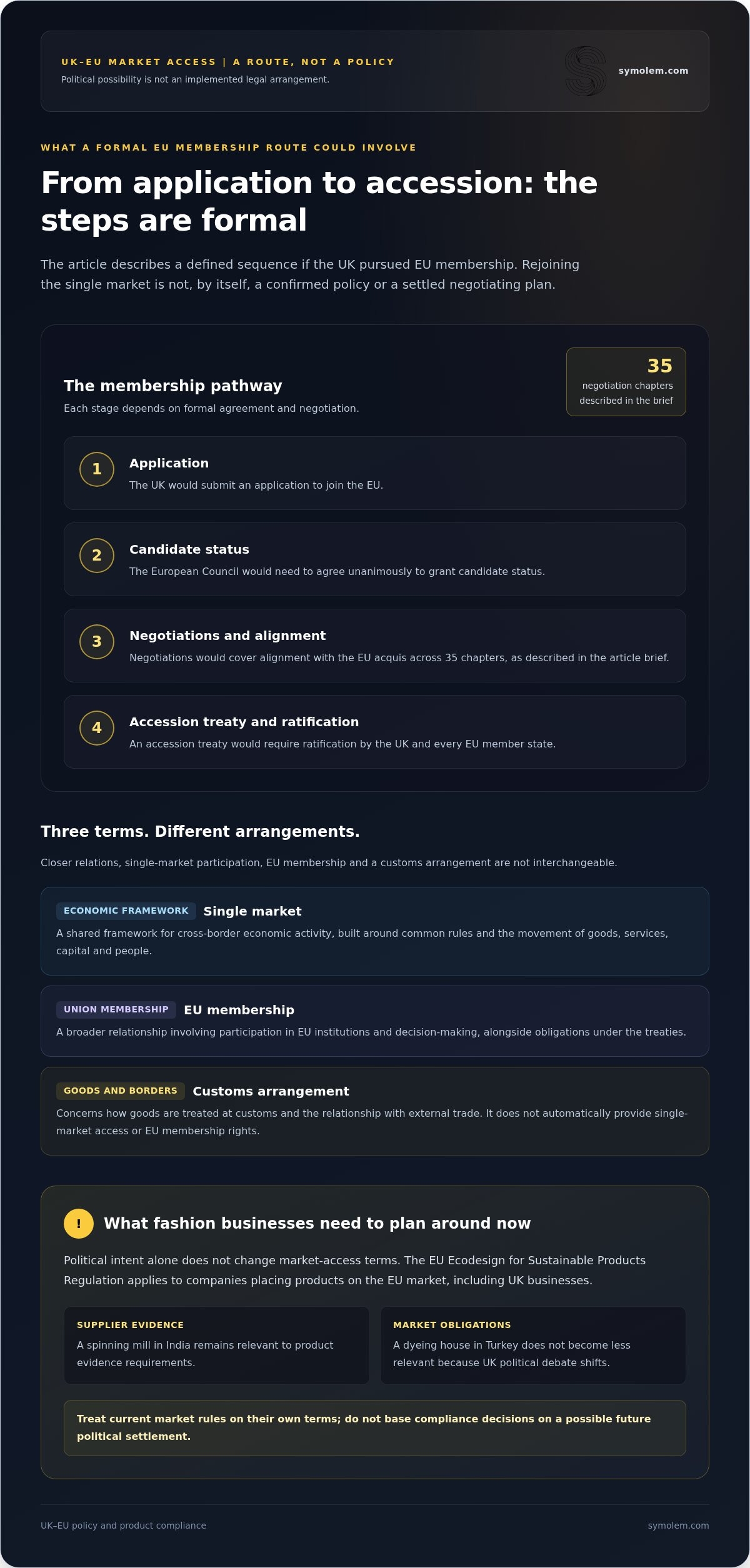
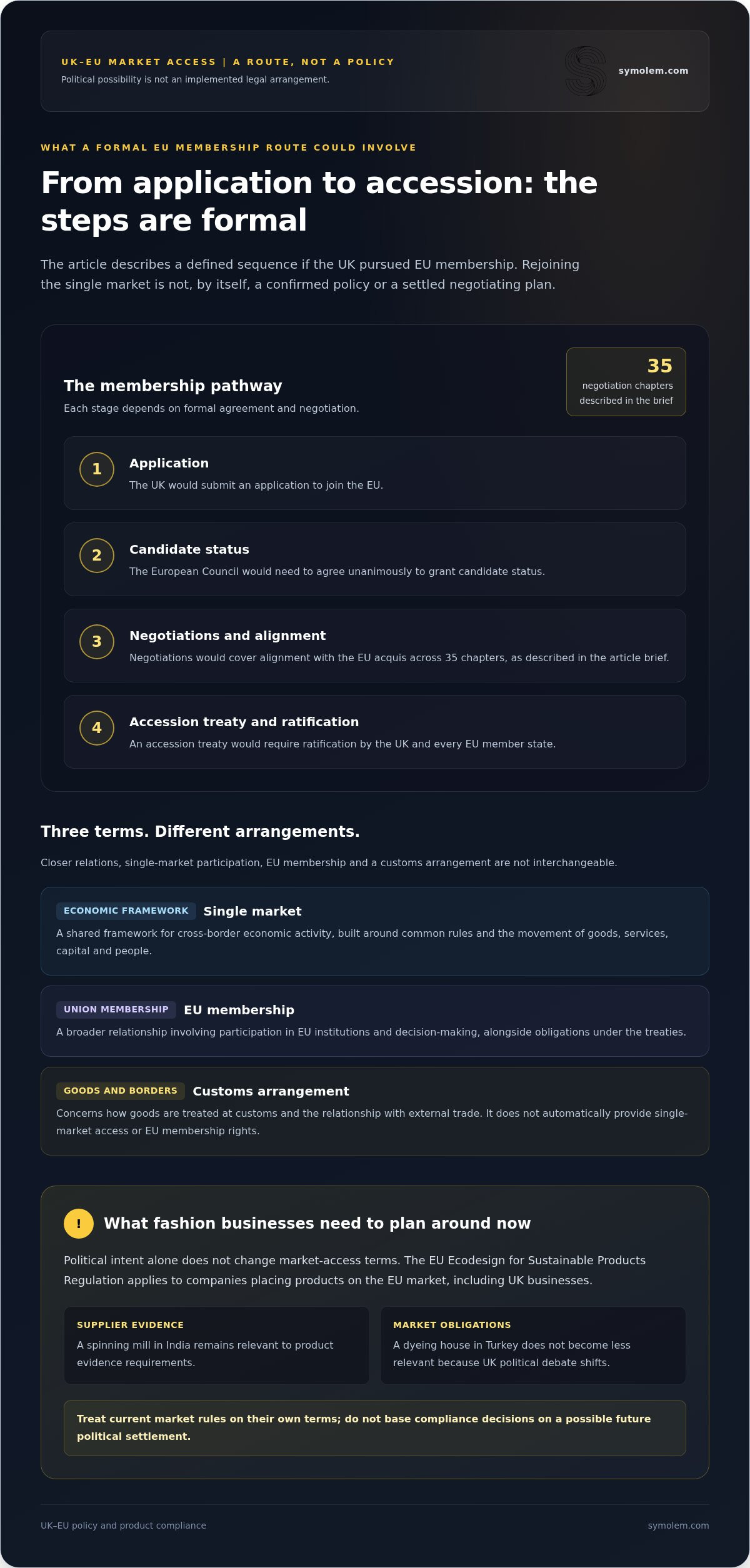
If the UK pursued EU membership, the research brief identifies a formal sequence: an application, unanimous agreement by the European Council to grant candidate status, negotiations covering alignment with the EU acquis, and an accession treaty requiring ratification by the UK and every EU member state. The brief describes negotiations across 35 chapters. The precise procedure, legal terminology and current treaty requirements should be checked by a specialist against official EU sources before publication or reliance.
A practical outline is:
- UK decision: Government and Parliament would need to establish what outcome the UK was seeking and provide the necessary political mandate.
- Negotiations: The parties would negotiate the route, scope and obligations, subject to the legal framework that applies.
- Agreed terms: Any final text would set out the rights, responsibilities and governance arrangements.
- Implementation: The relevant parties would complete the required approval and legal steps before the terms took effect.
For apparel businesses, this is a reason to track formal documents rather than infer compliance changes from campaign statements or summit discussions. Keep supplier records and product evidence organised so that a spinning mill’s fibre-origin records or a factory’s test reports can be assessed against the rules that actually apply to each market. Structured product compliance records can support that work without treating a political forecast as a compliance decision.
What could re-entry mean for UK fashion and textile trade?
The immediate commercial distinction is between obligations that apply now and changes that would depend on a future agreement. UK businesses placing products on the EU market may have to meet relevant EU product rules, depending on the product and each rule’s scope. A change in the UK’s relationship with the EU would not automatically remove those obligations or determine what UK rules would apply.
Today, UK-EU goods trade operates under the Trade and Cooperation Agreement (TCA), in force since 2021. It provides for tariff-free trade where goods meet the relevant rules of origin, but businesses still face customs procedures, origin requirements and VAT processes. These are operational conditions, not evidence that the UK has single-market access.
Which obligations apply to fashion businesses today?
The EU Ecodesign for Sustainable Products Regulation (ESPR) applies to companies placing products within its scope on the EU market, including UK businesses. The central EU Digital Product Passport registry went live on 20 July 2026, but that technical infrastructure does not make DPP requirements mandatory for every product. Textile-specific requirements depend on the relevant rules and their timing; businesses should verify the applicable scope rather than assume a general textile obligation is already in force.
The UK is exploring a domestic policy for digital product records, which could align with or diverge from the EU approach. For a more detailed jurisdiction-by-jurisdiction view, the article’s UK-versus-EU Digital Product Passport comparison can help frame the distinct questions of market scope, evidence and timing.
What might closer alignment change for apparel supply chains?
If a future agreement brought relevant product rules closer together, brands and buyers might be able to reuse more product data across markets. Whether that reduced evidence duplication or changed onboarding requirements would depend on the actual terms, product scope and implementation. Closer alignment would not, by itself, prove that customs or all compliance friction had disappeared.
Consider a garment made with yarn from a spinning mill in India, dyed in Turkey and assembled at a CMT factory in Portugal. Its product file may need to connect fibre-origin records, chemical test reports and manufacturing information to the relevant product and market. A common UK-EU data approach could make some records easier to reuse, if the rules and required data fields were sufficiently aligned. It would not remove the need to substantiate the underlying evidence.
For planning purposes, separate confirmed obligations from conditional possibilities:
- Confirmed today: The TCA governs UK-EU trade, with origin requirements and customs and VAT processes; relevant EU product rules apply to products placed on the EU market within their scope.
- Conditional: A future closer-alignment arrangement could affect rule updates, product-data formats or buyer onboarding, but its effects would depend on negotiated and implemented terms.
So, will the UK re-join the EU single market? Until there is a formal agreement and implementation, fashion businesses should base market-access decisions on current requirements and maintain evidence records that can be assessed against each market’s rules.
How should UK fashion businesses plan while the re-entry question remains open?
Build for the rules that apply now. Treat possible political change as a separate scenario, not as a reason to delay existing compliance controls or invest on the assumption that UK and EU requirements will converge. The question “will the UK re-join the EU single market?” doesn’t determine what a product must satisfy before it is placed on either market.
A proportionate planning sequence gives teams a workable baseline:
- Map markets: Record where each product is intended to be sold and which entity places it on each market.
- Identify applicable rules: Assess obligations by market, product type and business role. Distinguish confirmed duties from proposals or political statements.
- Map evidence gaps: Compare required records with evidence held for each product and its supply chain, assigning owners to unresolved gaps.
- Review at set intervals: Schedule reviews around formal legal or policy developments and internal range or sourcing changes, rather than reacting to headlines.
Keep two records of the decision: the current compliance assessment and any contingency assumptions about future policy. That separation helps teams show why a requirement applies today, while preserving a clear basis for updating procedures if an implemented change affects a product or market.
What should retailers and marketplaces do before signing a purchase order?
Buying and compliance teams should map third-party apparel ranges to their intended markets, then screen each SKU against the requirements that apply to its route to market. Record the result as Cleared, Blocked or Missing Evidence, and make the status visible before a purchase order is approved. A missing chemical test report, for example, should trigger a defined escalation to the responsible brand contact rather than being treated as evidence of compliance.
Set decision rights in advance: identify who can resolve a documentation gap, who can approve a purchasing hold and what evidence is needed to close it. This makes the control consistent across large ranges, even when buyers don’t manufacture the products and rely on third-party suppliers for records.
How can brands and manufacturers strengthen supplier evidence?
Map Tier 1-3 suppliers to the products they support. For each product, track whether chemical test reports, fibre-origin records and transaction certificates are available, current and attributable to the relevant material or production stage. Assign an owner to retrieve each missing record and maintain it alongside the product file; assign separate responsibility for social-accounting evidence, including worker welfare and fair-wage records.
Use a consistent data-governance structure to record source, date, product association and review status. A Digital Product Passport implementation framework can help teams think systematically about organising product information, while keeping the evidence itself traceable to its source. The objective is not to predict a political outcome. It is to make product records usable when buyers, compliance teams or changing market requirements call for substantiation.
For retailers, Symolem-ID screens third-party brand ranges against 50+ global textile regulations before purchase orders are signed. For brands, evidence retrieval across supplier tiers can address gaps that internal teams have not been able to close.
How Symolem supports fashion compliance across UK and EU markets
Political forecasting doesn’t establish whether a garment is compliant. Fashion businesses need controls that assess products against the requirements relevant to their markets and identify where supplier evidence is missing. Symolem is a product compliance intelligence platform and evidence advisory for fashion, footwear and textiles, focused on product records and evidence rather than predicting political outcomes.
That distinction is commercially important when retailers buy third-party ranges and brands depend on evidence gathered across multiple supplier tiers. A spinning mill, dyeing house and CMT factory may each hold different information needed to substantiate a product record. The operational task is to connect those records to the relevant product and make gaps visible before they affect purchasing or market access.
How does Symolem-ID support retailer and marketplace decisions?
Symolem-ID screens third-party brand ranges against 50+ global textile regulations in seconds, before purchase orders are signed. Its per-SKU outcomes, Cleared, Blocked or Missing Evidence, give buying and compliance teams a consistent way to identify which products have evidence gaps or require further action.
For a marketplace onboarding apparel from multiple brands, this supports structured oversight without treating supplier claims as verified evidence. Teams can record screening outcomes, escalate missing records and make documented purchasing decisions at SKU level, rather than relying on a range-wide assumption that every product has the same compliance status.
How does Symolem Advisory support brands and manufacturers?
For brands, evidence retrieval can involve following a product through suppliers that hold separate records. Symolem Advisory undertakes forensic evidence chasing across Tier 1-3 to retrieve chemical test reports, fibre-origin documentation, transaction certificates and packaging weights. These records can then be organised around the products and markets they support, helping teams respond to retailer and compliance requests with traceable information.
Where software cannot establish the underlying evidence, human-led advisory work can support social accounting and due diligence. This includes auditable records concerning worker welfare, fair wages and human rights due diligence. The purpose is to assemble and structure evidence for scrutiny, not to promise a particular legal or commercial outcome.
Where product information needs to feed a Digital Product Passport provider or retail onboarding system, Symolem verifies and structures product compliance records and assigns a Verification ID. Symolem does not issue consumer passports; its role is to strengthen the evidence that underpins a product record.
Will the UK re-join the EU single market? That remains a political question, not a substitute for checking the rules and records relevant to each product today. Retailers can apply pre-purchase-order screening to third-party ranges; brands can address supplier evidence gaps and prepare auditable records across their value chains.
Screen third-party brand compliance before signing the PO. Explore Symolem-ID or run a free product scan.
Need to retrieve missing Tier 1-3 supplier evidence or substantiate social accounting for retail stockists? Take the 5-minute Free Assessment or Book an Advisory Consultation.
Make compliance decisions that can withstand change
The question of whether the UK will re-join the EU single market may remain unresolved while fashion businesses make decisions about sourcing, buying and market access. The practical priority is to ensure those decisions are traceable: record which requirements informed them, what product evidence supported them and who owns any outstanding gaps. That discipline helps teams adapt when policy changes, without treating political signals as a substitute for current compliance checks.
Retailers and marketplaces can strengthen buying controls by screening third-party ranges before committing to orders. Brands and manufacturers can focus on the supplier records and social-accounting evidence that support their products. Both actions build operational readiness without requiring a prediction about the UK’s future relationship with the EU.
Screen third-party brand compliance before signing the PO. Explore Symolem-ID or run a free product scan.
Need to retrieve missing Tier 1-3 supplier evidence or substantiate social accounting for retail stockists? Take the 5-minute Free Assessment or Book an Advisory Consultation.
Clear records give your team a stronger basis for action, whichever direction policy takes.
Frequently Asked Questions
Will the UK re-join the EU single market?
There’s no confirmed re-entry decision. For practical purposes, distinguish a political statement from a formal government policy, an agreed negotiating mandate, a concluded agreement and its implementation. Each is a different signal, and only later stages could establish specific changes for businesses. When reviewing announcements, record their source, date and status, and avoid changing product controls in response to commentary that hasn’t become formal policy.
Is rejoining the EU single market the same as rejoining the EU?
No. The two outcomes would carry different institutional and legal implications. For a fashion business, a useful next step is to identify which operational assumptions depend on the distinction: who makes or updates relevant rules, what evidence buyers may request, and how changes would be recognised in product procedures. Treat those as questions for any future proposal, rather than assuming that one type of relationship guarantees the terms of another.
How soon could the UK re-join the EU single market?
No dependable completion date can be stated. Businesses planning seasonal ranges shouldn’t build a launch calendar around an unverified political forecast. Instead, define internal triggers for reassessment, such as publication of a formal UK policy, a negotiating mandate or agreed legal text. That gives teams a reason to reopen assumptions when concrete information emerges, without disrupting sourcing and buying decisions every time political commentary changes.
Would rejoining the single market remove customs checks between the UK and EU?
Don’t assume it would. Any effect on customs processes would depend on the precise arrangements agreed and how they were implemented. Until authoritative changes take effect, logistics teams should keep shipment documentation and operational instructions aligned with the procedures they currently use. If a formal agreement later changes those processes, update work instructions against its actual provisions rather than relying on a broad description of the UK’s relationship with the EU.
Do UK fashion brands already need to meet EU product rules when selling into the EU?
They may, depending on the product, activity and legislation in scope. Consider a brand selling the same style in the UK and EU: its technical file should make clear which product version the evidence relates to, which market it supports and whether the supporting document covers the material or batch concerned. A retailer’s request for a test report should prompt a check of that connection, not just a search for a file with a matching product name.
Could closer UK-EU alignment affect textile Digital Product Passports?
It could shape future policy choices, but businesses should distinguish alignment announcements from rules that have been adopted and apply to their products. In any UK-versus-EU Digital Product Passport comparison, examine the status, scope and required product information for each market separately. This helps teams identify which records might be reused and which may need market-specific treatment, without assuming that political alignment alone makes passport requirements identical.
What should a UK fashion business do while policy remains uncertain?
Make product evidence easier to audit by recording its source, date, product association and review status, then keep a change log when a record is replaced or corrected. For example, if a supplier updates a chemical test report, the product file should show which version was used for a buying decision. Clear ownership of those records helps compliance and buying teams explain decisions later, without relying on staff memory or scattered email threads.