UK SRS Scope 3 Reporting for Fashion: Strategic Guide
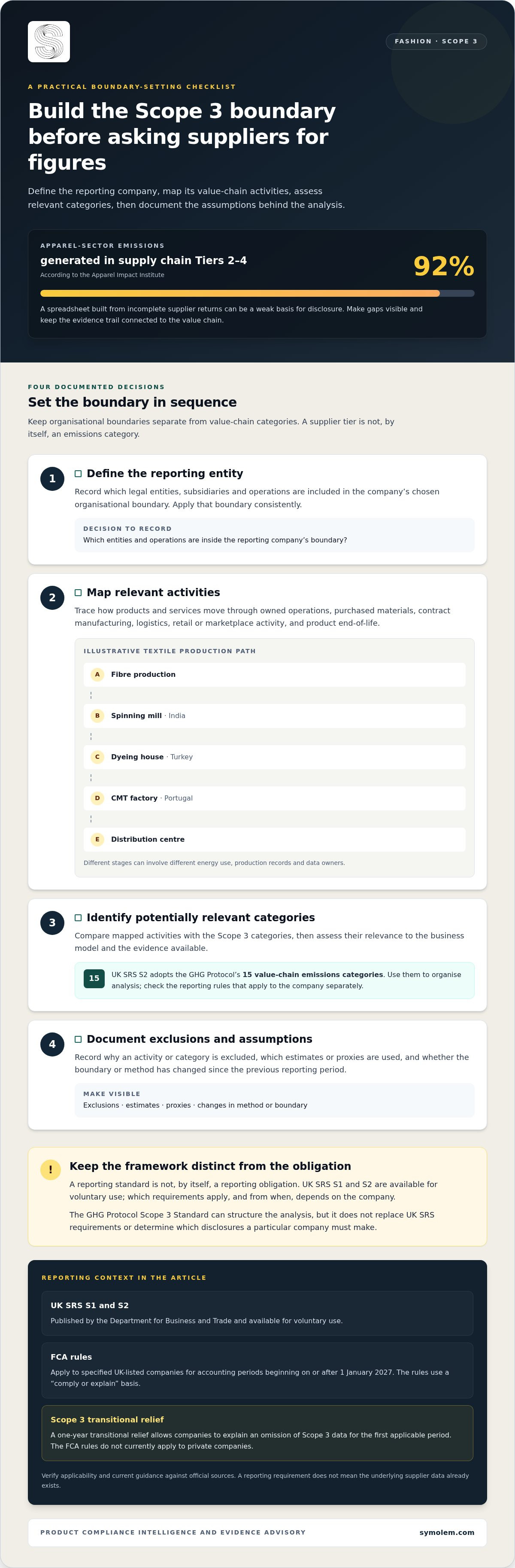
92% of apparel-sector emissions are generated in supply chain Tiers 2-4, according to the Apparel Impact Institute. That is where a spreadsheet built from incomplete supplier returns becomes a weak basis for disclosure. UK SRS scope 3 reporting for fashion businesses is therefore not just a calculation exercise; it depends on evidence that can be traced across materials, processing and production.
The uncertainty is understandable. UK Sustainability Reporting Standards are available for voluntary use, while FCA rules apply to specified UK-listed companies for accounting periods beginning on or after 1 January 2027. Scope 3 has a one-year transitional relief, but that does not remove the need to understand what applies, explain omissions where relevant, and prepare for stronger disclosures. Nor does a reporting requirement mean the underlying supplier data already exists.
This guide separates regulatory obligations from practical data readiness. It explains how to identify relevant requirements, organise evidence across suppliers and product records, and prioritise proportionate improvements where primary emissions data is limited. The aim is a defensible reporting process, not false precision: one that makes gaps visible and builds a reliable chain of evidence from textile production to disclosure.
Key Takeaways
- Separate UK SRS reporting requirements from voluntary preparation, and establish whether the rules apply to your organisation.
- For UK SRS scope 3 reporting fashion businesses should define the reporting entity, map value-chain activities, identify relevant categories and document exclusions.
- Assess supplier-specific data, activity records and secondary estimates against availability, relevance and documented assumptions.
- Assign clear ownership across sustainability, finance, sourcing, product and supplier-management teams so data can be reviewed before disclosure approval.
- Distinguish emissions measurement from product compliance evidence retrieval, then prioritise the gaps that matter most to reliable reporting.
Table of Contents
- What UK SRS Scope 3 Reporting Means for Fashion Businesses
- How to Set Scope 3 Boundaries Across a Fashion Value Chain
- Fashion Supplier Data: Compare Primary Evidence, Estimates, and Gaps
- Build Controls and a Practical Scope 3 Reporting Workflow
- Turn UK SRS Scope 3 Readiness into Supplier Evidence Action
What UK SRS Scope 3 Reporting Means for Fashion Businesses
A reporting standard is not, by itself, a reporting obligation. UK Sustainability Reporting Standards (UK SRS) establish a disclosure framework; whether a company must report against it, and from when, depends on the requirements applying to that company. Preparation can still be commercially necessary before a formal obligation applies, particularly where suppliers, investors or retail partners need reliable information.
Scope 3 means greenhouse-gas emissions across a company’s value chain that sit outside its direct operations and the energy it purchases. For fashion businesses preparing UK SRS Scope 3 reporting, the task is to distinguish the emissions boundary under assessment from the disclosure obligations applying to the reporting entity. The reporting framework does not create a uniform duty: companies can have different activities, boundaries and requirements.
The UK SRS S1 and S2 standards were published by the Department for Business and Trade on 25 February 2026 and are available for voluntary use. Separately, FCA final rules published on 30 September 2026 apply to specified UK-listed companies for accounting periods beginning on or after 1 January 2027. Those rules use a “comply or explain” basis; a one-year transitional relief allows companies to explain an omission of Scope 3 data for the first applicable period. The FCA rules do not currently apply to private companies. Verify applicability and current guidance against official sources rather than treating publication of a standard as proof that every business has the same duty.
What UK SRS S1 and S2 address
UK SRS S1 addresses sustainability-related financial disclosures, while UK SRS S2 focuses on climate-related disclosures. They are the UK-endorsed versions of the ISSB’s IFRS Sustainability Disclosure Standards, intended to connect sustainability-related information to a company’s financial reporting. Their publication establishes a framework, not a universal legal timetable: implementation depends on the requirements that apply to the company.
UK SRS S2 adopts the GHG Protocol’s 15 value-chain emissions categories. Fashion companies can use these categories to organise their analysis while distinguishing the accounting framework from the specific disclosure rules applicable to them.
Why fashion Scope 3 spans multiple supply-chain tiers
A garment’s production chain can cross several businesses and borders before it reaches a distribution centre. Fibre production may feed a spinning mill in India; yarn may then go to a dyeing house in Turkey, before fabric reaches a CMT factory in Portugal for cutting, making and trimming. Each stage can involve different energy use, production records and data owners.
The reporting company may control the product specification and purchase order without operating any of those facilities. It therefore depends on suppliers for activity and emissions information, while defining which entities and activities belong in its reporting boundary. Missing or inconsistent records are a data-quality issue to assess and manage under the applicable reporting requirements.
How to Set Scope 3 Boundaries Across a Fashion Value Chain
Boundary-setting starts with the reporting company, not a supplier spreadsheet. Organisational boundaries define which entities and operations the company accounts for; value-chain categories classify emissions linked to activities beyond those operations. Keeping these decisions separate prevents a common error: treating a supplier tier as an emissions category or assuming that every business has the same Scope 3 profile.
The GHG Protocol Scope 3 Standard offers a reference framework for identifying and accounting for value-chain emissions. It does not replace UK SRS requirements or decide, by itself, which disclosures a particular company must make. For UK SRS scope 3 reporting, fashion businesses should use the framework to structure analysis while checking applicable reporting rules separately.
Use a documented sequence before requesting figures:
- Define the reporting entity. Record which legal entities, subsidiaries and operations are included in the reporting company’s chosen organisational boundary, and apply that boundary consistently.
- Map relevant activities. Trace how products and services move through owned operations, purchased materials, contract manufacturing, logistics, retail or marketplace activity, and product end-of-life.
- Identify potentially relevant categories. Compare mapped activities with the Scope 3 categories, then assess their relevance to the business model and the evidence available.
- Document exclusions and assumptions. Record why an activity or category is excluded, what estimates or proxies are used, and whether a boundary or method has changed since the previous reporting period.
Map activities before requesting supplier figures
Start with process and procurement records, not a blanket supplier questionnaire. A brand may need to map purchased materials and contract production; a manufacturer may need to distinguish its own processing from materials bought for production; a retailer or marketplace may have a different mix of purchased goods, distribution and operational activity. For each mapped activity, note which supplier, intermediary, internal team or product record holds relevant information.
This inventory directs requests to the right evidence holder. A sourcing team may know the contracted factory, while a product file records material composition and logistics records identify transport activity. The map should make those connections visible before data collection begins.
Document category choices, exclusions, and assumptions
Not every category will be equally relevant to every fashion business. Record the rationale for including or excluding each potentially relevant activity, the materiality reasoning used, the evidence reviewed and any limitations. If figures rely on estimates because supplier-specific information is unavailable, retain the method and assumptions alongside the result; do not present an illustrative category map as a universal legal requirement.
Keep a versioned record of boundary decisions so changes can be explained and reviewed. Where supplier evidence retrieval is needed, structured supplier evidence advisory can help organise product and supply-chain records, without conflating compliance documentation with emissions measurement.
Fashion Supplier Data: Compare Primary Evidence, Estimates, and Gaps
Supplier data is rarely uniform. A brand may receive detailed energy records from one mill, production volumes from another, and no usable emissions information from a third. For UK SRS scope 3 reporting in fashion, method selection should reflect data availability, relevance to the reporting boundary, and assumptions that can be documented and reviewed. No single data type is automatically suitable for every activity.
Compare the available data
- Supplier-specific primary data: Information collected from the supplier about its own operations or the relevant production process. It can offer closer alignment to the activity being assessed, provided its boundary, period and basis are clear.
- Activity data: Records of quantities or activity, such as material volumes, units produced, energy consumed or transport undertaken. These inputs can support a calculation when paired with an appropriate emissions factor; activity records alone are not an emissions result.
- Secondary estimates: Values derived from external datasets, sector averages or other proxies when direct data is unavailable. They can help address a gap, but the source, suitability and assumptions should be recorded rather than implying supplier-level precision.
A transparent estimate with stated limitations is more useful than a precise-looking figure whose source and assumptions cannot be substantiated. If a Tier 2 dyeing house or Tier 3 fibre processor cannot provide relevant information, the resulting uncertainty should remain visible. It should not be concealed by reporting extra decimal places or treating an estimate as a verified supplier measurement.
What evidence can support fashion value-chain reporting
Useful records may include material composition, production quantities, process energy and transport activity. A bill of materials or purchase record can help establish what materials were used and in what quantities; energy records may describe a facility or process, while shipment records can document transport activity. For each input, identify whether it supports the activity itself, an emissions factor, or a calculated result. Those are distinct evidence functions.
Chemical test reports, fibre-origin records and transaction certificates serve specific product-compliance or traceability purposes. They may help establish information about a product, material or transaction, but they do not by themselves demonstrate energy consumption or calculate greenhouse-gas emissions. Keep these records connected to relevant product and supplier information without presenting them as emissions evidence they do not contain.
Respond to incomplete or inconsistent supplier returns
Maintain a record for each material input: source, reporting period, organisational or process boundary, assumptions, calculation method and known limitations. If supplier responses use different periods or cover different facility scopes, flag the mismatch before combining figures. Missing Tier 2 or Tier 3 information can weaken confidence in the result, particularly where the activity is relevant to the company’s boundary.
Prioritise follow-up according to the significance of the activity and the likely effect of the gap, rather than sending broad questionnaires that generate low-value responses. Escalation and evidence retrieval can help obtain missing production or supplier records; they support the evidence chain, but do not replace the emissions calculation method or the company’s review of its assumptions.
Build Controls and a Practical Scope 3 Reporting Workflow
Reliable disclosure depends on a controlled process, not a last-minute collection of figures. A practical workflow for UK SRS scope 3 reporting in fashion gives teams clear ownership from activity mapping through data review and approval, with a traceable record of how each figure was assembled. It should connect sourcing and supplier records to finance controls while keeping responsibility for the emissions calculation clear.
- Assign ownership. Sustainability coordinates the inventory and methods; finance aligns reporting periods and review controls; sourcing and supplier-management teams request and escalate information; product teams maintain relevant material and product records.
- Map activities and evidence holders. Identify the records needed for each activity, who owns them, and which suppliers or internal systems can provide them.
- Collect and log inputs. Record each value with its source, unit, period, boundary, method and limitations. Link source documents to the inputs they support.
- Review and reconcile. Check units, periods, completeness, duplicate entries and changes against prior records. Resolve inconsistencies or document why they remain.
- Approve disclosure. Route the inventory, assumptions and explanations through designated management review before external disclosure is authorised.
Prioritise data work by decision relevance and risk
Not every gap requires the same response. Rank gaps by likely emissions significance, reliance on supplier information, confidence in available data and relevance to the reporting boundary. A missing record for a major purchased material may call for prompt escalation; a less relevant input supported by a transparent estimate may be managed differently.
Separate near-term disclosure preparation from longer-term system improvements. Teams can document current assumptions and pursue priority supplier evidence now, while improving data capture within purchasing, product and supplier-management processes over time. Avoid treating one materiality threshold as suitable for every organisation, since relevance depends on its activities and applicable requirements.
Create an auditable record of methods and changes
Retain calculation inputs, source documents, estimation methods, approvals and methodological changes in a controlled record. Consistent definitions for reporting periods, units, supplier boundaries and activity types help prevent sustainability, finance and sourcing teams from producing conflicting figures. A change log makes revisions traceable and supports review between reporting periods.
Measurement principles should inform the workflow, while product-compliance evidence remains a distinct record set. Where product documentation is relevant to a connected compliance review, keep its purpose clear and do not treat it as emissions data.
Assurance and verification expectations depend on the requirements applying to the company and current official guidance. Internal review is an essential control, but it should not be described as external assurance or as a substitute for an applicable requirement. Strengthen supplier evidence retrieval by identifying missing Tier 1-3 records and assigning clear follow-up ownership.
Turn UK SRS Scope 3 Readiness into Supplier Evidence Action
Preparation becomes useful when it produces assigned actions, not another unowned spreadsheet. For UK SRS scope 3 reporting, fashion businesses can move from uncertainty to an evidence plan by first checking which requirements apply, then documenting boundaries, identifying missing records and allocating responsibility for each gap. Keep the reporting obligation distinct from readiness work: preparing data does not itself determine whether a company is legally required to disclose.
- Verify applicability: identify the rules relevant to the reporting entity and accounting period using current official guidance.
- Map boundaries: define included entities and activities, then connect relevant value-chain stages to evidence holders.
- Catalogue gaps: distinguish missing activity data, emissions factors, calculations and product-compliance records.
- Assign owners: name a team or individual responsible for each request, review and follow-up.
This sequence makes the difference between a data gap that has been recognised and one that remains invisible. A record of the source, reporting period, assumptions and limitations also helps teams explain how they reached a figure without overstating its certainty.
For retailers and marketplaces: screen product evidence before the PO
Retailers and marketplaces often assess third-party apparel ranges before they have direct visibility of the underlying product records. Symolem-ID screens brand ranges against 50+ global textile regulations in seconds and gives per-SKU outcomes: Cleared, Blocked or Missing Evidence. That status can surface product-compliance evidence gaps before a purchase order is signed, supporting a more controlled onboarding decision.
Product screening and Scope 3 accounting are related through supply-chain visibility, but they are not interchangeable. A product record or compliance status does not establish the emissions associated with its manufacture, transport or other value-chain activities. Retail reporting teams still need suitable emissions data, calculation methods and documented review controls.
For brands and manufacturers: retrieve evidence across supplier tiers
Missing records across Tier 1-3 can obstruct traceability and make it harder to review the activity information used in reporting. A factory’s production record, a material supplier’s fibre-origin document and a processor’s energy data serve different purposes; each must be identified, retrieved and categorised according to what it actually evidences. Supplier documentation retrieval supports the evidence chain, but does not replace emissions calculations or validate an emissions factor.
Symolem’s evidence advisory conducts forensic retrieval across supplier tiers, including chemical test reports, fibre-origin records, transaction certificates and packaging weights. It can also support auditable social-accounting evidence on worker welfare, fair wages and human rights due diligence. These are distinct evidence streams; teams should keep each record linked to its purpose and avoid representing product-compliance documentation as an emissions result.
Retailers and marketplaces: Screen third-party brand compliance before signing the PO. Explore Symolem-ID or run a free product scan.
Fashion brands: Need to retrieve missing Tier 1-3 supplier evidence or substantiate social accounting for retail stockists? Take the 5-minute Free Assessment or Book an Advisory Consultation.
Make Supplier Evidence a Routine Control
The next step is to turn readiness into a repeatable operating discipline. Treat UK SRS scope 3 reporting for fashion not as a one-off disclosure exercise, but as a reason to establish clear ownership, preserve source records and keep supplier evidence connected to the activities it supports. Reporting requirements and data availability remain distinct: a gap should be documented and managed, not disguised as certainty.
Retailers and marketplaces can use pre-purchase-order screening to identify product evidence issues before they become onboarding or trading problems. Fashion brands and manufacturers can build a structured response to missing supplier records and social-accounting evidence. Each action strengthens visibility across the value chain while keeping product compliance records separate from emissions calculations.
Start with the evidence gap that creates the greatest operational risk, assign an owner and record the next action. Consistent progress is more defensible than an unsupported claim of completeness.
For Retailers & Marketplaces: Screen third-party brand compliance before signing the PO. Explore Symolem-ID or run a free product scan.
For Fashion Brands: Need to retrieve missing Tier 1-3 supplier evidence or substantiate social accounting for retail stockists? Take the 5-minute Free Assessment or Book an Advisory Consultation.
Frequently Asked Questions
Does UK SRS require fashion businesses to report Scope 3 emissions?
It depends on the company and the rules that apply to it. Check the current UK SRS text, FCA rules and relevant implementation guidance against the reporting entity’s status and accounting period. Separate that legal assessment from internal readiness planning: a business may organise value-chain information for commercial or future reporting needs without concluding that it is currently required to disclose every Scope 3 category.
What counts as Scope 3 emissions for a fashion brand?
Scope 3 covers indirect greenhouse-gas emissions associated with activities in an organisation’s value chain. For a fashion brand, the relevant picture may include upstream material production, outsourced manufacturing or downstream distribution, depending on the company’s operations and accounting approach. A useful first test is to connect each activity to a business relationship, such as a purchase, service or product pathway, then assess whether it belongs in the inventory.
How should fashion companies collect Scope 3 data from suppliers?
Make each request specific enough for the recipient to answer consistently. Identify the supplier site or process, product or material reference, period, unit and requested activity information, then provide a clear response format and named contact. On receipt, check that the response matches the request and reconcile it with purchasing or production records. If a supplier reports at facility level, record how that information relates to the company’s relevant activity.
Can a fashion business use estimates when supplier emissions data is missing?
Estimates can be used where direct supplier information is unavailable, subject to the applicable reporting framework and guidance. Record the dataset or source, the calculation approach, the reason an estimate was needed and what would improve it. For example, a team might identify a supplier-specific production record as a future data request while retaining the current estimate and its limitations. Don’t describe the estimate as measured supplier data.
Which fashion supply-chain stages should a Scope 3 map include?
Use procurement, product development and logistics records to identify the stages connected to the company’s products. These may include fibre sourcing, yarn and fabric processing, garment assembly, packaging and distribution, but their relevance differs by business model. A retailer’s information may begin with brand and purchase records, while a manufacturer may hold process records directly. The map is most useful when it also identifies where handovers or missing records occur.
What records help make fashion Scope 3 reporting auditable?
Make the reporting file reproducible by retaining the calculation workbook or equivalent record alongside supporting documents and review evidence. Use consistent file references so a reviewer can follow a reported figure back to its input, identify who checked it and see what changed since the previous cycle. Access controls and a clear approval trail can reduce the risk of unreviewed edits. Confirm any formal assurance expectations against current applicable guidance.
Is supplier product-compliance evidence the same as Scope 3 emissions data?
No. Product-compliance records answer different questions from greenhouse-gas accounting. A fibre-origin document may help substantiate a material-origin statement, while a chemical test report relates to test results for a product or material; neither alone establishes emissions from producing it. Teams can cross-reference these records to identify suppliers or materials for follow-up, but should keep evidence purpose, calculation inputs and conclusions clearly distinguished.
For Retailers & Marketplaces: Screen third-party brand compliance before signing the PO. Explore Symolem-ID or run a free product scan.
For Fashion Brands: Need to retrieve missing Tier 1-3 supplier evidence or substantiate social accounting for retail stockists? Take the 5-minute Free Assessment or Book an Advisory Consultation.