Symolem works with award bodies, prize funds and grant programmes on the hardest question in the field: deciding how to fairly evaluate the impact of different applications.
The Zayed Sustainability Prize Impact Framework, 2026 — authored by Lavinia Fernandes.
Prize and award assessment
Symolem works with award bodies, prize funds and grant programmes on the hardest question in the field: deciding how to fairly evaluate the impact of different applications.
Awards sit in an unusual position. They confer credibility that entrants carry for years afterwards, into funding rounds, government partnerships and public trust. That makes the assessment methodology behind an award a matter of consequence, not administration. If the framework rewards the best-written submission rather than the best-evidenced outcome, the award becomes a communications exercise. If it rewards demonstrated change, it becomes an instrument of it.
The Zayed Sustainability Prize
The Zayed Sustainability Prize is one of the world's leading sustainability awards. Established by the United Arab Emirates in honour of Sheikh Zayed bin Sultan Al Nahyan, and now in its second decade, it recognises organisations delivering measurable sustainability outcomes across health, food, energy, water and climate action, drawing entrants from every region of the world.
Symolem authored the Prize's Impact Framework: the AI-native assessment methodology for evaluating impact across its categories, and the retrospective re-evaluation of past winners on which that methodology is founded.
The problem we were asked to solve
An award of this scale carries a structural difficulty at its centre. Its entrants are not comparable.
A decentralised solar programme in sub-Saharan Africa, a cold-chain intervention for vaccine delivery, a water desalination technology and a smallholder agriculture platform all claim impact. But they claim it in different units, over different timeframes, at different stages of maturity, and against wildly different standards of evidence. One submission arrives with a decade of operational data. Another arrives with a pilot and a projection. Both are asking the same jury for the same recognition.
Three things were needed to resolve that.
A common basis of comparison. A way to express outcomes from unlike interventions in terms that can be set beside one another without flattening what makes each of them valuable.
A standard of evidence. An explicit separation between impact that has been claimed and impact that has been demonstrated, applied consistently, so that rhetorical confidence cannot substitute for substantiation.
A baseline drawn from reality. A frame of reference for what strong impact actually looks like in this field, derived from the record rather than from theory.
That third requirement is what led us to start with the past.
Re-evaluating past winners
We did not build the framework in the abstract and then apply it. We built it backwards, from the evidence.
Symolem took the Prize's existing body of winners and re-assessed them: a retrospective evaluation of greenhouse gas impact and wider sustainability outcomes, conducted years after the awards were made, against a single consistent methodology applied to every case.
That exercise did four things at once.
Calibration. It established the real distribution of outcomes across a mature portfolio: what a genuinely exceptional result looks like at five and ten years out, and what merely looks exceptional on paper at the point of entry. A scoring framework without that distribution is guesswork.
Persistence testing. It revealed which interventions compounded, which plateaued, and which decayed once initial funding or attention moved on. This is the difference between an intervention that scales and a deployment that happened once. It is invisible at the point of application and unmistakable in retrospect, and it is now built into how the framework weighs durability.
Evidence audit. It exposed which claims could still be substantiated years later and which had rested on projection that never materialised. That finding shaped the framework's evidence tiers directly: the distinction between claimed and demonstrated impact is not a caveat in the methodology, it is a scoring dimension within it.
A defensible baseline. Future entrants are assessed against demonstrated precedent from the Prize's own history rather than against the persuasiveness of their own narrative. The framework can therefore hold its position under the scrutiny of an international jury, because its thresholds are empirical.
Most impact frameworks are written from good intentions and never really tested. This one was checked against real results before it was applied to a single applicant.
Past Winners Impact Validation Report, 2025 — the retrospective evaluation on which the Impact Framework is founded.
What the framework does
The methodology Symolem delivered is designed to be applied consistently at volume, across categories, by assessors working under time pressure.
Cross-category comparison. Outcomes from unlike interventions are expressed against a common denominator, so a health intervention and an energy intervention can be evaluated on the same scale without one being penalised for the shape of its impact.
Dimensional scoring. Impact is separated into scale, depth, durability and reach, rather than collapsed into a single headline figure that hides the trade-offs between them.
Tiered evidence weighting. Every claim is scored partly on what supports it. Operational data, third-party verification, modelled projection and unsupported assertion do not carry equal weight.
Counterfactual discipline. Assessment isolates change attributable to the intervention from change that would have occurred regardless, which is where a great deal of impact reporting quietly overstates itself.
AI-native application. The framework is built to run on structured data rather than narrative documents, so assessment is consistent across assessors and cycles, is auditable after the fact, and scales with entrant volume instead of degrading under it.
Where HIE® was tested
The re-evaluation gave Symolem something methodologies of this kind rarely get: a proving ground.
The Human Impact Equivalence Framework® (HIE®) is Symolem's proprietary methodology for quantifying outcomes in impacted lives. It exists because conventional impact accounting counts people rather than effects. A household connected to reliable power does not experience one improvement. It experiences several, along independent dimensions, over time. Reported as a single beneficiary, that undercounts what actually happened. HIE® applies multiplier logic to capture the multiple dimensions along which a single life is changed.
That is the theory. The Prize work is where it was put under load.
Re-evaluating past winners meant applying HIE® to a decade of real interventions, across health, food, energy, water and climate action, in circumstances the framework had not been designed around and could not be tuned to flatter. It tested the design directly:
Whether the multiplier logic held across intervention types that impact lives in structurally different ways
Whether the dimensions were the right dimensions, or whether real cases exposed effects the framework had no place to record
Whether it discriminated — producing meaningfully different results for meaningfully different outcomes, rather than compressing everything toward the middle
Whether it survived imperfect evidence, which is the condition all real impact assessment operates under
A framework that has only been applied to the cases it was designed from proves very little. HIE® was tested against outcomes it did not anticipate, at a scale and standard of scrutiny set by someone else. That is what makes it defensible now — and it is the same methodology that sits beneath Symolem's advisory practice and the impact dimension of our supply chain and Digital Product Passport work.
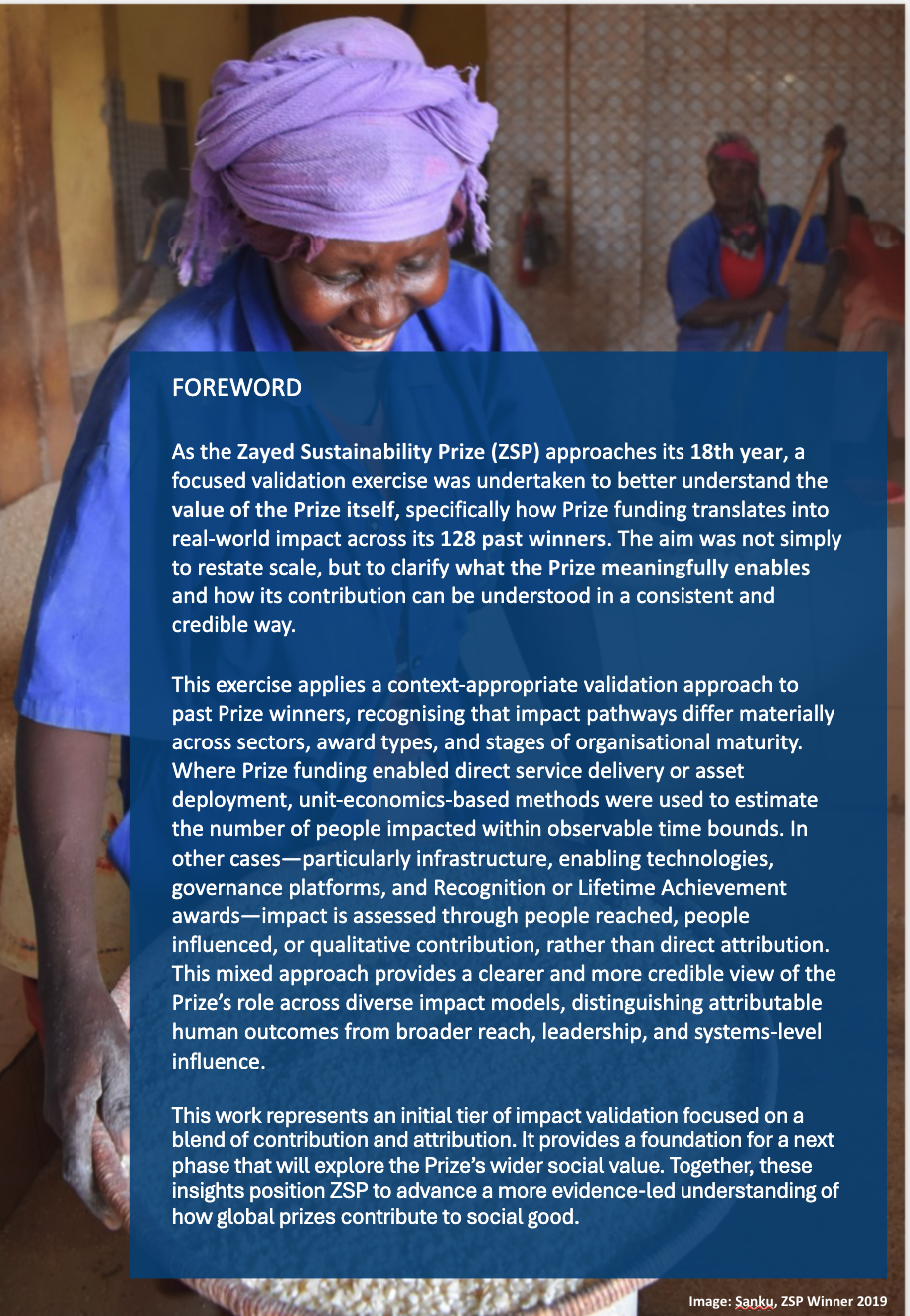
Foreword to the Past Winners Impact Validation Report — the re-evaluation that underpins the Prize's new assessment framework.
What we offer
Symolem works with prize bodies, foundations, funds and grant programmes on:
Framework authorship — designing assessment methodology capable of withstanding jury and public scrutiny
Retrospective portfolio evaluation — re-assessing past recipients to calibrate future assessment and evidence what a portfolio has actually delivered
Evidence standards and scoring architecture — separating claimed from demonstrated impact, systematically
Jury and assessor decision support — structured tooling that makes consistent judgement possible at scale
HIE® assessments — quantifying impact in impacted lives, for organisations that need a defensible figure rather than a persuasive one
The standard of evidence Symolem built for one of the world's most competitive sustainability awards is the same standard we apply to every client engagement.
Speak with Symolem
Design an award that rewards demonstrated change
Symolem advises award bodies, prize funds and grant programmes on framework authorship, retrospective portfolio evaluation and HIE® impact assessment. Speak with us about your programme.