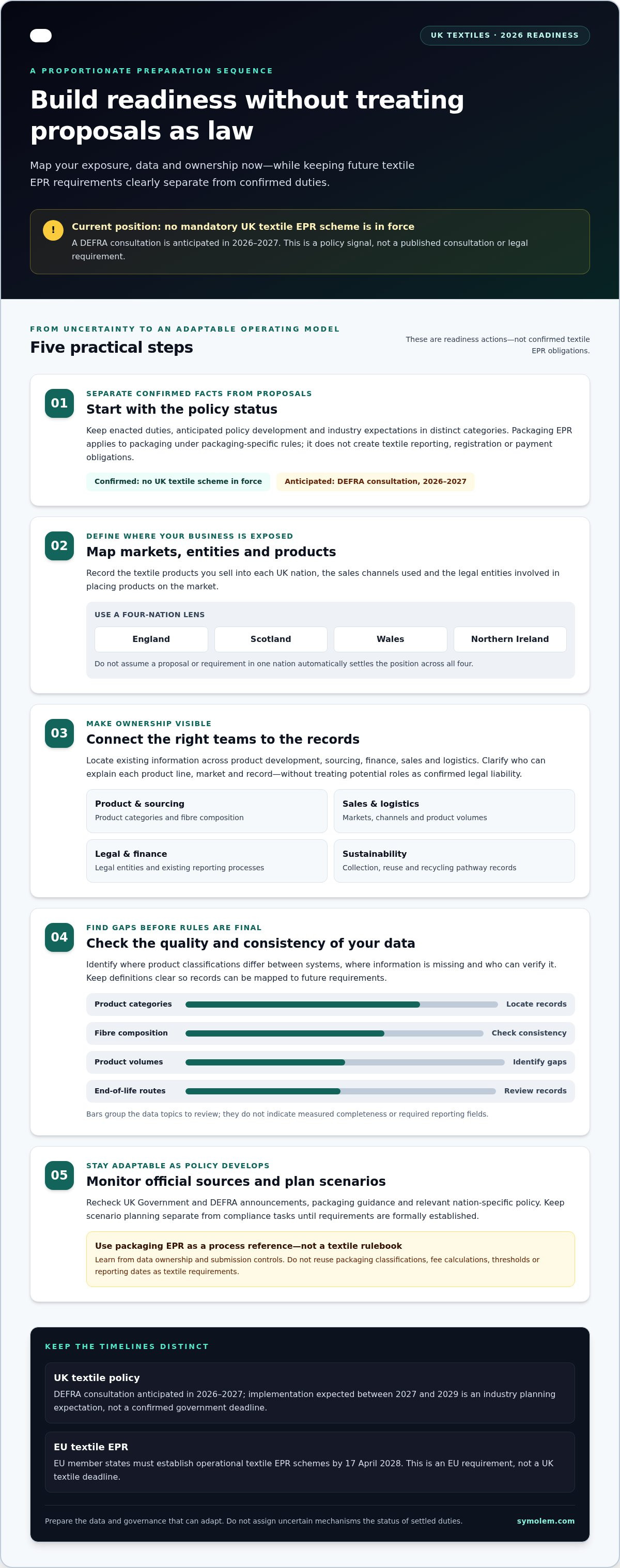
UK Textile EPR Scheme 2026: Strategic Compliance Guide
Prepare for textile EPR, but don’t mistake policy direction for a legal duty. The UK textile EPR scheme 2026 isn’t in force, and there’s no confirmed textile fee schedule or reporting deadline to apply. A DEFRA consultation is anticipated between 2026 and 2027, with implementation expected between 2027 and 2029. Those are planning horizons, not settled requirements.
The uncertainty is real, as is the risk of preparing against the wrong rulebook. Packaging EPR may offer useful operational lessons, but it isn’t textile law. Treating its duties as textile requirements can distort compliance plans before the policy is defined.
This guide sets out the UK policy position in 2026, separates confirmed facts from proposals, and explains what businesses can do now without overcommitting to assumptions. You’ll learn how to map regulatory exposure across the UK nations, identify ownership of product, material and end-of-life data, and align legal, sustainability, product and supply-chain teams around proportionate readiness. The objective isn’t to predict the final scheme. It’s to understand your gaps and build an operating model that can adapt as requirements take shape.
Key Takeaways
- Use the UK textile EPR scheme 2026 policy-status framework to distinguish enacted duties from proposals and industry expectations.
- Keep packaging EPR, UK textile policy and EU measures separate by comparing their scope, geography, liable parties and timing.
- Map your UK market exposure, legal entities and product categories before assigning accountable owners across teams.
- Identify gaps in product, material, volume and end-of-life data so your systems can adapt as policy details develop.
- Connect policy monitoring and scenario planning to wider circularity strategy, without treating uncertain mechanisms as settled requirements.
Table of Contents
- UK textile EPR scheme 2026: what is confirmed, proposed, or still uncertain?
- How a textile EPR policy could affect fashion brands and textile businesses
- UK textile EPR compared with packaging EPR and EU policy
- A practical 2026 readiness plan for UK textile EPR
- Turn UK textile EPR uncertainty into a managed compliance strategy
UK textile EPR scheme 2026: what is confirmed, proposed, or still uncertain?
Status checked 7 October 2026: the UK has no mandatory textile Extended Producer Responsibility (EPR) scheme in force. A DEFRA consultation is anticipated between 2026 and 2027, but that is not a published consultation or a legal requirement. Packaging EPR duties apply to packaging under packaging-specific rules. They do not create textile reporting, registration or payment obligations.
What does extended producer responsibility mean for textiles?
Extended Producer Responsibility (EPR) is a policy approach that assigns producers responsibility for aspects of a product’s end-of-life management. For textiles, a scheme could be designed to support systems such as collection, reuse, sorting and recycling. These are possible policy mechanisms, not duties established for UK textiles. The concept itself doesn’t determine which businesses would pay, what data they would report, or how any financial contribution would be calculated.
Is a UK textile EPR scheme in force in 2026?
No. As of 7 October 2026, a mandatory UK textile EPR scheme is not in force. The anticipated DEFRA consultation signals policy development, not an adopted scheme. Proposed product scope, liable parties, reporting rules, fees and implementation dates must remain unconfirmed unless formally established in legislation or official guidance.
Policy coverage also needs a four-nation lens. England, Scotland, Wales and Northern Ireland have their own administrations and may develop or implement relevant waste policy differently. Don’t assume that a UK-wide proposal, or a requirement applying in one nation, automatically settles the position across all four.
| Source to monitor | Status at 7 October 2026 | Material | Next verification date |
|---|---|---|---|
| UK Government and DEFRA policy or consultation announcements | Policy development: consultation anticipated in 2026-2027; no mandatory textile EPR scheme in force | Textiles | 7 January 2027 |
| UK packaging EPR legislation and official guidance | Enacted duties: packaging requirements are separate; they don’t establish textile EPR obligations | Packaging | 7 January 2027 |
| EU revised Waste Framework Directive | EU requirement: member states must establish operational textile EPR schemes by 17 April 2028 | Textiles in EU member states | 7 January 2027 |
For the UK textile EPR scheme 2026, treat expected implementation between 2027 and 2029 as an industry planning expectation, not a confirmed government deadline. Before turning policy signals into compliance tasks, check official announcements and the position in each nation.
How a textile EPR policy could affect fashion brands and textile businesses
A future textile EPR scheme could affect businesses differently depending on the products they place on the market, where they sell them, and how a final policy defines responsibility. For the UK textile EPR scheme 2026, treat possible obligations as scenarios, not current duties. Exact scope, liable-party definitions, fees and reporting rules require formal confirmation.
Which business activities could become relevant?
Start with the business facts a policy might need to distinguish. Map textile products sold into each UK nation, the sales channels used, and the legal entities responsible for placing them on the market. Then locate existing records for product categories, fibre composition and volumes. These records may sit across product development, sourcing, finance, sales and logistics, with different systems using inconsistent product classifications.
Potential roles will depend on the final rules. A brand owner might need to establish which entity owns a product line. A retailer may need to assess whether its own-brand and third-party sales are treated differently. An importer may need to trace products brought into the market, while a manufacturer may hold composition and production data. These are mapping questions, not confirmed allocations of legal liability.
Review end-of-life information too, such as existing collection, reuse or recycling pathways and the records used to describe them. This doesn’t mean a future scheme will require every data field listed here. Reporting content will depend on policy design. Osborne Clarke’s overview of regulatory compliance and sustainability for clothing and textiles in 2026 provides a legal perspective on the wider apparel policy context.
Why packaging EPR is not a textile compliance template
Packaging EPR can illustrate the administrative structure of a producer-responsibility system: defining accountable entities, gathering data and organising reporting. It cannot establish textile duties. Packaging-specific thresholds, material categories, fees and reporting dates belong to packaging rules. Copying them into a textile model would create false assumptions.
- Use packaging as a process reference: examine how your organisation assigns data ownership and controls submissions.
- Keep textile assumptions separate: don’t reuse packaging classifications, fee calculations or deadlines as textile requirements.
- Build adaptable records: preserve product, market, volume and material data with clear definitions so they can be mapped to future rules.
Disciplined preparation means tracing exposure and data ownership without pretending the scheme’s design is settled. A structured textile EPR readiness assessment can connect those questions to wider regulatory and circularity planning.
UK textile EPR compared with packaging EPR and EU policy
One label does not make three regimes equivalent. UK packaging EPR, UK textile policy and EU textile measures differ in legal status, product scope and geography. A UK business selling into the EU must assess the market where products are placed, rather than assume UK policy determines its EU obligations.
| Dimension | UK packaging EPR | UK textile policy | EU textile measures |
|---|---|---|---|
| Legal status | Confirmed: packaging-specific requirements apply under UK packaging rules. | Confirmed: no mandatory UK textile EPR scheme is in force as of October 2026. | Confirmed: the revised Waste Framework Directive entered into force on 16 October 2025. |
| Geography | Requires verification: check the applicable UK rules and administration for each business obligation. | Requires verification: monitor England, Scotland, Wales and Northern Ireland for relevant policy differences. | Confirmed: the Directive sets requirements for EU member states; national implementation details require verification. |
| Product scope | Confirmed: packaging, not the textile products inside it. | Proposed: textile scope awaits formal policy and legal definition. | Confirmed: member states must establish textile EPR schemes; national scheme details require verification. |
| Liable parties and data | Confirmed: packaging-specific rules define obligations and reporting; business applicability must be assessed under those rules. | Requires verification: liable-party definitions and reporting fields are not established by a UK textile scheme. | Requires verification: national rules will determine producer definitions, reporting and data requirements. |
| Timing | Confirmed: follow current packaging rules and reporting schedules. | Proposed: a DEFRA consultation is anticipated in 2026-2027; no textile deadline is established. | Confirmed: operational national schemes are required by 17 April 2028. |
How does textile EPR differ from UK packaging EPR?
The regulated stream is the dividing line. Packaging requirements concern packaging; they do not establish textile liability. Packaging thresholds, fee calculations, material categories and reporting dates cannot be carried across to clothing or other textile products. Use the UK packaging compliance framework as a process contrast only. It can prompt questions about governance and data controls, but it is not a textile compliance template.
What should UK businesses track in EU textile policy?
For EU sales, track the Directive’s national implementation separately from UK policy development. The EU deadline is a confirmed obligation on member states to establish schemes, but it does not itself settle every company’s national reporting fields or liability. Monitor the countries where products are placed on the market and connect relevant developments to product and circularity planning. Keep an EU textiles review alongside UK monitoring, and assess the two regimes separately.
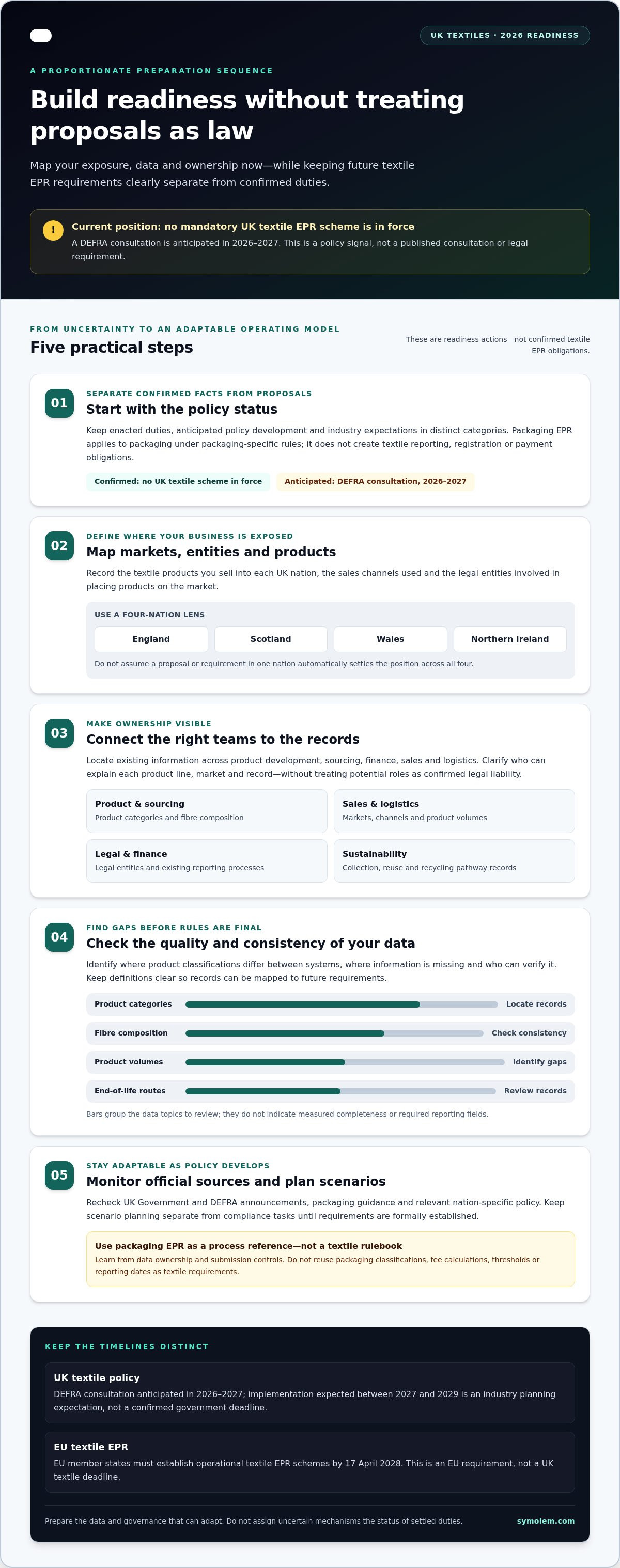
A practical 2026 readiness plan for UK textile EPR
Readiness now means building a system that can absorb policy changes, not guessing the final rules. For the UK textile EPR scheme 2026, use a staged plan to establish exposure, data quality and accountability while keeping unverified fees and dates out of budgets and compliance commitments.
- Map market exposure. Record where the business sells textile products across the UK, through which channels, and which legal entities place them on each market. Separate product categories so a future scope definition can be applied without rebuilding the inventory.
- Assign accountable owners. Name leads in regulatory affairs, sustainability, sourcing and finance. Clarify who interprets policy, owns product and supplier records, validates volumes, and approves external reporting if requirements emerge.
- Build an auditable data baseline. Map product and material information across design, sourcing, sales and returns. For each field, record its owner, source system, reporting period and supporting evidence. Mark missing supplier information as a gap; don’t present estimates as verified facts.
- Test data quality and traceability. Identify where product categories, fibre composition or sales volumes use inconsistent definitions across systems. Keep assumptions visible and distinguish measured, supplier-provided and estimated values, so teams can revise them when policy specifications are published.
- Model scenarios, not predictions. Prepare for alternative product scopes, implementation dates and producer-responsibility models. Assess operational impacts under each scenario, but don’t budget against unverified fees or treat expected timelines as legal deadlines.
- Set policy monitoring and review. Document a review cadence for UK-wide announcements and developments in England, Scotland, Wales and Northern Ireland. Assign responsibility for recording the source, date, status and business impact of each material change.
Make the baseline useful beyond compliance
The same data and ownership map can support decisions about sourcing, product durability, reuse pathways and circular business models. Connect readiness to a broader textile circularity strategy, rather than treating EPR as a standalone reporting exercise. That keeps investment decisions useful even if final scheme details differ from current scenarios.
To strengthen the baseline, map your textile EPR data and governance gaps through a structured compliance diagnostic and connect the findings to circularity planning.
Turn UK textile EPR uncertainty into a managed compliance strategy
Uncertainty is not a reason to wait, and it is not evidence that a compliance deadline is imminent. It is a reason to distinguish official requirements from policy signals, understand where your business could be exposed, and build the evidence needed to respond when the rules become clearer.
These elements work together. Policy interpretation establishes what is known and what remains a scenario. A data diagnostic shows which product and market records exist, who controls them, and where evidence is incomplete. Circularity strategy connects that regulatory preparation to decisions about product design, sourcing and end-of-life pathways. Keep the sequence disciplined: assess exposure first, then prioritise action against verified requirements and clearly labelled assumptions.
When does external policy and data expertise add value?
An independent perspective can help when sales cross multiple markets, responsibility sits across legal entities, supplier information is fragmented, or product records use inconsistent categories. A diagnostic can map potential exposure, accountable owners, data sources, assumptions and evidence gaps without treating a possible scheme design as settled law.
For fashion brands and textile manufacturers, the findings can also inform broader circularity planning where compliance readiness overlaps with commercial decisions. Symolem’s policy advisory, compliance diagnostics and implementation frameworks support this work through regulatory interpretation and structured gap analysis.
What a readiness engagement should produce
A useful output is practical and revisable: a map of relevant policy scenarios, internal responsibilities, data dependencies and evidence gaps, accompanied by prioritised actions that can change as official policy develops. Each assumption should be traceable, each information gap assigned an owner, and each proposed action linked to its rationale. That gives leadership a basis for deciding what to improve now and what to monitor.
Policy monitoring, data governance and business-model planning can also be considered together as part of a textile EPR compliance framework. The objective is not to forecast a final fee model. It is to build a response capability that remains useful as requirements take shape.
If your organisation is managing fragmented records or exposure across markets and entities, discuss a textile EPR readiness assessment with Symolem. A clear diagnostic can turn policy uncertainty into defined owners, evidence priorities and adaptable next steps.
Build readiness that can withstand policy change
The UK textile EPR scheme 2026 demands clear-eyed preparation, not premature compliance claims. A mandatory UK textile scheme isn’t in force, so businesses should distinguish policy signals from legal duties and avoid borrowing packaging EPR deadlines, fees or categories. The practical priorities are to map market exposure, identify who owns relevant product and material data, and document gaps that future rules may make important.
Readiness is strongest when it connects policy monitoring with data diagnostics and wider circularity decisions. That gives teams a traceable baseline they can adapt as requirements become clearer, rather than a plan built on unverified assumptions.
Symolem is an independent advisory firm registered in England and Wales, with expertise in textile circularity, regulatory policy and compliance diagnostics. Map your textile EPR exposure and build a policy-ready action plan to turn uncertainty into defined priorities and accountable next steps.
Frequently Asked Questions
What does textile EPR mean for UK fashion brands?
Textile EPR is a policy approach that can make producers more accountable for systems managing products at end of life. For a fashion brand, that could eventually affect how products are collected, reused, sorted or recycled, depending on the scheme’s design. No specific UK textile duties follow from the general EPR concept. Brands can map product categories, market volumes, material data, legal entities and internal data owners now, without treating possible fees or reporting fields as requirements.
Does UK packaging EPR apply to clothing and textiles?
No. UK packaging EPR concerns packaging obligations; it does not, by itself, create textile EPR duties. Packaging thresholds, fees and reporting categories are specific to packaging rules and shouldn’t be copied into a textile compliance plan. Assess each product stream separately using the relevant official guidance. Record the source and date used for each assessment so that packaging requirements aren’t mistaken for textile policy as it develops.
Who could be responsible under a future UK textile EPR scheme?
Responsibility would depend on the final rules, product scope and how a business places goods on the market. Brands, retailers, importers and manufacturers could each be relevant to policy design, but none should be treated as a confirmed liable party under a UK textile scheme. Map legal entities, sales routes and roles across the supply chain now. That record will help assess exposure once official producer definitions and scope are published.
What data should a textile business prepare for EPR?
Build a traceable baseline of product categories, material composition, sales markets, volumes and supplier information. Record who owns each field, its source system, reporting period and supporting evidence. Log gaps and label assumptions clearly; an estimate isn’t verified supplier data. These records are a readiness exercise, not a definitive statutory reporting list. Future requirements will depend on the scheme’s formal design, so keep data definitions flexible enough to adapt.
Does EU textile EPR automatically apply to UK businesses?
No. A UK company’s location alone doesn’t determine its obligations in the EU. Businesses selling into EU markets should assess relevant EU rules separately from UK domestic policy, considering the products, markets and business role involved. The revised EU Waste Framework Directive requires member states to establish operational textile EPR schemes by 17 April 2028, while national rules determine detailed obligations. Assess each jurisdiction independently rather than assuming one review covers every market.
How can a UK fashion business prepare before textile EPR rules are final?
Start by mapping market exposure, legal entities and product categories. Assign owners across regulatory affairs, sustainability, sourcing and finance, then inventory product and material data, document evidence gaps and set a process for monitoring official UK and devolved-nation updates. Use scenarios to test possible scopes and operating models, not unverified fee assumptions or deadlines. This creates reusable governance and evidence without presenting proposals as current legal duties.