Empowering Consumers Directive (EmpCo)
A Climate Neutral claim is no longer a label a fashion brand can support with offsets and a polished explanation. Under the Empowering Consumers Directive, applicable across the EU from 27 September 2026, claims that a product has a neutral, reduced or positive environmental impact based on carbon offsetting are prohibited. The question is not simply whether your brand can make the claim. It is whether the evidence, boundaries and decisions behind it can withstand scrutiny.
That scrutiny is difficult when emissions data is fragmented across suppliers, products and business functions. Sustainability terms are not interchangeable, either: a climate-neutral claim carries different implications from a reduction target or a statement about lower emissions. Treating claim review as a copywriting exercise leaves the underlying evidence and governance issues unresolved.
This article explains what climate-neutral claims can mean, how they differ from related climate terms, and what evidence and governance businesses need before communicating them. It also sets out how fashion companies can strengthen emissions measurement, assess claims against EmpCo, and build a defensible plan focused on operational improvement rather than using offsets as a marketing shortcut.
Key Takeaways
- Define whether a climate-neutral claim applies to a company, product, event or specific activity before assessing its credibility.
- Map the claim to a clear boundary and reporting period, then identify the emissions data, methods, assumptions and supplier inputs needed to support it.
- Understand why a Climate Neutral claim is not automatically credible or prohibited, and how its wording, evidence, audience and jurisdiction affect the review.
- Use a cross-functional approval process that assigns clear roles to legal, sustainability, procurement, data and marketing teams, with monitoring after publication.
- Connect claim governance to measurable operational progress through stronger impact measurement, MRV and regulatory understanding.
Table of Contents
What Does Climate Neutral Mean for a Fashion Brand?
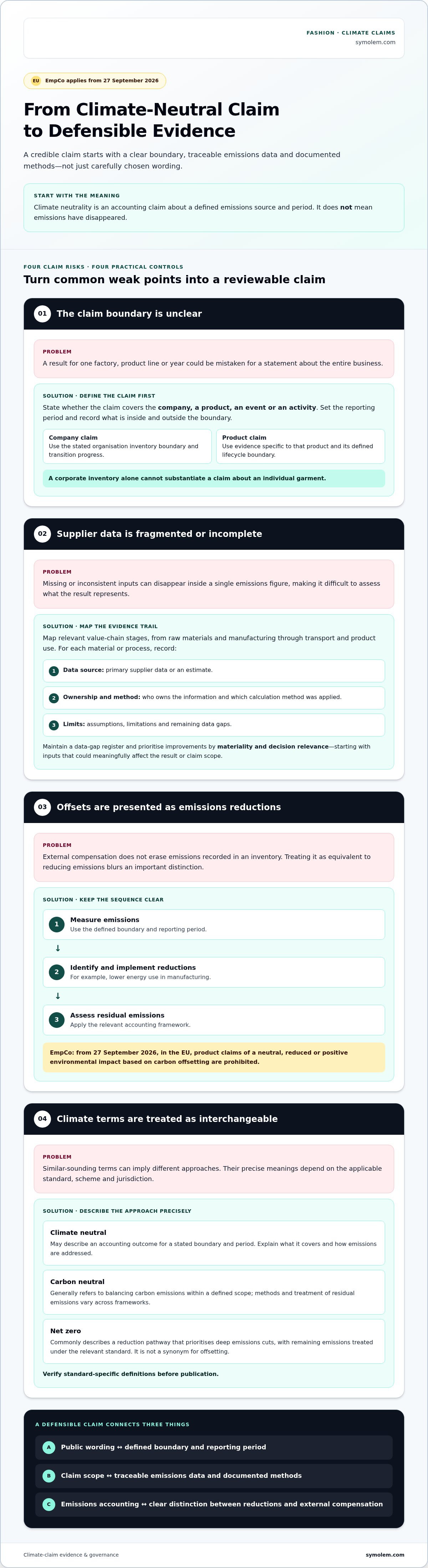
Climate neutrality is an accounting claim about a defined source of emissions and period, not a statement that emissions have disappeared. A low-emissions description indicates comparatively lower emissions, but does not establish that the remaining impact has been balanced or addressed. The distinction matters: a useful claim tells readers what it covers, how it was assessed and what action underpins it.
For a fashion business, “climate neutral” might refer to the whole company, a particular garment, an event or an activity such as shipping. These are different claims. Each needs a clear boundary and reporting period. Otherwise, a result for one factory, product line or year could be mistaken for a statement about the entire business. This precision also connects to the EU’s broader climate policy direction, including the European Green Deal, which sets the aim of climate neutrality for the EU by 2050.
Climate neutrality means accounting for emissions within a stated boundary and period, while explaining how they are reduced and how any remaining emissions are treated. It does not mean a product or company emits nothing. Under EmpCo, the method matters as much as the wording: from 27 September 2026, product claims of neutral, reduced or positive environmental impact based on carbon offsetting are prohibited in the EU.
Climate neutral, carbon neutral, and net zero: what differs?
These terms are not interchangeable. Their precise meanings depend on the applicable standard, scheme and jurisdiction, so verify standard-specific definitions before publication.
- Climate neutral may describe an accounting outcome for a stated boundary and period. Explain whether the claim concerns a company, product or activity and how emissions are addressed.
- Carbon neutral generally refers to balancing carbon emissions within a defined scope, but methods and the treatment of residual emissions vary across frameworks.
- Net zero commonly describes a reduction pathway that prioritises deep emissions cuts, with remaining emissions treated under the relevant standard. Do not use it as a synonym for offsetting.
Is a product claim different from a company claim?
Yes. An organisation-wide claim relates to the company’s stated inventory boundary and transition progress. A product claim needs evidence specific to that product and its defined lifecycle boundary. A corporate inventory alone cannot substantiate a claim about an individual garment.
For example, a claim about a cotton shirt needs traceable inputs relevant to that shirt, rather than a company-wide emissions figure presented as product evidence. Fragmented supplier data can make this difficult, so map boundaries, assumptions and evidence ownership. For a structured approach, see the textile impact measurement and MRV framework.
What Evidence Must Support a Climate-Neutral Claim?
A defensible claim starts with a defined boundary and reporting period. State whether the calculation covers the whole organisation, a product or a specific activity, identify the period it represents, and document what is inside and outside the assessment. Without those limits, readers cannot tell what the result means.
A credible Climate Neutral claim depends on transparent boundaries, traceable emissions data and documented methods that allow the result to be assessed. The evidence file should connect the public wording to the underlying inventory, rather than assemble supporting documents only after the claim has been drafted.
How should fashion brands map emissions and data gaps?
Map relevant value-chain stages, from raw materials and manufacturing through transport and product use. For each material or process, record whether the information is primary supplier data or an estimate, who owns it, which calculation method was applied, and what assumptions or limitations remain. Keep the evidence traceable to the claim’s boundary and reporting period.
Supplier information is often incomplete or inconsistent. Do not hide that uncertainty inside a single figure. Maintain a data-gap register and prioritise improvements according to materiality and decision relevance. Start with inputs that could meaningfully affect the result or the claim’s scope. This gives teams a basis for improving measurement over time, rather than treating missing data as a communications problem.
What role do reductions, residual emissions, and compensation play?
Keep the sequence clear: measure emissions, identify and implement reductions, then assess any residual emissions under the relevant accounting framework. Internal reductions, such as lowering energy use in manufacturing, change emissions within the assessed value chain. External compensation mechanisms are separate interventions; they do not erase emissions recorded in an inventory.
That distinction matters for consumer-facing language. Under EmpCo, applicable across the EU from 27 September 2026, claims that a product has a neutral, reduced or positive environmental impact based on carbon offsetting are prohibited. Any proposed treatment of residual emissions, including the eligibility and quality of external mechanisms, needs current legal and standard-specific review before it informs a claim. Do not present compensation as a substitute for product-level emissions evidence.
For a broader view of how claim readiness connects with textile compliance, review the ESPR readiness diagnostic. Symolem’s impact measurement and MRV advisory helps fashion businesses strengthen evidence ownership, measurement processes and accountability.
Are Climate-Neutral Claims Still Defensible Under 2026 Rules?
The wording alone does not decide the issue. A climate-neutral claim is not automatically credible, nor is every use prohibited in every context. Its treatment depends on what is being claimed, the evidence behind it, the audience and the jurisdiction. A product claim based on offsetting faces a different test from a company statement about its emissions-reduction transition.
For EU-facing consumer communications, Directive (EU) 2024/825, the Empowering Consumers Directive, applies from 27 September 2026. It amends existing consumer-protection rules. The enacted text and national implementation determine the legal position; proposed Green Claims Directive measures should not be presented as binding law.
What should EU-facing brands understand about climate claims?
EmpCo prohibits claims that a product has a neutral, reduced or positive environmental impact when they are based on carbon offsetting. Product-related environmental impact claims must be based on the product’s own lifecycle. This is not a blanket ban on every company-level climate statement: organisational transition communications need their own careful assessment of scope, substantiation and wording. Assess each claim on its own terms.
| Claim type | Key assessment | Context |
|---|---|---|
| Product-neutrality claim based on offsetting | Prohibited under EmpCo for consumer-facing product environmental impact claims | EU consumers, from 27 September 2026 |
| Product emissions or lifecycle claim | Define the product boundary and substantiate the stated impact | EU rules and applicable national law |
| Company transition statement | Clarify organisational scope, evidence and progress; don’t imply product-level outcomes | Assess wording and jurisdiction |
| UK environmental claim | Apply the CMA Green Claims Code principles and relevant consumer-protection law | UK consumers |
How should brands assess UK-facing claims?
The CMA Green Claims Code is guidance, not a separate law. Its principles reflect how environmental claims should be assessed under consumer-protection law: claims should be truthful and accurate, clear, supported by evidence, and not omit material information. Comparisons should be fair, and claims should account for relevant aspects of a product’s lifecycle. Use these principles as a practical review framework, while recognising that the legal duties arise from consumer-protection legislation.
A qualification buried in fine print may not correct a prominent, broad claim. Make the limits clear in the main wording and retain substantiation that matches the claim’s scope and audience. Requirements can differ by jurisdiction, so do not apply an EU conclusion automatically to UK marketing, or vice versa. For a wider view of intersecting requirements, see the EU sustainability legislation roadmap for fashion.
How Can a Brand Review a Climate-Neutral Claim Before Publication?
Make claim review a controlled approval process, not just a final copy check. A climate claim can fail because its wording goes beyond the evidence, no one owns a key data input, or a material change after approval goes unnoticed. Assign legal, sustainability, procurement, data and marketing owners, with clear responsibility for evidence, interpretation, wording and sign-off.
Use a documented sequence:
- Step 1: Define the claim. Record the exact wording, what it refers to, the intended audience and the channels where it will appear.
- Step 2: Set the boundary and period. Specify the organisation, product or activity covered, the relevant reporting period, and any exclusions.
- Step 3: Assemble and assess evidence. Link calculations and source data to the claim. Record methods, assumptions, supplier inputs, limitations and evidence owners.
- Step 4: Review wording and rules. Sustainability and data owners test whether the evidence supports the statement; procurement addresses supplier inputs; legal reviews relevant jurisdictional requirements; marketing checks that the final wording and presentation remain clear.
- Step 5: Approve and monitor. Store dated approvals and evidence versions, publish only the approved wording, and set review triggers for changed data, suppliers, methods or regulation.
What belongs in a claim review file?
Keep a single record connecting the published statement to its substantiation. Include the exact claim, audience, channel, scope, reporting period, calculation methods, data sources, exclusions, assumptions and review date. Track evidence versions so reviewers can identify which information informed approval. Record who approved the claim, unresolved limitations, corrective actions and the conditions that require a fresh review.
When should a brand pause or revise its wording?
Pause publication if the boundary is unclear, evidence is incomplete or material exclusions cannot be explained. Do not treat unresolved gaps as minor editorial details. If the evidence supports only a narrower statement, revise the wording to describe that specific product, activity, period or operational improvement, rather than implying a broader result. Reopen the review when supplier inputs change, new data alters the assessment, methodology is revised or applicable rules develop.
For the wider governance dimension, explore stakeholder engagement for ESPR compliance. To strengthen claim measurement and accountability, explore Symolem’s impact measurement and MRV advisory.
How Symolem Can Help Build a Defensible Climate-Claim System
A defensible claim requires more than careful wording. It depends on aligned measurement, accountable decision-making and a clear understanding of the rules that apply to the intended market. Symolem supports fashion and textile businesses by connecting impact measurement and MRV advisory with policy and regulatory insight. This helps teams build an evidence-led process rather than treating a Climate Neutral statement as a standalone communications asset.
What can a structured advisory engagement address?
The work starts by mapping the claim to the organisation’s products, value chain and operating context. This means clarifying what the statement covers, who owns the decision, which data sources underpin it, where evidence is incomplete, and which policy questions need assessment. The result is a practical view of what the business can substantiate now and what needs improvement.
From there, Symolem can help develop a prioritised workplan linking measurement to governance and implementation. Actions might include clarifying data ownership, improving supplier inputs, documenting assumptions, assigning review responsibilities or revising claim wording to reflect available evidence. Recommendations are tailored to the business context, helping teams focus on the gaps that matter to their claims and decisions.
Policy advisory adds regulatory context to proposed wording without treating one jurisdiction’s requirements as universal. This helps leadership understand where a claim needs further review and how evidence processes can support consistent, responsible communication.
What should leadership do next?
Begin with an inventory. Capture each existing climate claim, where it appears, whom it addresses and which team owns it. Then assign cross-functional responsibility for its evidence, review, approval and monitoring. Legal, sustainability, procurement, data and marketing teams each hold different parts of the control system, so their roles need to connect.
Use the review findings to make an explicit decision for every claim: substantiate it with stronger evidence, qualify it to match a narrower scope, revise its wording or withdraw it. Record the decision and rationale. This creates an accountable basis for action, not just a list of communications risks.
Symolem’s impact measurement and MRV advisory can help strengthen evidence quality and ownership, while policy advisory brings regulatory context into the decision process. If your organisation is reviewing climate claims or confronting fragmented evidence, discuss the measurement and governance challenges you need to resolve with Symolem.
Make Your Climate Claims Evidence-Led
A defensible Climate Neutral claim starts with clarity: define what the statement covers, match its wording to traceable evidence, and assign responsibility for review and monitoring. Under EmpCo, product claims based on offsetting face specific restrictions in the EU, so assess each claim in context rather than relying on a broad policy statement.
That takes more than a communications review. It requires emissions data with clear boundaries, documented assumptions and coordination across sustainability, procurement, data, legal and marketing teams. When evidence is incomplete, narrowing or revising the claim is more credible than allowing the wording to overstate what the business can demonstrate.
Symolem brings independent advisory expertise across textile policy, climate impact and circularity, alongside impact measurement and MRV advisory. Its work with fashion brands and textile manufacturers worldwide supports evidence-led decisions grounded in operational realities and applicable policy context.
Build a more rigorous approach to your claims and evidence. Discuss your climate-claim evidence and governance approach with Symolem.
Frequently Asked Questions
Is a climate-neutral claim legal in the EU in 2026?
Some climate-neutral claims may be permissible, but the wording, evidence, scope and audience matter. From 27 September 2026, the Empowering Consumers Directive applies across the EU and prohibits product claims of neutral, reduced or positive environmental impact when they are based on carbon offsetting. This is not a blanket ban on every company-level climate statement. Assess each claim against the enacted rules and applicable national implementation.
Can a company use carbon offsets to claim a product is climate neutral?
No. From 27 September 2026, a product claim that it has a neutral, reduced or positive environmental impact cannot be based on carbon offsetting under the EU rules. Offsets do not replace evidence about the product’s own lifecycle impact. Keep product claims grounded in product-specific evidence, and assess company-level statements separately, with clear boundaries and wording that does not imply an unsupported product outcome.
What evidence supports a climate-neutral claim?
Support the claim with a defined boundary and reporting period, an emissions inventory, documented calculation methods and traceable data. For fashion products, relevant evidence may include supplier inputs across materials, manufacturing and transport, alongside recorded estimates, exclusions, assumptions and data limitations. Assign owners to the evidence and retain dated records linking it to the exact wording. The claim should never reach further than the information can substantiate.
What is the difference between climate neutral and net zero?
The terms are not interchangeable, and definitions can vary by standard and jurisdiction. Climate neutral generally describes an accounting outcome within a stated boundary and period, including how remaining emissions are treated. Net zero commonly refers to a pathway that prioritises substantial emissions reductions, with residual emissions handled according to the relevant framework. Before using either term, check the applicable standard’s definition and ensure the claim reflects its requirements.
How should a fashion brand review a climate-neutral claim?
Start by recording the exact claim, intended audience, channel, scope and reporting period. Then connect it to evidence, document methods and assumptions, and identify gaps or exclusions. Assign sustainability, data, procurement, legal and marketing owners to review the relevant parts, with clear approval responsibility. If the evidence supports only a narrower statement, qualify or revise the wording. Monitor the claim for changes in data, suppliers, methods or rules.
Does the UK Green Claims Code apply to climate-neutral claims?
Yes. The CMA Green Claims Code provides guidance for assessing environmental claims made to UK consumers, including climate-neutral wording. It sets out principles such as making claims clear and accurate, supporting them with evidence, avoiding material omissions and considering relevant lifecycle impacts. The Code is guidance, not a separate law; consumer-protection legislation provides the legal basis. Review the exact claim, its context and substantiation under current UK requirements.