Textile DPP Data Requirements: Essential Checklist
A long data checklist can create false readiness. The real question is not only “what data goes in a textile digital product passport,” but which fields are legally established, which depend on the product, and what evidence supports each one. Brands are right to prepare, but collecting every available supplier record without a clear purpose, owner, or verification route creates a bigger data pile, not a defensible passport.
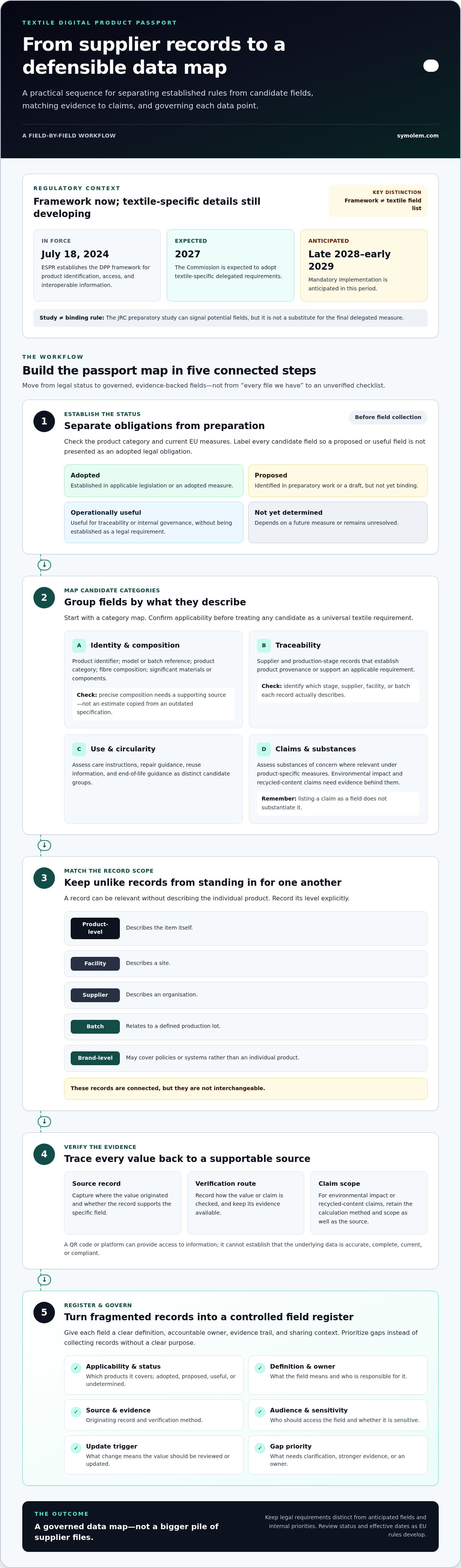
The distinction matters. ESPR (Regulation (EU) 2024/1781) has been in force since July 18, 2024, but textile-specific DPP requirements are still being developed. The European Commission is expected to adopt the delegated act in 2027, with mandatory implementation anticipated between late 2028 and early 2029. The JRC’s May 2026 preparatory study is a useful signal, not a substitute for the final rules.
This checklist explains which data categories to map, how to label each field by regulatory status, source, owner, and evidence, and how to prioritize gaps across fragmented supplier records. The goal is practical: build a governed data map that distinguishes obligations from preparation, supports verification, and avoids collecting information without a clear use or legal basis.
Key Takeaways
- Separate the ESPR framework from textile-specific requirements, so preparation isn’t mistaken for an established legal obligation.
- Identify what data goes in a textile digital product passport by mapping core product, material, supply-chain, care, and end-of-life categories.
- Assess each field by its source, verification method, audience, update trigger, and sensitivity before sharing it.
- Build a data-point map with status, definition, owner, and evidence for each field, turning fragmented supplier records into a governed data map.
- See how an ESPR readiness diagnostic and DPP advisory can help prioritize data gaps and implementation decisions.
Table of Contents
- What data goes in a textile Digital Product Passport under the ESPR framework?
- Which textile DPP data categories should brands map first?
- How should textile DPP data be verified, shared, and protected?
- How can a fashion brand build a textile DPP data map?
- How does Symolem help turn textile DPP data requirements into implementation?
What data goes in a textile Digital Product Passport under the ESPR framework?
A textile Digital Product Passport (DPP) is structured information about a product, linked to it through a data carrier such as a QR code or another suitable mechanism. The passport makes relevant product information accessible to defined users. The carrier is only the access point: a QR code or platform cannot establish whether the underlying data is accurate, complete, current, or compliant.
The key distinction is between the framework and product-specific rules. The Ecodesign for Sustainable Products Regulation (ESPR), Regulation (EU) 2024/1781, entered into force on July 18, 2024, and establishes the legal framework for DPPs. It sets a structure for product identification, data access, and interoperable information. Product-specific delegated measures determine which requirements apply to each category, including the information to include and relevant implementation details.
What does the ESPR framework establish for product passports?
The ESPR provides the architecture, not a universal field list for every product. Its framework addresses how a passport is linked to a product, how relevant actors access information, and how data can be exchanged consistently. The applicable delegated measure then specifies requirements for that product category. Until those rules apply, don’t describe proposed fields or useful industry practices as mandatory across all textiles.
Is there one definitive textile DPP data list in 2026?
No single checklist should be treated as legally definitive without checking the product category and current EU measures. As of October 2026, the Commission is expected to adopt textile-specific delegated requirements in 2027, with mandatory implementation anticipated between late 2028 and early 2029. The Joint Research Centre’s May 2026 study indicates potential fields, but a preparatory study is not itself the binding delegated measure.
Before building a candidate field into a compliance claim, record its status:
- Adopted: established in applicable legislation or an adopted measure.
- Proposed: identified in preparatory work or a draft, but not yet binding.
- Operationally useful: valuable for traceability or internal governance, without being established as a legal requirement.
- Not yet determined: detail depends on a future measure or remains unresolved.
Check status and effective dates against current EU measures in 2026, and repeat the review as rules develop. This prevents a likely data category from being presented as an adopted obligation, or a framework provision from being confused with a textile-specific field.
The practical answer to what data goes in a textile digital product passport depends on both the applicable rules and the product scope. A defensible map keeps legal requirements separate from anticipated fields and internal priorities, then records the source and evidence behind each data point. That is the difference between a digital label and a governed passport.
Which textile DPP data categories should brands map first?
Start with a category map, not a request for every supplier file. To determine what data goes in a textile digital product passport, group potential data points and record whether each is legally applicable, operationally useful, or still undetermined. This makes gaps visible without turning every available record into a compliance claim.
What product identity and composition information may be relevant?
Start with how the product is identified and what it contains. potential data points may include a product identifier, model or batch reference, product category, fibre composition, and a breakdown of significant materials or components. Match the level of detail to the available records. A precise composition claim needs a source that supports it, not an estimate copied from an outdated specification.
Assess whether information about substances of concern applies under the relevant product-specific measures. Don’t label a field universally mandatory just because it appears in a draft, study, supplier template, or internal checklist.
What traceability, use, and circularity information should teams assess?
Map supplier and production-stage records when they establish product provenance or support an applicable requirement. Be explicit about the level each record describes: product-level information describes the item; facility records describe a site; supplier records describe an organisation; batch records relate to a defined production lot; and brand-level records may cover policies or systems rather than an individual product. These records are connected, but they are not interchangeable.
Assess care instructions, repair guidance, reuse information, and end-of-life guidance as distinct candidate groups. Environmental impact and recycled-content claims also need an evidence trail, including the source record, calculation method, and scope behind the claim. Listing a claim as a data field does not substantiate it.
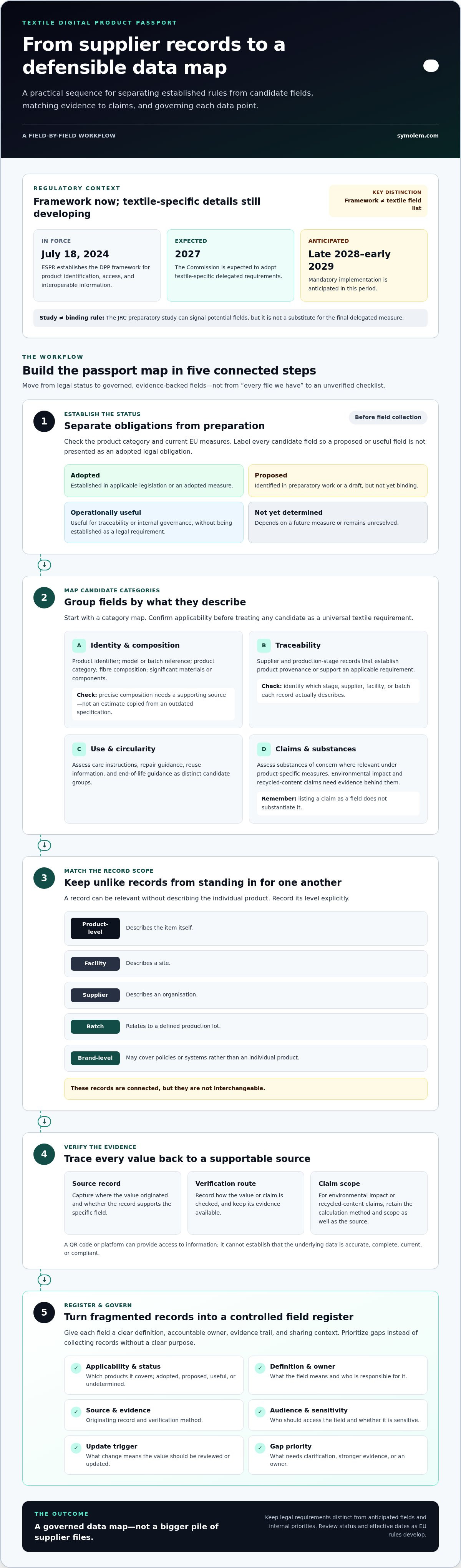
For each candidate field, maintain a register that captures:
- Applicability and status: which products it covers and whether it is adopted, proposed, operationally useful, or not yet determined.
- Source and evidence: the originating record and how the value or claim is supported.
- Owner and update frequency: the accountable function and the event or schedule that triggers review.
- Access audience: whether information is intended for public, authority, or supply-chain access.
This field-by-field approach gives teams a more defensible starting point than a generic textile checklist. For a broader implementation perspective, see Implementing Digital Product Passports: A Strategic Framework for Textile Compliance. An advisory-led textile DPP data-mapping approach can help translate potential data points into clear ownership, evidence, and implementation priorities.
How should textile DPP data be verified, shared, and protected?
Traceability shows where a record came from. It doesn’t prove the record is accurate. A supplier certificate, production file, or material declaration supports a product-level claim only when its scope, source, and connection to that product can be established and reviewed.
Data provenance is the documented history of a data point, including its source, method, date, and supporting evidence; it matters because product-level claims must be traceable to records that actually support them. For every field, capture the source system or supplier, the date received, the method used to generate or verify the value, and the supporting documentation. For example, for a fibre-composition claim, record the declaration or test evidence and establish which product or batch it covers.
Don’t reduce data quality to a simple yes or no. Label values as verified, estimated, conflicting, or missing, and define what review is needed to change a status. These distinctions help teams identify where supplier follow-up, validation, or a documented limitation is needed.
Use a data-point map to make controls visible
A compact register connects each data point to its legal status, accountability, evidence, and access decision. The entries below are illustrative. Actual field applicability depends on current measures and product scope.
| Field | Status | Source record | Accountable owner | Evidence | Access level |
|---|---|---|---|---|---|
| Fibre composition | Check applicable measure | Material declaration | Product data lead | Declaration or test record | Public or restricted, as applicable |
| Production facility | Assess applicability | Supplier production record | Sourcing team | Facility and batch linkage | Selective |
| Impact claim | Evidence-dependent | Calculation file | Sustainability team | Method, inputs, and scope | Public summary; supporting detail restricted |
Separate legal applicability from access rights
A field’s legal status and access level are separate decisions. Some information may be intended for public access, while other records may be shared with authorities or supply-chain actors, subject to applicable rules. Assess commercial sensitivity separately, rather than using it to obscure information that must be disclosed.
Role-based access can help define who sees which information, but it’s an implementation choice, not proof that a legal requirement has been met. Set access permissions, review them as data or roles change, and retain enough evidence to support authorized checks. For a deeper treatment, see Digital Product Passport Data Governance and Security.
Answering what data goes in a textile digital product passport is only part of readiness. A reliable map also records who can substantiate each field, who is accountable for updates, and which audience may access it.
How can a fashion brand build a textile DPP data map?
Start by defining the boundary. A map without a clear product scope can quickly mix markets, product types, and business processes, making gaps difficult to interpret. Specify the product category, business unit, target market, and regulatory assumptions covered by the mapping exercise. Record assumptions explicitly, including points that need review as EU measures develop.
Build a data-point map before requesting more data
Give every candidate field a stable name and a plain-language definition. Add its format or unit, applicable product scope, legal status, source, collection method, accountable owner, supporting evidence, access requirements, review date, and gap status. For example, define whether “fibre composition” means the product’s total fibre breakdown or a component-level breakdown, and state the expected format. Clear definitions prevent teams and suppliers from returning values that look comparable but measure different things.
Use explicit gap labels such as missing, estimated, conflicting, or verified, and attach a remediation action to each unresolved field. An unknown value is a gap to govern, not permission to insert an assumed figure.
Trace records before expanding supplier requests
For each field, identify the function or supplier most likely to hold its evidence, then check existing systems and records first. A product specification may sit in a product lifecycle management system, while a material declaration may come from a supplier. Either way, link the record to the correct product, component, or batch. Avoid broad questionnaires until teams have checked what information they already hold, who owns it, and whether it supports the intended claim.
Standardize definitions and permitted formats before collecting data across supplier tiers. Specify whether a response should be a measured value, a document reference, or a status, and provide a consistent way to report missing or unavailable evidence. This reduces avoidable rework and makes conflicting submissions easier to detect.
Prioritize remediation by weighing four factors: regulatory relevance, evidence weakness, operational dependency, and effort. A field tied to an applicable requirement or dependent on several upstream records may need attention before an optional internal metric. Keep the rationale visible so priorities can be revisited when the rules, product scope, or source evidence changes.
For related implementation risks, see Challenges of Digital Product Passport Implementation. An ESPR readiness diagnostic can help translate regulatory assumptions and data gaps into scoped mapping decisions, clear ownership, and implementation priorities.
How does Symolem help turn textile DPP data requirements into implementation?
Regulatory uncertainty doesn’t have to stop implementation, but it does call for disciplined decisions about scope, evidence, and responsibility. Symolem’s ESPR readiness diagnostic helps fashion brands and textile manufacturers translate evolving requirements into practical data-mapping priorities. It distinguishes fields to address now from assumptions that need review as measures develop.
The question of what data goes in a textile digital product passport cannot be answered through software configuration alone. Teams need to know which fields may apply to their products, where supporting records sit, who can verify them, and what to do when evidence is missing or changes. Symolem supports this governance work across textile value chains by mapping potential data points to sources, owners, evidence, and implementation dependencies. The resulting framework can be developed alongside existing business systems, rather than treating new software as a substitute for clear data controls.
When is expert DPP data mapping useful?
Advisory support is particularly useful when product information spans multiple suppliers and systems, or when material records use inconsistent definitions and formats. A structured diagnostic can reveal fields with no clear owner, evidence that doesn’t cover the product or batch in question, and dependencies that may delay verification. For regulatory context, see ESPR Readiness Diagnostic: A Strategic Mandate for Textile Compliance in 2026.
This work should produce decisions, not just an inventory of gaps: which fields need attention, which records can support them, who is accountable, and what review or remediation is required.
What should the next implementation step be?
Select a representative product scope and test the data-point map against real source records. Check whether definitions are understood consistently, evidence can be linked to the right product or batch, and named owners can maintain the information. Then prioritize gaps by regulatory relevance, evidence weakness, and operational dependency. Assign accountable owners and review controls before scaling the process to other products.
This creates a controlled route from fragmented records to implementation priorities without treating uncertain values as facts. Explore Symolem’s textile DPP frameworks and readiness diagnostics to discuss a data-mapping approach tailored to your product scope and value chain.
Turn your textile DPP data map into a governed plan
A defensible textile DPP starts with more than a list of fields. It separates established requirements from proposed or operationally useful data, then connects each relevant field to a source, evidence, accountable owner, and access decision. That discipline helps teams answer what data goes in a textile digital product passport without mistaking assumptions for obligations or collecting records without a clear purpose.
The next step is practical: test a defined product scope against real supplier and internal records, identify the most important gaps, and assign owners and review controls. A QR code or data platform can support access, but sound governance makes the underlying information defensible.
Symolem is an independent advisory firm focused on textile policy, circularity, sustainability, and climate impact. Through DPP frameworks and technical data-field mapping, it helps organisations clarify evidence, ownership, and implementation priorities across textile value chains worldwide.
Discuss a textile DPP readiness diagnostic with Symolem to move from fragmented records toward a structured, workable data map. With clear scope and accountable decisions, your team can build readiness step by step.
Frequently Asked Questions
What data goes in a textile Digital Product Passport?
The applicable product-specific rules determine the required fields. Candidate categories include product identification, fibre composition, supply-chain information, care, durability, recycled content, substances of concern, and end-of-life information. A product identifier, such as a GTIN, may help link data to an item. To establish what data goes in a textile digital product passport for a specific product, separate adopted requirements from proposed or operationally useful fields, and record the source and evidence for each.
Is there a mandatory textile DPP data list in 2026?
There isn’t one definitive textile-specific mandatory field list to apply across all products in 2026. The ESPR framework is in force, but textile requirements depend on product-specific measures. As of October 2026, the Commission is expected to adopt textile-specific delegated requirements in 2027, with mandatory implementation anticipated between late 2028 and early 2029. Check current EU measures and effective dates before describing any field as legally required.
Does a textile DPP need fibre composition and supplier information?
Fibre composition and supplier records are important candidate data, but their exact requirements depend on the applicable textile measures and product scope. Link composition information to the product or component and retain the supplier declaration, specification, or other evidence that supports it. Supplier and production-stage information can support provenance or traceability, but don’t assume every supplier detail must be public or universally mandatory. Distinguish product-level facts from facility, supplier, batch, and brand records.
Can a QR code alone make a textile product passport compliant?
No. A QR code can act as a data carrier that links a product to passport information, but it doesn’t establish that the underlying data is accurate, complete, current, or compliant. Teams also need to determine which rules apply, maintain relevant records, verify claims, and manage access and updates. Treat the code as an access mechanism, not a substitute for governed product data and supporting evidence.
How should a fashion brand verify data for a textile DPP?
For every field, identify the source, collection method, date, accountable owner, and supporting evidence. Check that the record applies to the relevant product, component, or batch. Label values clearly as verified, estimated, conflicting, or missing rather than treating them as equivalent. For example, link a material declaration to the product it describes, and send any unresolved mismatch for review rather than assuming a value.
Which textile DPP data should be public?
Determine public access based on applicable legal requirements and the passport’s intended users, not on a blanket assumption that every record belongs on a consumer-facing page. Separate information intended for public access from information shared with authorities or supply-chain actors. Assess commercial sensitivity and access rights independently from whether a field is required. Role-based permissions may support this design, but they don’t replace the need to follow applicable rules.
How do brands start mapping textile DPP data fields?
Choose a defined product scope, business unit, and target market, then test a data-point map against existing internal systems and supplier records. For each field, record its definition, status, source, evidence, owner, access needs, and gap or remediation action. Prioritize gaps by regulatory relevance, evidence weakness, and operational dependency. An ESPR readiness diagnostic or DPP framework can help clarify responsibilities and implementation priorities without assuming missing values.