Sustainable Textile Infrastructure Costing: A Strategic Framework for 2026
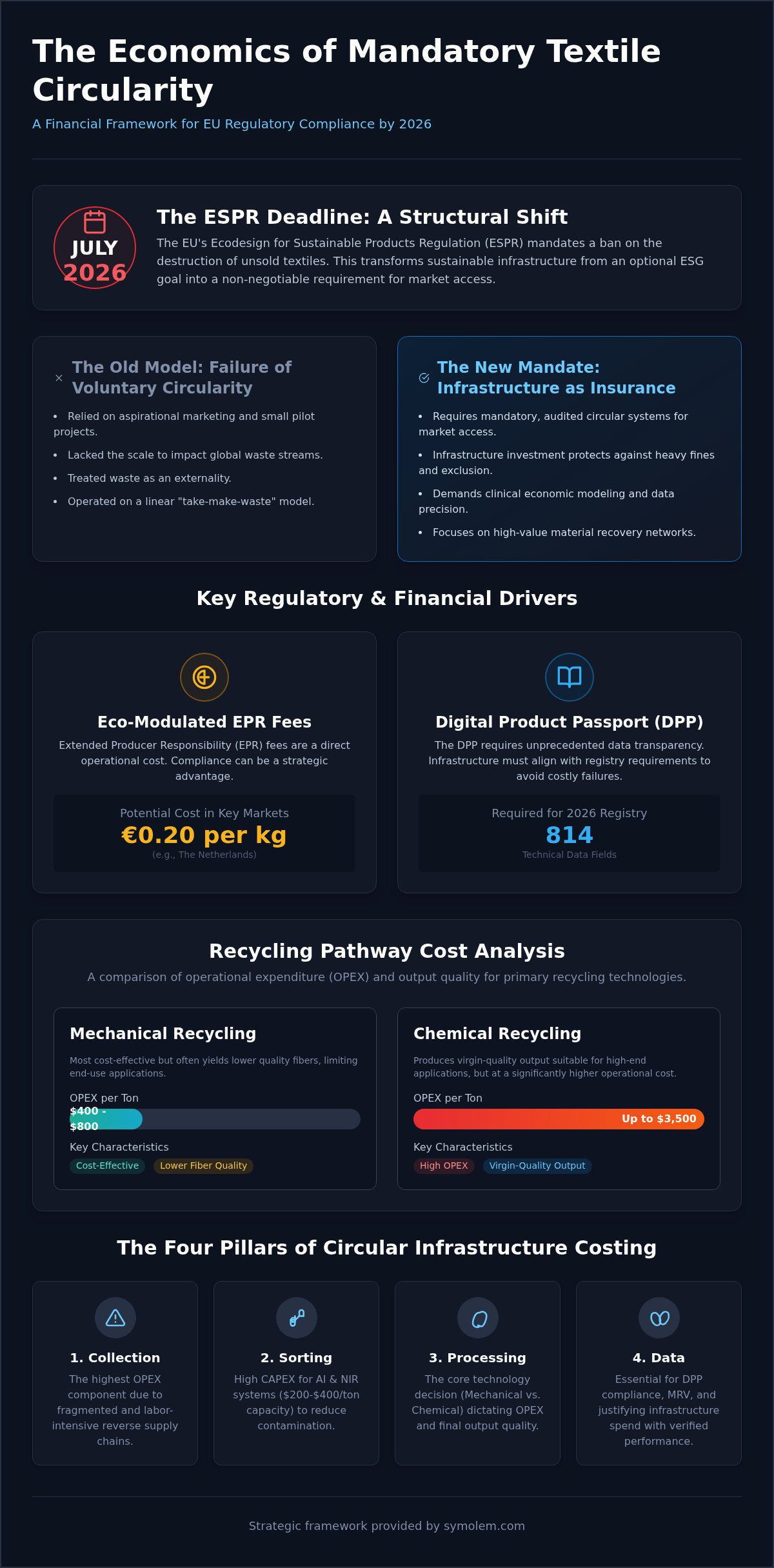
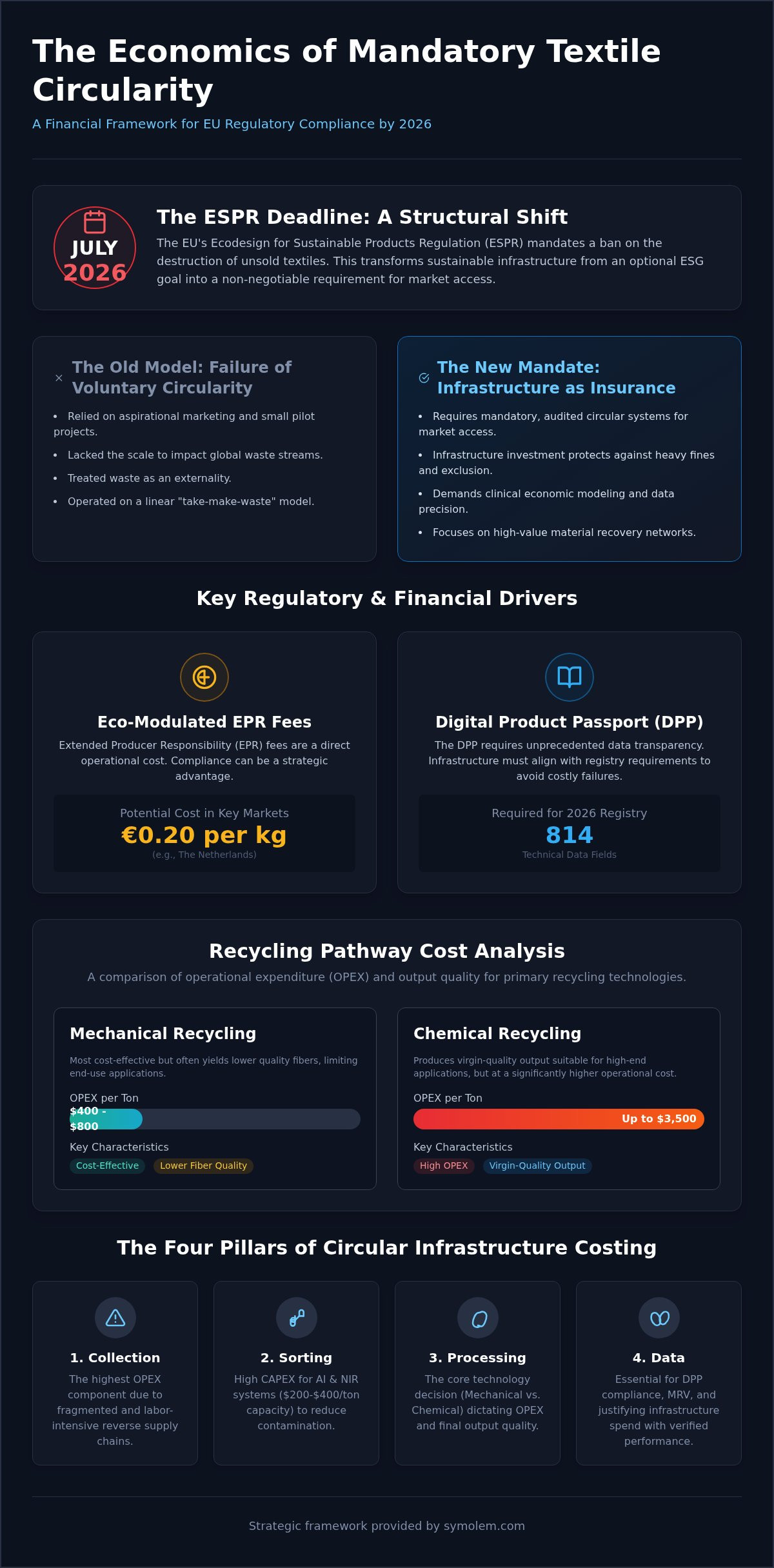
Sustainable infrastructure isn't a discretionary ESG line item; it's a mandatory regulatory insurance policy for market access. As the July 2026 ESPR deadline for the destruction of unsold textiles passes, the industry faces a structural reckoning that demands clinical financial precision. Most brands remain trapped in data silos, unable to perform accurate sustainable textile infrastructure costing while facing EPR fees that could reach €0.20 per kilogram in key markets. You likely recognize that current pricing for textile-to-textile recycling is opaque and the ROI for circularity feels like a moving target in a shifting legal landscape.
We'll strip away the aspirational narratives to provide the clinical economic modeling required to build and scale these systems under evolving EU mandates. This framework delivers a precise breakdown of CAPEX versus OPEX for mechanical, thermo-mechanical, and chemical recycling pathways. You'll gain the technical vocabulary and structural mapping needed to justify multi-million euro infrastructure spends to a skeptical board. We'll examine the mechanics of eco-modulated fees and the up to 236 data points in the UNTP schema of the Digital Product Passport to ensure your organization is ready for the 2026 registry rollout.
Key Takeaways
- Market participation in the EU now requires structural circularity instead of aspirational narratives. This framework establishes infrastructure as a mandatory regulatory requirement for 2026.
- Master the precision needed for sustainable textile infrastructure costing by deconstructing the specific CAPEX and OPEX requirements for mechanical and chemical recycling pathways.
- Learn how to leverage eco-modulated EPR fees to transform compliance costs into a strategic advantage that protects your margin integrity.
- Evaluate the economic trade-offs between proprietary infrastructure and shared consortium models to ensure systemic efficiency and long-term ROI.
- Align your infrastructure investment with the up to 236 data points in the UNTP schema required by the Digital Product Passport registry to avoid costly diagnostic failures.
Table of Contents
- The Economic Imperative of Sustainable Textile Infrastructure
- Deconstructing the Cost Components of Circular Systems
- Regulatory Drivers: How ESPR and EPR Reshape Infrastructure ROI
- Strategic Costing Models: CAPEX, OPEX, and Systemic Efficiency
- Navigating the Transition: Implementation and Strategic Advisory
The Economic Imperative of Sustainable Textile Infrastructure
The era of optional sustainability is over. Infrastructure is no longer a peripheral concern for ESG committees; it's a structural requirement for market participation. For decades, the textile industry operated on a linear model that treated waste as an externality. That luxury ended on July 19, 2026, when the EU officially banned the destruction of unsold clothing and footwear under the Ecodesign for Sustainable Products Regulation (ESPR). This shift necessitates an immediate transition from basic waste management to sophisticated, high-value material recovery networks. Organizations that fail to integrate sustainable textile infrastructure costing into their 2026 fiscal planning aren't just risking their reputation; they're risking their legal right to operate within the European Single Market.
Infrastructure as Regulatory Insurance
Compliance isn't a checkbox. It's a financial strategy. The cost of ESPR non-compliance is potentially ruinous, involving heavy fines and the total exclusion of non-compliant products from EU shelves. Implementing a robust ESPR readiness diagnostic allows brands to identify structural gaps before they become legal liabilities. By investing in sorting and processing infrastructure now, companies create a buffer against the volatility of future EPR fees, which already reach €0.20 per kilogram in the Netherlands. This isn't just about environmental stewardship. It's about systemic integrity and maintaining long-term market access through verified, audited supply chains that can withstand the scrutiny of the 2026 Digital Product Passport registry.
The Failure of Voluntary Circularity
Soft-focus sustainability initiatives have failed. For years, brands relied on aspirational marketing and pilot projects that lacked the scale to impact global waste streams. These voluntary efforts ignored the core circular fashion principles that require deep, systemic change in how materials are recovered and repurposed. We've reached the end of the pilot phase. The transition toward mandatory, audited infrastructure frameworks demands a level of diagnostic precision that most fashion boards currently lack. Accurate sustainable textile infrastructure costing requires moving beyond data silos to understand the granular mechanics of CAPEX and OPEX in a circular economy. Inertia leads to market decay. Precision leads to resilience.
Deconstructing the Cost Components of Circular Systems
Circular systems aren't just an extension of existing logistics. They are a fundamental inversion of the global value chain. Most organizations fail because they treat circularity as a waste management problem rather than an infrastructure design challenge. Effective sustainable textile infrastructure costing requires a granular deconstruction of four distinct pillars: collection, sorting, processing, and data. While the industry fixates on processing technology, the logistical reality of reverse supply chains often dictates the ultimate ROI.
The premium on textile-to-textile recycling is driven by a significant technology gap. Mechanical recycling remains the most cost-effective at $400 to $800 per ton in OPEX, yet it often fails to meet the fiber quality requirements of high-end brands. Conversely, chemical recycling offers virgin-quality output but carries an OPEX of up to $3,500 per ton. This disparity is why the EU Strategy for Sustainable and Circular Textiles emphasizes the need for large-scale investment to bridge these economic divides. Integrating Impact Measurement and MRV into your costing model is the only way to verify systemic integrity amidst these technological shifts.
Collection and Sorting Economics
Collection is the highest OPEX component of the circular system. In a globalized market, retrieving post-consumer textiles requires a reverse supply chain that is inherently fragmented and labor-intensive. Automated sorting technologies, such as Near-Infrared (NIR) and AI-driven systems, represent a high CAPEX investment of $200 to $400 per ton per year capacity but are essential for reducing contamination. High contamination rates are the primary killer of material yield; a 5 percent increase in non-recyclable content can render an entire batch economically unviable. Precision in sorting is the only way to protect the integrity of the feedstock.
The Data Layer: Costing the DPP
Data is the most overlooked infrastructure cost in 2026. Transitioning to a circular model is impossible without a digital twin for every physical asset. Mapping the up to 236 data points in the UNTP schema required for the Digital Product Passport (DPP) across thousands of SKUs represents a massive administrative and technical burden. When budgeting for the challenges of Digital Product Passport implementation, brands must account for the cost of verification, auditing, and real-time MRV. This data layer is the connective tissue of the entire system. Without it, sustainable textile infrastructure costing is merely guesswork based on incomplete snapshots of the value chain.
Regulatory Drivers: How ESPR and EPR Reshape Infrastructure ROI
Regulation is a structural architect. It's no longer sufficient to view compliance as a static cost center; instead, it's the primary driver of ROI for circular investments. The eco-modulation of Extended Producer Responsibility (EPR) fees transforms sustainable design from an ethical choice into a competitive fiscal advantage. In the Netherlands, where preliminary fees for 2025 are set at €0.20 per kilogram, the financial delta between a high-impact product and a circular one is significant. By navigating EPR for textiles with clinical precision, brands can secure lower fee tiers through verified durability and recyclability. This requires a robust sustainable textile infrastructure costing model that accounts for the role of Monitoring, Reporting, and Verification (MRV) in validating material claims to regulators.
The EU Ecodesign Regulation (ESPR) mandates that infrastructure must support the entire lifecycle, including durability and repairability. This shifts the economic burden from disposal to maintenance and recovery. Securing lower fee tiers isn't just about design; it's about the systemic integrity of the data used to prove that design. High-fidelity MRV systems are essential for auditing these claims, ensuring that the infrastructure spend actually translates into reduced regulatory levies on the balance sheet.
ESPR and the Cost of Product Redesign
The ESPR mandates a fundamental shift toward disassembly and mono-material construction. This isn't a superficial design change. It's a structural overhaul that requires significant CAPEX to redesign global production lines. You must evaluate the infrastructure needed to support repairability and high-value recovery, as these investments directly influence the recovery economics of your products. A failure to align production with these recovery requirements leads to higher eco-modulated fees and potential market exclusion. The intersection of design for circularity and recovery economics is where margin integrity is either won or lost.
UK vs EU: Managing Divergent Cost Structures
Navigating the 2026 landscape of textile regulation impact on business models requires managing a dual-track regulatory environment. While the EU moves toward a mandatory Digital Product Passport registry by July 19, 2026, the UK's alignment remains in a state of technical flux. Costing infrastructure for cross-border operations necessitates a strategic advisory approach that prioritizes systemic efficiency over fragmented compliance. Brands must build data and physical systems capable of meeting the most stringent EU requirements to ensure seamless market access across all European jurisdictions. Integrating sustainable textile infrastructure costing into this cross-border strategy is the only way to maintain margin integrity while fulfilling divergent legal mandates.
Strategic Costing Models: CAPEX, OPEX, and Systemic Efficiency
Strategic financial planning is the only antidote to regulatory uncertainty. To build a robust cost-benefit analysis of circular textile models, brands must move beyond superficial estimates and confront the granular reality of sustainable textile infrastructure costing. This involves aligning multi-million euro investments with the 2030 regulatory deadlines for recycled content. For example, mechanical recycling requires a CAPEX of $200 to $400 per ton per year of capacity with a 2 to 4 year payback period. In contrast, chemical recycling demands $1,500 to $3,000 per ton in CAPEX and a 5 to 10 year payback. These timelines dictate that investment must begin immediately to ensure operational maturity before the next decade's mandates take full effect.
OPEX considerations are equally critical. Energy, labor, and chemical inputs for advanced recycling represent a continuous drain on margin integrity if not optimized through systemic efficiency. A clinical approach to sustainable textile infrastructure costing must account for:
- Energy consumption in thermo-mechanical processing ($800 to $1,500 per ton OPEX).
- Chemical feedstock and solvent recovery costs in high-purity recycling.
- Labor for manual pre-sorting of complex blends that defeat automated systems.
The Consortium Model vs. Vertical Integration
The choice between vertical integration and the consortium model is a strategic hedge against CAPEX volatility. For Tier 1 brands, vertical integration offers total control over feedstock and systemic integrity, yet it carries the full weight of infrastructure risk. Conversely, consortium models allow for pre-competitive cost-sharing. This reduces the individual burden of building regional sorting hubs or chemical recycling plants. Risk management in these shared agreements requires clear protocols for material ownership and fee distribution to prevent systemic failure when one partner fluctuates in volume. It's about building stability into a volatile recovery market.
Verifying Impact: The MRV Cost Multiplier
Impact measurement is not a secondary task; it's a financial multiplier. Because verifying textile sustainability claims for ESPR requires dedicated financial allocation, brands must treat MRV as a core infrastructure cost. Third-party auditing and supply chain transparency systems add a necessary layer of verification that reduces regulatory friction. Investing in high-fidelity data systems eliminates the "greenwashing tax" by providing the clinical proof required for lower EPR fee tiers. This verification rigor ensures that every euro spent on infrastructure is defensible under the scrutiny of EU regulators. To ensure your investment strategy aligns with these technical requirements, consider a Circular Economy Strategy Development session to map your transition path.
Navigating the Transition: Implementation and Strategic Advisory
Diagnosing the problem is merely the preamble. True systemic resilience requires shifting from theoretical mapping to structural implementation. This transition is fraught with financial risk; an incorrect choice in recycling technology or a failure to account for regional EPR fee fluctuations can strand millions in CAPEX. Effective sustainable textile infrastructure costing must therefore serve as a dynamic roadmap rather than a static spreadsheet. Independent advisory provides the clinical distance necessary to audit these investments, ensuring that infrastructure scaling aligns with both current ESPR requirements and the 2030 mandates for recycled material content, which require 15 percent recycled polyester and 10 percent recycled cotton in new products.
The roadmap for 2026 to 2030 demands a phased approach to scaling. Attempting to build a fully closed-loop system overnight is a recipe for fiscal collapse. Instead, brands must prioritize high-leverage nodes where regulatory pressure is highest and material recovery is most technically feasible. This strategic sequencing allows for the amortization of infrastructure spend over a multi-year period while maintaining compliance with evolving EU mandates. Without this methodical progression, organizations risk over-investing in unproven technologies or under-investing in the data layer required for legal verification.
The Symolem Framework for Infrastructure Costing
We bridge the gap between digital requirements and physical recovery capabilities. Our process begins by mapping the technical data fields of the Digital Product Passport to the specific mechanical or chemical processing limits of your value chain. This identifies high-leverage investment points where targeted CAPEX can yield maximum regulatory relief through lower eco-modulated fees. We don't just suggest solutions; we ensure systemic integrity through rigorous technical auditing of every node in the recovery network. This diagnostic-led approach ensures that your sustainable textile infrastructure costing model is rooted in physical reality rather than aspirational projections.
Next Steps for Senior Leadership
The window for reactive planning has closed. Senior leadership must now move with authoritative urgency to secure market access. This requires an immediate gap analysis of current recovery capacity versus the looming 2027 and 2028 EU-wide EPR deadlines. Budget allocation for the technical mapping of DPP fields and ESPR readiness must be prioritized as a critical business imperative. Engaging with strategic architects allows you to design cost-effective circular frameworks that protect margin integrity against regulatory friction. Secure your market access. Consult Symolem for an ESPR Readiness Diagnostic.
Securing Systemic Resilience in a Regulated Market
The shift from linear waste management to high-value recovery is no longer a theoretical exercise; it's a legal mandate. Success requires a clinical understanding of sustainable textile infrastructure costing to ensure that multi-million euro investments in mechanical or chemical recycling yield the intended regulatory relief. Brands must move beyond data silos and embrace the up to 236 data points in the UNTP schema of the Digital Product Passport to verify their circularity claims. Inertia in building these systems leads to market exclusion. Precision creates a defensible competitive advantage.
As an independent advisory firm specializing in systemic integrity, Symolem provides the global perspective on textile policy and economics needed to navigate this transition. You can design your circular infrastructure with Symolem advisory through our expert-led ESPR readiness diagnostics. We help you map complex value chains and identify the high-leverage investment points that ensure long-term stability. The transition is complex, but the framework for stability is now within your reach.
Frequently Asked Questions
What are the primary cost drivers for sustainable textile infrastructure in 2026?
CAPEX for advanced sorting and OPEX for reverse logistics are the primary drivers. Mechanical recycling requires $200 to $400 per ton in CAPEX, while chemical recycling jumps to $1,500 to $3,000 per ton. These costs are exacerbated by the labor-intensive nature of pre-sorting and the energy requirements of thermo-mechanical processing. Precision in sustainable textile infrastructure costing must account for these technological disparities to avoid margin erosion before 2030 deadlines.
How does ESPR compliance impact the ROI of circular business models?
ESPR compliance acts as a mandatory insurance policy that protects long-term market access and stabilizes ROI. By mandating durability and recyclability, the regulation forces a shift from volume-based profit to value-retention models. While initial infrastructure spend is high, the avoidance of non-compliance fines and market exclusion ensures that circular systems remain fiscally viable. Organizations that fail to align their recovery networks with these mandates face structural obsolescence and financial penalties.
What is the estimated cost of implementing Digital Product Passports for a global fashion brand?
Implementing Digital Product Passports requires significant investment in data architecture rather than just software licenses. Brands must budget for the technical mapping of up to 236 data points in the UNTP schema across their entire SKU library. This involves auditing supply chain transparency and ensuring real-time data verification. While specific total costs vary by SKU volume, the administrative burden of verification and MRV often represents a larger financial commitment than the digital interface itself.
Can shared infrastructure consortiums effectively lower the CAPEX for textile recycling?
Consortium models effectively distribute CAPEX by allowing brands to invest in pre-competitive regional sorting and processing hubs. This shared approach reduces the individual burden of building high-capacity chemical recycling plants, which require a minimum viable scale of 20,000 tons per year. By pooling resources, brands can achieve the economies of scale necessary for advanced recovery while mitigating the risks associated with proprietary infrastructure failure in a volatile and evolving market.
How do eco-modulated EPR fees incentivize infrastructure investment?
Eco-modulated fees provide a direct financial incentive by rewarding products designed for durability and high-value recovery with lower levies. In the Netherlands, preliminary fees for 2025 reach €0.20 per kilogram, creating a clear fiscal delta between compliant and non-compliant goods. This fee structure forces brands to integrate sustainable textile infrastructure costing into their product development cycles. Lowering these regulatory costs justifies the upfront CAPEX required for circular system implementation.
What role does MRV play in sustainable textile infrastructure costing?
Monitoring, Reporting, and Verification (MRV) serves as the technical auditor for all infrastructure investments. It provides the empirical evidence required to secure lower EPR fee tiers and prove ESPR compliance to EU regulators. Without rigorous MRV, infrastructure spend remains unverified and susceptible to penalties. Dedicated financial allocation for MRV ensures that every euro spent on recovery systems is defensible and contributes to the overall systemic integrity of the global organization.
How should brands budget for reverse logistics in a circular textile economy?
Budgeting for reverse logistics requires a move away from traditional waste management line items toward high-fidelity material retrieval systems. Brands must account for the high OPEX of post-consumer collection, which is often fragmented and labor-intensive across global value chains. Effective budgeting incorporates the cost of automated sorting and the mitigation of contamination rates. These logistical costs must be weighed against the rising expense of landfilling and the regulatory penalties for unsold textile destruction.
Is vertical integration of recycling technology viable for mid-sized fashion retailers?
Vertical integration of recycling technology is rarely viable for mid-sized retailers due to the extreme CAPEX and high minimum viable scales. Chemical recycling, for instance, requires a payback period of 5 to 10 years and massive throughput to break even. Mid-sized entities should instead focus on strategic advisory to navigate consortium models or third-party processing agreements. This approach allows for regulatory readiness without the crippling debt associated with proprietary infrastructure development and maintenance.