ESPR Compliance for Non-EU Textile Manufacturers: A 2026 Strategic Mandate
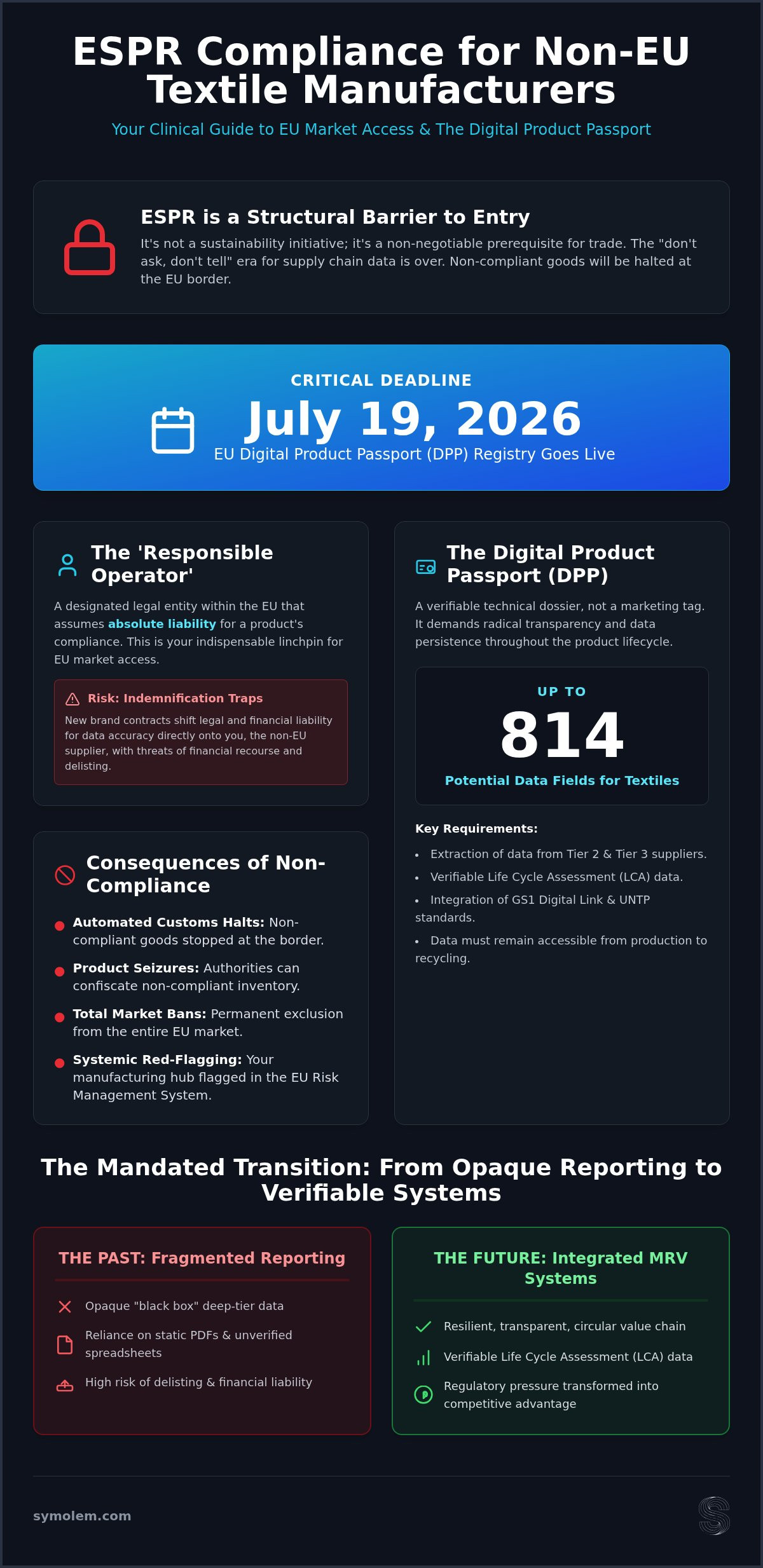
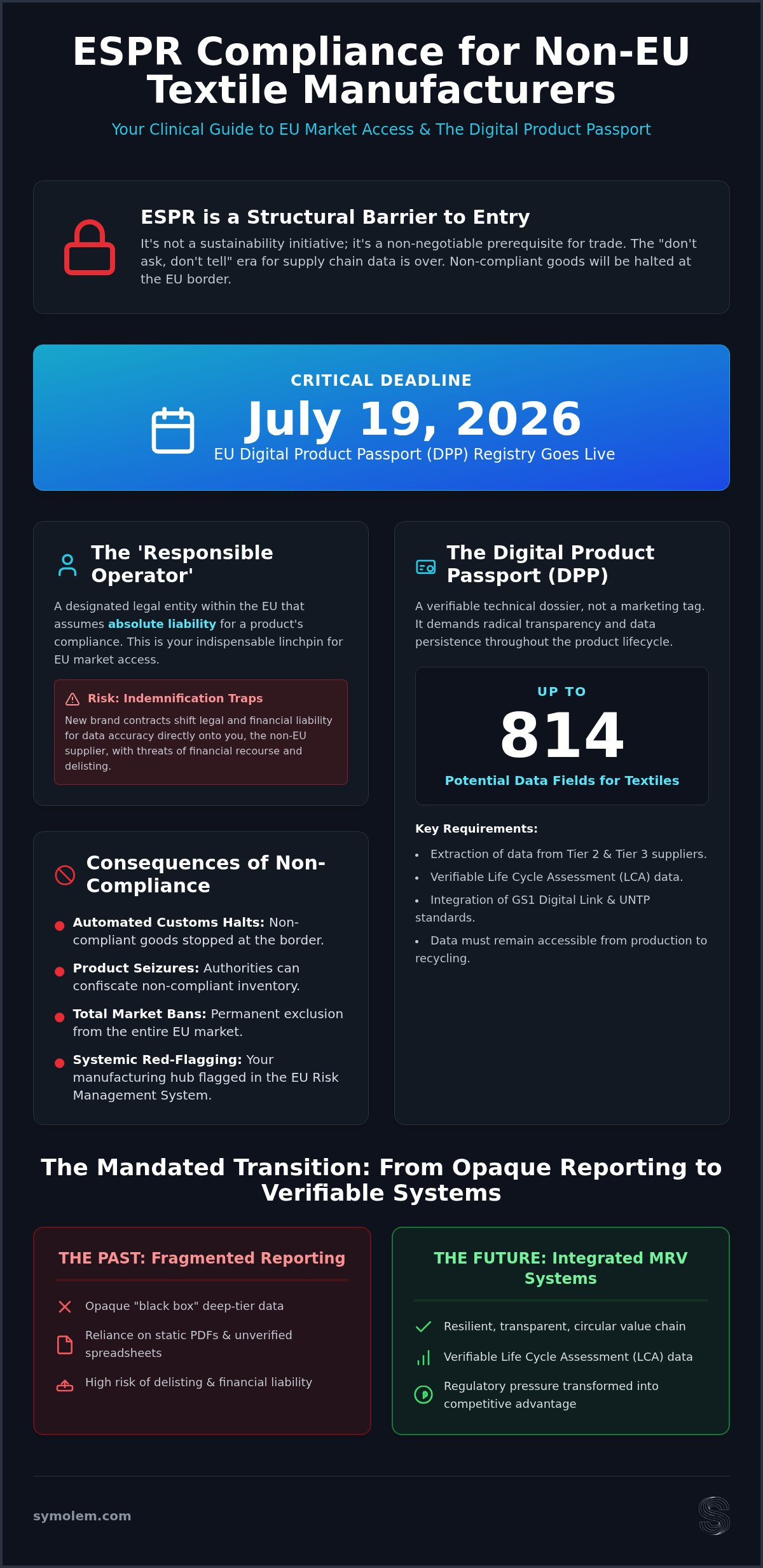
ESPR is not a sustainability initiative; it's a structural barrier to entry for the unprepared. For years, global supply chains operated on a "don't ask, don't tell" policy regarding deep-tier data, but the Ecodesign for Sustainable Products Regulation has permanently dismantled that luxury. You likely feel the mounting pressure of opaque data requests from EU partners, and the fear of being delisted is a rational response to this systemic shift. With the EU DPP Registry scheduled to go live on July 19, 2026, the risk of market exclusion is no longer a theoretical concern but a looming operational reality.
This article provides a clinical diagnostic of how to secure ESPR compliance for non-EU textile manufacturers by overhauling your data governance and value chain integrity. We'll map the transition from fragmented reporting to a robust Monitoring, Reporting, and Verification (MRV) system, clarify the legal weight of the Responsible Operator role, and outline a roadmap for implementing the up to 236 data points in the UNTP schema required for the Digital Product Passport. This guide moves past superficial narratives to analyze the clinical mechanics of market retention in a circular economy.
Key Takeaways
- Market access depends on identifying a 'Responsible Operator' and accepting that ESPR applies to all products entering the EU regardless of where they're manufactured.
- Securing ESPR compliance for non-EU textile manufacturers requires a clinical mapping of 814 potential data fields to meet the 2026 Digital Product Passport deadline.
- You'll learn to identify indemnification traps in new brand contracts that shift legal and financial liability for data accuracy directly onto the supplier.
- Transitioning from fragmented reporting to integrated MRV systems is the only cost-effective way to provide the verifiable Life Cycle Assessment data regulators demand.
- A strategic readiness diagnostic transforms regulatory pressure into a competitive advantage by building a resilient, transparent, and circular value chain.
Table of Contents
- The Extraterritorial Reach of ESPR: Why Non-EU Manufacturers Are Not Exempt
- The Digital Product Passport (DPP) Mandate: Mapping Technical Data Fields
- Strategic Risk: The Shifting Liability Between Importers and Manufacturers
- Building a Compliance-Ready Value Chain: From LCA to MRV Systems
- Navigating the 2026 Landscape: Symolem’s ESPR Readiness Framework
The Extraterritorial Reach of ESPR: Why Non-EU Manufacturers Are Not Exempt
Geography is no longer a shield. The Ecodesign for Sustainable Products Regulation (ESPR) operates on the clinical principle of market placement, not point of origin. If a textile product is placed on the EU market, it must adhere to the full rigor of European law, regardless of where the fiber was spun or the garment stitched. By July 19, 2026, the EU DPP Registry will become operational, triggering automated customs verifications that will effectively halt non-compliant goods at the border. This extraterritorial enforcement mechanism ensures that ESPR compliance for non-EU textile manufacturers is a non-negotiable prerequisite for trade. Article 14 further tightens this net by imposing own-label import obligations that force global manufacturers to mirror EU standards or lose their primary export channels. The shift is absolute; it demands a transition from opaque supply chains to a regime of radical transparency and verifiable data.
Defining the Responsible Operator Role
The 'Responsible Operator' is the designated legal entity within the Union that assumes absolute liability for a product's regulatory alignment. This mandate creates a direct chain of accountability that non-EU manufacturers cannot ignore. It's a role that demands the verification of technical documentation, the continuous maintenance of the Digital Product Passport, and the immediate response to inquiries from market surveillance authorities. We're observing a significant shift in the legal landscape as EU brands restructure their supplier agreements to offload this risk. These new contracts often include aggressive indemnification clauses, requiring manufacturers to guarantee data accuracy under threat of severe financial recourse and immediate delisting from the EU market.
Market Access as a Regulatory Privilege
Compliance has transitioned from a marketing narrative to a literal license to operate. The EU's market surveillance authorities are now empowered to conduct clinical audits, impose product seizures, and issue total market bans on any entity failing to meet these transparency mandates. For those who fail to adapt, the consequences aren't merely bureaucratic; they involve the permanent red-flagging of manufacturing hubs within the EU's centralized Risk Management System. This creates a high-stakes environment where systemic failure leads to total market exclusion and the collapse of trade relations. Securing ESPR compliance for non-EU textile manufacturers is therefore the only path to maintaining a presence in the European theater. The 'Responsible Operator' functions as the indispensable linchpin of EU market access, serving as the sole point of accountability for the systemic integrity of the entire value chain.
The Digital Product Passport (DPP) Mandate: Mapping Technical Data Fields
The Digital Product Passport (DPP) is the technical manifestation of a new regulatory era. It's a dossier, not a tag. According to the official ESPR legal text, the transition from marketing narratives to verifiable technical credentials is now a legal mandate. For those managing ESPR compliance for non-EU textile manufacturers, the scale of this task is immense. Mapping the 814 potential data fields required for textiles involves a level of granularity that current ERP systems are rarely equipped to handle. Data persistence is a critical requirement; manufacturers must ensure these records remain verifiable and accessible throughout the entire product lifecycle, from initial production to end-of-life recycling.
This shift necessitates the integration of GS1 Digital Link and UNTP standards into existing infrastructure. Global value chains can no longer rely on static PDFs or unverified spreadsheets. Instead, manufacturers must adopt a decentralized data architecture where they serve as the authoritative issuers of product information. It's a structural redesign of how value is communicated across borders.
Data Governance and Supply Chain Transparency
The primary challenge lies in the "black box" of Tier 2 and Tier 3 suppliers. Achieving ESPR compliance for non-EU textile manufacturers requires a clinical extraction of data regarding fiber origin, chemical processing, and wet-processing impacts. Manufacturers must implement verifiable credentials for product passports to ensure the integrity of this upstream data. Without these cryptographic safeguards, the risk of data falsification becomes a systemic liability that can lead to immediate market exclusion.
Technical Interoperability and Registry Requirements
The EU DPP Registry will function as a decentralized verification layer starting in 2026. It won't store the granular data; it will store the pointers to it. This architecture places the burden of data hosting and maintenance squarely on the manufacturer or their designated operator. Verification is the final hurdle. Manufacturers must move away from aspirational storytelling and toward textile sustainability claims for ESPR that are validated through automated MRV systems. Success depends on identifying these technical gaps early. Conducting an ESPR readiness diagnostic provides the necessary clarity to restructure data governance before regulatory enforcement begins.
Strategic Risk: The Shifting Liability Between Importers and Manufacturers
Liability is shifting. EU brands are no longer absorbing the regulatory risks associated with upstream data opacity. As European retailers face the prospect of fines reaching 4% of their annual turnover for unverified sustainability claims, they're aggressively revising Master Service Agreements to ensure the financial burden of any data discrepancy falls squarely on the factory floor. This indemnification trap is a structural reality of ESPR compliance for non-EU textile manufacturers. If the data within a Digital Product Passport is found to be fraudulent or even merely inaccurate, the manufacturer isn't just risking a single order; they're risking their entire legal standing within the European trade zone. The cost of non-compliance extends beyond immediate fines to include the permanent red-flagging of manufacturing hubs, which triggers automated rejections at customs. In this high-stakes environment, a robust textile circularity strategy functions as a critical risk management tool rather than a secondary ethical goal.
Contractual Rigor in 2026
The 2026 landscape demands a new level of contractual precision. Modern manufacturing agreements now include specific mandates for data availability, requiring suppliers to provide verified records for up to ten years after a product is placed on the market. Third-party audits have transitioned from social compliance checklists to rigorous technical inspections of data pipelines and chemical management systems. Manufacturers must also prepare for the financial implications of EPR for textiles, as EU brands seek to pass through the costs of end-of-life management to their global supply partners. Those who can't provide the necessary data for fee modulation will find themselves economically sidelined.
The Economics of Compliance
Infrastructure is an investment, not just a cost. While the initial implementation of MRV systems and data mapping protocols requires capital, the alternative is total market exclusion. Conducting a clinical cost-benefit analysis of circular textile models reveals that early movers secure preferential status with major EU fashion conglomerates who are desperate to de-risk their value chains. By 2028, the industry will be bifurcated. Compliant manufacturers will consolidate market share as they become the only viable partners for brands that cannot afford the liability of unverified goods. This is a battle for systemic relevance in a regulated market.
Building a Compliance-Ready Value Chain: From LCA to MRV Systems
Operationalizing ESPR compliance for non-EU textile manufacturers requires a transition from reactive reporting to proactive systems engineering. It's a five-step structural overhaul. First, you must conduct an ESPR readiness diagnostic to map the specific delta between your current data output and the EU's technical requirements. This is followed by the implementation of granular Life Cycle Assessment (LCA) protocols that move beyond industry averages to capture primary, facility-level data. Third, manufacturers must establish a secure, automated data bridge between their internal ERP systems and the EU DPP Registry to ensure real-time synchronization. Fourth, production lines must be restructured to meet circular design protocols, prioritizing fiber-to-fiber recyclability and chemical safety. Finally, every sustainability claim must be backed by third-party verification to withstand the clinical scrutiny of EU customs.
The Role of Impact Measurement and MRV
Generic sustainability reports are now a liability. The ESPR mandates a shift toward primary data, meaning that industry averages for water consumption or carbon intensity will no longer suffice for products entering the EU market. You've got to establish a verification-ready data trail that tracks every chemical input and energy unit used in the manufacturing process. This creates a transparent, auditable history that satisfies the rigorous demands of market surveillance authorities. MRV is the audit shield that protects non-EU manufacturers from the clinical scrutiny of European market surveillance.
Circular Design as a Manufacturing Standard
Design is now a regulatory constraint. The EU's Green Claims Directive, working in tandem with ESPR, introduces heavy penalties for unverified environmental assertions, including fines of up to 4% of annual turnover. To remain competitive, manufacturers must design for longevity, ensuring garments meet new durability thresholds that challenge the fast-fashion paradigm. This involves a fundamental redesign of material selections and construction techniques to facilitate repairability and eventual recycling. Transitioning to these standards isn't optional; it's the baseline for systemic integrity. If you're ready to de-risk your operations, Symolem provides the Impact Measurement and MRV frameworks necessary to secure your EU market access.
Navigating the 2026 Landscape: Symolem’s ESPR Readiness Framework
Compliance is a design problem, not a paperwork exercise. Symolem’s diagnostic approach identifies the exact structural failures in current data governance before they manifest as legal liabilities at the EU border. While many manufacturers seek "off-the-shelf" software solutions, these tools often lack the strategic depth required to navigate the complex interplay between ESPR, the Green Claims Directive, and national EPR schemes. Strategic advisory is the indispensable foundation for long-term regulatory readiness. It provides the architectural blueprint that software merely populates. Our framework moves beyond simple reporting to build resilient global value chains where data serves as the primary currency of trust. The Symolem roadmap is a methodical trajectory that transitions your operations from fragmented reporting to a state of total transparency, ensuring that ESPR compliance for non-EU textile manufacturers functions as a definitive competitive advantage rather than a mere cost of doing business.
Strategic Advisory for Global Manufacturers
The gap between a factory in Dhaka or Istanbul and a corporate headquarters in Paris or Berlin is often a matter of data translation. We bridge this communication divide by aligning manufacturing capabilities with the clinical requirements of EU law. Designing cost-effective circular infrastructure requires more than just superficial material substitutions; it demands a fundamental restructuring of chemical management systems and wet-processing protocols to satisfy the EU's clinical safety and durability thresholds. Our expert-led audits provide the uncompromising realism necessary to identify and remediate systemic risks within Tier 2 and Tier 3 networks, ensuring that your 'Responsible Operator' can validate technical documentation with absolute confidence in its underlying integrity. This level of scrutiny transforms your value chain into a transparent, audit-ready asset.
Taking the First Step Toward Compliance
Hesitation is a strategic failure. With the 2026-2027 rollout approaching, the window for structural adjustment is closing rapidly. Initiating a high-level ESPR readiness audit allows you to identify critical data gaps before they result in product seizures, financial penalties, or total market bans. Early data field mapping for the Digital Product Passport is the only way to avoid the bottleneck of last-minute implementation as the EU DPP Registry goes live. This proactive stance transforms regulatory pressure into a license to operate within the world's most lucrative textile market, allowing you to capture market share from competitors who remain tethered to opaque models. Contact Symolem for a Strategic ESPR Readiness Diagnostic to secure your position as a preferred partner in the new circular economy.
The Mandate for Systemic Integrity
The transition to a circular EU market is an absolute structural shift. By July 2026, the luxury of data opacity will vanish as the EU DPP Registry begins automated enforcement at every port of entry. Maintaining ESPR compliance for non-EU textile manufacturers requires more than a software patch; it demands a clinical overhaul of data governance and a proactive approach to the shifting liability in supplier contracts. You've seen that market access is now a regulatory privilege reserved for those who can provide verifiable technical credentials across 814 distinct data fields.
Symolem provides the independent expertise in EU textile policy and the rigorous frameworks necessary to map these complex requirements. Our focus on global value chain resilience ensures that your operations aren't just compliant but strategically fortified against future regulatory shocks. It's time to move past superficial narratives and build the technical infrastructure that secures your commercial future. Secure your EU market access with a Symolem ESPR Readiness Diagnostic and lead the transition toward a transparent, resilient, and high-integrity value chain.
Frequently Asked Questions
Does ESPR apply to manufacturers located outside the European Union?
Yes. The regulation applies to every product placed on the EU market, irrespective of its geographic origin. For global value chains, this means that ESPR compliance for non-EU textile manufacturers is a mandatory requirement for maintaining export access. The regulation's extraterritorial reach is enforced through automated customs verifications and market surveillance audits that target a product's technical alignment rather than the manufacturer's physical coordinates.
Who is legally responsible for the Digital Product Passport of an imported textile product?
Legal responsibility lies with the 'Responsible Operator' based within the European Union. This entity, typically the importer or an authorized representative, is accountable for the accuracy of the Digital Product Passport and must ensure technical documentation remains available for ten years. However, EU brands are increasingly utilizing indemnification clauses to shift the financial and operational liability for data integrity directly back to their non-EU manufacturing partners through updated supplier agreements.
What are the specific data requirements for the textile DPP in 2026?
While the specific Delegated Act for textiles is expected in 2026, the framework mandates mapping up to 814 potential data fields. These include fiber composition, raw material origin, chemical substances of concern, and durability scores. Manufacturers must also provide verifiable data on recycled content and end-of-life instructions. This information must be hosted in a decentralized architecture that remains accessible to customs authorities and consumers via a persistent digital identifier.
How much does it cost for a non-EU manufacturer to become ESPR compliant?
Total costs vary based on the existing maturity of a manufacturer's data governance and MRV systems. Expenses typically include conducting an ESPR readiness diagnostic, restructuring ERP systems for DPP interoperability, and implementing facility-level impact measurement protocols. While the initial investment in infrastructure is significant, it's a strategic expenditure to avoid the far higher costs of market exclusion, product seizures, and the loss of major EU retail contracts.
Can existing certifications like GRS or OEKO-TEX satisfy ESPR requirements?
Voluntary certifications like GRS or OEKO-TEX provide a useful foundation but don't satisfy the full scope of ESPR mandates. The regulation requires granular, primary data and specific technical fields that standard certifications aren't designed to capture. Manufacturers must transition from relying on third-party certificates to maintaining their own verifiable impact measurement and MRV systems. ESPR demands a level of technical interoperability and data persistence that goes beyond traditional textile labels.
What happens if a non-EU manufacturer provides inaccurate data for the DPP?
Providing inaccurate or unverified data triggers severe systemic consequences. EU market surveillance authorities can impose product seizures, total market bans, and fines reaching 4% of annual turnover. Beyond legal penalties, non-compliant manufacturers risk being red-flagged within the EU's centralized risk management systems, leading to automated rejections at customs. This results in the immediate collapse of trade relationships as EU brands cannot afford the liability of hosting unverified product passports.
How does ESPR interact with Extended Producer Responsibility (EPR) schemes?
These frameworks are interconnected. The Digital Product Passport provides the verifiable data necessary for the eco-modulation of EPR fees. Manufacturers who can prove high durability and recyclability through their DPP data enable their EU brand partners to pay lower EPR levies. Conversely, a lack of transparent data results in maximum fee penalties, making the manufacturer's products economically uncompetitive for EU importers who must manage national textile waste schemes by 2027.
Is there a grace period for non-EU manufacturers to comply with these regulations?
The ESPR is already in force as of July 18, 2024. While the textile-specific Delegated Act is expected in 2026 with mandatory enforcement likely starting by 2027, there's no effective grace period for data collection. Systems for ESPR compliance for non-EU textile manufacturers must be operational well before these deadlines to ensure products have a complete, verifiable history. Waiting for enforcement dates risks immediate exclusion from the 2026 and 2027 ordering cycles.