Financing Models for Textile Circularity
The era of voluntary sustainability is dead. With the July 2026 EU ban on the destruction of unsold textiles now in effect, the industry faces a structural reckoning that transcends marketing narratives. You likely recognize that current balance sheets aren't built for a closed-loop system, especially when high capital expenditure for unproven recycling infrastructure threatens short-term margins. Scaling viable financing models for textile circularity requires more than just green bonds or ESG sentiment. It demands a clinical diagnostic of how capital flows through a value chain that's being fundamentally rewritten by the Ecodesign for Sustainable Products Regulation.
This article provides a strategic audit of the capital structures required to fund this systemic shift. We'll move past aspirational rhetoric to examine how standardized Measurement, Reporting, and Verification (MRV) turns circularity data into bankable assets. You'll gain a clear framework for hybrid financing models that leverage regulatory mandates to de-risk investments. By mapping the transition from linear depreciation to circular asset management, we establish a roadmap for navigating the 2026 mandates without compromising systemic integrity.
Key Takeaways
- Recognize why linear "take-make-waste" models are no longer just ethical failures but structural legal liabilities that create immediate financial exposure.
- Analyze the hybrid financing models for textile circularity required to blend public and private capital for scaling unproven recycling infrastructure.
- Leverage EPR and ESPR mandates as investment catalysts by using eco-modulated fees to lower the cost of capital for compliant value chains.
- Establish Measurement, Reporting, and Verification (MRV) as the primary currency of circular finance to turn technical data into bankable assets.
- Deploy a strategic 2026 roadmap centered on an ESPR readiness diagnostic to identify capital gaps and map essential Digital Product Passport data fields.
Table of Contents
The Structural Bankruptcy of Linear Textile Economics
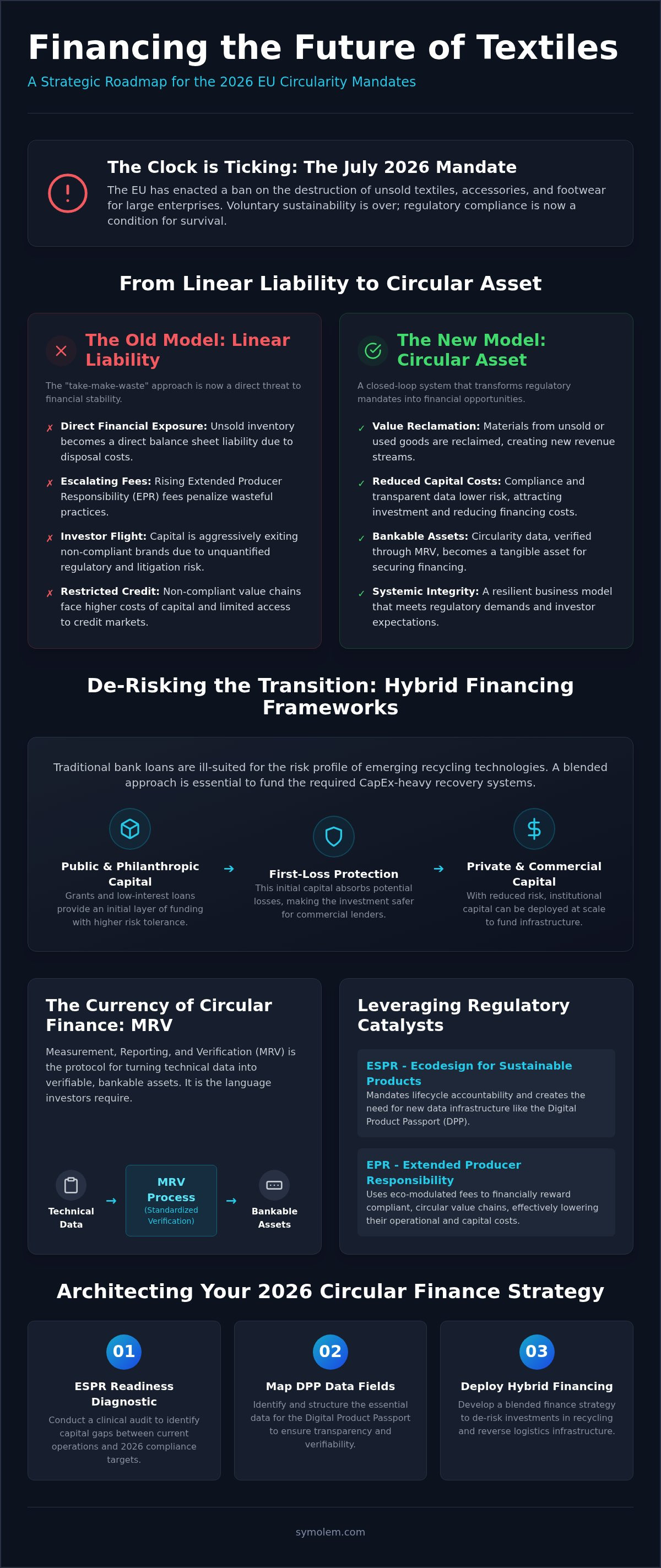
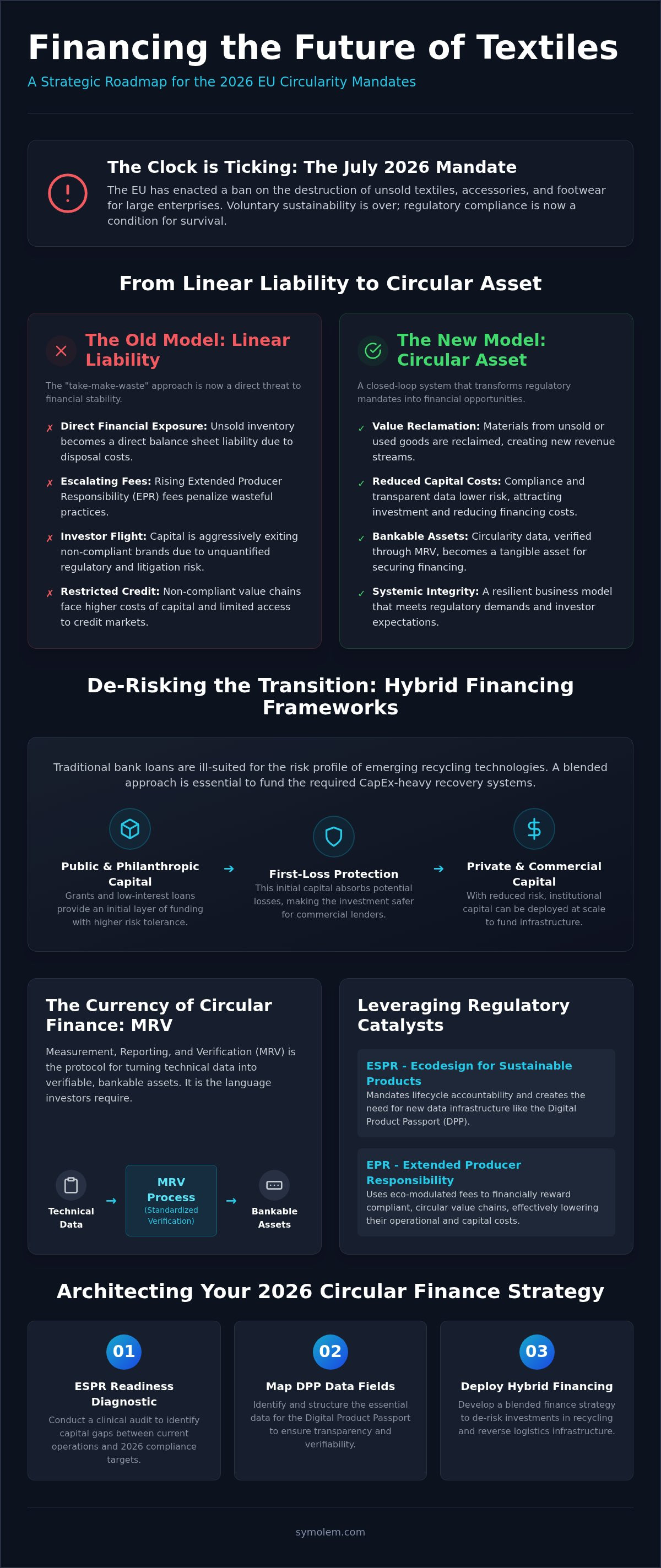
The linear textile model is no longer a viable economic strategy. It's a structural liability. For decades, global value chains operated on the assumption that waste was an externalized cost borne by the environment or distant municipalities. That era ended on July 19, 2026, when the EU ban on the destruction of unsold clothes, accessories, and footwear for large enterprises took effect. This regulatory pivot transforms "Linear Risk" from a theoretical ESG metric into a direct hit to the balance sheet. Linear Risk represents the cumulative financial exposure triggered by unsold inventory disposal costs, escalating Extended Producer Responsibility (EPR) fees, and the systemic inability to reclaim material value. To mitigate this, firms must adopt robust financing models for textile circularity that account for the total lifecycle of every fiber. Understanding What is Circular Fashion? is now a prerequisite for solvency, as the Ecodesign for Sustainable Products Regulation (ESPR) renders traditional high-volume, low-durability inventory models obsolete. Regulators have effectively weaponized the cost of externalities, ensuring that the "cheap" garment of 2020 is the liability of 2026.
The Internalization of Environmental Costs
Regulators are systematically stripping away the illusion of cheap production. The EU ESPR forces brands to account for the full lifecycle, shifting the burden of proof from marketing departments to technical compliance officers. This isn't a minor adjustment to operational expenditure. It's a fundamental shift toward capital-intensive recovery systems that require significant upfront investment. Brands must now fund the infrastructure for automated sorting, chemical recycling, and reverse logistics before a single unit is sold. A clinical diagnostic of the financial delta between current "leakage" rates and 2026 compliance targets is the only way to avoid structural bankruptcy. The transition from OpEx-heavy disposal to CapEx-heavy recovery is the defining financial hurdle of the decade.
Capital Flight from Non-Compliant Brands
Institutional capital is moving with predatory speed. Investors are aggressively exiting positions in brands that lack a verified textile circularity strategy. The cost of capital is rising for "high-leakage" value chains because they represent unquantified regulatory risk and potential litigation. 2026 marks the definitive end of "soft" sustainability reporting characterized by aspirational goals. In its place, investors demand hard Measurement, Reporting, and Verification (MRV) data that proves systemic integrity. Without standardized metrics, the transition to financing models for textile circularity remains stalled. This leaves non-compliant brands trapped in a cycle of diminishing returns, increasing legal exposure, and restricted access to the credit markets necessary for survival.
De-risking the Circular Transition: Hybrid Financing Frameworks
Scaling textile-to-textile recycling requires a radical departure from traditional debt financing. The risk profile of emerging recovery technologies, combined with the inherent volatility of secondary raw material markets, often deters institutional lenders. Standard bank loans aren't designed for the systemic uncertainty of a nascent circular economy. To solve this, firms must adopt hybrid financing models for textile circularity that layer different capital types to absorb initial shocks. This approach recognizes that circularity isn't just a technical challenge. It's a capital allocation problem. By blending public, private, and philanthropic funds, the industry can distribute risk across stakeholders who have different return horizons and risk tolerances.
Blended Finance and Public-Private Partnerships
Blended finance acts as the primary catalyst for infrastructure development. It utilizes developmental or philanthropic capital to provide first-loss protection, which effectively de-risks commercial bank loans. According to the UNEP FI Guidelines, this layering is essential for standardized risk assessment across the textile value chain. Securing these grants and low-interest loans requires a rigorous cost-benefit analysis of circular textile models to prove long-term systemic viability. In emerging markets, this logic is already being used to scale recovery infrastructure by decoupling physical risk from brand balance sheets and leveraging government-backed guarantees.
Asset-Light Models for Brands
Physical asset ownership is increasingly a liability in a rapidly evolving technological landscape. Brands shouldn't own recycling plants or repair hubs. Instead, the industry is shifting toward Equipment-as-a-Service (EaaS) and revenue-share models for circular retail. Third-party Circular Service Providers, backed by specialized infrastructure funds, manage the physical machinery and logistics. This allows brands to remain asset-light. Their primary responsibility shifts from owning hardware to governing the data that flows through the system. This transition requires a technical architect to map the financial delta between current operations and future requirements. Conducting a strategic ESPR readiness diagnostic is the first step in identifying where hybrid capital can be deployed effectively to bridge these gaps.
- Equipment-as-a-Service: Reduces upfront CapEx by converting infrastructure costs into predictable OpEx.
- Revenue-Share Models: Incentivizes circular retail (repair, resale, rental) by aligning the interests of brands and service providers.
- Infrastructure Funds: Provide the long-term, patient capital required for large-scale sorting and recycling facilities.
Regulatory Arbitrage: EPR and ESPR as Capital Catalysts
Extended Producer Responsibility (EPR) is frequently mischaracterized as a punitive tax. It isn't. It's a mechanism for capital reallocation. For the strategic executive, EPR represents a potential investment fund that can be leveraged to subsidize the high costs of systemic recovery. By 2026, as EU Member States finalize national schemes, the industry will shift from passive compliance to active regulatory arbitrage. This involves navigating EPR for textiles not as a cost center but as a predictable cash flow variable. The UNEP FI guidelines for circular economy finance highlight how policy instruments like EPR provide the structural stability needed to attract institutional investors. Brands that act early to secure capacity in limited circular infrastructure will gain a definitive competitive advantage over those waiting for market maturity.
Eco-Modulation: The Financial Incentive for Design
Eco-modulation of fees is the primary lever for design-led financial optimization. Under these frameworks, the fees a producer pays are directly tied to the durability, repairability, and recyclability of their products. High-quality, mono-material textile designs don't just lower environmental impact. They lower the cost of capital. By reducing the projected EPR liability, brands improve their net margins and present a lower risk profile to lenders. Strategic advisory on mapping technical data is essential to ensure that every design choice is verified and reported correctly to minimize these regulatory fees. The financial ROI of "design for circularity" is now measurable through the direct reduction of mandatory compliance costs.
EPR as an Infrastructure Funding Mechanism
Collective schemes, or Producer Responsibility Organizations (PROs), are increasingly mandated to reinvest collected fees into local recycling infrastructure. This creates a unique opportunity for brands to influence how their "compliance capital" is deployed. There is currently a significant gap between fee collection and the availability of high-grade recycling facilities. Brands shouldn't just pay their fees and walk away. They should advocate for higher, strictly ring-fenced EPR fees that are dedicated to building the very infrastructure they need to survive. This proactive stance ensures that financing models for textile circularity are supported by a steady stream of dedicated capital. It turns a mandatory expense into a strategic asset that builds long-term value chain resilience.
- Fee Transparency: Demand clear reporting on how PROs reinvest capital into textile-to-textile technology.
- Strategic Advocacy: Collaborate with regulators to ensure eco-modulation rewards genuine technical innovation.
- Infrastructure Prioritization: Focus reinvestment on the specific bottlenecks in your own secondary raw material supply.
The MRV Imperative: Turning Data into Bankable Assets
Measurement, Reporting, and Verification (MRV) is not a bureaucratic hurdle. It is the primary currency of circular finance. Without high-fidelity data, the risk associated with financing models for textile circularity remains unquantifiable for institutional investors. Capital requires certainty. In the linear model, certainty was found in throughput and sales volume. In the circular economy, certainty is derived from the verified recovery, quality, and systemic displacement of materials. This shift necessitates a transition from aspirational sustainability reporting to hard financial disclosure. By treating circularity data as a bankable asset, brands can unlock the capital required to build the recovery infrastructure discussed in previous sections.
DPP as a Financial Disclosure Tool
Data integrity is the primary barrier to circular investment. The Digital Product Passport (DPP) is often marketed as a consumer transparency tool, but its true utility lies in financial auditing. By mapping technical data fields—including the extensive requirements for 814 DPP fields—to financial risk indicators, the DPP provides a granular view of an asset's "Residual Value." This value is no longer a speculative guess. It is a verified data point that allows lenders to assess the collateral value of a textile product throughout its lifecycle. Successfully verifying textile sustainability claims for ESPR builds the necessary trust for institutional capital to enter the space. Without this level of verification, circularity remains a speculative expense rather than a strategic investment.
Standardizing Circularity Performance Indicators
Standardization is the prerequisite for securitization. To attract large-scale investment, the industry must move beyond vague "recycled content" percentages toward "systemic displacement" metrics. These metrics measure how effectively a circular project displaces the need for virgin primary raw materials and high-impact disposal. Standardized data allows for the bundling and securitization of circular textile projects, creating investment vehicles that fit the portfolios of global asset managers. This requires independent third-party verification to ensure that reporting isn't just self-attestation. Tokenization of these verified credits via blockchain offers a potential path for real-time, audit-ready recovery tracking. To secure your position in this emerging financial landscape, you must establish a rigorous data foundation. Symolem provides the Impact Measurement and MRV frameworks necessary to convert your operational data into institutional-grade financial assets.
Architecting Your Circular Finance Strategy for 2026
Execution is the final differentiator. As the regulatory window narrows, the transition from linear to circular operations must shift from a boardroom discussion to a technical implementation phase. Architecting financing models for textile circularity requires a methodical approach that aligns capital allocation with the specific technical requirements of the 2026 mandate. This isn't a task for generalists; it's a structural overhaul that demands clinical precision and a deep understanding of the underlying economic mechanics.
The first step is to conduct a rigorous ESPR readiness diagnostic to identify immediate capital gaps. This audit reveals where your existing value chain is most vulnerable to the July 2026 ban on destroying unsold goods, allowing you to prioritize investment where it's needed most. Following this, you must map the technical data requirements for your future Digital Product Passports, ensuring that all 814 DPP fields are accounted for to satisfy both regulators and institutional investors. Once the data foundation is secure, evaluate hybrid financing options against your specific value chain geography, leveraging the blended finance and asset-light models discussed in earlier sections. Finally, engage Symolem for clinical, diagnostic advisory on infrastructure costing to ensure your circular transition is both compliant and structurally sound.
The Diagnostic Phase: Mapping the Financial Gap
Identifying where your current business model fails under 2026 EU law is a matter of corporate survival. A superficial understanding of compliance is insufficient; you must quantify the "Cost of Inaction" with surgical precision. This calculation includes projecting the financial impact of mandatory EPR fees, the risk of litigation under the Green Claims Directive, and the potential for significant brand equity loss if systemic failures are exposed. By creating a rigorous roadmap for capital reallocation, you move beyond reactive spending toward a proactive investment strategy. This diagnostic phase transforms vague regulatory threats into a structured plan for systemic integrity, ensuring that every euro spent contributes to long-term resilience.
Strategic Implementation with Symolem
Our advisory services bridge the gap between policy and profit. We don't offer generic sustainability advice; we provide the technical and strategic architecture needed to navigate a fragmented regulatory landscape. By tailoring frameworks to the specific needs of global brands, we ensure that your financing models for textile circularity are built on a foundation of verifiable data and structural realism. This is the moment to secure your systemic integrity before the full weight of the 2026 regulations hits. The cost of delay is no longer just an environmental concern, but a direct threat to your bottom line.
Securing Systemic Integrity in the Post-Linear Era
The transition to circular textile value chains is no longer a matter of ethical preference. It's a structural mandate. We've diagnosed the bankruptcy of linear economics and the necessity of hybrid financing models for textile circularity to bridge the multi-billion-euro infrastructure gap. Success in 2026 depends on your ability to convert technical data into bankable assets through rigorous MRV and Digital Product Passport frameworks. Capital requires certainty. By leveraging regulatory catalysts like EPR eco-modulation, you can lower the cost of capital and secure first-mover capacity in limited recovery systems.
As an independent strategic advisor for global fashion leaders, Symolem provides the uncompromising realism required to cost these complex transitions. Don't wait for the July 2026 deadlines to expose structural vulnerabilities. Secure your 2026 compliance with a Symolem ESPR Readiness Diagnostic. Our deep technical expertise in ESPR and DPP field mapping ensures your strategy is built on a foundation of truth. You have the opportunity to architect a resilient future; start now.
Frequently Asked Questions
What are the primary financing models for textile circularity in 2026?
The primary financing models for textile circularity involve hybrid frameworks that blend public, private, and philanthropic capital to distribute risk. These include Equipment-as-a-Service (EaaS) to minimize upfront capital expenditure and revenue-share models for circular retail services like repair and resale. Blended finance remains the catalyst for scaling recovery technology. By layering different capital types, the industry can fund the systemic infrastructure required to meet 2026 mandates without burdening brand balance sheets.
How does the EU ESPR regulation affect circularity investment?
The Ecodesign for Sustainable Products Regulation (ESPR) fundamentally shifts circularity from an ESG aspiration to a legal mandate. It internalizes environmental costs by setting mandatory standards for durability and recyclability. This regulatory pressure forces institutional investors to prioritize brands with verified circular strategies. Consequently, the regulation acts as a capital catalyst; it makes compliance a prerequisite for accessing competitive credit markets and ensuring long-term solvency in the high-stakes European market.
Can EPR fees be used to fund a brand’s own recycling infrastructure?
Producers don't typically retain Extended Producer Responsibility (EPR) fees for internal use. Instead, these funds are managed by Producer Responsibility Organizations (PROs) which are increasingly mandated to reinvest in collective recycling infrastructure. However, brands can use eco-modulation to lower their fee liabilities. By designing products that are easier to recycle, brands effectively free up internal capital that would otherwise be lost to regulatory costs, which can then be reinvested into proprietary recovery systems.
What is the role of the Digital Product Passport in circular finance?
The Digital Product Passport (DPP) serves as a critical financial auditing tool by providing granular data on an asset's composition and lifecycle. It allows lenders to verify the residual value of textile products, transforming discarded garments into bankable assets. By mapping technical data to financial risk indicators, the DPP builds the transparency required for the securitization of circular projects. It's the primary mechanism for proving systemic displacement and material integrity to institutional investors.
Why is blended finance necessary for the textile industry?
Blended finance is essential because it uses developmental or philanthropic capital to provide first-loss protection for commercial lenders. The risk profile of emerging textile-to-textile recycling technologies is often too high for traditional banks to handle alone. By layering capital, the industry can absorb initial technical shocks and market volatility. This structure provides the patient capital needed to build large-scale sorting and recovery facilities that require long-term investment horizons and stable funding.
How do brands measure the ROI of circularity investments?
Measuring the ROI of circularity requires shifting from sales-volume metrics to total lifecycle value. Brands calculate returns through the direct reduction of EPR fees via eco-modulation and the elimination of disposal costs for unsold inventory. Additionally, ROI is found in the reclaimed value of secondary raw materials and the mitigation of regulatory fines. Standardized MRV systems allow brands to quantify these savings; they prove that circularity is a driver of margin protection.
What is the "Cost of Inaction" for brands failing to comply with ESPR?
The cost of inaction includes immediate financial penalties for non-compliance and the total loss of value from unsold stock due to the destruction ban. Beyond direct fines, brands face restricted access to capital as institutional investors divest from high-leakage value chains. Failing to comply by the 2026 deadlines creates a structural liability that erodes brand equity and threatens long-term solvency. Inaction is effectively a high-risk bet against the permanence of EU law.
How can small fashion brands access financing for circularity?
Small brands can access financing by utilizing Equipment-as-a-Service (EaaS) models that convert high capital expenditure into manageable operational costs. They should also explore local government grants and collaborative schemes managed by PROs that subsidize recovery infrastructure for smaller players. By focusing on data governance and asset-light models, smaller enterprises can participate in the circular economy without the need for massive upfront investment. Strategic partnerships are the primary lever for scaling these operations.