
Spotlight · What is in your shirt?
Garment Facts Label: a nutrition label for clothing
One standard box on the swing tag that shows shoppers what is in a garment, how far it travelled and what the people who made it were paid.
The Garment Facts Label (GFL) is a nutrition-style label for clothing created by British industrial designer Peter Gorse. Printed on a garment's swing tag or hangtag, it shows synthetic chemical content, synthetic dye, the factory's energy source, minimum number of wears, supply chain distance, materials and recycling information, microfibre shedding and textile worker pay.
Enquire about using the Garment Facts Label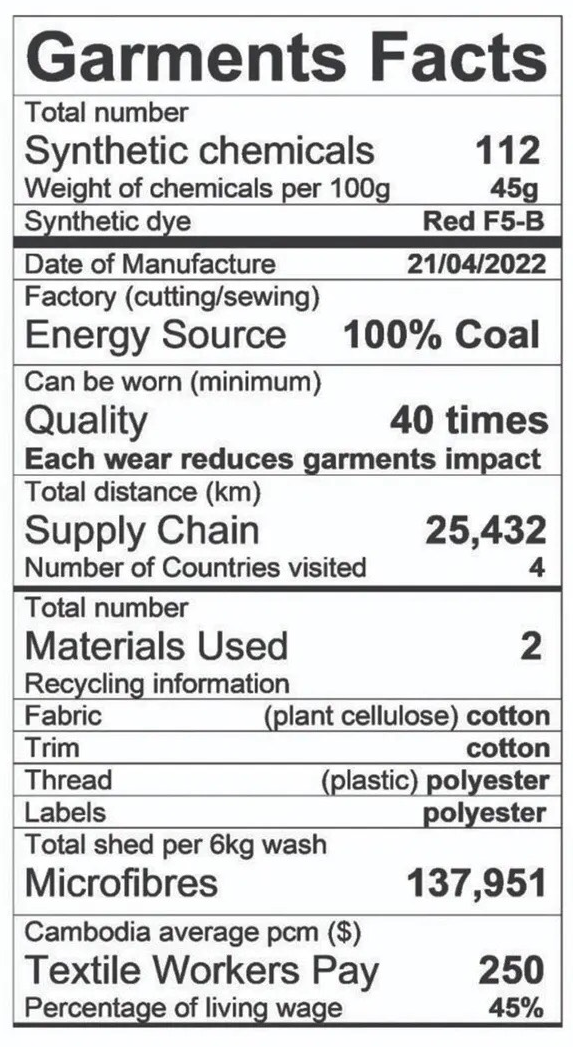
The Garment Facts Label is copyright protected. © Peter Gorse. It must not be reproduced, adapted or used on products without his written permission. To ask about using it, use the enquiry form.
The short version
What it is. A nutrition-style label for clothing, designed by Peter Gorse, with eight blocks of facts, from synthetic chemicals to textile worker pay as a share of the local living wage.
Why it matters. Shoppers can read what is in their food but not what is in their clothes. Standard labels work when the data is universal and uniform, and not shaped by a brand's own marketing.
Where it stands. It is a voluntary initiative, not law. It has been featured in Vogue Business, nominated for the Global Change Award 2025 (H&M Foundation), used in a course at the Fashion Institute of Technology and discussed at a Union of Concerned Researchers in Fashion workshop. Its creator is looking for brands to pilot it.
What Symolem thinks. We endorse the approach. It is not a certification, and some measures, microfibre shedding especially, are hard to measure consistently and need testing.
Food and appliances carry a standard label. Clothing does not.
The US Congress told the Food and Drug Administration to design a new nutrition label for packaged food in 1990. The label that emerged in 1994 became the model, and the UK followed two years later [1]. Appliances carry energy labels. Clothing carries fibre content and care symbols.
The gap: a shopper cannot compare two garments on chemical content, how long they are designed to last, how far they travelled or what workers were paid. The scale is not small. Vogue Business cites an estimated 75 million garment workers and some 16,000 chemicals used in plastic or polyester [1].
The information exists in the supply chain. It rarely reaches the tag. "Greenwashing" is the common term for vague or unproven environmental claims; Symolem calls the hopeful version greenwishing. Standard labelling is the corrective: it is most credible when it is not shaped by a brand's own marketing.
The label puts eight facts in one box
| Block | What the shopper sees | Why it matters |
|---|---|---|
| Synthetic chemicals | The number of synthetic chemicals and their weight per 100g | Makes chemical use visible without specialist testing |
| Synthetic dye | Whether synthetic dye is used | Separates dye choice from fibre choice |
| Factory energy source | The energy source at the cutting and sewing factory | Links the garment to the energy behind it |
| Minimum wears | The minimum number of times it is designed to be worn | Puts durability on the tag |
| Supply chain distance | Total distance and number of countries visited | Shows how fragmented the chain is |
| Materials and recycling | What each material is and how it can be recycled | Shows whether a garment can be recycled |
| Microfibres | Microfibres shed in a 6kg wash | Makes shedding visible |
| Textile workers' pay | Pay as a percentage of the local living wage | Puts pay beside the price |
Source: Garment Facts Label sample design by Peter Gorse; Symolem analysis. The figures on the sample label illustrate the format and are not data about a real product.
Its design choices are deliberate
One box, one standard format. Every garment is described the same way, so shoppers can compare.
Facts that can be measured or checked. Each line is drawn from researched sources, not from a brand's own claims.
The whole garment, not one stage. The label spans chemistry, energy, durability, distance, materials, shedding and pay.
Deliberate omissions. It leaves out carbon footprint and water use, which its creator judged hard to quantify consistently. Peter Gorse does not claim the label is perfect. [1]
The evidence so far is encouraging but early
What supports it
- Featured in Vogue Business on 10 June 2024 [1].
- A newsletter piece by Tiffanie Darke on 18 June 2024 made the case for food-style clothing labels [2].
- Nominated for the Global Change Award 2025 (H&M Foundation).
- Used in a course at the Fashion Institute of Technology, New York.
- Selected for the Fashion Vocabulary in 2026.
- Discussed at a Union of Concerned Researchers in Fashion workshop, where participants scored the label's proposed metrics and rated supply chain distance, number of materials and synthetic chemicals highest [3].
What is still open
- Microfibre shedding is hard to measure, and some experts doubt consumers need that level of technical detail [1].
- Workshop participants questioned whether shoppers would understand the chemicals measure [3].
- The label is voluntary and has no regulatory backing.
- It needs pilots across real suppliers and products.
Why Symolem endorses the Garment Facts Label: facts, a standard format and passport-ready data
Symolem works on one question: can a product prove what is said about it? The Garment Facts Label answers that in a form a shopper can read in seconds, which is why we endorse it.
Facts, not claims. Every line on the label is something that can be measured or checked, not a promise. That is the direction of the EU and UK rules on green claims, and it is how we advise brands to work.
A standard format. A label only helps shoppers compare when every garment is described the same way and no brand chooses which facts to show. That principle sits behind regulated labelling and behind Digital Product Passports.
Passport-ready data. The verified product data a Digital Product Passport holds is the data a label like this needs. The passport sits behind the product and the label sits on the tag.
What this means for brands and retailers
Check the claims on your tags and product pages against EmpCo, which applies from 27 September 2026, and the UK DMCC Act.
Test whether you hold evidence for each of the eight blocks. Many brands will find gaps in chemicals, supply chain distance and worker pay.
If you want to pilot the label, use the enquiry form.
Related reading: Digital Product Passport and DPP for brands and retailers. The ESPR delegated act for textiles is indicatively scheduled for 2027, so passport rules are still being set.
Reading the label
How to read the label
The label is read top to bottom, one block at a time. The version shown here is a sample: its figures illustrate the format and are not data about a real product.
The Garment Facts Label is copyright protected. © Peter Gorse. It must not be reproduced, adapted or used on products without his written permission. To ask about using it, use the enquiry form.
Synthetic chemicals
How many synthetic chemicals were used to make the garment, and their combined weight.
Synthetic dye
Whether the colour comes from synthetic dyes.
Factory energy
The source of the energy used at the factory where the garment was made.
Minimum wears
The minimum number of times the garment is designed to be worn.
Supply chain distance
How far the garment travelled through its supply chain, and the countries it passed through.
Materials and recycling
What each material is, and how each one can be recycled.
Microfibres
How many microfibres the garment sheds in a standard 6kg wash.
Workers' pay
What textile workers were paid, shown as a percentage of the local living wage.
How the label feeds the passport
Every block on the label has to be traced and recorded somewhere before it can be printed on a swing tag. A Digital Product Passport could be that record: verified data about a garment, held across its life. What passports for textiles must contain is still being set, so the mapping below shows what a passport could record, not what every passport holds today. The label is the shopper-facing summary; the passport is where the evidence lives.
- Synthetic chemicals
- A passport can record chemical content declared by the mills and dyehouses in the supply chain.
- Synthetic dye
- It could hold dye declarations made when the fabric is finished.
- Factory energy
- It can record the energy source at the facility where the garment was made, drawn from supplier records.
- Minimum wears
- It could hold durability information and design intent documented by the brand.
- Supply chain distance
- It can record the route the garment took, with the facilities and countries on it.
- Materials and recycling
- It can record fibre composition and recyclability for each material.
- Microfibres
- It could hold shedding test results linked to the product.
- Workers' pay
- It could hold wage data from supplying facilities, measured against the local living wage.
The two work as one system: the passport can hold the data, the label makes it legible at the point of sale. For a brand, building the passport data set is also the work that makes a label like this possible.
Recognition
10 June 2024
2025
Nominated for the Global Change Award 2025 (H&M Foundation).
2026
Selected for the Fashion Vocabulary, a living fashion encyclopaedia.
Used in a course at the Fashion Institute of Technology, New York.
Discussed at a Union of Concerned Researchers in Fashion workshop.
The creator
About Peter Gorse
Peter Gorse is a British industrial designer and textile researcher. He trained as an industrial designer at Coventry University, and his early work won an Audi Design Foundation Award and funding from the National Composite Network.
He went on to set up his own brand designing sports products, including a small collection of decorated apparel, and held accounts with Dockers Europe, Selfridges, Paul Smith shops and independent retailers.
More recently he worked as a textile researcher at Cranfield University on regenerated cellulosic fibres with embedded natural dyes. He created the Garment Facts Label during the Covid lockdown and continues research into its individual metrics and into consumer behaviour. He is looking to pilot the label with selected fashion brands.
Career at a glance
- Training
- Industrial design, Coventry University
- Recognition
- Audi Design Foundation Awards; funding from the National Composite Network
- Business
- Founded a sports products brand; stockists included Dockers Europe, Selfridges and Paul Smith shops
- Research
- Textile researcher, Cranfield University (regenerated cellulosic fibres, natural dyes)
- Now
- Creator of the Garment Facts Label, piloting with fashion brands
If a shopper can read what is in their food, they should be able to read what is in their clothes.
Frequently asked questions
- What is the Garment Facts Label?
- It is a nutrition-style label for clothing, created by British industrial designer Peter Gorse. It sits on the swing tag and shows the facts about a garment in one standard box.
- What information does a garment facts label show?
- Synthetic chemical content and weight, synthetic dye, the factory's energy source, minimum number of wears, supply chain distance and countries visited, materials and recycling information, microfibres shed per wash, and textile worker pay as a percentage of the local living wage.
- Who created the Garment Facts Label?
- Peter Gorse, a British industrial designer and textile researcher formerly at Cranfield University. He created it during the Covid lockdown.
- Is the Garment Facts Label a legal requirement?
- No. It is a voluntary initiative. Its supporters argue that governments should adopt a label like it, as they did for food and appliances.
- How is it different from a care label or fibre content label?
- A care label tells you how to wash a garment and a fibre label lists its materials. The Garment Facts Label adds how the garment was made, how far it travelled, how long it is designed to last and what workers were paid.
- Can brands pilot the Garment Facts Label?
- Yes. Peter Gorse is looking to pilot the label with fashion brands. Use the enquiry form and we will pass your details to him.
Sources
[1] Vogue Business
Show me the ingredients: The story behind fashion's first nutrition label
Christina Binkley · 10 June 2024
The story of how the label was conceived and what it sets out to show.
Read[2] It's Not Sustainable (newsletter)
It's More Than You Think
Tiffanie Darke · 18 June 2024
Argues the case for food-style clothing labels. The piece does not name the Garment Facts Label.
Read[3] Concerned Researchers blog
A Label For Pressing Sustainability And Social Issues
Union of Concerned Researchers in Fashion
A write-up of a workshop where participants scored the label's proposed metrics for feasibility and importance.
Read
Enquire
Enquire about using the Garment Facts Label
Interested in piloting the label, licensing it for your products, or writing about it? Tell us below and we will pass your enquiry to Peter Gorse.
The Garment Facts Label is copyright protected. © Peter Gorse. It must not be reproduced, adapted or used on products without his written permission. To ask about using it, use the enquiry form.