Green Claims Directive for Textiles: From Aspirational Branding to Systemic Verification
Aspirational branding is no longer a creative exercise; it's a systemic liability. For decades, the fashion industry has operated on a logic of "good enough" certifications and vague environmental descriptors. This era of ambiguity terminates on September 27, 2026. The enforcement of the green claims directive textiles landscape, specifically via the Empowering Consumers for the Green Transition Directive, mandates that every "eco-friendly" or "carbon neutral" claim must be anchored in rigorous, third-party verified data.
You're likely struggling with fragmented data across global supply chains and the realization that current certifications offer no protection against high-stakes greenwashing litigation. It's a structural failure that marketing departments cannot solve. We'll unpack the shift from marketing-led narratives to legally mandated environmental substantiation. This analysis examines the technical requirements of the Product Environmental Footprint (PEF) methodology, the 4% turnover penalty risks, and the strategic architecture needed to align your brand's technical reality with its public claims.
Key Takeaways
- Establish the Product Environmental Footprint (PEF) methodology as your primary technical baseline to ensure all environmental claims are anchored in science-based life cycle rigor.
- Recognize that the current legislative landscape for the green claims directive textiles allows no "compliance holiday," requiring immediate alignment with the already active Empowering Consumers Directive.
- Transition from fragmented marketing silos to integrated data governance frameworks that can support the complex data fields required for Digital Product Passport implementation.
- Utilize Impact Measurement and Monitoring, Reporting, and Verification (MRV) as a critical diagnostic layer to mitigate legal exposure and systemic reputational risk.
- Reframe regulatory compliance as a strategic driver for circular business models, converting mandatory transparency into a verifiable competitive advantage in the post-greenwash market.
Table of Contents
The Structural Failure of Aspirational Fashion Marketing
Aspirational marketing has reached its structural limit. For decades, the textile industry relied on a "trust me" model of sustainability, where vague narratives and unverified certifications sufficed to capture market share. This discretionary era is over. The green claims directive textiles framework serves as the definitive verification layer for the broader EU Green Deal, acting as the mechanism that terminates the era of self-regulated sustainability narratives. It transforms voluntary Corporate Social Responsibility (CSR) from a flexible PR tool into a rigid, legally mandated requirement for data transparency.
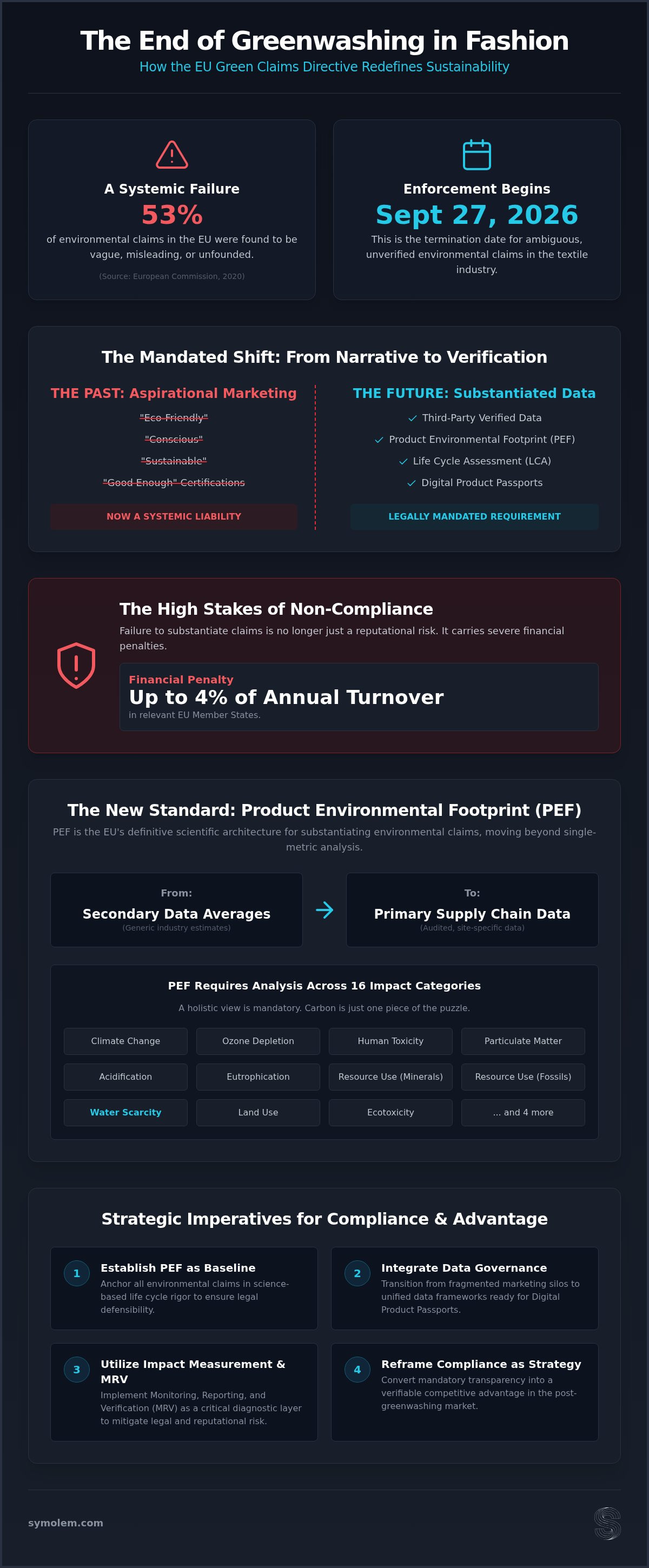
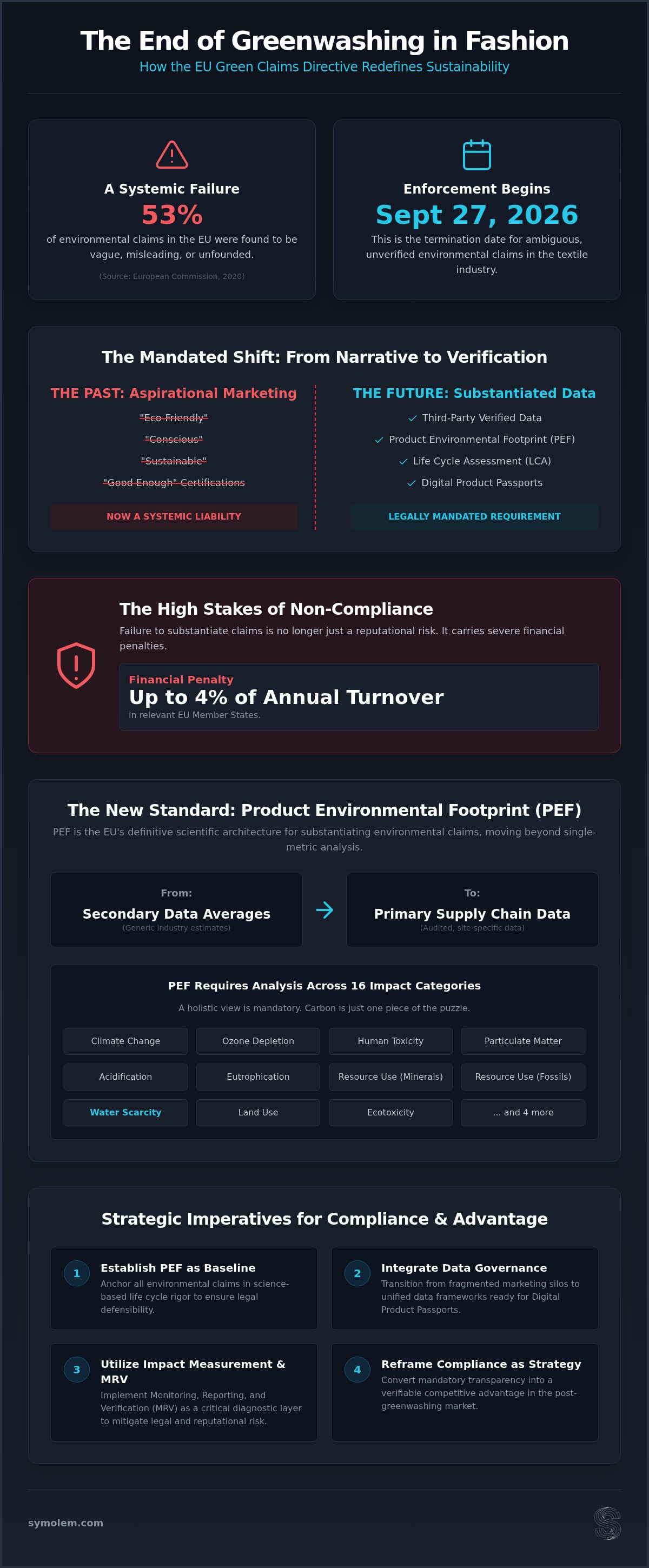
The European Commission's 2020 study revealed that 53% of environmental claims were vague, misleading, or unfounded. This statistic highlights a systemic failure of data governance. While competitors often view deceptive marketing practice as a mere branding error, it is actually the result of a profound disconnect between marketing departments and technical supply chain realities. The current regulatory shift forces an alignment where every outward-facing claim must be the output of a rigorous, internal auditing process.
The End of Generic Environmental Claims
Vague adjectives are now liabilities. Terms like "eco-friendly," "conscious," or "sustainable" have become legally toxic under new enforcement protocols starting in September 2026. The directive demands specific, granular evidence for every voluntary claim. This scrutiny targets both brand-level assertions and product-specific labels. If a brand claims a "reduced carbon footprint," it must provide the exact baseline, the specific percentage of reduction, and the scientific methodology used to verify the data. Ambiguity is no longer a marketing strategy; it is a legal trigger for investigation.
The Economic Cost of Narrative Misalignment
The stakes are no longer purely reputational. Non-compliance invites financial penalties reaching up to 4% of annual turnover in relevant EU Member States. This represents a significant threat to corporate liquidity. Beyond immediate fines, narrative misalignment erodes investor confidence and degrades credit ratings as ESG assessments transition from qualitative stories to quantitative audits. To survive this transition, brands must adopt a robust textile impact measurement and MRV framework. This technical infrastructure ensures that marketing statements are a direct reflection of operational reality, shielding the organization from the systemic shock of regulatory litigation and market exclusion.
Decoding Technical Mandates: PEF and Life Cycle Rigor
Data is the new baseline for market access. The green claims directive textiles framework establishes the Product Environmental Footprint (PEF) as the definitive scientific architecture for substantiating environmental assertions. This methodology moves the industry away from the era of "aspirational storytelling" and into a regime of clinical, data-backed verification. While some industry voices suggest that simple LCA software is a sufficient solution, they ignore the strategic necessity of interpreting complex data within a shifting regulatory landscape. The EU's official position confirms that claims must be substantiated by recognized, science-based methodologies, positioning Life Cycle Assessment (LCA) as the only acceptable baseline for the textile sector.
The transition from secondary data averages to primary supply chain data represents a massive structural shift. Historically, brands relied on global database averages to estimate their impact, a practice that obscured the actual environmental cost of specific production sites. Under the new directive, these generic estimates are insufficient. If your claim is predicated on a "global average" for recycled polyester, but your specific tier-three facility operates with high-intensity energy inputs, your claim becomes a legal liability. Substantiation now requires direct primary data, audited through a rigorous process of Impact Measurement and MRV (Monitoring, Reporting, and Verification).
The 16 Impact Categories of PEF
A rigorous environmental claim must look beyond carbon. The PEF methodology requires brands to account for 16 distinct impact categories, including water scarcity, land use, and human toxicity. This multi-dimensional approach prevents "burden shifting," where a brand reduces carbon emissions at the expense of massive water pollution or biodiversity loss. Managing this level of data granularity across global value chains is an immense technical challenge. It requires mapping hundreds of specific data fields, a process that is foundational to any Digital Product Passport implementation strategy. Brands that fail to build this data infrastructure will find themselves unable to make even the most basic environmental claims by 2026.
Third-Party Verification Protocols
Self-certification is dead. The directive mandates that all environmental claims undergo independent, third-party verification by accredited bodies. These verifiers will not merely check a box; they will audit the underlying data sets, the methodology applied, and the accuracy of the final communication. Many existing certifications, which were built on voluntary and often opaque standards, are currently being re-evaluated for their regulatory rigor. To legally display a claim, brands must obtain a "Certificate of Conformity" that validates the technical reality of their assertions. Initiating an ESPR Readiness Diagnostic allows brands to identify gaps in their verification chain before they trigger enforcement actions or financial penalties.
GCD vs. UCPD: Navigating the 2026 Regulatory Convergence
The legislative pause is a tactical distraction. Many fashion brands interpreted the June 2025 withdrawal of the standalone Green Claims Directive proposal as a reprieve, but this perspective reflects a fundamental misunderstanding of the EU's regulatory architecture. While that specific proposal was withdrawn due to political friction, its core anti-greenwashing mandates were already absorbed into the Empowering Consumers for the Green Transition Directive (EU 2024/825). This directive was published in March 2024 and mandates enforcement starting September 27, 2026. There is no compliance holiday. The green claims directive textiles landscape is already defined by these amendments to the Unfair Commercial Practices Directive (UCPD), which effectively criminalize generic environmental assertions.
Substantiation now requires a level of operational transparency that bridges the gap between marketing and waste management. When navigating EPR for textiles, it becomes clear that end-of-life data is no longer a separate operational concern. If a brand markets a jacket as "recyclable," but the Extended Producer Responsibility (EPR) data shows no viable recycling infrastructure for that specific fiber blend in the target market, the claim is legally fraudulent. The UCPD now treats such narrative gaps as prohibited commercial practices, carrying the same 4% turnover penalty risks previously associated with the standalone GCD.
The Immediate Mandate: Empowering Consumers Directive
The rules taking effect in September 2026 are binary and unforgiving. Generic claims like "green" or "sustainable" are prohibited unless a brand can demonstrate "recognized excellent environmental performance" relevant to the claim. Furthermore, sustainability labels not based on an independent third-party certification scheme or established by public authorities are now banned. National authorities across the EU are already recalibrating their enforcement mechanisms to target these specific failures. Brands must audit their existing label portfolios today to avoid a total collapse of their consumer-facing narratives when the transposition deadline arrives in March 2026.
The Future Mandate: Green Claims Directive Nuances
The eventual re-introduction of a more specific GCD will likely shift the focus toward comparative claims. Future regulations will set the technical criteria for how one brand can legally claim its products are "better" than a competitor's. This will require a standardized use of the Product Environmental Footprint (PEF) methodology to ensure comparisons are mathematically valid rather than rhetorically persuasive. Preparing for the most stringent interpretation of these rules is the only viable path for future-proofing. By adopting a "maximum rigor" approach to data now, brands ensure they aren't forced into a costly, reactive redesign of their data infrastructure when the next wave of comparative claim mandates arrives.
Building the Data Infrastructure for Verified Claims
Marketing silos are the primary point of failure. Substantiating claims under the green claims directive textiles requires a total transition to integrated data governance. This isn't about better storytelling. It's about building a technical infrastructure that can withstand a clinical regulatory audit. Brands that continue to treat sustainability as a peripheral marketing function will find themselves unable to meet the substantiation requirements of 2026. Data must flow seamlessly from the factory floor to the consumer label, ensuring that every claim is a direct reflection of a verifiable, technical reality.
The introduction of the Digital Product Passport (DPP) makes this infrastructure mandatory. Brands must map hundreds of data fields across Tier 1 to Tier 4 suppliers, identifying the specific environmental impacts at every stage of production. Adopting a strategic framework for 2026 is the only way to manage this complexity. Without a centralized architecture, data remains fragmented, inconsistent, and ultimately indefensible under legal scrutiny. Technologies like blockchain and IoT are no longer optional experiments; they're essential tools for ensuring data traceability and systemic integrity.
Supply Chain Transparency and Traceability
Transparency has evolved into a rigid technical requirement. Brands must audit supplier data for accuracy and PEF compatibility, moving beyond the superficial reliance on third-party certificates that often lack granular impact data. This requires the textile circularity framework development to be deeply integrated into corporate data systems. If your supply chain data isn't interoperable with EU reporting standards, your environmental claims will fail the verification process before they even reach the market.
Internal Compliance Audits
Structural integrity requires cross-functional oversight. Establishing a compliance task force that unites Legal, ESG, and Marketing is essential for creating a workflow that verifies a claim's technical basis before it reaches the consumer. Every claim must be supported by a "Data Evidence Folder" containing the primary data, verification certificates, and LCA calculations used for substantiation. This folder serves as the clinical proof required during regulatory inspections. To evaluate your current data capabilities, you should schedule an ESPR Readiness Diagnostic to identify and remediate critical infrastructure gaps.
Beyond Compliance: Integrating Verification into the Business Model
Compliance is not a static endpoint. The regulatory pressures exerted by the green claims directive textiles ecosystem act as a decisive catalyst for circular fashion business model consulting, forcing a fundamental reassessment of how value is created and captured. In a market saturated with unverified sustainability labels, the ability to provide clinical, data-backed evidence becomes a primary differentiator. This transition demands a shift from volume-based revenue models to value-based circular services. Profitability must be decoupled from the extraction of virgin resources and the production of disposable inventory. Symolem acts as the systemic architect in this space, building regulatory readiness for global fashion leaders who recognize that the era of superficial narratives is over.
The Strategic Advantage of Rigour
Verified transparency isn't just about avoiding fines; it's about winning consumer trust in a post-greenwash era. Investors and insurers now view unverified environmental claims as material risks that threaten corporate liquidity. Consequently, the integration of ESPR readiness diagnostics into corporate strategy directly impacts business valuation by demonstrating a lower risk profile and a higher degree of operational stability. Brands that can prove their impact through rigorous MRV (Monitoring, Reporting, and Verification) will secure preferential access to capital. These organizations will also benefit from insurance markets that are increasingly hostile to opaque supply chains and high-stakes litigation risks.
Next Steps for C-Suite Implementation
Immediate action is a business imperative. C-suite leaders must prioritize the auditing of high-risk environmental claims that lack primary data substantiation. This diagnostic phase is the first step in mapping a comprehensive regulatory roadmap for the 2026 to 2030 period, particularly as the green claims directive textiles requirements evolve from simple bans on generic terms to complex comparative claim mandates. Engaging strategic advisors to map this landscape ensures that your organization isn't merely reacting to individual directives but is building a resilient, future-proof business model. Symolem provides the technical and policy expertise required to navigate the convergence of GCD, ESPR, and the Digital Product Passport. To protect your market position and mitigate systemic liability, secure your ESPR and GCD compliance diagnostic with Symolem today.
Decoupling Branding from Ambiguity
Narrative-driven sustainability has reached its expiration date. The shift toward the green claims directive textiles framework represents a permanent transition from marketing-led narratives to legally mandated, data-backed substantiation. By September 2026, the industry must move beyond aspirational descriptors and adopt the scientific rigor of Product Environmental Footprint (PEF) methodologies. This isn't a discretionary project; it's a critical business imperative that determines future market access. Integrating verification into your core business model is the only way to mitigate the 4% turnover penalty risks and systemic reputational collapse.
Symolem provides the intellectual rigor and technical expertise required to navigate this landscape. Through our independent systemic audit approach, we specialize in mapping the up to 236 data points in the UNTP schema necessary for the Digital Product Passport (DPP). As an authoritative advisory for global textile value chains, we help you align your operational reality with regulatory requirements.
Architect your regulatory readiness with Symolem’s ESPR and GCD Diagnostic.
Securing your data infrastructure today ensures your brand's integrity remains unassailable in a more transparent, verified market.
Frequently Asked Questions
What is the current status of the EU Green Claims Directive in 2026?
The standalone Green Claims Directive proposal was officially withdrawn in June 2025, but its core anti-greenwashing mandates are active through the Empowering Consumers for the Green Transition Directive. This directive was adopted in early 2024 and member states must transpose it into national law by March 2026. Full enforcement begins on September 27, 2026. Brands must recognize that the legislative pause on the specific GCD proposal does not grant a compliance holiday.
How does the Green Claims Directive differ from the Empowering Consumers Directive?
The Empowering Consumers Directive serves as a broad amendment to the Unfair Commercial Practices Directive, specifically banning generic claims like "eco-friendly" without recognized proof. The original Green Claims Directive was intended to provide the granular technical methodology for substantiation. Currently, the industry must follow the ECD's strict prohibitions while utilizing the Product Environmental Footprint (PEF) as the scientific baseline for verifying any voluntary environmental assertions made to consumers.
Can we still use third-party certifications like GOTS under the new rules?
Third-party certifications remain permissible but they must now meet significantly higher standards of independence and transparency. Under the 2026 rules, any sustainability label must be based on a certification scheme established by public authorities or an independent third-party verification system. Private, self-regulated labels that lack scientific rigor or public transparency are prohibited. Brands should audit their certification portfolios to ensure their partners provide the granular data required for clinical substantiation.
What are the specific penalties for non-compliance with the Green Claims Directive?
The penalties for non-compliance are designed to be economically transformative. Member states are empowered to impose fines reaching up to 4% of a company's annual turnover in the affected markets. Authorities may also move to confiscate revenues generated from the sale of non-compliant products and exclude brands from public procurement processes for up to 12 months. These high-stakes measures treat the green claims directive textiles landscape as a critical business and legal imperative.
Does the Green Claims Directive apply to non-EU fashion brands selling in Europe?
Yes, the regulatory framework applies to all brands placing products on the EU market, regardless of where the company is headquartered. If a non-EU fashion brand targets European consumers, it must adhere to the same substantiation and verification requirements as domestic firms. Global organizations must recalibrate their international marketing strategies to ensure that any environmental claims made within the EU are backed by verified, primary data from their global supply chains.
How does the Product Environmental Footprint (PEF) methodology work for textiles?
The PEF methodology is a science-based architecture that measures environmental impact across 16 distinct categories, including water scarcity, land use, and toxicity. It requires a transition from secondary database averages to primary data collected from specific Tier 1 to Tier 4 suppliers. This life cycle approach prevents burden shifting, ensuring that a reduction in carbon emissions doesn't mask a significant increase in water pollution. PEF is the mandatory technical baseline for substantiating environmental claims.
What is the role of the Digital Product Passport in claim substantiation?
The Digital Product Passport (DPP) acts as the permanent digital record that hosts the verified data fields required for claim substantiation. It bridges the gap between the physical product and its environmental impact data, making it impossible to hide behind vague branding. By centralizing the technical evidence required by the green claims directive textiles framework, the DPP ensures that every claim is anchored in a verifiable, auditable technical reality that is accessible to regulators and consumers.
How can a fashion brand prepare for a green claims audit?
Preparation requires a systemic shift from marketing narratives to rigorous data governance. Brands should immediately establish a "Data Evidence Folder" for every active claim, containing primary supply chain data and third-party certificates of conformity. Engaging in an ESPR Readiness Diagnostic is essential to identify gaps in your current data infrastructure. You must prioritize the audit of high-risk claims and establish a cross-functional task force to ensure that all future marketing is a direct output of technical reality.