Circularity Performance Indicators for Textiles: What Gets Measured
The era of the sustainability narrative is over. It's been replaced by a clinical regime of resource decoupling and residual value retention enforced by rigorous European law. As the 2026 mandate for the Ecodesign for Sustainable Products Regulation (ESPR) approaches, the distance between marketing sentiment and technical reality has become a significant legal liability. You're likely grappling with fragmented data across opaque global supply chains and the looming threat of the EU Green Claims Directive. It's a high-stakes environment where vague storytelling is no longer just ineffective; it's a financial risk.
This guide moves beyond superficiality to help you master the specific circularity performance indicators textiles require for absolute regulatory alignment. You'll gain a defensible set of KPIs for upcoming audits and a clear understanding of how to bridge the gap between internal impact metrics and external mandates. We'll unpack the mechanics of Digital Product Passport data readiness, mapping the up to 236 data points in the UNTP schema necessary to ensure your brand survives the transition from aspirational goals to audited, systemic integrity. We'll provide the roadmap you need to transform compliance from a burden into a structural advantage.
Key Takeaways
- Replace soft-focus sustainability narratives with a clinical auditing framework to mitigate legal risks associated with the EU Green Claims Directive.
- Master the technical circularity performance indicators textiles require to quantify resource decoupling and verify systemic integrity across global supply chains.
- Navigate the complexities of the Digital Product Passport by aligning internal data governance with the up to 236 data points in the UNTP schema mandated by the ESPR.
- Analyze the economic architecture of textile recovery, shifting the focus from ethical sentiment to the precise costing of circular infrastructure and residual value retention.
- Build a defensible roadmap for regulatory audits through a diagnostic approach that prioritizes structural design over superficial compliance tools.
Table of Contents
- Beyond Storytelling: The Shift to Structural Circularity Auditing
- Core Circularity Performance Indicators for the 2026 Textile Industry
- Mapping KPIs to the Digital Product Passport (DPP) and ESPR
- The Economics of Recovery: Costing Circular Infrastructure
- Implementing a Defensible Circularity Framework with Symolem
Beyond Storytelling: The Shift to Structural Circularity Auditing
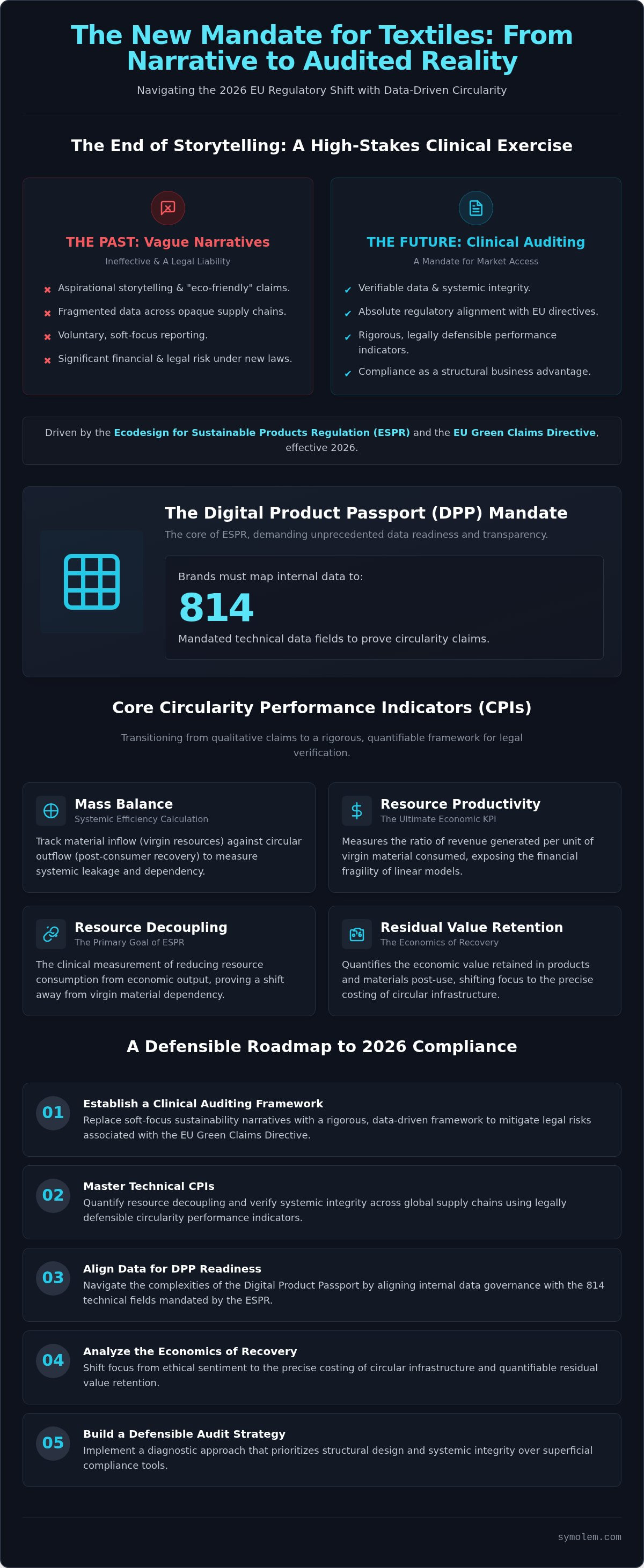
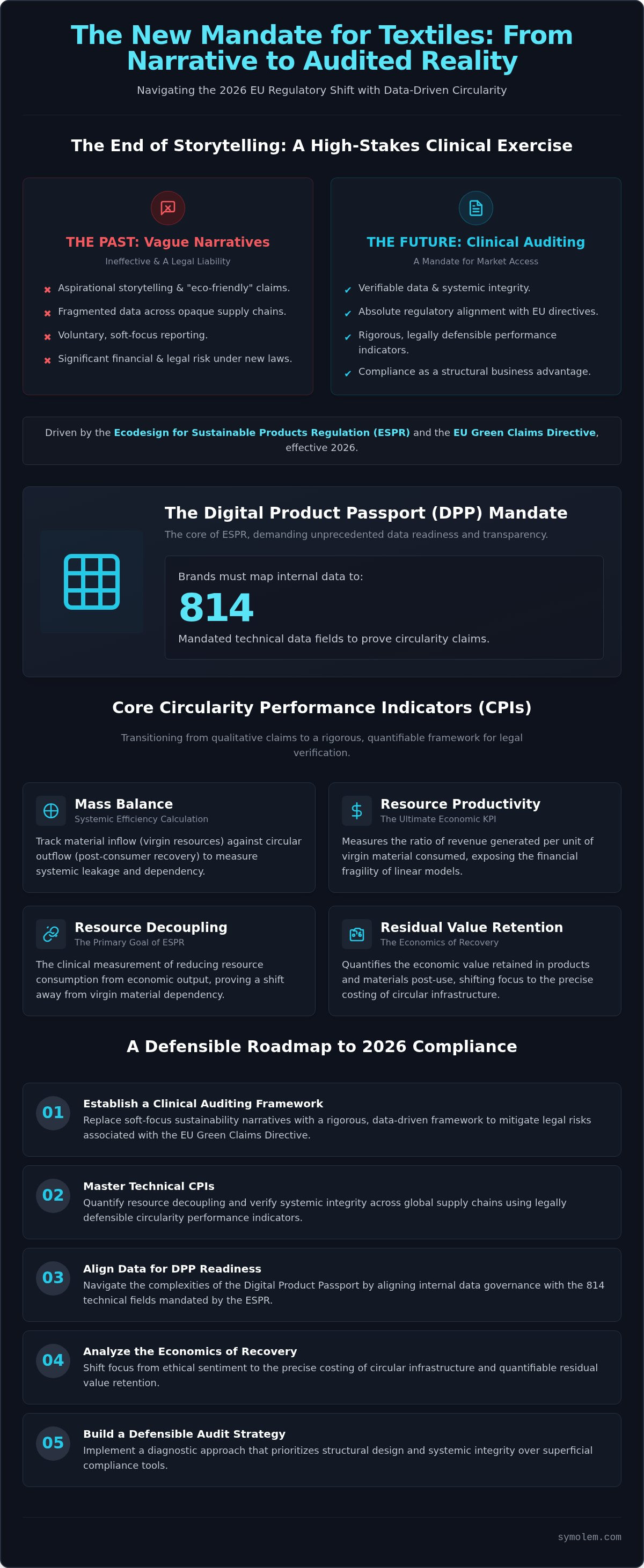
The marketing narrative is dead. For decades, the textile industry relied on aspirational storytelling to mask structural inefficiencies and opaque supply chains. This era of ambiguity ends in 2026. Circularity performance indicators textiles are not merely sustainability metrics; they are diagnostic tools designed to measure systemic integrity and verify resource decoupling. This shift represents a transition from voluntary, soft-focus reporting to a rigorous legal mandate where every data point must be defensible under a regulatory audit. Accuracy is the new currency of market access.
The upcoming Ecodesign for Sustainable Products Regulation (ESPR) fundamentally alters the global business landscape. It demands a level of technical granularity that most existing reporting frameworks simply cannot provide. Implementing an ESPR readiness diagnostic is now a strategic necessity for brands that intend to survive the transition. It's no longer enough to claim a product is "circular" based on ethical intent. You must prove it through the clinical measurement of material flows, durability parameters, and residual value retention across the entire product lifecycle.
The Failure of Qualitative Sustainability
Vague claims about "eco-friendly" materials or "recycled content" provide zero protection against the EU Green Claims Directive. These qualitative metrics fail because they ignore the foundational circular fashion principles required for genuine system change. Recycled content, for instance, is often an insufficient metric if the resulting garment is designed for a linear end-of-life or lacks the structural durability to justify its resource footprint. We're moving toward a regime where verified structural data replaces aspirational goals. If your circularity claims cannot be audited with mathematical precision, they are a significant legal liability.
Circularity as a Legal Business Imperative
Regulatory compliance in 2026 is a high-stakes clinical exercise. The European Union's focus on systemic integrity means that circularity performance indicators textiles must be integrated into the core financial and operational reporting of a brand. Failure to adopt this level of precision will result in severe financial penalties and eventual market exclusion. Establishing a robust textile circularity strategy is the only way to navigate this complex regulatory architecture. It requires a move away from superficial PR and toward a documented, data-driven framework that treats circularity as a structural design requirement rather than an optional ethical sentiment.
Core Circularity Performance Indicators for the 2026 Textile Industry
Measurement is the prerequisite for management. To meet the 2026 mandate, brands must transition from qualitative "eco-friendly" claims to a rigorous framework of circularity performance indicators textiles require for legal verification. This starts with a clinical analysis of mass balance. You must track material inflow to identify structural dependencies on virgin resources while simultaneously measuring circular outflow to determine the actual post-consumer recovery rate. It's a calculation of systemic efficiency. Accuracy isn't a choice; it's a requirement for market access.
Resource productivity serves as the ultimate economic KPI in this new regime. It measures the ratio of revenue generated per unit of virgin material consumed, exposing the financial fragility of linear business models. High-performing brands will utilize the Circular Transition Indicators (CTI) to benchmark their progress against industry standards. This level of scrutiny ensures that circularity isn't just a marketing initiative but a core driver of operational resilience. If you can't measure your resource decoupling, you can't prove your compliance.
Measuring Material Circulation and Waste
The "Circularity Gap" represents the structural failure of a value chain to retain material value. Measuring this gap requires a granular methodology for tracking fiber-to-fiber recycling efficiency, specifically identifying where high-value polymers are downgraded into low-tier applications. Residual Value Retention is the percentage of a product's initial economic value that remains recoverable at its end-of-life stage. If you can't quantify this retention, you're effectively planning for financial waste. Assessing these gaps is a primary component of our Circular Economy Strategy Development services.
The Durability Mandate
Durability is no longer a quality control metric; it's a regulatory requirement. Under the ESPR, circularity performance indicators textiles must include technical data on pilling resistance, tensile strength, and colorfastness to justify a product's claimed lifespan. These longevity metrics are the foundational inputs for textile impact measurement and MRV, providing the verification rigor needed for regulatory audits. Extending the technical life of a fiber directly reduces the carbon footprint per wear, creating a verifiable link between structural integrity and climate targets. Brands that fail to document these parameters will find themselves locked out of the European market by 2026.
Mapping KPIs to the Digital Product Passport (DPP) and ESPR
The Digital Product Passport (DPP) is the technical enforcement mechanism of the ESPR. It isn't a voluntary transparency tool; it's a legal gatekeeper. To achieve compliance, brands must map their internal circularity performance indicators textiles to the up to 236 data points in the UNTP schema mandated by the European Commission. This requires a clinical level of data granularity that most current ERP systems aren't designed to handle. It's a structural overhaul of how information flows through the value chain, shifting the focus from marketing narratives to audited technical specifications. Accuracy is the only path to market access.
DPP Data Readiness and Governance
Success in implementing Digital Product Passports depends on a fundamental shift in data governance. You can't rely on self-reported spreadsheets from Tier 3 suppliers. The framework demands verifiable credentials and immutable records to ensure trust and systemic integrity. A diagnostic process is essential to identify the inevitable data gaps across global operations before regulatory deadlines arrive. As the "Responsible Operator," your organization carries the legal burden of verification; any failure in data accuracy is a direct breach of ESPR obligations and carries significant financial risk.
ESPR Compliance and Performance Tiers
The ESPR doesn't just mandate disclosure; it sets performance floors. Your circularity performance indicators textiles will eventually determine your product’s "Compliance Tier," influencing everything from public procurement eligibility to consumer-facing labels. High-performing products will be distinguished by their technical durability, repairability scores, and absence of substances of concern, while those failing to meet minimum ecodesign standards will face immediate market exclusion. This reporting is further complicated by navigating textile EPR requirements, which link performance data directly to the financial fees paid for end-of-life management. It's an interconnected regulatory web where technical precision is the only defense against systemic failure. Failure to meet these performance tiers isn't just a PR problem; it's a structural barrier to trade.
The Economics of Recovery: Costing Circular Infrastructure
Circularity is a balance sheet equation. It's not a moral aspiration but a clinical calculation of recovery costs versus virgin material savings. For brands operating in EU markets, "Infrastructure Readiness" has emerged as a critical KPI within the broader set of circularity performance indicators textiles require for 2026 compliance. This metric evaluates a brand's actual capacity to retrieve and reprocess materials within a specific geographic footprint. Localized recovery infrastructure is proving more cost-effective than globalized logistics when accounting for rising carbon taxes and the logistical friction of cross-border waste movement. Understanding the granular details of sustainable textile infrastructure costing is the only way to build a long-term strategy that survives the transition to a regulated circular economy.
Modeling the True Economics of Circularity
Regulatory fines are the primary drivers of circular ROI. In the 2026 landscape, the cause-and-effect chain is clear: failure to invest in infrastructure leads to non-compliance, which triggers punitive fines that dwarf the original capital expenditure. Extended Producer Responsibility (EPR) fees are no longer marginal costs; they are structural margin killers that penalize linear design. Brands must move beyond isolated pilot projects toward systemic integration, ensuring that circularity is baked into the financial architecture of the business. It's a high-stakes transition where the cost of inaction is mathematically higher than the cost of implementation. This is why financial modeling must be a core component of your circularity performance indicators textiles framework.
Supply Chain Transparency as a Performance Metric
Transparency is a risk management framework. "Verification Rigor" is the metric that separates defensible data from marketing fiction. The shift from Tier 1 to Tier 4 visibility is a technical requirement for any brand attempting to prove compliance under the ESPR. You need absolute clarity on where your fibers originate and how they are recovered to mitigate the risks of supply chain disruption and legal scrutiny. Systems that provide this level of diagnostic precision aren't just reporting tools; they are essential infrastructure for maintaining market access. To evaluate your current position and identify structural data gaps, book an ESPR Readiness Diagnostic to secure your 2026 market standing.
Implementing a Defensible Circularity Framework with Symolem
Software doesn't solve structural failures. While the market is flooded with SaaS platforms promising automated compliance, these tools often fail to address the underlying data gaps and systemic inefficiencies that trigger regulatory penalties. Achieving 2026 readiness requires more than a dashboard; it demands a clinical, expert-led strategy that treats circularity performance indicators textiles as a legal imperative rather than a reporting exercise. Symolem operates as a diagnostic architect, providing the intellectual rigor necessary to move beyond superficial metrics and establish a framework that survives the scrutiny of a European Commission audit.
Our approach is built on uncompromising realism. We recognize that most global supply chains are currently incapable of providing the granular data required for the Digital Product Passport (DPP). This is why we prioritize Strategic Advisory and Policy Consulting as the foundation of systemic integrity. By identifying the specific friction points where material value is lost, we help brands build a roadmap for 2027 regulatory maturity that is both mathematically defensible and operationally viable. It's a transition from reactive compliance to proactive structural design.
The Symolem Diagnostic Methodology
The first step in our process is a comprehensive ESPR readiness audit. This isn't a high-level survey; it's a deep-tissue examination of your data architecture and supply chain visibility. We specialize in mapping the 814 DPP technical data fields, ensuring that every circularity performance indicators textiles metric is backed by verifiable credentials. This methodology applies rigorous scrutiny to impact measurement and MRV (Monitoring, Reporting, and Verification) protocols, identifying where your current reporting fails to meet the legal standards of the EU Green Claims Directive. We don't just find the gaps; we architect the remedy.
Securing Systemic Integrity
Securing your market position requires a willingness to disrupt failing industry norms. Traditional sustainability models are often built on ethical sentiment, but the 2026 mandate requires a shift toward the true economics of textile recovery. You must cost your circular infrastructure with the same precision applied to your virgin material procurement. This level of strategic clarity is only possible through independent advisory that values truth over comfort. The window for technical preparation is closing. To secure your 2026 market standing and address the granular requirements of the new regime, schedule a strategic consultation for Digital Product Passport implementation and begin the work of systemic integration today.
Architecting Systemic Resilience for the 2026 Mandate
The transition from aspirational storytelling to clinical, audited performance is no longer a strategic choice. It's a legal imperative. By 2026, the success of your textile operation will depend on the precision with which you map and verify circularity performance indicators textiles. You must move beyond superficial metrics to address the up to 236 data points in the UNTP schema of the Digital Product Passport while rigorously costing the infrastructure required for systemic recovery.
Symolem stands as an independent advisory firm specializing in ESPR and DPP mapping. Our expertise in global textile value chain infrastructure costing and EU regulatory risk management ensures your brand moves toward systemic integrity rather than just checking a compliance box. Don't let fragmented data or opaque supply chains become a terminal liability. It's time to replace narrative uncertainty with technical clarity.
Secure your 2026 regulatory readiness with a Symolem diagnostic audit.
The window for technical preparation is closing, but the opportunity to lead a structurally sound, circular future remains open for those who act with diagnostic precision today.
Frequently Asked Questions
What are the most critical circularity performance indicators for textiles under ESPR?
Material inflow, technical durability, and end-of-life recovery rates are the primary metrics. These indicators serve as diagnostic tools to verify resource decoupling and systemic integrity across the value chain. Brands must move beyond qualitative claims and focus on technical data that proves every material flow is auditable. Every metric must be defensible to withstand the clinical scrutiny of the European Commission by the 2026 regulatory deadline.
How do circularity metrics differ for fashion brands vs. textile manufacturers?
Manufacturers focus on production-phase efficiency, specifically fiber-to-fiber recycling yields and chemical management. Fashion brands carry the legal burden of the "Responsible Operator" under the ESPR, requiring them to track the entire product lifecycle from material origin to post-consumer recovery. While manufacturers optimize the technical durability of the fiber, brands must manage the data governance of the Digital Product Passport across their fragmented global supply chains.
What is the role of durability in circularity performance measurement?
Durability is a technical floor for circularity; a product cannot be circular if it lacks structural longevity. Longevity KPIs quantify the technical lifespan of fibers through standardized testing for pilling, tensile strength, and colorfastness. These metrics are essential inputs for circularity performance indicators textiles require to justify product life extension claims. High durability directly reduces the carbon footprint per wear, creating a verifiable link between engineering and climate targets.
How many data fields are required for a textile Digital Product Passport in 2026?
Current frameworks for the textile Digital Product Passport identify up to 236 data points in the UNTP schema that brands must map for regulatory compliance. These fields cover material composition, supply chain transparency, and repairability instructions. Mapping this volume of data requires a clinical overhaul of existing ERP systems. Failure to provide accurate, verifiable data for these fields will result in market exclusion and significant financial penalties under the EU Green Claims Directive.
Can circularity indicators help reduce Extended Producer Responsibility (EPR) fees?
Yes, circularity indicators are the primary tools for eco-modulation of EPR fees. Regulatory bodies use performance data to penalize linear designs while rewarding products that demonstrate high recovery rates and technical durability. By optimizing the circularity performance indicators textiles require, you can lower the financial burden of end-of-life management. This creates a direct financial incentive to move away from systemic waste and toward a model that prioritizes residual value retention.
What is the difference between a circularity KPI and a standard ESG metric?
ESG metrics are often broad, qualitative assessments of corporate behavior, whereas circularity KPIs are clinical, mass-balance measurements of material flows. Circularity performance is about resource decoupling and the technical retention of material value within a system. While ESG might report on general sustainability goals, circularity KPIs provide the audited technical specifications required for ESPR compliance. They are diagnostic tools for systemic integrity rather than just ethical reporting.
How does Symolem help brands map technical data for DPP compliance?
Symolem acts as a diagnostic architect, providing independent advisory to bridge the gap between fragmented supply chain data and regulatory requirements. We specialize in mapping the up to 236 data points in the UNTP schema required for the Digital Product Passport. Our methodology moves beyond software-only solutions by applying rigorous scrutiny to impact measurement and MRV protocols. We ensure that every data point is defensible, helping brands establish a roadmap for systemic integrity by the 2026 mandate.
Why is "recycled content" no longer a sufficient indicator of circularity?
Recycled content is an isolated inflow metric that fails to account for a product's end-of-life viability or structural durability. A garment made of recycled fibers that is designed for a linear end-of-life remains a systemic failure. The ESPR requires a holistic view of resource decoupling, including repairability and actual recovery rates. Relying solely on recycled content exposes brands to greenwashing risks under the EU Green Claims Directive if the overall system integrity is absent.