DMCC Green Claims: Fashion Enforcement & Compliance
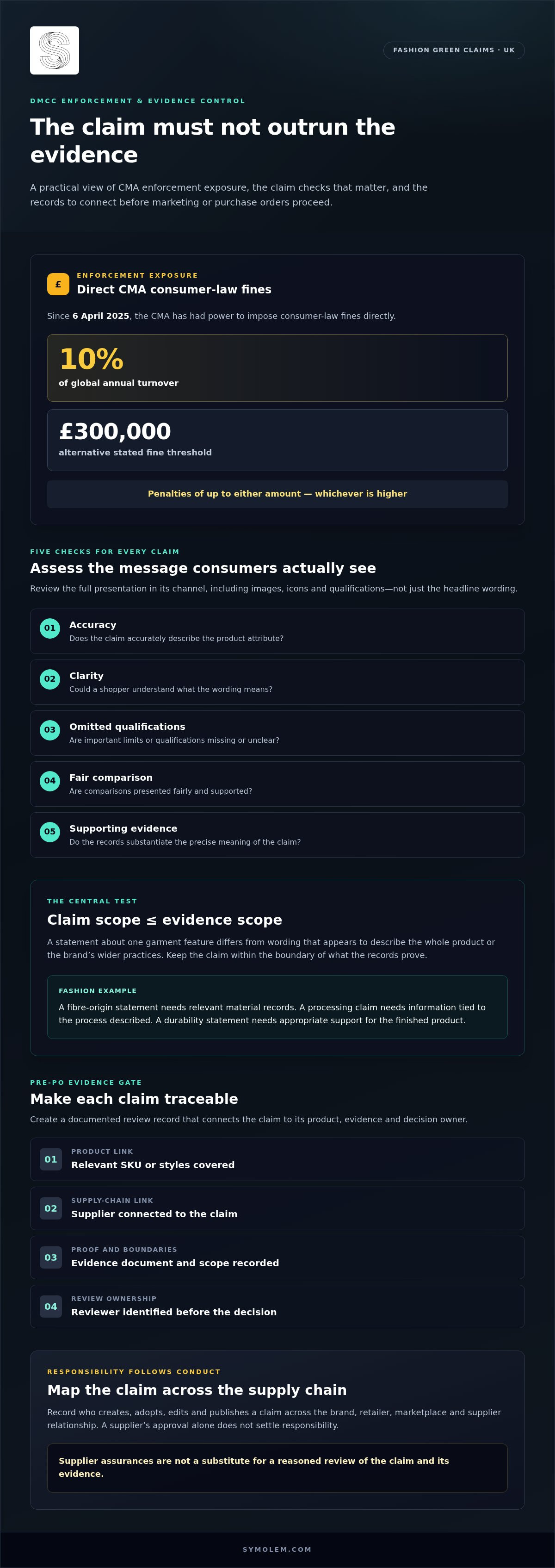
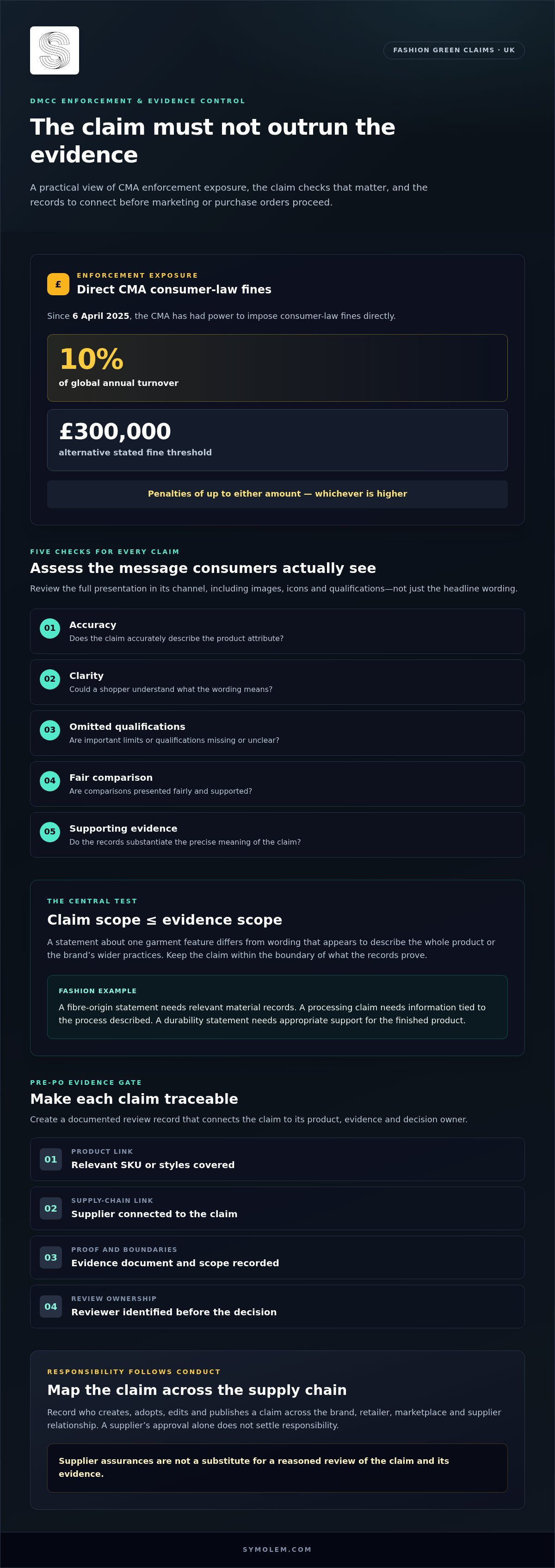
A green claim can travel further than the evidence behind it. Under DMCC green claims enforcement, fashion businesses face scrutiny not only for claims they create, but also for claims they repeat across complex supply chains. Since 6 April 2025, the CMA has had power to impose consumer-law fines directly, with penalties of up to 10% of global annual turnover or £300,000, whichever is higher.
For retailers, marketplaces and brands, that changes the purchase-order calculation. A claim supplied by a brand may depend on fibre-origin records from a spinning mill in India or process evidence from a dyeing house in Turkey, yet the business using that claim still needs a credible basis for it. Supplier assurances alone may leave a critical evidence gap.
This article explains the CMA’s enforcement role, the Green Claims Code principles and how responsibility can extend across retailers, marketplaces, brands and suppliers. It also sets out how to build a documented evidence gate before products are marketed or purchase orders proceed, so teams can assess claims against the evidence available rather than relying on assumptions.
Key Takeaways
- Assess each environmental claim for accuracy, clarity, omitted qualifications, fair comparison and supporting evidence before it appears in marketing or product listings.
- Map who creates, adopts, edits and publishes a claim across the brand, retailer, marketplace and supplier relationship; supplier approval alone doesn’t settle responsibility.
- Use a documented pre-PO review linking each claim to the relevant SKU, supplier, evidence document, scope and reviewer.
- Understanding DMCC green claims enforcement fashion businesses face can help teams turn claim review into a defined buying control, rather than a last-minute marketing check.
- Symolem-ID screens third-party fashion ranges against 50+ global textile regulations, with per-SKU statuses to support pre-PO decisions; screening supports due diligence but doesn’t guarantee legal compliance.
Table of Contents
Why DMCC green-claims enforcement matters to fashion businesses
An unsupported environmental claim can create commercial exposure before a garment reaches the shop floor. A product description may need correction, a listing may be challenged or a buying decision may have to be revisited while teams establish what the available records actually support. The risk is not confined to the wording: unclear evidence can disrupt the hand-off between marketing, merchandising and procurement.
The DMCC Act provides the consumer-law enforcement framework relevant to environmental claims made to shoppers. The CMA Green Claims Code is separate practical guidance on how businesses should communicate those claims. Keeping the two distinct helps teams understand the difference between the legal basis for enforcement and the standards used to assess the impression a claim creates.
The CMA’s video introduces the Code’s role in reviewing environmental claims:
What the DMCC Act changes for green claims
The Act gives the CMA a direct route to enforce consumer protection law, including in cases involving potentially misleading environmental claims. That enforcement framework does not itself determine whether a particular statement is misleading. The substance of the claim and the evidence behind it still need to be assessed under the applicable consumer protection rules, with the Green Claims Code offering practical guidance.
For fashion businesses, DMCC green claims enforcement is the CMA’s use of consumer-law powers to address potentially misleading environmental claims connected with fashion products. Non-compliance can bring enforcement consequences and commercial disruption, including the need to amend or remove claims. The outcome depends on the specific facts and conduct, so a supplier’s assurance should not be treated as a substitute for a reasoned review.
Why fashion claims create specific evidence pressures
Environmental claims can draw on separate parts of a garment’s lifecycle, and the supporting records may sit with different suppliers. Fibre-origin statements require records relevant to the material; claims about processing need information tied to the process described; durability statements need appropriate product-performance support. End-of-life wording must also reflect what the product’s materials and construction allow, rather than relying on a broad assumption about one fibre.
A retailer may promote a brand’s product without controlling how its materials were sourced, processed or assembled. That distance makes evidence hand-offs a real operational challenge, but supply-chain position alone doesn’t determine responsibility; the business’s role and conduct matter. The wider discussion of Sustainable fashion and green claims also highlights why environmental messaging must be considered alongside the complexity of fashion supply chains.
Teams selling across markets should also distinguish UK consumer-law controls from separate EU textile requirements. A useful starting point is to map each claim to the product, relevant evidence and decision owner, then make sure unresolved gaps are visible before the claim informs marketing or buying.
How the CMA assesses fashion green claims and enforcement risk
The CMA considers the impression a claim is likely to create for the consumer seeing it. A product-page headline, garment label and paid campaign can communicate different messages, even when each uses similar wording. Review the complete presentation in its actual channel, including images, icons, qualifications and the point at which a shopper encounters them.
Scope is a useful diagnostic. A statement about one feature of a garment is materially different from wording that appears to describe the whole product or the brand’s wider practices. The scope of a fashion claim must not exceed the scope of the evidence supporting it. For DMCC green claims enforcement fashion reviews, teams should check that both the wording and its presentation stay within that boundary.
Which fashion claims need substantiation?
Claims need evidence that supports their precise meaning, not merely a related attribute. For example, a statement about a garment’s expected lifespan should be supported by information relevant to that finished item, rather than a general statement about the fabric used. The same discipline applies where a claim refers to a product range: records for a sample or single style may not establish that every item in the range shares the stated characteristic.
- Product-specific wording: Check that the evidence identifies the garment or styles covered, rather than relying on a supplier document with unclear product references.
- Range-wide statements: Confirm that the records cover the full set of products implied by the claim, including any variations in materials or construction.
- Qualified wording: Ensure a qualification is visible and understandable at the point where consumers encounter the main statement.
- Brand-level statements: Distinguish evidence about a particular product from evidence that could support a broader description of the business.
These checks help identify a mismatch between what a record proves and what a customer could reasonably understand the claim to mean. A document can be genuine yet insufficient for the broader message presented.
How omissions and comparisons can mislead
Placement affects meaning. A qualification buried below a long product description may not correct a bold headline at the top of the page; a symbol beside a product name may also strengthen an environmental impression beyond the written copy. Review the complete customer-facing display, not only the text submitted for approval.
Comparative claims need a defined reference point. Make clear which products or versions are being compared and ensure the evidence uses a relevant, like-for-like basis. If the comparison depends on a particular period or product configuration, make that context clear rather than leaving shoppers to infer it.
Retail and brand teams can assess a claim as it will appear across product pages, labels and campaigns, then retain the reviewed version with its supporting rationale. This makes the presentation itself part of the review record and gives DMCC green claims enforcement fashion controls a clearer basis for consistent decisions.
Who carries responsibility across a fashion supply chain?
A supplier’s approval of a statement doesn’t automatically remove a retailer’s responsibility for how that statement is presented to consumers. Under the CMA’s approach, the role each business plays matters: who originated the claim, adopted it, changed its wording, published it or placed it prominently before customers. Responsibility depends on the facts and conduct, not simply on where a business sits in the supply chain.
This distinction matters for DMCC green claims enforcement fashion teams because product information can change as it passes from a manufacturer to a brand, then to a retailer or marketplace. A factual statement in a brand’s technical file may become a broader environmental promise when a buyer shortens the copy, adds a badge or uses the claim in promotional material.
Retailers and marketplaces selling third-party fashion brands
A retailer may reproduce a brand’s approved wording unchanged, or it may edit the description, rank the product under an environmental category or add its own headline. Each action affects the overall presentation and is relevant to assessing the retailer’s role. This doesn’t mean every retailer is automatically liable for every supplier statement; the claim, evidence, conduct and applicable consumer law need to be considered.
Buying teams should therefore review the claim and supporting evidence before range approval and purchase orders, not treat supplier sign-off as a substitute for their own assessment. For DMCC green claims enforcement fashion controls, this means documenting what the retailer reviewed and how its own edits or promotional framing affected the claim before approval.
Brands, manufacturers and upstream evidence owners
Consider a fibre-origin statement. A spinning mill in India may hold records about fibre inputs, a dyeing house in Turkey may provide process documentation, and a CMT factory in Portugal may hold garment composition or production records. The brand must connect relevant supplier records to the finished product and ensure the consumer-facing wording doesn’t claim more than those records establish.
Gaps can include missing laboratory tests, transaction certificates or composition records, but the right evidence depends on the specific claim. A contract assigning responsibility for marketing language or supplier documents may define work between businesses; it doesn’t, by itself, demonstrate that a consumer-facing environmental statement is substantiated.
- Supplier: Provides records within its knowledge and control, with enough product or material detail to identify their scope.
- Brand: Maps those records to the finished garment, checks their relevance and approves claim wording.
- Retailer or marketplace: Reviews evidence for the claim it publishes or amplifies, including edits, labels and promotional placement.
Keep this analysis distinct from product-law roles. ESPR responsible-operator obligations concern defined product-law responsibilities; they don’t, on their own, determine who made or communicated a potentially misleading environmental claim. For DMCC green claims enforcement fashion assessments, trace the wording and evidence hand-off at each stage, then record who approved the final consumer presentation.
Build a pre-PO evidence control for fashion green claims
A pre-PO evidence control turns claim review into a buying decision, not a last-minute copy check. It should identify what is being claimed, which product and channel are involved, what records support the statement and who has authority to approve, qualify or block it. For DMCC green claims enforcement in fashion, traceable decisions matter: teams need to show how they assessed the claim before it shaped a listing or purchase order.
A practical claim-to-evidence review sequence
Use the same sequence across brand ranges, product pages and promotional material. A consistent workflow makes missing evidence visible and gives buying, compliance and marketing teams a shared basis for action.
- Capture the claim. Record the exact wording, product or SKU, intended audience, channel and responsible business function. Include relevant imagery, labels and placement, since these can affect the impression the claim creates.
- Define its scope. Identify whether the statement concerns a fibre, component, finished garment, product range or wider brand activity. Record any qualification consumers will see alongside it.
- Match supporting records. Link each claim to the relevant supplier and source document. Check that the record’s date, product coverage and scope support the wording. A fibre-origin record, for example, should be traceable to the material and garment covered by the claim.
- Review the method and limitations. Consider whether the evidence is appropriate to the environmental statement and whether assumptions or boundaries affect what can reasonably be communicated. Textile impact-measurement methods can inform this assessment, but the method and its limits must fit the claim.
- Record the decision. Approve, qualify, reject or request further evidence, with the reviewer, date and rationale recorded. Retain the claim version and evidence reviewed so later changes can be assessed against the original decision.
The minimum record should connect each claim to its SKU, supplier, document, scope and reviewer. Add the decision, review date and any outstanding action. This creates an auditable trail rather than a folder of documents whose relevance to the claim is unclear.
Respond when supplier evidence is missing
Missing, expired or mismatched evidence should change the status of the claim. Don’t replace an unsupported statement with broader marketing language; pause its use, request the specific record needed and assign the request to the supplier tier most likely to hold it. If the gap remains unresolved, escalate it to the designated compliance or buying decision-maker before the listing or order proceeds.
- Substantiated: The evidence supports the wording and product scope reviewed.
- Qualified: A narrower claim may be supportable if the qualification is clear and prominent.
- Blocked or awaiting evidence: The claim shouldn’t proceed while required support is missing or does not match the product.
Reassess the decision when supplier documents, product composition or copy changes. Retailers can use Symolem-ID pre-PO screening to structure third-party range reviews; screening supports due diligence but doesn’t guarantee legal compliance.
Turn DMCC readiness into fashion compliance operations
Readiness must be operational, not a policy document stored outside the buying process. A workable governance model connects the person who owns the claim to the product record, supplier evidence, review decision and purchase-order control. Each hand-off should preserve the wording assessed and the records used, so a change to a material, supplier or product description triggers a fresh review.
This is the control point for DMCC green claims enforcement in fashion: teams should know which claims are supported, which need qualification and which cannot proceed on the evidence available. A screening result supports due diligence, but it doesn’t replace legal judgement or guarantee compliance.
For retailers and marketplaces: screen before signing the PO
Retail buying teams manage third-party ranges at SKU level, often without direct control over manufacturing or every upstream document. Symolem-ID screens third-party brand ranges against 50+ global textile regulations in seconds and assigns each SKU a status: Cleared, Blocked or Missing Evidence. These outcomes help teams identify records or compliance gaps that require attention before purchase orders are signed.
Use the result as an operational input alongside claim-specific review. A status doesn’t certify that every environmental statement is legally sound; the retailer still needs to assess the claim, its presentation and the supporting evidence relevant to the product. The value is earlier visibility: a missing record can be escalated before range approval rather than discovered after a listing or campaign is live.
Screen third-party brand compliance before signing the PO. Explore Symolem-ID or run a free product scan.
For fashion brands: retrieve evidence and substantiate claims
Brands need to connect claims to records that match the garment and the exact wording used with retail stockists. Symolem’s evidence advisory supports green claims verification and forensic retrieval of relevant supplier documentation across Tiers 1-3, including fibre-origin records, chemical laboratory tests, transaction certificates and composition information. The aim is a traceable basis for assessing claim scope, not a broader statement than the evidence can support.
That evidence chain should remain usable as products and supplier information change. Record the source, product coverage and review decision, then provide retail teams with documentation they can assess before purchase. Where records are incomplete, identify the gap and seek the relevant evidence rather than relying on a supplier assurance alone.
Need to retrieve missing Tier 1-3 supplier evidence or substantiate social accounting for retail stockists? Take the 5-minute Free Assessment or Book an Advisory Consultation.
Make evidence part of the buying decision
DMCC green claims enforcement fashion businesses face is a reason to make claim governance routine, not a response assembled after a listing is challenged. Set clear ownership, keep decisions traceable and ensure unresolved evidence gaps reach the people who can pause a claim or buying decision. That discipline helps teams act on new information instead of allowing unsupported wording to move unchecked through marketing and procurement.
Retailers and marketplaces can use pre-PO screening to identify third-party range issues before committing to orders. Symolem-ID provides per-SKU statuses to support that review, while Symolem’s evidence advisory helps fashion brands retrieve and verify supplier records, including chemical tests and fibre-origin documentation. These controls support due diligence; they don’t guarantee legal compliance.
For Retailers & Marketplaces: Screen third-party brand compliance before signing the PO. Explore Symolem-ID or run a free product scan.
For Fashion Brands: Need to retrieve missing Tier 1-3 supplier evidence or substantiate social accounting for retail stockists? Take the 5-minute Free Assessment or Book an Advisory Consultation.
Build the evidence gate into your next buying cycle, and give teams a sounder basis for every claim they choose to make.
Frequently Asked Questions
Does the DMCC Act apply to fashion green claims?
Yes. The DMCC Act can apply where fashion businesses make environmental representations to consumers in connection with selling products. The key issue isn’t whether a garment is marketed as sustainable, but whether the commercial communication falls within consumer protection law and could mislead in context. This may include a brand’s advertising or environmental wording presented through a retailer’s consumer-facing sales channel.
Can a fashion retailer rely on a supplier’s evidence for a green claim?
A retailer can use supplier evidence as part of its assessment, but receiving a document isn’t the same as establishing that it supports the claim. Check that the record is authentic, current and attributable to the relevant product or material, and retain the version reviewed. For example, a supplier certificate may cover a particular production run, while the retail listing continues to describe later batches.
What happens if a fashion brand cannot substantiate an environmental claim?
If a brand can’t substantiate a claim, it risks CMA scrutiny and possible enforcement consequences under consumer law. The commercial effects can extend beyond the regulator: a stockist may suspend a listing, request supporting records or require corrected product information under its own processes. Brands should also preserve the claim versions and related approvals so they can establish what was communicated and to whom.
How should retailers check green claims before signing a purchase order?
Build the check into range approval, and include evidence requirements in the buying workflow so claims aren’t treated as an afterthought. Pay particular attention to product variants: a claim supported for one fabric composition may not fit every colourway or revised style. Set a named decision owner and a route for escalating unresolved questions, then make the purchasing decision in light of that review.
Does the DMCC Act make suppliers and retailers automatically jointly liable?
No. The DMCC Act doesn’t impose automatic joint liability on every supplier and retailer connected to a product. Assessment depends on the circumstances and each business’s involvement in the relevant consumer communication. A commercial contract may allocate tasks between parties, but it doesn’t determine by itself how a regulator would assess a particular claim or the conduct of each business.
Is the EU EmpCo Directive the same as the UK DMCC Act?
No. They are separate frameworks with different legal bases and territorial application. Directive (EU) 2024/825, known as EmpCo, has applied since 27 September 2026, while the DMCC Act forms part of UK law. A fashion business selling in both markets should identify which rules apply to each consumer-facing activity and avoid assuming that a UK review alone addresses EU requirements.