Implementing Digital Product Passports: A Strategic Framework for Textile Compliance
Is your supply chain built on verifiable data or on the fragile hope that regulators won't scrutinize the structural gaps in your Tier 4 reporting? Transparency is now mandatory. The era of voluntary disclosure ended on July 19, 2026, when the Ecodesign for Sustainable Products Regulation (ESPR) became the definitive legal floor for market entry, making the process of implementing Digital Product Passports a critical business imperative. You're likely struggling with the reality that fragmented supplier data and the complexity of mapping up to 236 data points in the UNTP schema represent a systemic risk to your operations.
Software alone won't bridge this gap. This article outlines a rigorous framework for compliance, ensuring your infrastructure meets the technical standards published in the EU Official Journal as of July 2026. By mastering these requirements, you move from reactive compliance to a position of strategic integrity. We'll dismantle the complexity of the current regulatory landscape and provide a clinical roadmap for integrating verifiable data into your business model before mandatory textile enforcement takes hold.
Key Takeaways
- Understand the non-negotiable legal requirements of ESPR (EU) 2024/1781 to secure continued market access and mitigate the risk of regulatory penalties.
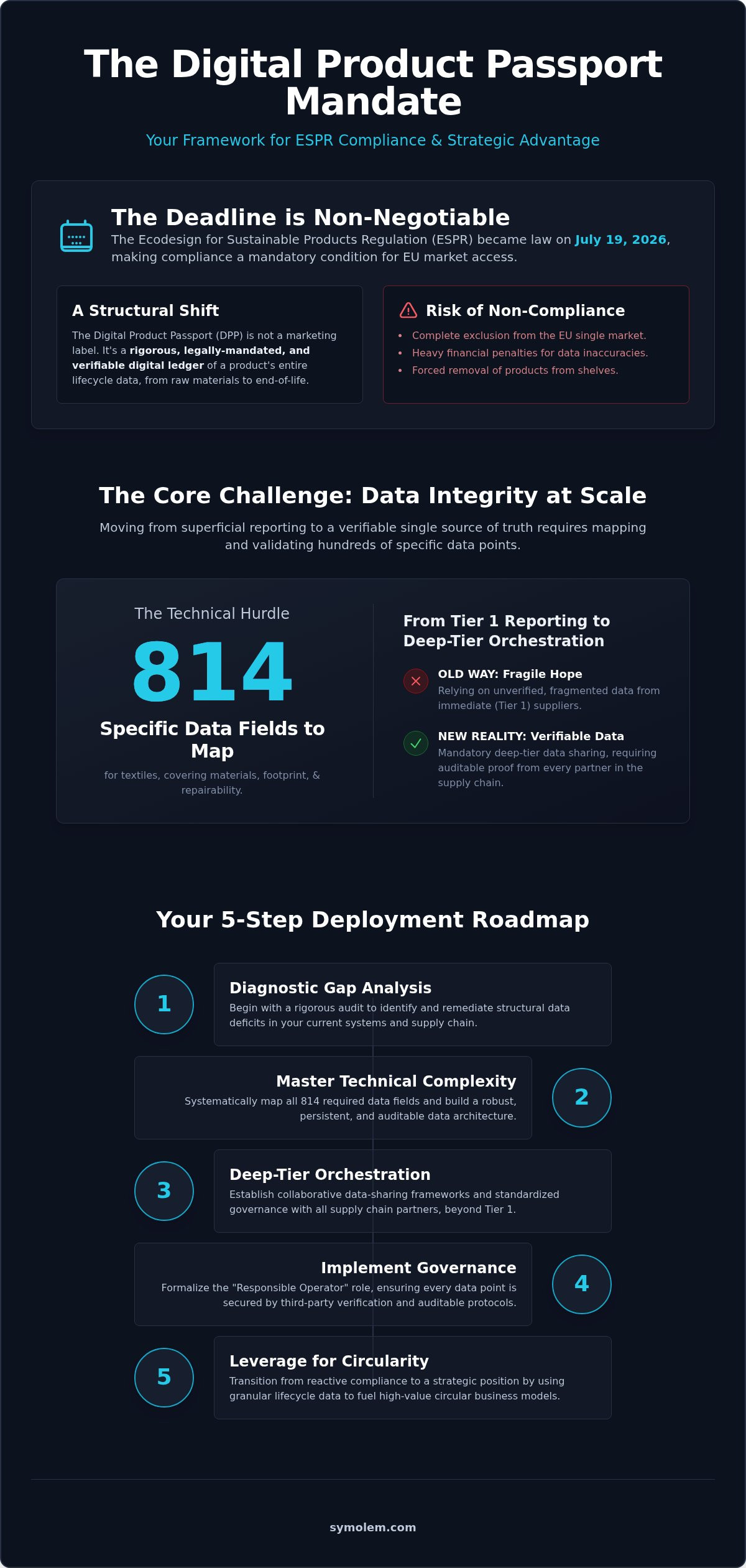
- Master the technical complexity of implementing Digital Product Passports by mapping 814 specific data fields to establish a clinical, verifiable source of truth.
- Shift from superficial Tier 1 transparency to deep-tier supply chain orchestration through collaborative data sharing and standardized governance frameworks.
- Execute a structured five-step deployment roadmap that begins with a rigorous diagnostic gap analysis to identify and remediate structural data deficits.
- Leverage granular product lifecycle data to transition from reactive compliance to a strategic position within the emerging high-value circular economy.
Table of Contents
- The Regulatory Mandate: Why DPP Implementation is Non-Negotiable in 2026
- Data Architecture and Mapping: The Technical Core of the Passport
- Supply Chain Orchestration: Moving Beyond Tier 1 Transparency
- Deployment Roadmap: A 5-Step Execution Framework for Fashion Brands
- Strategic Advisory: Integrating DPP into Circular Business Models
The Regulatory Mandate: Why DPP Implementation is Non-Negotiable in 2026
Compliance is no longer a marketing choice. It's a structural requirement for market access. The Ecodesign for Sustainable Products Regulation (ESPR) (EU) 2024/1781 became applicable on July 19, 2026, fundamentally altering the legal landscape for any brand operating within the European Union. Central to this shift is the Digital Product Passport, which functions as a systemic digital container for a product's entire lifecycle data. This isn't a digital label. It's a rigorous, verified ledger of environmental and circularity metrics that ensures systemic integrity across the single market.
Implementing Digital Product Passports requires moving past the era of vague sustainability storytelling. Regulators now demand granular, verifiable data points that prove a product's durability, repairability, and material composition. Brands that rely on aspirational narratives rather than clinical data mapping face immediate exclusion from the single market. With the delegated act for textiles expected in 2027, the window for structural diagnostic action is closing. 2026 is the year for building the architectural foundation of your data governance.
ESPR and the Shift to Product Accountability
The ESPR introduces the "Responsible Operator" role, a legal designation that carries significant liability for data accuracy. You can't hide behind unverified supplier certificates anymore. Third-party verification is now the baseline for compliance, meaning every data field must be auditable and secure. This shift necessitates a comprehensive ESPR readiness diagnostic to identify where your current systems fail to meet the new legal floor. Failure to establish these protocols creates a liability chain that could result in heavy fines or the complete removal of products from EU shelves.
Textile-Specific Requirements: Beyond the QR Code
Apparel and footwear face unique scrutiny. The textile-specific requirements go far beyond a simple QR code on a care label. Data must be machine-readable and interoperable, adhering to the six product-agnostic standards published in July 2026, specifically EN 18216:2026 through EN 18223:2026. Implementing Digital Product Passports without a strategic automation framework invites administrative red tape that can paralyze your operations. You need a system that integrates with existing PLM and ERP structures to ensure data flows seamlessly from the factory floor to the central EU registry without human error or data corruption.
Data Architecture and Mapping: The Technical Core of the Passport
Data integrity is the bedrock of the Ecodesign for Sustainable Products Regulation. Implementing Digital Product Passports isn't a surface-level digital transformation; it's a fundamental reconfiguration of how your brand identifies, validates, and shares product lifecycle information. The technical core of this transition lies in establishing a single source of truth that survives the complexity of global supply chains. You aren't just collecting data; you're building a persistent, auditable architecture that must remain accessible for decades. This requires a shift from siloed spreadsheets to integrated digital ecosystems.
Standardization is the only defense against administrative chaos. Utilizing the GS1 Digital Link ensures that product identification is both persistent and interoperable across different systems and stakeholders. This infrastructure allows for the secure management of proprietary information through selective disclosure, ensuring regulatory transparency doesn't compromise your competitive advantage. Establishing this governance requires a clinical focus on verification rather than just aggregation. Without a robust identification standard, your data becomes a liability rather than a strategic asset in the circular economy.
Mapping DPP Data Fields for Apparel
Textiles demand a granular level of detail that few existing PLM systems can support. You must categorize data across material composition, environmental footprints, and specific repairability metrics. Life Cycle Assessment (LCA) data becomes the primary engine for populating these technical attributes, requiring rigorous primary data from deep-tier suppliers. The up to 236 data points in the UNTP schema challenge represents the primary barrier to compliance for fashion brands attempting to navigate these requirements without a structural framework. Success depends on your ability to automate the population of these fields while maintaining verifiable accuracy throughout the product's lifespan.
Technical Interoperability and the EU Registry
The central EU DPP Registry, operational since July 2026, acts as a central index rather than a data silo. Your internal architecture must interact seamlessly with this registry, adhering to the United Nations Transparency Protocol (UNTP) standards to ensure global interoperability. This trust framework relies on verifiable credentials to prove the authenticity of every claim. If you haven't yet audited your current data stacks, a strategic ESPR readiness diagnostic is the necessary first step to identify structural deficits in your technical mapping. Implementing Digital Product Passports requires a strategic alignment between your IT infrastructure and the evolving regulatory standards of the European Commission to ensure long-term market viability.
Supply Chain Orchestration: Moving Beyond Tier 1 Transparency
Tier 1 visibility is a strategic illusion. Most fashion brands operate with a profound disconnect from the deep-tier manufacturing processes where the majority of environmental impacts occur. For those implementing Digital Product Passports, this lack of visibility represents a critical compliance failure. You can't populate a passport with "unknown" attributes for fiber origin or chemical usage at the wet processing stage. Moving beyond Tier 1 is no longer a goal for the few; it's a mandatory requirement for any operator wishing to remain in the EU market. The structural failure of current supply chain mapping must be addressed through clinical, diagnostic rigor rather than aspirational sentiment.
Orchestrating this data flow requires a shift from coercive mandates to collaborative incentives. Suppliers in global value chains often view data requests as an administrative burden or a threat to their competitive secrets. To solve this, brands must deploy automated data collection systems that reduce friction and ensure standardized reporting across disparate geographies. This isn't just about gathering information. It involves auditing the audit to verify that the data provided by a Tier 4 spinning mill is as accurate as the data from a Tier 1 garment factory. Verification is the only currency that matters to EU regulators.
Bridging the Gap Between Importers and Manufacturers
The legal burden of data accuracy rests squarely on the "Responsible Operator." For own-label brands, this means navigating the "Article 14" import obligations, which dictate that importers are legally liable for the technical documentation of the products they place on the market. Managing this data flow between global manufacturers and EU importers requires a clinical diagnostic approach. You need strategies for cost-effective verification in emerging markets where digital infrastructure may be fragmented. Aligning with EURATEX industry priorities ensures that your strategy accounts for the practical realities of SME suppliers while maintaining the rigor required by EU regulators.
Data Security and IP Protection
Transparency doesn't mean the end of intellectual property. Brands can utilize encryption and selective disclosure protocols to share compliance data without exposing sensitive trade secrets or proprietary material blends. Decentralized identifiers (DIDs) play a pivotal role here, allowing brands to maintain control over their data while providing the necessary transparency to market surveillance authorities. This level of technical verification is essential for robust Textile Impact Measurement and MRV. Implementing Digital Product Passports without a secure, decentralized trust framework turns your compliance strategy into a structural vulnerability rather than a tool for systemic integrity.
Deployment Roadmap: A 5-Step Execution Framework for Fashion Brands
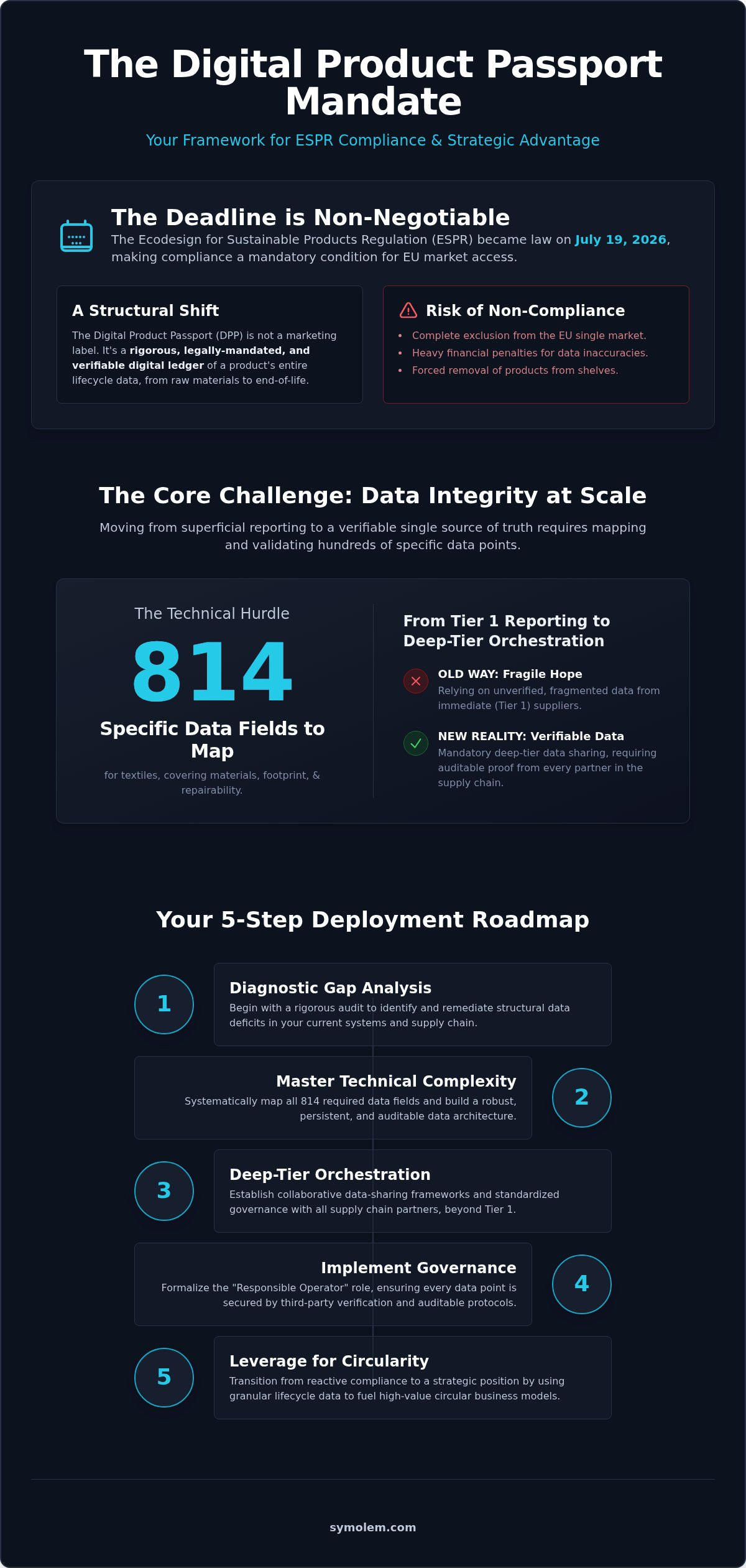
Execution is the only differentiator. For fashion brands, the process of implementing Digital Product Passports is not a procurement exercise but a rigorous reconfiguration of the corporate data architecture. Success depends on a methodical transition from diagnostic discovery to technical scaling. This five-step framework provides the clinical roadmap necessary to ensure systemic integrity and regulatory compliance:
- Step 1: Conduct a comprehensive ESPR Gap Analysis to identify data deficits.
- Step 2: Define your data governance framework and select interoperable standards.
- Step 3: Pilot implementation on a high-risk product category, such as denim or outerwear.
- Step 4: Scale data collection through supplier integration and automated MRV.
- Step 5: Integrate DPP data into consumer-facing circular services like repair and resale.
Phase 1: Diagnostic and Discovery
Structural failure begins with hidden data silos. You must map the existing fragmentation within your PLM, ERP, and SCM systems to expose where information is missing, unverified, or entirely absent. This stage requires establishing the uncompromising economic reality: the cost of implementation is high, but the cost of market exclusion due to non-compliance is terminal. Identifying the "Responsible Operator" within the corporate hierarchy is a legal necessity. This individual or department carries the liability for every data field's accuracy, making clear accountability the first step toward building a verifiable trust framework. You cannot manage what you haven't audited with clinical precision.
Phase 2: Technical Execution and Scaling
The choice between a proprietary build and third-party compliance platforms is a strategic inflection point. Your architecture must support the GS1 Digital Link resolver to ensure global product access and persistent identification across the single market. Real-time data updates are non-negotiable. As products move through their lifecycle, the passport must reflect changes in ownership, repair status, and eventual recycling potential. This requires a seamless integration between your digital infrastructure and physical supply chain operations. Implementing Digital Product Passports at scale demands a shift toward automated MRV systems that eliminate human error. To begin this transformation and identify your specific technical gaps, secure your position by initiating an ESPR readiness diagnostic today.
Strategic Advisory: Integrating DPP into Circular Business Models
Compliance is the baseline. Circularity is the competitive edge. While the immediate pressure of 2026 centers on market access, the long-term economic winners will be those who view the process of implementing Digital Product Passports as a tool for value recovery rather than a mere regulatory hurdle. Transitioning from "Passports for Compliance" to "Passports for Circularity" requires a fundamental shift in how brands value their post-consumer products. By establishing a persistent digital identity for every garment, you create the technical infrastructure necessary to scale repair, reuse, and high-value recycling programs that were previously hindered by information asymmetry.
The economics of textile recovery depend entirely on data integrity. High-value textile-to-textile recycling is currently plagued by high sorting costs and material contamination, issues that are directly addressed by the granular data contained within a Digital Product Passport. When recyclers can instantly verify fiber blends and chemical finishes through a machine-readable ID, the cost of feedstock preparation drops significantly. This systemic efficiency transforms the circular economy from an ethical sentiment into a clinical economic reality, positioning your brand as a leader in both regulatory readiness and structural innovation.
Unlocking New Revenue Streams
Data is the primary currency of the secondary market. By implementing Digital Product Passports, brands can provide instant authentication for resale platforms, eliminating the risk of counterfeits and increasing the residual value of their products. This verifiable provenance supports higher price points in the pre-owned market and facilitates automated sorting for industrial recyclers who require precise material specifications. For a deeper understanding of the financial implications, review our Cost-Benefit Analysis of Circular Textile Models to see how data-driven recovery impacts the bottom line.
The Symolem Approach: Diagnostic-Led Implementation
Software is a tool, not a strategy. In a high-stakes legal environment where non-compliance results in market exclusion, relying on a software-only solution without a rigorous strategic framework is a critical business risk. Symolem provides the diagnostic-led advisory necessary to bridge the gap between complex EU mandates and technical execution. We meticulously map the 814 required data fields to ensure your organization achieves long-term ESPR readiness while maintaining operational efficiency. Don't leave your market access to chance. Secure your supply chain’s future with a Symolem ESPR Readiness Diagnostic and move from reactive compliance to strategic systemic integrity.
Securing Market Access through Systemic Data Integrity
The transition from voluntary sustainability claims to mandatory regulatory accountability is final. Implementing Digital Product Passports represents a fundamental reconfiguration of your brand's relationship with its value chain. Success requires moving beyond surface-level transparency to master the technical mapping of 814 specific data fields. It's not a project you can solve with software alone; it demands a strategic architecture that integrates regulatory requirements with economic reality.
Brands that act now will secure their position in the EU single market while those that delay face structural exclusion. Symolem provides the clinical diagnostic precision needed to bridge the gap between policy mandates and technical execution. As independent policy advisors for global textile value chains, we specialize in building the frameworks that turn compliance into a competitive advantage. Book an ESPR Readiness Diagnostic with Symolem to ensure your infrastructure is resilient enough for the circular economy. Your path to systemic integrity begins with a diagnostic-led strategy.
Frequently Asked Questions
What is the deadline for implementing Digital Product Passports for textiles?
The likely timeframe for mandatory textile compliance is between 2028 and 2029. While the Ecodesign for Sustainable Products Regulation became applicable on July 19, 2026, the specific delegated act for apparel and footwear is expected in 2027. Enforcement typically begins 18 to 36 months after that publication. Brands should use 2026 to establish their data governance before the legal floor rises and market access is restricted.
How much does it cost to implement a Digital Product Passport system?
Implementation costs vary based on supply chain complexity and existing digital maturity. You'll need to account for infrastructure upgrades, data mapping labor, and third-party verification fees. Organizations must weigh the capital expenditure of implementing Digital Product Passports against the terminal cost of market exclusion. Strategic diagnostics often reveal that the efficiency gains in data orchestration offset the initial structural investment over time through improved lifecycle management.
What specific data fields are required for a textile DPP under ESPR?
Current frameworks identify up to up to 236 data points in the UNTP schema required for full textile compliance. These include material composition, recycled content percentages, and specific environmental footprint metrics. While a 2026 preparatory study suggested a smaller subset of 49 points, the final delegated act will likely demand much higher granularity. You must map every attribute from fiber origin to chemical usage at the wet processing stage to ensure verifiable integrity.
Can we use existing QR codes for Digital Product Passport compliance?
Existing QR codes are insufficient unless they adhere to the specific interoperability standards published in July 2026. Compliance requires a machine-readable data carrier that utilizes the GS1 Digital Link standard for persistent identification. If your current codes only lead to a static marketing page, they fail the legal requirement for lifecycle data access. Your infrastructure must support real-time updates through a standardized resolver. This transition demands a shift toward verifiable technical architecture.
Who is legally responsible for the data in a Digital Product Passport?
The "Responsible Operator" holds the primary legal liability for the accuracy and accessibility of passport data. For own-label brands, this is typically the importer or the manufacturer placing the product on the EU market. This role carries significant liability for data corruption or non-compliance. You can't delegate this responsibility to a software provider or an unverified supplier; the legal floor remains with the operator who manages the product's market entry.
How does the DPP impact UK fashion brands selling into the EU?
UK brands must comply with the ESPR to maintain access to the EU single market. Since the regulation applies to products "placed on the market," any item sold within the EU must carry a valid passport regardless of the brand's headquarters. This creates a de facto global standard. Failure to align your data architecture with EU requirements results in immediate border friction and potential seizure of non-compliant goods by market surveillance authorities.
What is the role of the EU DPP Registry in the implementation process?
The EU DPP Registry serves as a central index that allows market surveillance authorities to verify the existence of a valid passport. It doesn't store your proprietary product data. Instead, it links to your brand-level data carrier. Implementing Digital Product Passports requires your internal systems to interact seamlessly with this registry to ensure that every SKU is registered and auditable by regulators in real-time. This ensures systemic transparency across the entire single market.
How do we protect trade secrets while complying with DPP transparency rules?
You can protect intellectual property through selective disclosure and encryption protocols. The regulation requires transparency for specific environmental metrics but allows proprietary material blends or supplier identities to remain confidential in certain contexts. Utilizing decentralized identifiers and secure data layers ensures you meet the legal floor for transparency without exposing your competitive advantage. Strategic data governance is the only way to balance these competing imperatives. Clinical precision in data mapping prevents accidental IP leakage.