Textile Industry Regulatory Risk Management: A Structural Redesign for 2026
What if the greatest threat to your brand isn't a market downturn, but a structural failure to map up to 236 data points in the UNTP schema before the 2026 deadline? Most fashion executives treat compliance as a legal box to check. This reactive posture is a terminal strategy in a landscape defined by the Ecodesign for Sustainable Products Regulation. Effective textile industry regulatory risk management is no longer about avoiding fines; it's about redesigning the economic value of every garment you produce. The shift from voluntary ethical narratives to mandatory, legally enforceable frameworks, such as the EU's July 19, 2026, ban on destroying unsold goods, requires a clinical audit of your entire supply chain.
You likely feel the pressure of fragmented data and the looming launch of the central Digital Product Passport registry. It's clear that the old ways of managing supply chain opacity are collapsing under the weight of new EU and California mandates. This article provides the structural roadmap you need to build a cost-effective circular infrastructure and secure your brand's position through verified data systems. We'll examine the mechanics of ESPR readiness, the technical requirements of DPP mapping, and the strategic transition from reactive firefighting to systemic resilience.
Key Takeaways
- Transition from aspirational sustainability to a rigorous framework for textile industry regulatory risk management that addresses the 2026 EU mandate.
- Analyze the interconnected mechanics of ESPR, DPP, and EPR to ensure your brand's infrastructure is built for systemic integrity rather than reactive compliance.
- Map the complex technical architecture required for Digital Product Passports, specifically addressing the up to 236 data points in the UNTP schema necessary for regulatory verification.
- Protect profit margins by abandoning superficial sustainability fixes in favor of a structural redesign that integrates circularity into the core business model.
- Implement a clinical diagnostic process to identify regulatory gaps and establish a cost-effective roadmap for the 2026 legislative transition.
Table of Contents
The Shift from Voluntary Ethics to Mandatory Systemic Risk
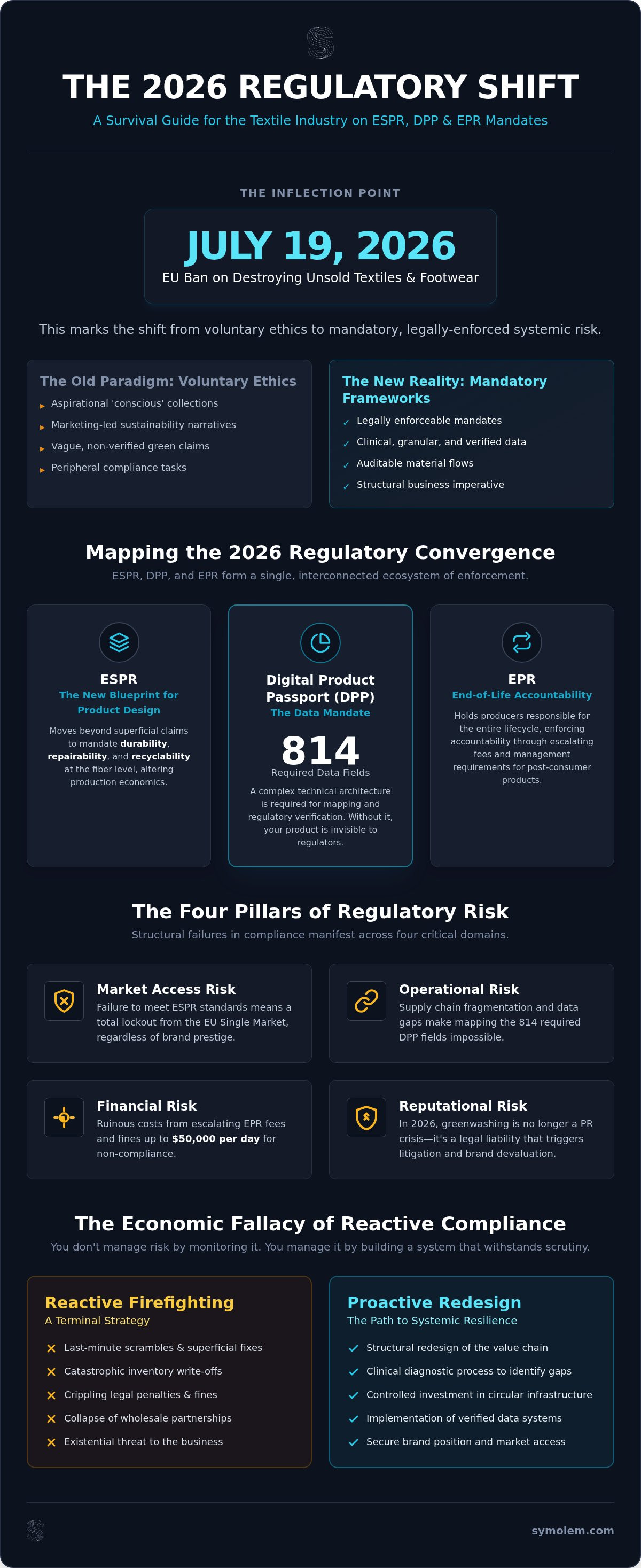
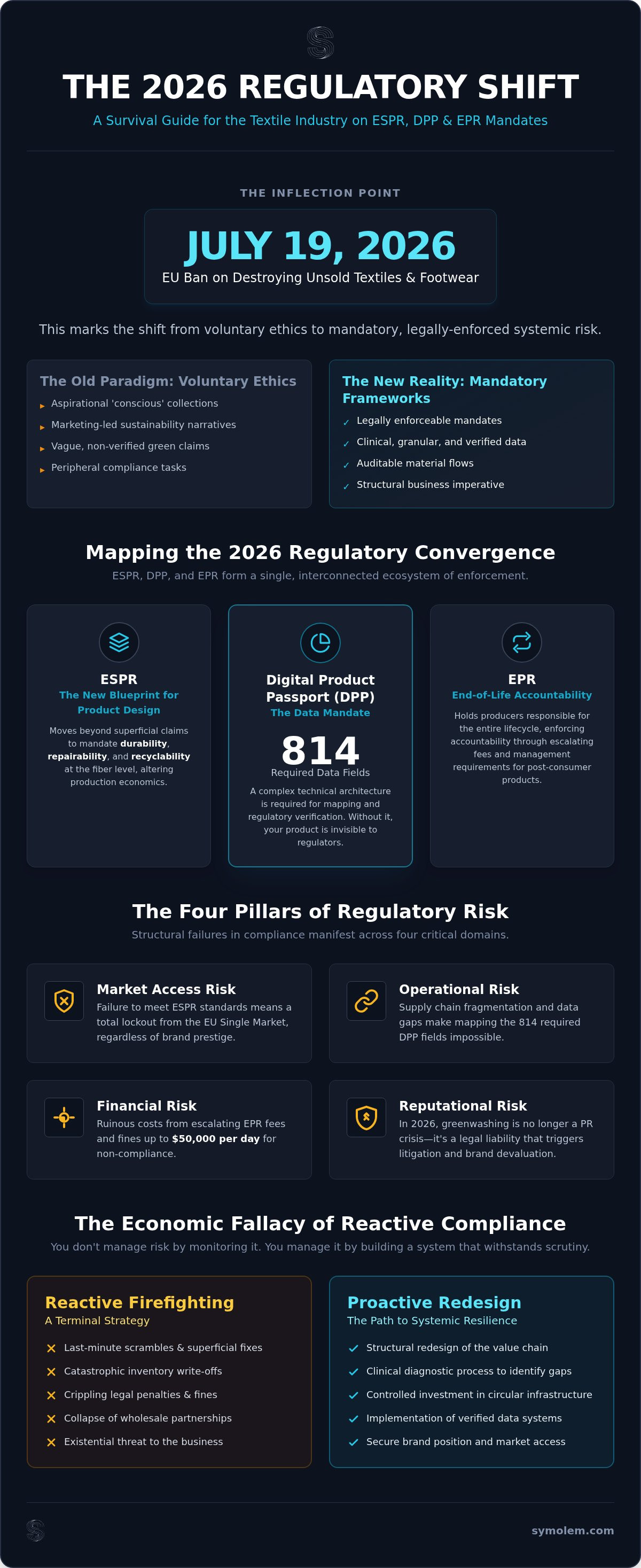
Sustainability is no longer a marketing choice. It's a legal mandate. For decades, the fashion sector operated within a vacuum of voluntary commitments and soft-focus 'conscious' collections. That era ended with the adoption of the Ecodesign for Sustainable Products Regulation (ESPR). We must now define textile industry regulatory risk management as a structural business imperative rather than a peripheral compliance task. By July 19, 2026, large enterprises face an absolute prohibition on destroying unsold textiles and footwear within the EU. This isn't a suggestion; it's a hard stop for traditional inventory management. The year 2026 represents the ultimate inflection point where global value chains must either integrate verified data or face exclusion from the world's most lucrative markets.
The Collapse of Aspirational Sustainability
Marketing-led narratives are failing. The EU Green Claims Directive has effectively criminalized the vague, non-verified terminology that previously defined brand communication. You can't rely on ethical sentiment when the law demands clinical, granular proof across hundreds of distinct data points. In the context of global textile industry regulations, the only valid currency is verified data. Moving from a 'doing less harm' mindset to one of systemic integrity requires a total audit of material flows. If your data isn't auditable, your product doesn't exist in the eyes of the regulator. Brands that continue to prioritize storytelling over structural verification will find themselves sidelined by enforcement agencies that value technical accuracy over brand heritage.
Identifying the Four Pillars of Regulatory Risk
Structural failures in compliance manifest across four distinct domains. First, market access risk. Failure to meet ESPR standards means a total lockout from the EU Single Market, regardless of brand prestige. Second, operational risk. Most brands suffer from supply chain fragmentation where data gaps make mapping the 814 required DPP fields impossible. Third, financial risk. Between California's SB 707 fines of up to $50,000 per day for intentional violations and escalating EPR fees, the cost of non-compliance is ruinous. Finally, reputational risk. In 2026, greenwashing isn't just a PR crisis; it's a legal liability that triggers immediate litigation and brand devaluation.
The cost of a proactive structural redesign is significant, yet it's a controlled investment. Compare this to the existential risk of reactive compliance, where last-minute scrambles lead to inventory write-offs, legal penalties, and the collapse of wholesale partnerships. You don't manage risk by monitoring it. You manage it by building a system that can withstand scrutiny.
Mapping the 2026 Regulatory Convergence: ESPR, DPP, and EPR
Regulatory silos are collapsing. The EU Strategy for Sustainable and Circular Textiles provides a master blueprint that synchronizes design mandates, transparency requirements, and end-of-life accountability. This convergence forces a total rethink of textile industry regulatory risk management. It's no longer enough to monitor individual policies in isolation. You must now view ESPR, Digital Product Passports, and Extended Producer Responsibility as a single, interconnected ecosystem of enforcement. Failure in one area, such as data mapping, inevitably triggers failure in others, like market access or financial liability management.
ESPR: The New Blueprint for Product Design
The Ecodesign for Sustainable Products Regulation (ESPR) fundamentally alters the economics of production. It moves beyond superficial recycled content claims to mandate durability, repairability, and recyclability at the fiber level. Perhaps the most disruptive measure is the July 19, 2026, ban on the destruction of unsold textiles and footwear for large enterprises. This mandate transforms excess inventory from a manageable write-off into a legal and financial liability. Brands must pivot toward circular business models or face ruinous penalties. Utilizing an ESPR readiness diagnostic allows firms to identify these design-phase gaps before they manifest as market exclusion. It's a clinical tool for assessing whether your current product architecture can survive the 2026 transition.
Digital Product Passports: Technical Data Governance
Data is the new barrier to entry. The Digital Product Passport (DPP) is frequently misunderstood as a simple QR code on a care label. In reality, it's a complex data governance framework requiring the mapping of up to 814 distinct data fields per product. This level of transparency demands a decentralized yet secure infrastructure where data ownership and verification are paramount. Most supply chains are currently too fragmented to support this requirement. Understanding the challenges of Digital Product Passport implementation is critical for any brand that intends to maintain its position in the EU market. Without a robust system for impact measurement and MRV, your DPP will be a hollow shell that invites regulatory scrutiny rather than providing a safe harbor.
The regulatory pressure is compounded by Extended Producer Responsibility (EPR) and the Corporate Sustainability Due Diligence Directive (CSDDD). EPR schemes, such as California's SB 707, transform textile waste into a permanent balance-sheet liability. Meanwhile, CSDDD forces brands to conduct rigorous due diligence across their entire global value chain, holding them legally responsible for environmental and human rights violations. This isn't a transition; it's a structural purge of inefficient supply chains. Conducting a high-level diagnostic is the only way to map these requirements against your current operational reality.
The Economic Fallacy of Reactive Compliance
Treating compliance as a short-term legal expense is a fundamental economic error. It ignores the reality that textile industry regulatory risk management is a matter of structural redesign, not bureaucratic box-ticking. Many brands still view sustainability as a 'bolted-on' feature, a layer of marketing applied to an existing, linear business model. This perspective is financially dangerous. Reactive strategies create permanent technical debt, where fragmented data systems and manual collection processes lead to escalating operational overhead. In France, where textile EPR is already enforced, fines for non-compliance can reach €7,500 per unit. A wait-and-see approach is a recipe for disaster when navigating EPR for textiles, as late adopters will be forced to pay premium rates for recovery services that they failed to secure through early infrastructure investment.
The True Cost of Data Fragmentation
Data fragmentation is a transparency tax that drains margins. When supply chain information is siloed across disparate spreadsheets and manual emails, the cost of verification skyrockets. Systematic data collection is the only way to survive the EU's stricter verification protocols. Audit failure is not just a PR risk; it's a market access barrier. Effective firms are already navigating environmental regulations in the textile industry by mapping their technical architecture to the 814 DPP data fields before the 2026 deadline. Manual collection is no longer viable in a global value chain that demands clinical precision and real-time accountability.
Infrastructure vs. Narrative
The era of storytelling is over. Brands must shift their capital from creative campaigns to physical and digital infrastructure. Investing in circular systems and MRV (Measurement, Reporting, and Verification) is a high-stakes risk-mitigation strategy. This transition requires a clinical view of infrastructure costing, moving away from aspirational claims toward verifying textile sustainability claims for ESPR. With inventory levels reaching record highs in 2024, holding stock 21% longer than before the pandemic, the inability to manage end-of-life textiles is a structural failure that no amount of marketing can fix. Building systemic integrity is the only way to secure long-term stability.
A Structural Framework for Regulatory Risk Mitigation
Mitigation is not a policy; it's a structural process. To transition from reactive compliance to systemic resilience, brands must adopt a clinical framework that treats textile industry regulatory risk management as a core engineering challenge. This process requires a methodical approach to identifying and sealing technical gaps before they trigger legal penalties. A robust framework consists of five critical steps:
- Regulatory Gap Analysis: Pinpoint specific technical failures within the current value chain where data is lost or misreported.
- Technical Data Architecture: Map the flow of information from Tier 4 suppliers to the final consumer interface to ensure it's seamless and immutable.
- Economic Modeling: Calculate the precise financial impact of Extended Producer Responsibility (EPR) on per-unit margins.
- Impact Measurement: Implement a verification-ready system that meets the rigorous standards of the EU's MRV requirements.
- Procurement Redesign: Alter design cycles to prioritize material durability and chemical transparency, effectively removing non-compliant fibers at the source.
Mapping the 814+ DPP Data Fields
Technical requirements for apparel manufacturers and retail buyers have reached a level of unprecedented complexity. Mapping the up to 236 data points in the UNTP schema required for the Digital Product Passport is a monumental task that demands total interoperability across global supply chain partners. This isn't just about data entry; it's about data integrity. Every field, from fiber origin to chemical finishing, must be verified through a robust MRV system to withstand EU regulatory scrutiny. Conducting a cost-benefit analysis of circular textile models is a 2026 strategic mandate for any brand attempting to justify the technical and operational shift required for these passports. Without this economic grounding, data mapping becomes a cost center that threatens the very viability of the product line.
Infrastructure Costing and Modeling
Moving from theoretical circularity to operational reality requires a cold, hard look at infrastructure costing. Designing cost-effective recovery systems for end-of-life textiles is the only way to protect margins as EPR fees escalate globally. You must build systems that can actually recover, sort, and reprocess fibers at scale, rather than relying on third-party services that will inevitably raise prices as demand surges. This modeling is a diagnostic requirement to ensure that circularity doesn't collapse under its own weight. Protecting your brand's future requires a technical architect who understands the granular details of global operations. To begin your transition, secure an ESPR Readiness Diagnostic and identify the structural gaps in your current risk management strategy.
Symolem’s Diagnostic Approach to Systemic Integrity
Compliance isn't a destination; it's a structural state. Symolem operates as a technical and strategic architect, filling the critical gap between high-level policy and granular operational reality. We don't provide soft-focus advisory or superficial marketing narratives. Instead, we deliver the intellectual rigor required to rebuild global value chains for systemic integrity. At the center of our approach is the ESPR Readiness Diagnostic. This is a clinical audit designed to strip away the opacity of your current supply chain and expose the structural failures that threaten your market access. Effective textile industry regulatory risk management requires an independent voice that prioritizes truth over comfort, ensuring your data systems are verified and auditable before the 2026 enforcement window closes.
The transition involves more than just monitoring new laws. It's about understanding the textile regulation impact on business models and how the 2026 EU landscape redefines the very nature of fashion retail. Symolem provides the framework to navigate this shift, moving your organization from a state of reactive panic to one of strategic stability. We focus on the mechanics of material flows and data verification, treating every garment as a technical asset that must carry its own proof of compliance.
Expert-Led Implementation Frameworks
Independent scrutiny is essential for regulatory readiness. Internal teams often lack the clinical distance required to identify systemic weaknesses in data architecture or infrastructure costing. Symolem moves beyond standard policy advisory by providing implementation frameworks that translate legal mandates into technical requirements. We help you map the mechanics of circularity, ensuring that your impact measurement and MRV systems meet the uncompromising standards of EU and California regulators. Securing your brand's future in a regulated global market isn't a task for generalists; it requires a specialist who understands the physics of global supply chains.
Next Steps: Securing Your 2026 Roadmap
The timeline for compliance is non-negotiable. With the EU Digital Product Passport registry scheduled to be operational by July 19, 2026, and California's SB 707 registration deadline falling on July 1, 2026, the work must begin immediately. Engaging with Symolem for a comprehensive ESPR Readiness Diagnostic is the first step in stabilizing your operations. We provide the diagnostic precision needed to build a cost-effective circular infrastructure that protects your margins and your reputation. Contact Symolem for a high-stakes strategic consultation to secure your 2026 roadmap and ensure your organization is a survivor of the regulatory transition.
Building Systemic Resilience for the 2026 Mandate
The transition from voluntary sustainability to mandatory systemic integrity is a structural reality that can't be managed through superficial narratives. Success in this new landscape depends on treating compliance as a core business engineering challenge rather than a peripheral legal expense. Effective textile industry regulatory risk management requires a total audit of material flows and the precise mapping of technical data fields before the 2026 enforcement window closes. Brands that fail to integrate verified data into their operational architecture face not just fines, but total market exclusion.
Symolem acts as a technical architect for global textile value chains, providing the independent scrutiny required to navigate these high-stakes requirements. Our approach involves the expert mapping of 814 DPP technical fields and the application of rigorous diagnostic frameworks to seal operational gaps. You can Secure Your 2026 Compliance Strategy with Symolem to ensure your brand is built on a foundation of systemic integrity. While the regulatory burden is significant, the organizations that redesign their systems today will define the economic reality of the industry tomorrow. Your path to a resilient, circular future starts with a clinical diagnostic.
Frequently Asked Questions
What is the primary objective of textile industry regulatory risk management?
The primary objective of textile industry regulatory risk management is to transition a brand from reactive firefighting to systemic resilience. This process ensures that a business can maintain market access by aligning its operational architecture with mandatory EU and global standards. It focuses on identifying structural failures within the value chain and implementing verified data systems that mitigate the financial and legal risks associated with non-compliance.
Does the EU ESPR apply to UK-based fashion brands?
Yes, the Ecodesign for Sustainable Products Regulation (ESPR) applies to any brand placing products on the EU market, regardless of where the headquarters are located. UK-based fashion brands must meet these technical requirements to maintain their export operations. Failure to comply with design, durability, and transparency mandates results in an immediate lockout from the EU Single Market, making it a critical strategic priority for British exporters.
How many data fields are required for the Digital Product Passport?
Current frameworks for the Digital Product Passport (DPP) in the textile sector require the mapping of up to 814 distinct data fields. These fields cover the entire product lifecycle, including fiber origin, chemical finishing, and end-of-life recovery instructions. Mapping this technical architecture is a monumental task that demands total interoperability across global supply chain partners to ensure that every data point is verified and auditable under EU scrutiny.
What happens if a brand fails to comply with the destruction ban on unsold textiles?
Large enterprises that violate the July 19, 2026, ban on destroying unsold textiles and footwear face severe legal and financial consequences. Enforcement agencies can impose significant fines, which in some jurisdictions like France already reach €7,500 per unit. Beyond immediate penalties, non-compliance triggers permanent reputational damage and legal liability under the Corporate Sustainability Due Diligence Directive, potentially leading to exclusion from wholesale partnerships and investment portfolios.
Is ESPR compliance relevant for small to medium-sized fashion brands?
While micro-enterprises may receive certain exemptions, ESPR compliance is a mandatory consideration for most small and medium-sized fashion brands. The regulation creates a trickle-down effect where large retailers and platforms require verified data from all their suppliers to fulfill their own Digital Product Passport obligations. SMEs that fail to implement these systems risk being purged from global value chains as larger partners seek to minimize their own regulatory exposure.
How does EPR differ from ESPR in the textile industry?
Extended Producer Responsibility (EPR) focuses on the end-of-life stage, making brands financially responsible for the collection and recovery of textile waste. In contrast, the Ecodesign for Sustainable Products Regulation (ESPR) targets the design and production phases. While EPR transforms waste into a balance-sheet liability, ESPR mandates the technical standards for durability and transparency that determine whether a product is legally fit for sale in the first place.
What is the role of an independent advisory firm in regulatory readiness?
An independent advisory firm like Symolem acts as a technical architect, providing the clinical scrutiny required to identify structural gaps in a brand's operations. Unlike internal teams, independent experts offer an uncompromising perspective on systemic integrity. They move beyond general policy monitoring to provide implementation frameworks for ESPR Readiness Diagnostics and DPP mapping, ensuring that a brand's data systems are robust enough to withstand rigorous regulatory audits.
Can existing sustainability software solve all DPP requirements?
Existing sustainability software is a tool, not a complete solution for Digital Product Passport requirements. Software cannot fix a fragmented supply chain or solve the underlying structural failures in data collection. Mapping up to 236 data points in the UNTP schema requires a strategic framework and a clinical audit of material flows that most SaaS platforms aren't designed to provide. Brands must first establish a verified data architecture before attempting to automate compliance through digital tools.