Scaling Circular Textile Infrastructure: From Pilot Fatigue to Regulatory Reality
The era of the circular pilot is dead. For years, the textile industry has survived on a diet of small-scale recycling trials and aspirational marketing, yet these isolated experiments have failed to produce the systemic shifts required by a hardening legal landscape. You've likely experienced the mounting frustration of pilot fatigue, where the technical success of a capsule collection is neutralized by the crushing reality of inconsistent data and high capital expenditure. As the July 2026 ban on destroying unsold goods takes hold, the luxury of experimentation has evaporated, replaced by a non-negotiable business and legal imperative.
Scaling circular textile infrastructure is no longer an optional sustainability goal; it's a structural requirement for market access. You'll discover the precise economic and regulatory frameworks necessary to transition from fragmented recovery efforts to a unified, global infrastructure. We'll unpack the mechanics of infrastructure costing, the integration of Digital Product Passport data, and the strategic readiness required to meet the 2026 ESPR mandates. This is a diagnostic roadmap for moving beyond superficial narratives into the reality of systemic textile recovery.
Key Takeaways
- Identify the structural failures of isolated pilots and understand why fragmented value chains prevent circular initiatives from reaching industrial scale.
- Analyze the legal transition from voluntary sustainability to mandatory compliance under ESPR, defining the specific infrastructure obligations of the "Responsible Operator."
- Master the technical data architecture required for scaling circular textile infrastructure by utilizing Digital Product Passports as the digital backbone of physical recovery.
- Evaluate the economic reality of systemic circularity through a diagnostic breakdown of the CapEx and OpEx models for collection, sorting, and pre-processing.
- Establish a strategic roadmap for 2026 regulatory readiness by conducting an ESPR Readiness Diagnostic to identify and bridge critical infrastructure gaps.
Table of Contents
The Structural Impasse: Why Textile Circularity Fails to Scale
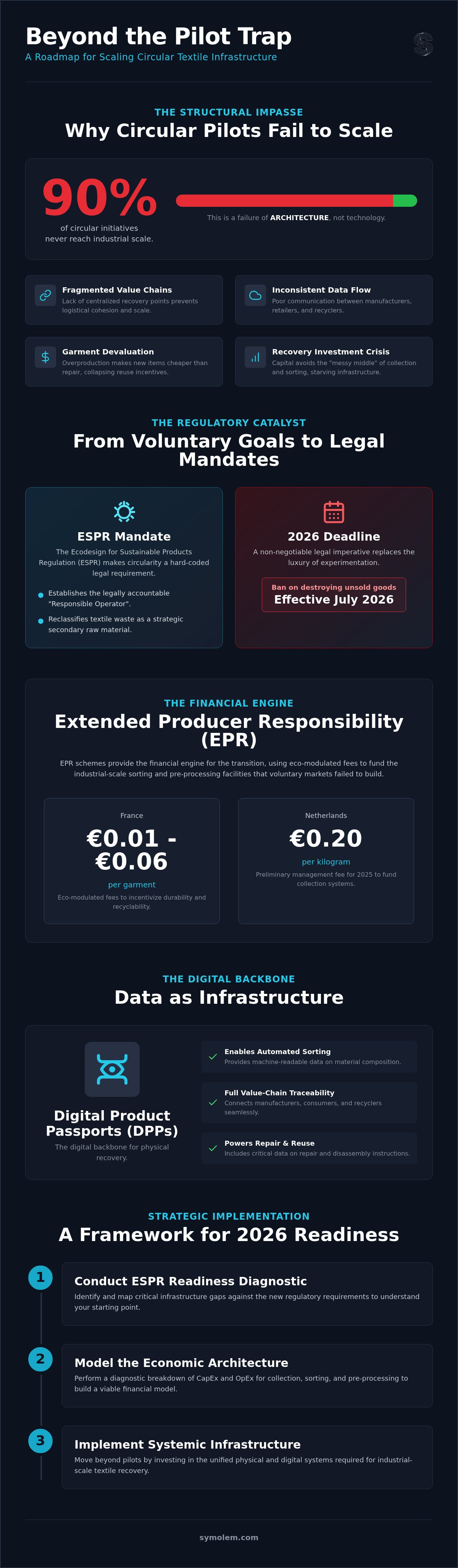
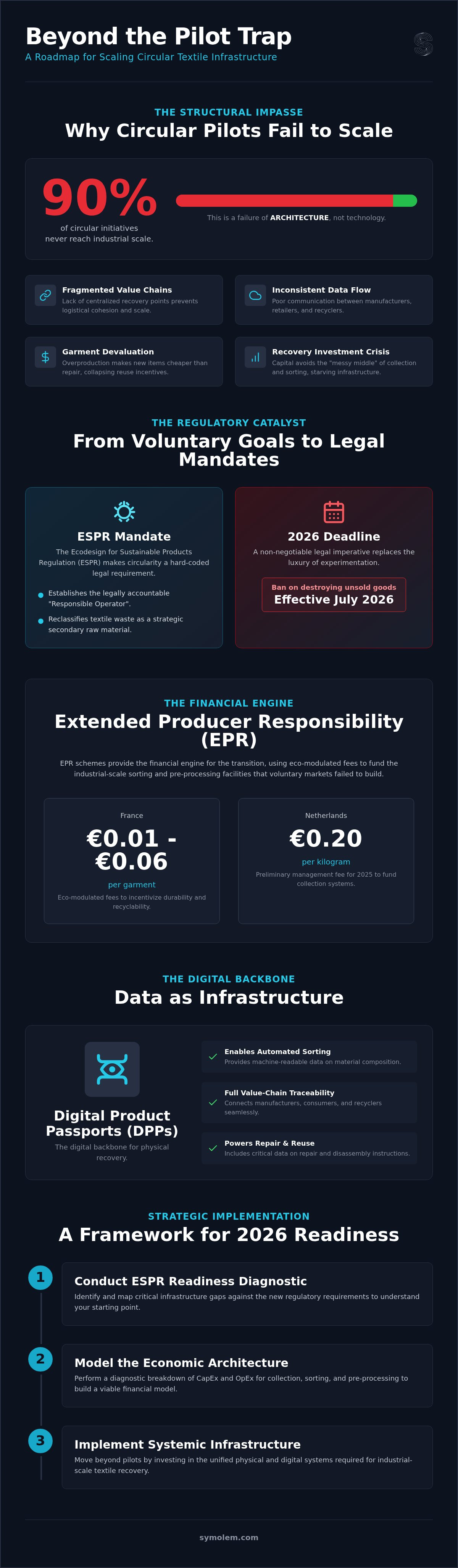
Textile circularity has stalled at the gate. Despite hundreds of high-profile brand collaborations, the industry remains tethered to a linear model because it treats circularity as a marketing exercise rather than an industrial necessity. The "Pilot Trap" is a documented reality; approximately 90% of circular initiatives never reach industrial scale, remaining confined to limited-edition capsules that serve brand optics but fail to move the needle on systemic waste. This is not a failure of technology. It's a failure of architecture. The global value chain is notoriously fragmented, characterized by a lack of centralized recovery points and inconsistent data flow between manufacturers, retailers, and recyclers. Without a cohesive framework for scaling circular textile infrastructure, the logistical burden of recovery falls into a void. Voluntary action has failed because market forces prioritize short-term margins over the long-term capital expenditure required to build automated sorting facilities and chemical recycling plants. We must recognize that circular fashion cannot exist without a rigid, industrial-grade backbone that connects physical recovery with digital verification.
The Erosion of Perceived Garment Value
Overproduction has decimated the economic incentive for repair and reuse. When new garments are priced lower than the cost of a professional repair, the financial logic of the circular economy collapses. This oversupply leads to a flood of low-quality, blended textiles that are technically difficult and financially unviable to recycle at scale. A clinical diagnostic of current business models reveals a widening "emotional durability" gap; garments are designed for a single transaction rather than multiple life cycles. This systemic devaluation of the product makes material recovery a race to the bottom rather than a value-added process.
The Financial Crisis in Material Recovery
The material recovery sector is currently facing an insolvency crisis that threatens the entire transition. Capital investment has historically avoided the "messy middle" of collection and sorting, preferring the cleaner optics of retail-facing apps or high-tech fiber innovations. However, without stable, high-volume collection systems, these innovations lack the feedstock to survive. De-risking this infrastructure requires long-term financial instruments and a shift in perspective. Scaling circular textile infrastructure requires robust, systemic integration that treats textile waste as a high-value industrial resource rather than a liability. We don't need more capsule collections; we need industrial-scale systems that can handle the millions of tonnes of waste currently destined for incineration.
The Regulatory Catalyst: ESPR and the Mandate for Recovery
Voluntary circularity is dead. The Ecodesign for Sustainable Products Regulation (ESPR) transforms aspirational sustainability into a hard-coded legal requirement, stripping away the ambiguity that has allowed the "pilot trap" to persist. This regulation moves beyond simple design guidelines, introducing the concept of the "Responsible Operator," a legal entity held accountable for the recovery potential and environmental integrity of every product placed on the EU market. It is a shift that demands a physical and digital architecture capable of supporting scaling circular textile infrastructure at a continental level. This isn't just about waste management; it's a fundamental pivot toward resource security. Under new EU laws, textile waste is being reclassified as a strategic secondary raw material, ensuring that high-value fibers remain within the European value chain to buffer against global supply chain volatility.
Extended Producer Responsibility (EPR) schemes provide the financial engine for this transition. In France, mature EPR frameworks already utilize eco-modulated fees ranging from €0.01 to €0.06 per garment to incentivize durability and recyclability. Similarly, the Netherlands has established a preliminary management fee of €0.20 per kilogram for 2025. These fees are designed to fund the industrial-scale sorting hubs and pre-processing facilities required to turn discarded textiles back into high-grade feedstock, effectively subsidizing the infrastructure that voluntary market forces failed to build.
Mapping the 2026 Regulatory Roadmap
The 2026 roadmap is unforgiving. As of July 19, 2026, large companies face an immediate ban on the destruction of unsold apparel and footwear, a mandate that forces a radical reassessment of inventory and end-of-life protocols. This ban is the first in a sequence of milestones, including the requirement for all EU member states to have operational EPR schemes by April 2028. Navigating this landscape requires more than surface-level adjustments; it necessitates an ESPR Readiness Diagnostic: A Strategic Mandate for Textile Compliance in 2026 to identify structural gaps in current operations before they become legal liabilities.
From Compliance to Competitive Advantage
Organizations that view these mandates as a mere compliance exercise risk creating "Regulatory Stranded Assets"—investments or business models that will be legally or economically unviable by the end of the decade. Conversely, early adopters who master navigating EPR for textiles will secure a significant competitive advantage by locking in access to high-quality secondary raw materials. This transition requires a move away from generalist consulting toward specialized Policy and Regulatory Advisory that can map technical requirements to industrial reality. By scaling circular textile infrastructure today, brands don't just avoid fines; they build the resilient supply chains of 2030.
Data as Infrastructure: The Role of Digital Product Passports
Data is the connective tissue of circularity. Without it, physical infrastructure is blind. The Digital Product Passport (DPP) serves as the "Digital Twin" of the physical garment, providing the essential technical specifications required for automated recovery. Scaling circular textile infrastructure depends entirely on the transition from manual, error-prone audits to high-velocity, automated data exchange. We're moving beyond the era of self-reported sustainability claims into a regime of clinical, machine-readable verification. The complexity is granular. A functional DPP requires mapping hundreds of distinct data fields, covering everything from precise fiber blends and dye chemistries to the presence of specific chemicals of concern that could contaminate recycling streams. This data must be accessible to sorting facilities at the point of discard to allow them to process tonnes of material per hour with surgical precision.
The Connectivity Crisis in Global Value Chains
The primary obstacle remains the "Black Box" of Tier 2 and Tier 3 suppliers. Most brands lack the visibility required to extract critical material data from deep within their supply chains, where the actual chemical processing and fiber blending occur. Integrating DPP data with automated sorting technologies, such as Near-Infrared (NIR) spectroscopy and AI-driven visual recognition, is the only way to bridge this gap at scale. However, the technical path is complex and requires a standardized language of recovery. Addressing the challenges of Digital Product Passport implementation requires a move away from siloed software solutions toward a unified data architecture that can scale across global borders. This architecture must support real-time data flow from the factory floor to the sorting hub.
MRV: The Backbone of Trust
Verification is the new currency of compliance. Monitoring, Reporting, and Verification (MRV) frameworks are the structural mechanisms that transform raw data into legally defensible evidence. As the EU DPP registry becomes an operational reality, brands must adopt verifiable credentials that are cryptographically secured and independently audited. Understanding the nuances of verifying textile sustainability claims for ESPR is essential for preventing the litigation risks associated with greenwashing. Rigor is not a choice; it's a prerequisite for systemic trust. By scaling circular textile infrastructure through robust data, the industry finally moves from performative pilots to industrial-grade recovery. This data-driven approach ensures that every claim of recyclability is backed by the technical reality of the product's composition.
Economic Architecture: Costing the Transition to Recovery
Circularity is fundamentally an accounting challenge. The transition from a linear to a circular system requires a radical reallocation of capital, moving away from short-term procurement savings toward long-term infrastructure investment. Building the necessary systems to handle 18 to 26% of gross textile waste in Europe by 2030 requires an estimated €6 billion to €7 billion in capital expenditure. This financial burden is not merely an operational cost; it is a structural necessity for scaling circular textile infrastructure. Organizations must distinguish between the CapEx required for automated sorting facilities and the ongoing OpEx of collection and pre-processing. The "Circularity Tax"—the cumulative cost of inaction—is now higher than the cost of compliance. Brands that fail to invest in recovery systems face escalating EPR fees, potential market exclusion, and the legal risks of non-compliance with 2026 mandates. We are witnessing a decisive shift in revenue models, where value is no longer derived solely from volume-based sales but from the high-margin recovery and resale of existing material assets.
Modeling the ROI of Circular Infrastructure
The economic viability of fiber-to-fiber recycling has reached a critical tipping point. In the second quarter of 2026, the blended EU recycled textile fiber price index rose to €980 per tonne, while the price gap between recycled and virgin fiber narrowed to just €30 per tonne. This convergence significantly reduces the "green premium" and accelerates the break-even point for industrial-scale recycling plants. EPR fee modulation further rewards this shift; by designing products for easier recovery, brands can lower their per-item management fees and improve their overall recovery rates. To understand the granular financial implications of these shifts, organizations should conduct a cost-benefit analysis of circular textile models to align their capital allocation with upcoming regulatory realities.
Infrastructure Costing in Emerging Markets
Global reverse flows present a unique set of logistical and ethical challenges. While the regulatory pressure originates in the EU, the physical reality of scaling circular textile infrastructure must extend to manufacturing hubs like India and Bangladesh. Failure to invest in recovery systems within these regions risks perpetuating "waste colonialism," where discarded textiles are exported without the local capacity for high-value processing. Mapping the logistics costs of these global reverse flows is essential for building an equitable system. This requires sophisticated Circular Economy Strategy Development to ensure that infrastructure investment is distributed across the entire value chain rather than concentrated in consumption markets. Only through systemic investment can the industry move beyond the "messy middle" of collection and into a truly circular material flow.
Strategic Implementation: A Framework for Systemic Scale
Systemic change is an architectural overhaul. It's not a peripheral sustainability project but a fundamental re-engineering of the enterprise to survive in a regulated market. Moving from fragmented pilots to industrial reality requires a clinical, five-step framework that prioritizes structural integrity over superficial metrics. This transition is binary: you're either building the infrastructure for recovery or you're preparing for market exclusion. The path forward requires a shift from linear extraction to circular resource management, treating every garment as a managed asset rather than a disposable commodity.
- Step 1: Conduct an ESPR Readiness Diagnostic. You can't bridge gaps you haven't identified. This diagnostic provides a baseline of your current infrastructure and identifies the physical and digital deficits that will trigger non-compliance.
- Step 2: Map the technical data architecture. Scaling circular textile infrastructure relies on the seamless flow of machine-readable data. You must define the DPP requirements for every SKU before they enter the supply chain.
- Step 3: Establish the "Recovery Network." Secure strategic partnerships with sorters and recyclers today. Capacity is limited, and those who don't lock in their recovery pathways will face skyrocketing costs as 2028 deadlines approach.
- Step 4: Implement MRV systems. Monitoring, Reporting, and Verification are the only ways to prove systemic integrity to regulators and avoid the litigation risks of the Green Claims Directive.
- Step 5: Transition the business model. Pivot the organization's KPIs from volume-based sales to resource-efficiency and high-margin recovery.
Building the Circular Ecosystem
No brand can scale infrastructure in isolation. The capital requirements for automated sorting hubs and chemical recycling plants are too significant for any single entity to bear. Pre-competitive collaboration is the only logical path to building regional sorting hubs that can handle the massive volumes of post-consumer waste mandated by EU law. You must ask: is your supply chain ready for the textile regulation impact on business models? Scaling circular textile infrastructure requires a collective commitment to standardized data and shared physical assets to achieve the necessary economies of scale.
The Symolem Path to Systemic Integrity
Symolem acts as the technical architect for your circular transition. We don't offer generic consulting; we provide the diagnostic precision required to map 814+ DPP data fields with clinical accuracy. Our approach ensures that your digital architecture matches the physical reality of your global supply chain, bridging the gap between Tier 3 production and Tier 1 recovery. By leveraging our expert-led Policy and Regulatory Advisory, you secure your 2026 regulatory readiness and transform compliance into a long-term competitive advantage. We build the systems that turn regulatory pressure into industrial resilience.
Transitioning from Fragmented Pilots to Industrial Resilience
The transition to a circular economy isn't a matter of ethical sentiment; it's a structural mandate enforced by the weight of EU law. We've moved past the "pilot trap" into a landscape where the destruction of unsold goods is illegal and every product must carry a digital passport. Scaling circular textile infrastructure requires more than just physical recycling plants; it demands a clinical integration of technical data, economic modeling, and regulatory foresight. Success in this new regime depends on your ability to map complex value chains with absolute precision, ensuring that physical recovery systems are backed by verifiable digital twins.
The complexity of 814+ mandatory DPP fields and the financial pressure of eco-modulated EPR fees leave no room for guesswork. As an independent advisor, Symolem specializes in the technical implementation of these frameworks, providing the global regulatory expertise needed to bridge the gap between Tier 3 production and Tier 1 recovery. Secure your regulatory future with a Symolem ESPR Readiness Diagnostic and move your organization from a state of uncertainty to one of systemic integrity. The path to industrial resilience is clear for those ready to build.
Frequently Asked Questions
What is the primary barrier to scaling circular textile infrastructure?
The primary barrier is the structural fragmentation of the global value chain. Current systems are optimized for linear disposal, not high-volume recovery. Scaling circular textile infrastructure requires overcoming the "Pilot Trap" where isolated successes fail to reach industrial capacity due to a lack of centralized sorting hubs. Without a unified framework for data and logistics, the capital expenditure required for automated recycling remains too high for individual brands to justify alone.
How does the EU ESPR regulation impact textile infrastructure?
The ESPR regulation imposes a legal mandate for recovery potential. It introduces the "Responsible Operator" role, making brands legally accountable for the environmental integrity of their products. This regulation forces a redesign of the supply chain, requiring brands to prove that their garments are technically recyclable. It moves the industry away from aspirational marketing toward a regime of clinical, verifiable compliance that treats textile waste as a strategic secondary resource.
Will Digital Product Passports be mandatory for all textiles by 2026?
No, the Digital Product Passport won't be mandatory for all textiles by 2026. The current roadmap indicates that the delegated act for textiles is expected in late 2027, with full implementation likely between 2028 and 2029. However, large companies must comply with the ban on destroying unsold apparel and footwear starting July 19, 2026. This immediate requirement serves as a critical precursor to the broader digital data mandates that will follow.
What is the difference between EPR and ESPR in textile circularity?
ESPR and EPR serve distinct but interconnected roles. ESPR focuses on product design and the digital architecture, specifically the Digital Product Passport. EPR is the financial mechanism that utilizes eco-modulated fees to fund the physical management of waste. While ESPR dictates how a product is built, EPR provides the capital needed for industrial management. Both are essential components for the systemic transition from voluntary pilots to mandatory, industrial-scale recovery systems.
How much does it cost to implement circular infrastructure for a fashion brand?
Industrial-scale implementation requires significant capital. Estimates suggest that €6 billion to €7 billion in capital expenditure is needed by 2030 to scale fiber-to-fiber recycling across Europe. For individual brands, the cost varies based on supply chain complexity and SKU volume. The real financial risk is inaction. Escalating EPR fees and the threat of market exclusion under 2026 mandates make the "Circularity Tax" far more expensive than proactive strategic investment.
Can small brands afford to comply with the new textile recovery mandates?
Compliance is a prerequisite for market access, regardless of brand size. While the 2026 ban on destroying unsold goods initially targets large companies, it extends to medium-sized firms by 2030. Smaller brands can't build physical infrastructure in isolation. They must leverage pre-competitive collaboration and shared sorting networks. Failure to integrate into these circular ecosystems will lead to legal liabilities and an inability to navigate the increasingly rigid EU regulatory landscape.
What role do emerging markets play in global circular infrastructure?
Emerging markets are the physical engine of global recovery. Since hubs like India and Bangladesh host the majority of textile manufacturing, they must also house the infrastructure for pre-processing and chemical recycling. Building local capacity prevents "waste colonialism" and ensures that high-value secondary raw materials remain accessible to the manufacturers who need them. Global scaling circular textile infrastructure depends on equitable investment that bridges the gap between Western consumption and Eastern production.
How do I start an ESPR readiness diagnostic for my organization?
You can initiate a diagnostic by engaging with technical architects who specialize in regulatory mapping. At Symolem, the process begins with a clinical audit of your current data architecture and supply chain visibility. We map 814+ potential DPP data fields to identify your specific infrastructure gaps. This diagnostic provides the baseline required to move your organization from pilot fatigue to a state of total regulatory readiness for the 2026 mandates.