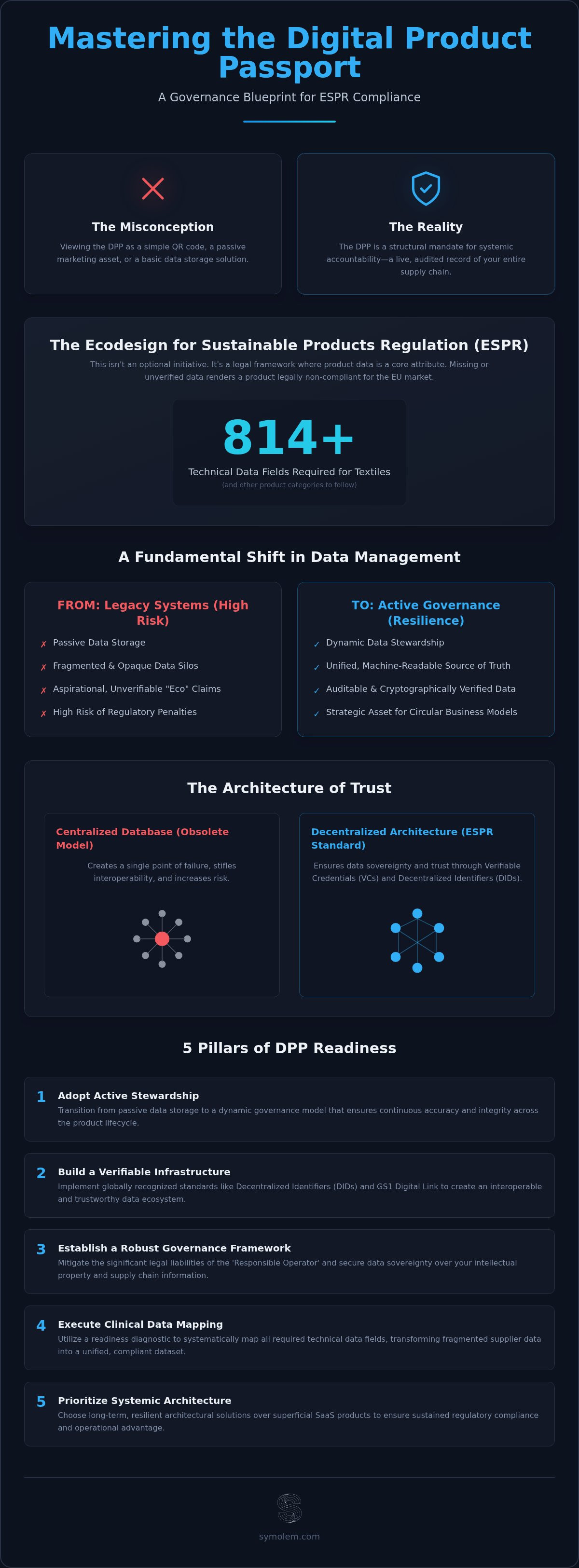
Digital Product Passport Data Governance: Architecting Systemic Integrity for ESPR
The assumption that a Digital Product Passport is merely a high-tech barcode is a strategic failure that will cost global brands millions in regulatory penalties. It isn't a marketing asset. It's a structural mandate for systemic accountability. Robust Digital Product Passport data governance requires more than a simple storage solution. It demands a rigorous architecture capable of verifying up to 236 data points in the UNTP schema across fragmented and often opaque supply chains. You're no longer just selling a product. You're managing a live, audited record of every material input, chemical additive, and carbon gram associated with your inventory.
You likely recognize that your current data silos are insufficient for the granular demands of the Ecodesign for Sustainable Products Regulation. This article provides the technical roadmap to master the governance of these complex datasets, ensuring your infrastructure satisfies EU auditors while securing a strategic advantage through transparency. We'll examine the mechanics of data ownership, the necessity of interoperable frameworks, and the precise steps to transform compliance into a resilient circularity engine.
Key Takeaways
- Shift from passive data storage to active stewardship to meet the high-stakes legal requirements of the ESPR framework and ensure systemic integrity.
- Implement decentralized identifiers and GS1 Digital Link standards to build a verifiable infrastructure of trust that remains accessible across the EU registry.
- Establish a robust Digital Product Passport data governance framework to mitigate the legal liabilities of the Responsible Operator and secure data sovereignty.
- Execute a clinical mapping of the up to 236 data points in the UNTP schema required for textiles by utilizing a specialized ESPR readiness diagnostic.
- Prioritize strategic systemic architecture over superficial SaaS solutions to ensure long-term regulatory compliance and operational resilience.
Table of Contents
- Beyond the Digital Container: Redefining Data Governance for the ESPR Era
- Technical Architecture and Verifiable Credentials: The Infrastructure of Trust
- The 'Responsible Operator' Mandate: Navigating Liability and Data Sovereignty
- Strategic Implementation: Mapping 814 Textile Data Fields into Governance Frameworks
- Symolem’s Diagnostic Approach to DPP Readiness
Beyond the Digital Container: Redefining Data Governance for the ESPR Era
The Ecodesign for Sustainable Products Regulation (ESPR) has fundamentally altered the definition of a physical good. A product is no longer merely its physical composition; it's now inextricably linked to its digital shadow. Treating the EU Digital Product Passport as a static digital container is a tactical error that overlooks the necessity of active verification. Digital Product Passport data governance is the systemic framework required to ensure data integrity, legal accountability, and structural stability across the entire lifecycle. It isn't a passive archive. It's a dynamic stewardship model that mandates continuous accuracy.
Compliance is not a storage exercise. Static data repositories fail because they lack the mechanisms to handle the rigorous stewardship required by the ESPR. Under this new regime, data is a legal product attribute. If the data is missing, unverified, or fragmented, the product itself is legally non-compliant. This reality forces a shift from siloed supplier spreadsheets to a unified, machine-readable single source of truth. Establishing this source of truth requires a clinical mapping of the entire global value chain, transforming data from a byproduct of manufacturing into a core pillar of product engineering.
The Shift from Aspirational to Verifiable Data
Marketing-led sustainability narratives have become a corporate liability. Vague claims of "eco-friendly" sourcing cannot survive the clinical scrutiny of an EU auditor or the technical requirements of a machine-readable passport. The transition to auditable data structures is mandatory for any brand placing textiles on the EU market. Data governance is the structural verification of a product’s lifecycle. By moving away from soft-focus storytelling, brands can build a technical foundation that facilitates real-time auditing and automated compliance checks. This rigor replaces "trust" with "verification," ensuring that every data point is backed by a credible chain of custody.
Data as a Strategic Asset in Circular Business Models
Governance is the engine of the circular economy. Without verified product history, secondary markets remain inefficient and high-risk. High-integrity data allows brands to unlock secondary market revenue by providing proof of material quality and repair history to recyclers and resellers. This transition requires a sophisticated cost-benefit analysis of circular textile models to understand where data investments yield the highest returns. Moving from defensive compliance to an offensive strategic advantage means viewing Digital Product Passport data governance as a tool for supply chain optimization. This systemic approach transforms a legal mandate into a driver of operational resilience and market differentiation.
Technical Architecture and Verifiable Credentials: The Infrastructure of Trust
Trust in global value chains is not a sentiment; it is a technical requirement. The architecture supporting the ESPR must facilitate seamless data exchange between disparate actors while maintaining the cryptographic integrity of every claim made about a product's origin, material composition, or environmental footprint. Effective Digital Product Passport data governance relies on a decentralized model where the European Commission's registry, which became operational on July 20, 2026, stores only unique identifiers rather than the full dataset. This structure ensures that manufacturers retain control over their intellectual property while providing regulators with the necessary access to verify compliance without the risks associated with centralized data harvesting.
Decentralised Data vs. Centralised Databases
Centralized databases represent a structural failure for global value chains. They create high-risk targets for data breaches and force suppliers into rigid, proprietary ecosystems that stifle interoperability and increase technical debt. In contrast, a decentralized architecture utilizes Decentralized Identifiers (DIDs) to create a self-sovereign data environment. This approach allows brands to maintain a distributed ledger of verifiable credentials (VCs), which act as digital, notarized statements that prevent data tampering as information moves from fiber producer to garment manufacturer. By adopting these standards, companies can ensure that their data remains sovereign and secure, even when shared across complex, multi-tiered networks.
The GS1 Digital Link and Data Resolvers
The GS1 Digital Link serves as the primary gateway to the passport. It transforms the traditional barcode into a web-enabled URI, creating a persistent connection between the physical item and its digital record. This is not a temporary link; it must remain functional for the product’s entire lifespan, which often exceeds ten years in high-quality textile sectors. Data resolvers then route users, recyclers, or auditors to the specific information they are authorized to see. To navigate these complexities, many brands utilize a specialized Digital Product Passport implementation framework to bridge the gap between technical standards and operational reality.
Interoperability is further secured through the United Nations Transparency Protocol (UNTP). These standards ensure that global textile manufacturers can exchange data without friction, regardless of the specific software platforms they employ. This clinical focus on open standards prevents vendor lock-in and ensures that the infrastructure of trust is built on systemic stability rather than proprietary whims.
The 'Responsible Operator' Mandate: Navigating Liability and Data Sovereignty
Accountability is no longer a shared aspiration; it's a concentrated legal liability. Under Article 14 of the ESPR, the "Responsible Operator" is the entity that bears the full weight of compliance. This is typically the importer or the manufacturer placing the product on the EU market. They're legally required to ensure that every digital passport is accurate, accessible, and up to date. If a data gap is identified, the liability rests entirely with the operator, not the upstream supplier. Consequently, Digital Product Passport data governance becomes a defensive shield against product withdrawals and heavy financial penalties. It isn't enough to simply collect data. You must own the integrity of that data under the threat of regulatory sanction.
The diagnostic reality of data sovereignty is often ignored until a crisis occurs. What happens to your compliance status if a Tier 3 supplier ceases operations or a contract is terminated? If you don't have a governance framework that secures data ownership, you're left with a legal product that cannot be sold. Systemic integrity requires that data is not just "shared" via a portal, but secured through protocols that ensure the brand retains access to the necessary verifiable credentials regardless of the supplier's future status. This is the difference between a fragile data link and a resilient architecture.
Article 14 and the Importer’s Burden
For global brands, the importer's burden is a diagnostic challenge. You're legally required to verify that every product meets ecodesign requirements before it crosses the border. A single missing field can trigger a market-wide recall. This risk necessitates a navigating EPR for textiles approach that integrates data collection with broader producer responsibility frameworks. If a supplier refuses to cooperate, the brand remains the target of EU auditors. Governance protocols must include data escrow or contractual mandates that secure information beyond the life of a single vendor relationship.
Protecting IP in a Transparent Supply Chain
The primary objection from manufacturers is the fear of exposing proprietary trade secrets. This tension between transparency and commercial confidentiality is a structural hurdle that simple software cannot resolve. Strategic Digital Product Passport data governance utilizes tiered access and zero-knowledge proofs to verify claims without revealing sensitive cost structures or specific chemical recipes. By defining strict boundaries between mandatory regulatory disclosures and voluntary transparency, brands can protect their intellectual property while satisfying the state. Verification doesn't require total exposure. It requires a clinical, architected flow of information that prioritizes systemic integrity over indiscriminate sharing.
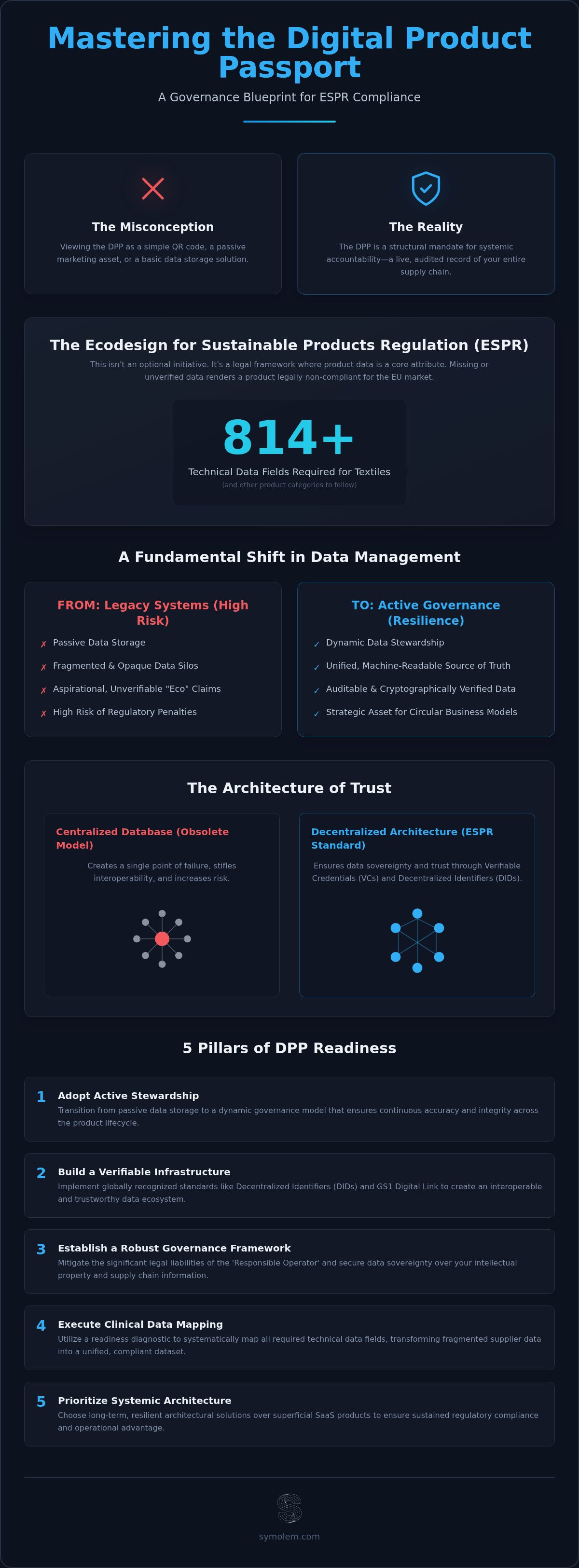
Strategic Implementation: Mapping 814 Textile Data Fields into Governance Frameworks
Mapping up to 236 data points in the UNTP schema is an exercise in clinical precision. It's a task that exceeds the capabilities of standard ERP systems or decentralized marketing databases. Brands must confront the granular reality of the EU ecodesign regulation for textiles by architecting a system that captures every material input and chemical additive. Implementation begins with an ESPR readiness diagnostic to identify structural gaps in current data collection. Once these gaps are mapped, the brand must establish data ownership across design, procurement, and logistics to ensure accountability isn't lost in corporate silos. This leads to the implementation of automated protocols for Tier 1 through Tier 4 suppliers, followed by verifying textile sustainability claims for ESPR through a centralized governance workflow.
The Taxonomy of Textile Data
Textile data is categorized into three primary tiers: material composition, recycled content, and chemical presence. These are the technical foundations of compliance. The challenge for most operators lies in governing complex metrics like durability and repairability, which require standardized verification methods to satisfy European auditors. Effective Digital Product Passport data governance ensures these metrics are not merely estimated but are architected into the product's digital record from the initial design phase. This rigorous mapping prevents the structural failure of non-compliance at the point of market entry. It transforms a legal hurdle into a verifiable record of quality.
Establishing the Data Governance Office
A Digital Product Passport is too complex for a sustainability department to manage in isolation. It requires a cross-functional task force with clear mandates. This office must include Data Stewards to maintain field integrity, Legal Counsel to mitigate the Article 14 liability risks, and Supply Chain Architects to design the data flow from global manufacturers. KPIs must focus on data completeness and the frequency of verification audits. If your organization hasn't yet defined these roles, you should engage a specialist to architect your Digital Product Passport (DPP) Frameworks to ensure long-term systemic integrity. This isn't a short-term fix. It's a fundamental restructuring of how product information is managed across the global value chain.
Symolem’s Diagnostic Approach to DPP Readiness
Software is not a strategy. It is a secondary mechanism that functions only when the underlying organizational architecture is sound. Many brands are currently making the tactical error of procuring SaaS solutions before they have addressed the systemic fragmentation of their own data silos. Symolem rejects this technology-first shortcut. We prioritize robust Digital Product Passport data governance as a prerequisite for any digital tool. This approach is designed to mitigate the documented challenges of Digital Product Passport implementation by resolving structural root causes of data opacity before a single line of code is integrated into your supply chain.
The transition from voluntary sustainability claims to mandatory, machine-readable data is a high-stakes shift. It requires more than a digital container; it requires a systemic overhaul of how information is verified and owned. Our framework ensures that your data remains an asset rather than a liability. By establishing clear protocols for data stewardship, we help brands navigate the clinical requirements of the ESPR without compromising their commercial confidentiality or intellectual property.
The Diagnostic Framework
Symolem’s diagnostic is a clinical evaluation of an organization’s structural readiness. We measure maturity across three critical pillars: policy alignment, impact measurement, and digital infrastructure. We don't merely identify gaps. We cost the implementation of necessary circular infrastructure based on granular data insights derived from your specific value chain. This methodology moves the organization beyond the "pilot project" phase, which is frequently little more than a marketing exercise, into a state of systemic integration. It is a methodical process of building a foundation that can support the weight of up to 236 data points in the UNTP schema without collapsing under the pressure of an EU audit.
Architecting the Future of Fashion
Symolem operates as an independent advisor in an increasingly complex and crowded regulatory landscape. We provide the intellectual rigor necessary to bridge the gap between high-level policy and granular operational reality. A robust data governance framework is the only pathway to long-term business resilience in an era of uncompromising transparency. The 2026 mandate is not a suggestion; it is a clinical reality that will filter the market. Brands that fail to architect their data systems today will face structural failure when the European Commission’s registry becomes the ultimate arbiter of market access. To secure your supply chain and ensure compliance, the first step is a comprehensive ESPR Readiness Diagnostic. Prepare for the mandate with clinical precision.
Architecting Resilience for the 2026 Mandate
The 2026 deadline is a structural filter. It's not a distant milestone but a clinical reality that demands immediate systemic realignment. We've established that robust Digital Product Passport data governance is the only defense against the liability risks inherent in the Responsible Operator mandate. By meticulously mapping the up to 236 data points in the UNTP schema required for textiles, brands can transform a regulatory burden into a strategic asset that secures long-term supply chain transparency. Compliance isn't a one-time event; it's a permanent shift in how value is recorded and verified across the global economy.
Symolem acts as a strategic architect for global value chains. As independent textile policy experts, we provide the specialized technical data mapping and strategic advisory necessary for apparel brands to survive this transition. Don't leave your market access to unverified SaaS promises or fragmented supplier spreadsheets. Secure your 2026 compliance with a Symolem ESPR Readiness Diagnostic and build a foundation of clinical precision today. Your operational future depends on the structural integrity of your data.
Frequently Asked Questions
What is the legal basis for Digital Product Passport data governance?
The legal basis is the Ecodesign for Sustainable Products Regulation (ESPR), specifically Regulation (EU) 2024/1781, which entered into force on July 18, 2024. This framework mandates that products placed on the EU market must possess a machine-readable passport. Effective Digital Product Passport data governance is the structural requirement for meeting the specific data integrity and accessibility standards defined in subsequent product-specific delegated acts, ensuring every claim is legally verifiable and auditable.
Who is responsible for the accuracy of data in a textile DPP?
Under Article 14 of the ESPR, the "Responsible Operator" bears the full legal liability for data accuracy. This is typically the manufacturer or the importer placing the product on the EU market. While suppliers are the primary sources of raw information, the responsible operator must verify this data before it enters the registry. Failure to maintain data integrity results in non-compliance, regardless of where the original data error occurred in the supply chain.
How many data fields are required for a textile Digital Product Passport?
While early European Parliament research identified approximately 125 individual data attributes, Symolem specializes in mapping over up to 236 data points in the UNTP schema required for comprehensive textile compliance. These fields encompass material composition, chemical presence, and supply chain traceability. The exact requirements are finalized through delegated acts, but brands must prepare for this high level of granularity to ensure their digital records satisfy the clinical scrutiny of EU regulatory auditors.
Can we use blockchain for DPP data governance?
Blockchain is a technical tool for decentralized data management, but it doesn't constitute a complete governance strategy. Systemic integrity relies on decentralized identifiers (DIDs) and verifiable credentials to prevent data tampering across the value chain. While blockchain can provide an immutable ledger, Digital Product Passport data governance requires a broader framework that defines data ownership, interoperability standards, and clear accountability protocols that exist independently of any specific technology or software provider.
What happens if our DPP data is found to be inaccurate by EU authorities?
Inaccurate data is a legal failure that triggers immediate regulatory consequences, including significant financial penalties and the potential withdrawal of products from the EU market. Because the digital passport is a mandatory legal attribute, a data gap is treated with the same severity as a physical product defect. Authorities can prohibit the sale of goods until the data is remediated, making structural verification a critical business imperative for maintaining market access.
How does DPP data governance impact small to medium-sized fashion brands?
Small to medium-sized brands face acute implementation challenges due to limited resources for global supply chain mapping. Annual implementation costs for a small brand can range from €2,500 to €10,000, while mid-sized companies may spend up to €50,000. For these entities, robust governance is a survival mechanism. It ensures they aren't excluded from the EU market by larger competitors who have already architected the necessary infrastructure for mandatory transparency.
Will the UK adopt similar Digital Product Passport requirements?
The UK has not yet implemented an identical mandate, but global brands should expect high levels of alignment to facilitate frictionless trade with the EU. Most UK-based manufacturers are already adopting ESPR standards to avoid the administrative burden of dual-reporting. Strategic readiness ensures that brands remain prepared for a future where digital transparency is a global trade requirement rather than a regional exception or a voluntary sustainability claim.
How long must DPP data remain accessible after a product is sold?
Data must remain accessible for the duration of the product's expected lifespan, which frequently exceeds ten years in the high-quality textile sector. This persistence ensures that recyclers and secondary market operators can access material composition and repair history long after the initial transaction. Maintaining this accessibility requires a governance architecture that is not tied to a single software vendor, protecting the data if a technology provider ceases operations or a contract ends.