Assessing Textile Circularity Readiness: A Strategic Framework for 2026 Compliance
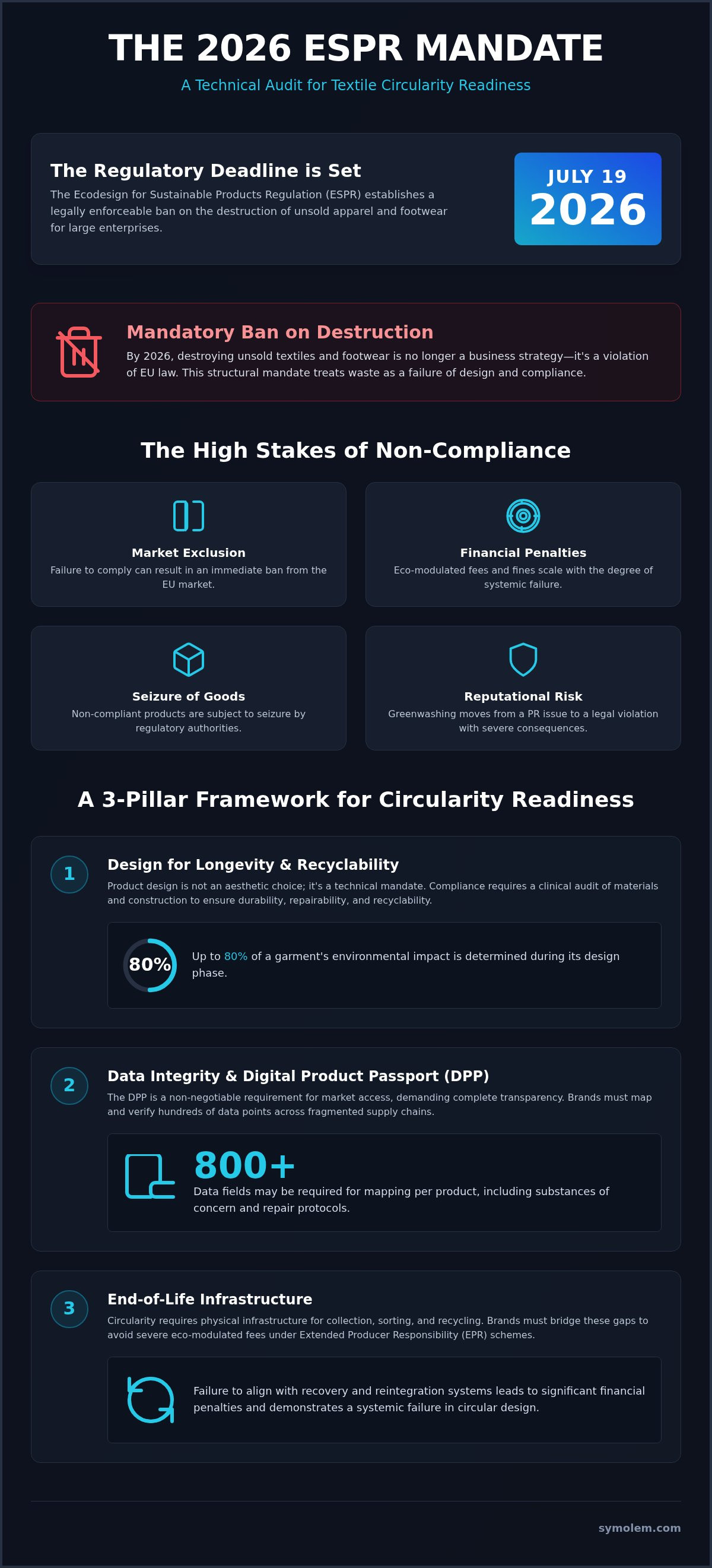
By July 19, 2026, the era of disposal as a business strategy ends. Large enterprises will face an immediate, legally enforceable ban on destroying unsold apparel and footwear under the Ecodesign for Sustainable Products Regulation. This isn't a suggestion for better stewardship; it's a structural mandate that treats waste as a failure of design and a violation of EU law. Achieving compliance requires a clinical approach to assessing textile circularity readiness, as most brands currently operate within a fragile architecture of fragmented supplier data that won't survive a rigorous regulatory audit.
You likely understand that your current value chain lacks the transparency required for the Digital Product Passport registry, yet the path to systemic integration remains obscured by high infrastructure costs and technical ambiguity. This guide provides the strategic framework necessary to master the technical and regulatory requirements for 2026. We'll examine the mechanics of mapping up to 236 data points in the UNTP schema, analyze the requirements for circular infrastructure investment, and provide a diagnostic roadmap for achieving full compliance before the delegated acts take effect. By the end of this analysis, you'll have a clear gap analysis of your operations to avoid market exclusion.
Key Takeaways
- The 2026 ESPR deadline transforms circularity into a mandatory technical audit of systemic integrity.
- Assessing textile circularity readiness requires a clinical evaluation of product design and material purity. You must verify hundreds of unique data points to succeed.
- Digital Product Passport maturity depends on your ability to aggregate complex data regarding substances of concern and repair protocols across fragmented supply chains.
- Eco-modulated fees under Extended Producer Responsibility will create significant financial penalties for brands that fail to bridge circular infrastructure gaps.
- It's essential to use a structured diagnostic process to map regulatory exposure. This ensures market access before enforcement begins.
Table of Contents
- The 2026 Regulatory Mandate: Why Readiness is a Technical Audit
- Core Dimensions of a Circularity Readiness Framework
- Data Integrity: Assessing Digital Product Passport (DPP) Maturity
- The Economics of Recovery: Identifying Infrastructure Gaps
- Implementing the ESPR Readiness Diagnostic: From Mapping to Execution
The 2026 Regulatory Mandate: Why Readiness is a Technical Audit
Compliance is not a marketing exercise. It is a clinical verification of systemic integrity. The 2026 Ecodesign for Sustainable Products Regulation (ESPR) establishes a new baseline where circularity readiness is defined as the total alignment of product design, data management systems, and physical recovery infrastructure with stringent European mandates. Brands often mistake superficial ESG reporting for the rigorous data verification now required for market access, yet the two are fundamentally different in both depth and legal consequence. Systemic integrity relies on accurately assessing textile circularity readiness across every tier of production to ensure that every claim is backed by immutable technical evidence.
The 2026 mandate introduces a hard stop for traditional linear operations. On July 19, 2026, the EU will enforce a ban on the destruction of unsold textiles and footwear for large enterprises, while simultaneously requiring a functional Digital Product Passport (DPP) registry. Waiting for the final delegated acts is a high-risk strategy that ignores the years of lead time required to re-engineer global value chains. If your infrastructure isn't already being mapped to these requirements, you're not just behind; you're approaching a point of irreversible market exclusion.
The Shift from Aspirational to Mandatory Circularity
The transition toward Circular fashion has shifted from a voluntary ethical commitment to a rigid legal framework that demands total lifecycle accountability. This evolution in the EU regulatory landscape for textiles has fundamentally redefined business models by prioritizing durability, repairability, and material purity over high-volume throughput. It's a clinical reality that compliance is now a prerequisite for European market entry. You can no longer rely on vague claims of "recycled content" to satisfy regulators, as the ESPR demands granular proof of how a product is designed to be recovered and reintegrated into the economy at its end-of-life.
The High Stakes of Non-Compliance in 2026
The penalties for failing to meet these standards extend far beyond simple fines. Brands face immediate market exclusion, the seizure of non-compliant goods, and severe financial penalties that scale with the degree of systemic failure. There's also a significant reputational risk as "greenwashing" moves from the court of public opinion into the court of law, where unsubstantiated claims are treated as regulatory violations. Assessing textile circularity readiness early is the only way to identify the structural gaps that lead to these vulnerabilities. The cost of non-compliance is a structural business failure. Without a verified roadmap for DPP implementation and infrastructure alignment, your brand remains exposed to a landscape that no longer tolerates ambiguity.
Core Dimensions of a Circularity Readiness Framework
Circularity is a structural engineering problem. A framework for assessing textile circularity readiness must move beyond superficial metrics to evaluate the clinical integrity of a brand's operations. It requires a multi-dimensional diagnostic of three critical pillars: product design, supply chain transparency, and end-of-life infrastructure. These dimensions ensure that a brand doesn't just claim circularity but possesses the structural capacity to prove it under the EU Strategy for Sustainable and Circular Textiles. Without this alignment, your business remains exposed to the high-stakes legal consequences of the 2026 mandates.
Design for Longevity and Recyclability
Product design determines up to 80% of a garment's environmental impact across its lifecycle. This isn't an estimate; it's a design reality that demands a rigorous audit of material compositions. You must scrutinize chemical safety and mechanical recyclability at the fiber level to ensure that products don't become hazardous waste at their end-of-life. Establishing repairability scores that meet upcoming EU standards is no longer optional. Utilizing an ESPR Readiness Diagnostic allows for a clinical audit of these design choices to ensure they meet the durability requirements of the 2026 framework.
Systemic Traceability and Supplier Engagement
Transparency is the foundation of the Digital Product Passport. You can't rely on annual supplier surveys to meet 2026 mandates. Real-time data verification from tier 1 through tier 4 is now mandatory for assessing textile circularity readiness. This involves evaluating whether suppliers possess the technical capacity to provide granular data on origin, substances of concern, and manufacturing processes. Integrating textile impact measurement and MRV provides the verification rigor necessary to substantiate every claim within the passport. For brands seeking to close these systemic gaps, Circular Economy Strategy Development provides the necessary strategic roadmap.
The Logistics of End-of-Life Infrastructure
Designing a recyclable garment is useless if no infrastructure exists to sort or process it into feedstock. Circularity fails when the logistical chain for recovery is broken. Brands must identify specific gaps in regional recovery networks and feedstock preparation facilities to avoid the financial penalties of eco-modulated EPR fees. This dimension requires a realistic assessment of how products will be collected, identified, and reintegrated into the production cycle after consumer use. It's a clinical challenge of mapping physical assets against regulatory requirements to ensure long-term systemic stability.
Data Integrity: Assessing Digital Product Passport (DPP) Maturity
Data is the structural foundation of the circular economy. A brand's Digital Product Passport (DPP) maturity is defined by its capacity to aggregate, verify, and transmit hundreds of product-specific data points across a fragmented value chain. This isn't a simple labeling exercise; it's a clinical audit of IT infrastructure. You must evaluate whether your current ERP systems can communicate with a DPP resolver to provide real-time, immutable product histories. Without this connectivity, assessing textile circularity readiness becomes an exercise in guesswork rather than a verified compliance strategy.
The 2026 mandate requires specific data attributes, including material origin, substances of concern, and detailed repair manuals. To prevent data falsification, the adoption of verifiable credentials is non-negotiable. This ensures that every entry—from fiber content to factory audits—is authenticated at the source. If your data systems cannot support this level of scrutiny, your products risk being barred from the EU market as the registry goes live in July 2026.
Technical Data Mapping for Textiles
Mapping ESPR requirements to individual SKUs is a monumental undertaking. Implementing Digital Product Passports across diverse product lines requires a granular understanding of every component, from primary fibers to buttons and zippers. You need to identify which data points are mandatory for each product category under the specific delegated acts. In this new regulatory environment, data granularity is the new currency of textile compliance. Brands that fail to achieve this level of detail will find themselves unable to substantiate their circularity claims during a regulatory audit.
DPP Integration with Circular Services
The passport must do more than store data; it must facilitate action. By providing consumer-facing information on repair, resale, and recycling, Digital Product Passports act as the interface for circular services. This functionality is critical for assessing textile circularity readiness because it proves a product's viability beyond its first life. The accuracy of this data directly impacts the economics of textile recovery systems, where precise material identification reduces sorting costs and increases the value of recycled feedstock. Furthermore, the readiness of Digital Product Records for both UK and EU markets will determine your brand's ability to navigate cross-border regulatory shifts without disrupting your global logistics chain.
The Economics of Recovery: Identifying Infrastructure Gaps
Circularity is a logistical and economic challenge, not a design sentiment. The transition from linear disposal to circular feedstock management requires a radical re-engineering of the financial model. Most brands currently ignore the structural deficit between their production volume and the regional capacity for textile recovery. Assessing textile circularity readiness means identifying the specific points where the physical supply chain, including collection points, sorting facilities, and chemical recycling hubs, fails to meet mandatory EU targets. This is a clinical audit of physical assets and economic viability, not a general sustainability goal.
Extended Producer Responsibility (EPR) Readiness
Navigating textile EPR compliance in 2026 requires a deep understanding of eco-modulation fees. These fees are designed to penalize material complexity and reward durability, essentially taxing products that are difficult to recycle. If your product margins are already thin, the financial impact of these modulated fees could render certain product lines entirely unviable. You must also map the geographic availability of sorting infrastructure to ensure that end-of-life products are captured before they exit the circular loop. Without a verified network for recovery, your brand remains financially exposed to the rising costs of waste management under the new EU framework.
Infrastructure Costing and Modeling
Strategic infrastructure mapping is the only way to secure future textile feedstock in a competitive market. Brands must develop a comprehensive cost-benefit analysis to determine which circular business models, such as resale, repair, or fiber-to-fiber recycling, offer the most stability. This involves quantifying the investment required to build or access recovery networks that can handle the volume of goods your brand produces. Assessing textile circularity readiness at this level ensures that you aren't just designing for a circular future but are actively building the economic architecture to support it. Quantifying these costs early prevents the systemic shocks that occur when regulatory deadlines meet inadequate logistical preparation.
To identify and close these systemic gaps before the 2026 mandates take effect, utilize our Circular Economy Strategy Development services to build a resilient recovery architecture.
Implementing the ESPR Readiness Diagnostic: From Mapping to Execution
Strategy without a rigorous execution framework is merely a liability. Assessing textile circularity readiness requires a clinical, five-step diagnostic process designed to transform abstract regulatory requirements into a functional operational roadmap. This isn't a surface-level survey; it's a deep-tissue audit of your business's systemic integrity. Each step is designed to isolate specific failures in your current model and replace them with verified, compliant structures.
- Step 1: Regulatory Scoping. We identify exactly which EU and UK mandates apply to your specific product portfolio to prevent wasted effort on irrelevant criteria.
- Step 2: Data Gap Analysis. This involves auditing existing supply chain information against the potential DPP data fields to pinpoint exactly where your transparency fails.
- Step 3: Technical Product Audit. We evaluate physical products against specific ecodesign criteria, such as fiber purity and mechanical durability, to ensure they meet 2026 standards.
- Step 4: Infrastructure Mapping. This stage focuses on costing recovery and recycling pathways, providing a realistic financial model for end-of-life management.
- Step 5: Strategic Roadmap. We prioritize interventions based on risk and impact, ensuring your brand achieves full compliance before enforcement begins.
The Role of Strategic Advisory in Circularity
Independent scrutiny is the only way to eliminate internal bias and corporate inertia. Internal teams often struggle to objectively critique the very systems they built, which is why a clinical, expert-led diagnostic is essential for assessing textile circularity readiness. Symolem acts as the clinical architect of your transition, offering a level of intellectual rigor that generic consulting firms cannot match. By choosing us as your partner for textile circularity strategy, you ensure that your readiness assessment is backed by technical precision rather than aspirational narratives. We prioritize truth and scrutiny over comfort, providing the clarity needed to navigate a high-stakes landscape.
Securing the Future of the Fashion Organization
The transition to circularity is a core risk management function that belongs in the boardroom. Proactive brands will leverage these mandates to build a structural advantage, while reactive ones will struggle under the weight of market exclusion and financial penalties. It's time to move beyond the superficial and secure your organization's future in a regulated landscape. Don't wait for the first wave of enforcement to reveal your systemic failures. Your board must understand that circularity is no longer an ethical preference; it's a legal imperative for survival. Schedule your ESPR Readiness Diagnostic with Symolem today to begin the clinical mapping of your 2026 compliance journey.
Securing Systemic Integrity for the 2026 Mandate
The 2026 regulatory shift is a clinical reality that demands a move away from aspirational marketing toward rigorous technical verification. Success in this new landscape depends on your ability to align product design with the logistical requirements of recovery while managing the granular data demands of the Digital Product Passport. Assessing textile circularity readiness is the only way to ensure that your supply chain isn't just transparent, but legally defensible. By isolating systemic failures now, you position your brand as a resilient leader in an industry that no longer tolerates ambiguity or waste.
Symolem offers specialist advisory for the fashion global value chain, utilizing expertise in mapping over 800 DPP fields to provide independent audit rigor. We act as the clinical architect of your compliance journey, replacing uncertainty with a strategic roadmap for implementation. Secure your 2026 market access with a Symolem ESPR Readiness Diagnostic and build the structural integrity your business requires. Your proactive engagement with these mandates will secure your place in a stable, circular future.
Frequently Asked Questions
What is the primary objective of a textile circularity readiness assessment?
The primary objective is to identify systemic gaps between a brand's current operations and the technical requirements of the 2026 EU mandates. This involves a clinical audit of product design, supply chain transparency, and recovery infrastructure. By assessing textile circularity readiness, organizations can mitigate the risk of market exclusion and financial penalties. It serves as a diagnostic roadmap to ensure every product sold possesses the necessary integrity to survive a rigorous regulatory audit.
How does the ESPR impact fashion brands selling in the EU in 2026?
The Ecodesign for Sustainable Products Regulation (ESPR) introduces legally enforceable requirements for durability, repairability, and recyclability. Starting July 19, 2026, large enterprises are prohibited from destroying unsold apparel and footwear. Additionally, brands must provide standardized data through a Digital Product Passport. This regulation shifts circularity from a voluntary ethical choice to a critical business and legal imperative, where non-compliance results in immediate market exclusion and severe financial penalties across the EU.
Can we use existing sustainability reports to prove circularity readiness?
Existing sustainability reports are generally insufficient because they often rely on aspirational narratives rather than technical, SKU-level data. Proving readiness requires clinical verification of material purity, chemical safety, and supply chain granularity. You can't substitute a marketing-led ESG report for the rigorous data mapping required by the Digital Product Passport. Readiness demands immutable evidence of systemic integrity, which most current reporting frameworks fail to capture with the precision required by EU regulators.
What is the difference between a circularity strategy and a compliance diagnostic?
A circularity strategy outlines the long-term vision for business model transformation, while a compliance diagnostic is a clinical audit of current operational readiness. The diagnostic identifies immediate technical failures in data systems and product design that would trigger regulatory violations. Assessing textile circularity readiness through a diagnostic process provides the granular gap analysis necessary to inform a successful strategy. One defines the destination, while the other identifies the structural repairs needed to reach it legally.
How much does it cost to implement a Digital Product Passport (DPP)?
The cost of implementing a Digital Product Passport varies significantly based on the complexity of the product portfolio and the maturity of existing ERP systems. Brands must account for the technical mapping of hundreds of data fields and the integration of verifiable credentials across the value chain. Rather than viewing this as a singular expense, it's a structural investment in market access. The financial penalty for non-compliance often far exceeds the cost of technical implementation.
What are the key data points required for the textile DPP in 2026?
The textile DPP requires granular data across several categories, including material composition, geographic origin, and the presence of substances of concern. Brands must also provide technical documentation such as repair manuals and disassembly instructions to facilitate recovery. The European Commission is expected to finalize specific delegated acts for textiles in 2026, requiring brands to map hundreds of unique data fields. This level of granularity ensures every product's environmental footprint is verified and accessible throughout its lifecycle.
Is circularity readiness different for small versus large fashion brands?
Regulatory thresholds vary, particularly regarding the ban on destroying unsold goods which applies first to large enterprises as of July 19, 2026. However, the technical requirements for the Digital Product Passport and ecodesign standards will eventually encompass the broader market. Small brands may face lower initial reporting burdens but still require systemic integrity to access retail partners and global value chains. Regardless of size, every brand must align with these structural mandates to avoid being designed out of the economy.
How often should a brand conduct a circularity readiness audit?
A brand should conduct a circularity readiness audit annually or whenever significant regulatory shifts occur, such as the adoption of new delegated acts under the ESPR. Continuous monitoring is essential because global value chains are dynamic and supplier data can degrade over time. Regular audits ensure your data systems remain synchronized with evolving EU standards and that your infrastructure costing models reflect current economic realities. This clinical oversight prevents the accumulation of technical debt and regulatory exposure.