
Framework
The 6M Model of textile circularity.
Circularity is not a diagram of ideal material flows. It is a set of decisions made by brands, retailers and regulators. The 6M Model tracks the six factors that determine whether a product system closes or leaks — and what you have to be able to prove for each one.
30 minutes on your products and the rules that apply to them.Led by Lavinia Fernandes, a UN/CEFACT UNTP Supply Chain Working Group member.
Decisions, not flows.
Most circularity frameworks describe how materials should move. The 6M Model describes who decides whether they move at all. It is built around the choices that brands and retailers actually make: what to source, how long to build products to last, how much to put on the market, and whether they can be recovered.
A recycled-fibre garment is still another garment. Per-item gains are swallowed by rising volume. The model measures the total footprint of the system, not the footprint of one good intention.
A framework only works if you can evidence it.
Every one of the six factors resolves to the same question: can you prove it? A materials claim is only as good as the certificate behind it. A durability claim is only as good as the construction record. An end-of-life route is only as good as the product's own recoverability.
That is the gap between a framework and a compliance position. The 6M Model tells you which six decisions matter. The evidence for those decisions has to be collected, verified and made available to the retailers, regulators and customers who ask for it.
The six factors
The six factors
MATERIALS
The decision: what it is made from.
The fibres, chemistries and inputs a product is made from. Materials set the baseline intensity of a garment: what it costs the planet before a single stitch is sewn, and what can be recovered at end of life.
What you must be able to prove
Fibre and blend composition traced to source, the chemistry used in processing, and certification that is current rather than lapsed.
How Symolem-ID verifies it
Symolem-ID links every composition claim to the certificate or test report behind it and tracks expiry dates. A GOTS or GRS claim that lapses mid-season is flagged before it reaches a product page.
MANUFACTURING
The decision: how it is made, and by whom.
The processes, energy and labour used to make the product. Manufacturing converts material intensity into embedded impact and determines whether a garment can be disassembled, repaired or recycled.
What you must be able to prove
Which sites performed which processes, tier by tier, and whether social and environmental audit status at those sites is current.
How Symolem-ID verifies it
Each transformation is captured as its own event, signed by the party responsible for it. Multi-tier provenance becomes a record rather than a supplier questionnaire.
MAGNITUDE
The decision: how much is placed on the market.
The volume of product placed on the market. Magnitude is the multiplier that swallows per-item efficiency gains; a recycled-fibre garment is still another garment.
What you must be able to prove
Units placed on market per jurisdiction, reconciled against the passports actually issued for them.
How Symolem-ID verifies it
This is the factor almost nobody can answer. A passport programme covering a fraction of the volume placed on market is a pilot, not compliance. Reconciling issuance against declared volume is the hardest and most defensible thing the platform does.
MAINTENANCE
The decision: how long it stays in use.
How long the product stays in use through care, repair, resale and reuse. Maintenance extends useful life and delays the moment a garment enters the recovery system.
What you must be able to prove
Repairability, care instructions, spare part availability, and whether the construction actually supports the life being claimed for it.
How Symolem-ID verifies it
Repair and care information sits on the passport record and stays resolvable across the product's life, so a durability claim can be checked against what the product genuinely supports.
MARKETS
The decision: how many times it is sold.
Building revenue beyond the first transaction through resale, rental and take-back. Markets is the hinge where the loop closes or breaks.
What you must be able to prove
That the product record survives the change of owner, with its credential history intact.
How Symolem-ID verifies it
A passport that stops resolving at first sale cannot support resale. Symolem-ID keeps the passport addressable after the product leaves the original retailer, carrying forward its verified credentials so a second-hand buyer, a resale platform or a repairer reaches the same evidence the first buyer did.
METHANE
The decision: what happens when the loop fails.
Mapping the leak. Landfill, incineration, and export to markets without recovery infrastructure. Methane names the leak in the system rather than drawing over it.
What you must be able to prove
The intended end-of-life route per market, Extended Producer Responsibility fee liability, and whether the product can in fact be recovered given its own material and construction record.
How Symolem-ID verifies it
Recoverability is determined at Materials and Manufacturing, not at disposal. Symolem-ID reads a product's own composition and construction record back against its declared end-of-life route and flags where the two do not agree, which is where greenwishing usually lives.
The framework
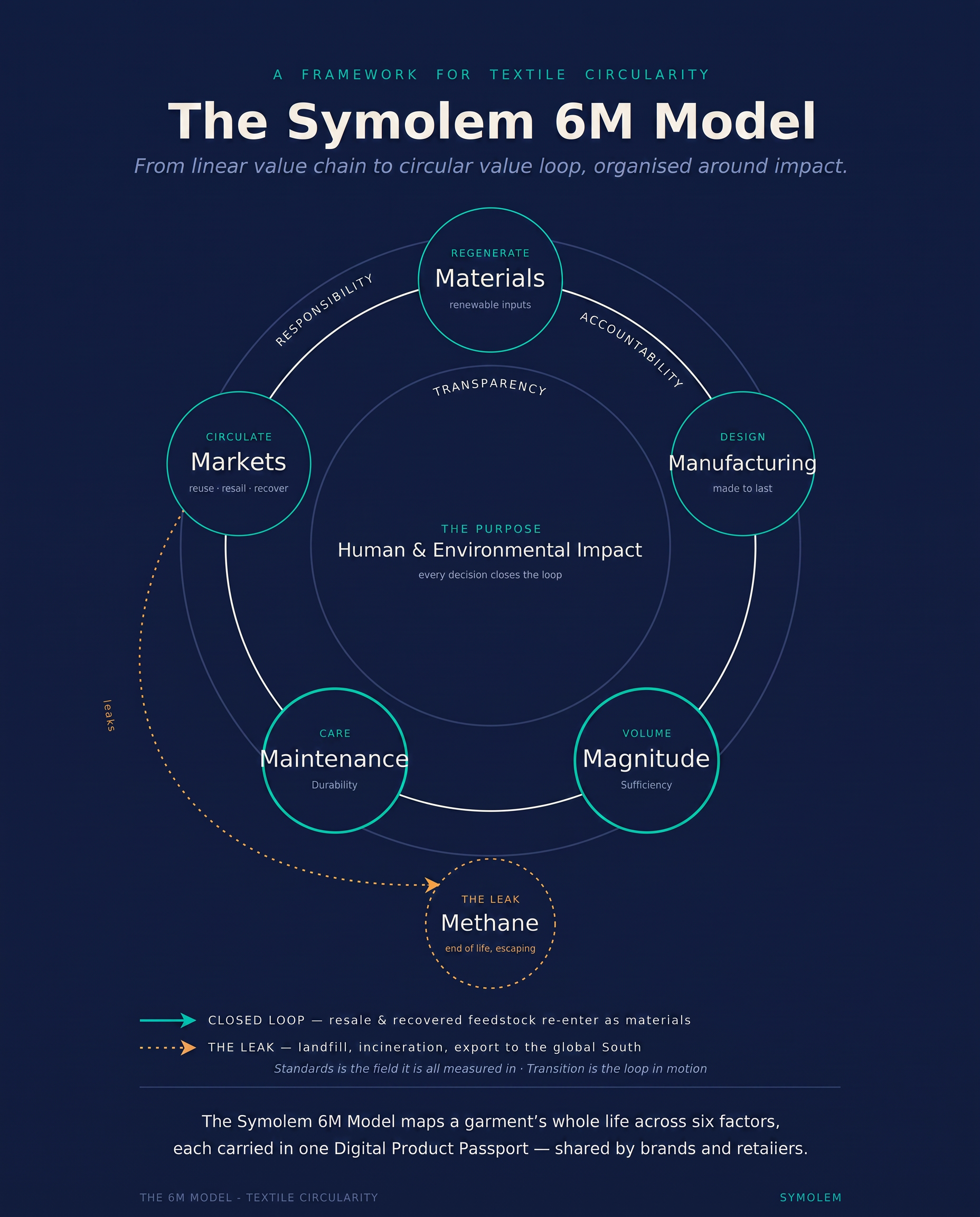
From linear value chain to circular value loop, organised around impact
Built around who decides
Most circularity diagrams map how materials should flow — not who decides. The 6M Model is built around the choices brands and retailers actually make: what to source, how long to build it to last, how much to put on the market, and whether it can come back.
Efficiency isn't enough
A recycled-fibre garment is still another garment. Per-item gains are swallowed by rising volume, so the model measures the total footprint — not the footprint of one good intention.
Read it as three pairs
Quality (Materials + Manufacturing), Scale (Magnitude + Maintenance) and Fate (Markets + Methane). The first sets intensity, the second decides volume and lifespan, the third decides where it all ends up.
The hinge and the leak
Markets is where the loop closes — or breaks. Whatever fails to recirculate leaves as Methane: landfill, incineration, export. The model names that leak rather than drawing over it.
The 6M Model is the what. Our START framework is the how.
System redesign
Circularity is a redesign of product decisions, not a recycling add-on
Incremental improvements to sourcing or recycling rates will not, on their own, deliver a circular system. The 6M Model treats circularity as a set of linked product decisions — what to source, how much to place on the market, how long products remain in use, and whether they can be recovered — each of which determines where value is retained and where it is lost.
Every factor — Materials, Manufacturing, Magnitude, Maintenance, Markets and Methane — is a point where that system can be tightened or allowed to leak. Our role is to identify which points carry the greatest risk, and to build the evidence base that turns a circularity ambition into a defensible compliance position.

From framework to evidence
Two ways to apply the 6M Model
The 6M Model is applied two ways at Symolem — directly, through advisory engagements, and continuously, through the platform that holds the product-level evidence underneath it.
Advisory
Symolem Limited
We apply the 6M Model and the START framework to your business directly, through diagnostic, roadmap and delivery engagements.
Start with the Assessment →Platform
Symolem-ID
The Digital Product Passport verification platform for fashion retail. Retailers use it to verify the passports of every brand they stock. Brands use it to substantiate their own claims. Currently in beta.
See the platform →Further reading
Read more on this


30 minutes on your products and the rules that apply to them.
Speak with Symolem about applying the 6M Model to your ESPR readiness, Digital Product Passport planning, and circularity system design.
Led by Lavinia Fernandes, a UN/CEFACT UNTP Supply Chain Working Group member.
What we do
Where to go next
Plain-English pages on the rules that apply to you, the evidence you need, and the people who do the work.
Looking for something specific? See every page on the site.