Global Textile Supply Chain Transparency: From Narrative to Regulatory Mandate
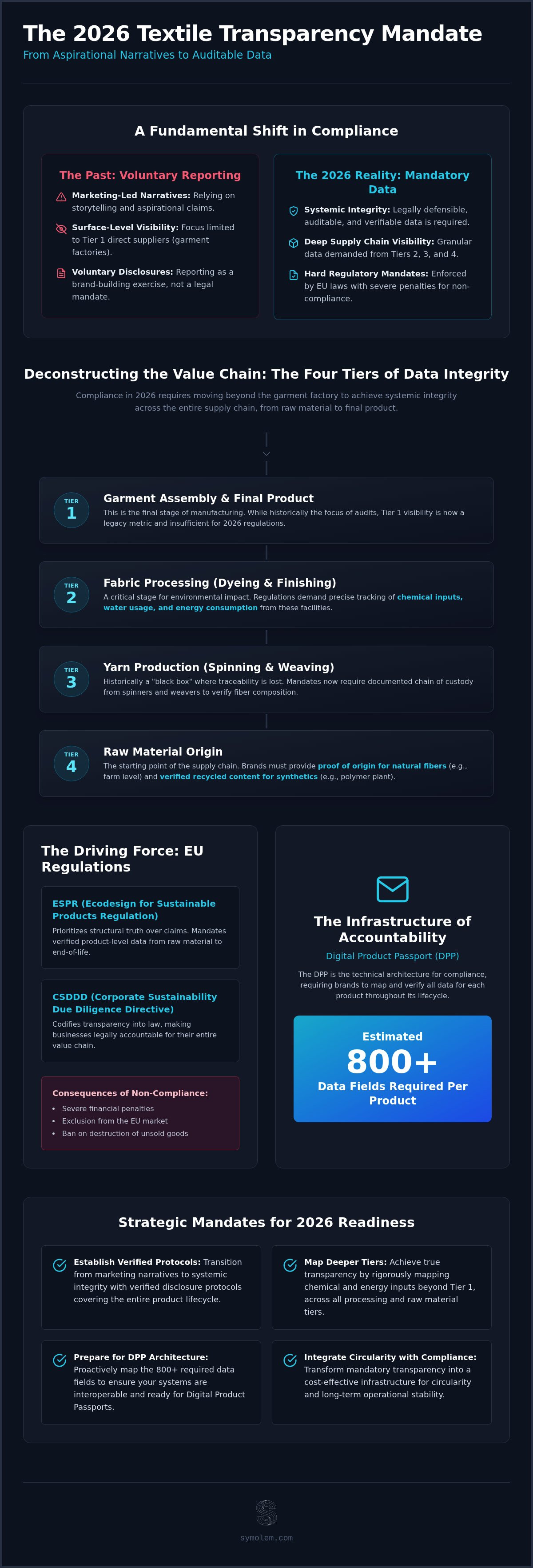
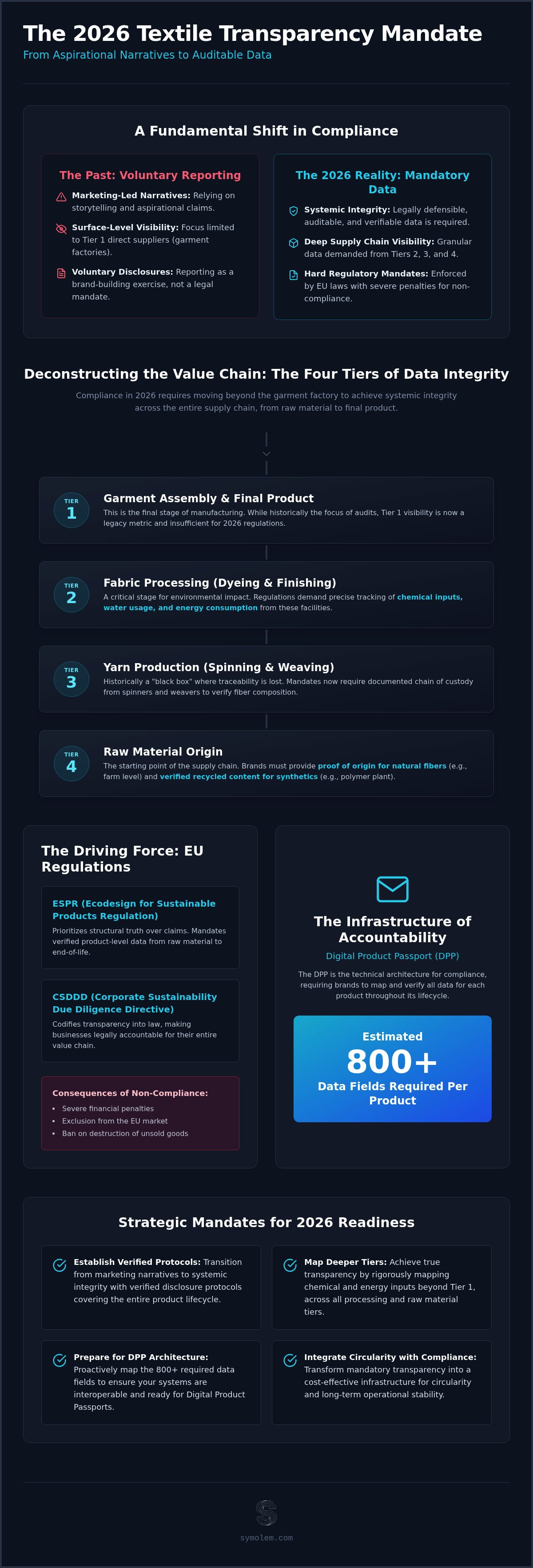
Narrative is no longer a substitute for data. In the 2026 landscape, global textile supply chain transparency has transitioned from a voluntary marketing exercise into a hard regulatory mandate with severe consequences for the unprepared. The luxury of "aspirational" reporting ended when the EU Corporate Sustainability Due Diligence Directive (CSDDD) and the Ecodesign for Sustainable Products Regulation (ESPR) codified transparency into law. Brands can't rely on Tier 1 surface-level audits when regulators now demand granular visibility into the spinners, weavers, and raw material sources across Tiers 2 through 4.
You're likely feeling the mounting pressure of legal anxiety regarding ESPR Article 14 and the high costs associated with building robust MRV systems. It's a valid concern. The structural failures of legacy supply chains are being exposed by new, data-centric compliance requirements that leave no room for ambiguity. This analysis offers a clinical diagnostic of the 2026 global landscape, providing a roadmap for regulatory readiness and a strategy for cost-effective circular infrastructure design. We'll unpack the mechanics of verifiable transparency to ensure your operations survive the shift from superficial narratives to systemic integrity.
Key Takeaways
- Transition from marketing-led narratives to systemic integrity by establishing verified disclosure protocols that span the entire product lifecycle from origin to disposal.
- Achieve true global textile supply chain transparency by looking beyond Tier 1 suppliers to rigorously map chemical and energy inputs across the deeper processing and raw material tiers.
- Prepare for the technical architecture of Digital Product Passports by proactively mapping the estimated 800+ required data fields to ensure interoperability and regulatory readiness.
- Integrate circular economy strategy with compliance frameworks to transform mandatory transparency into a structured, cost-effective infrastructure for long-term operational stability.
- Utilize a diagnostic-led approach to navigate complex EPR and ESPR mandates, replacing fragmented data with a unified framework for legal and economic security.
Table of Contents
- The Death of Voluntary Transparency: 2026 Regulatory Realities
- Deconstructing the Value Chain: The Four Tiers of Data Integrity
- Digital Product Passports (DPP): The Infrastructure of Accountability
- Strategic Mapping: Building a Verification-Ready Supply Chain
- Beyond Mapping: Implementing Systemic Transparency with Symolem
The Death of Voluntary Transparency: 2026 Regulatory Realities
The era of the voluntary sustainability report is over. By 2026, global textile supply chain transparency is defined not by marketing intent but by the verified disclosure of product-level data from raw material origin to end-of-life. This represents a fundamental shift from storytelling to systemic integrity. Data must now be auditable, interoperable, and legally defensible. Companies that once relied on high-level ESG narratives now face the granular requirements of the Ecodesign for Sustainable Products Regulation (ESPR), which prioritizes structural truth over aspirational claims.
While the concept of Sustainable fashion has historically been driven by ethical sentiment, it's now governed by clinical regulatory mechanics. Voluntary disclosures no longer satisfy the European Commission. The stakes are binary. Either provide verified data or face market exclusion. Non-compliance triggers severe financial penalties and the potential for immediate bans on the destruction of unsold apparel, a mandate taking effect for large companies on July 19, 2026. There's no middle ground for brands that fail to map their value chains with technical precision. This isn't just about ethics. It's about the legal right to operate.
The Legal Role of the Responsible Operator
Under 2026 EU law, the Responsible Operator is the central point of legal accountability. For own-label brands and importers selling in the EU market, this role carries significant weight. You're now legally liable for the accuracy of data across the entire supply chain, including Tiers 3 and 4 where you've previously lacked visibility. Importers can't claim ignorance of supplier practices. The law requires proactive verification and a documented chain of custody for every SKU entering the single market. Failure to identify a responsible entity within the EU results in immediate non-compliance.
ESPR vs. EPR: Interconnected Compliance Mandates
Transparency is the engine that drives Extended Producer Responsibility (EPR) fee structures. In the 2026 framework, the transparency of your supply chain directly impacts the eco-modulation of fees you pay for product end-of-life management. Ecodesign requirements are inextricably linked to supply chain visibility. You can't prove durability, repairability, or recyclability without primary data from processing mills and spinners. To manage these overlapping requirements, brands are adopting an ESPR readiness diagnostic to identify data gaps before they become legal liabilities. This diagnostic approach ensures that global textile supply chain transparency is treated as a structural asset rather than a reporting burden. By mapping data fields early, brands can minimize financial exposure to high EPR fees.
Deconstructing the Value Chain: The Four Tiers of Data Integrity
Tier 1 visibility is a legacy metric that no longer satisfies the 2026 requirement for global textile supply chain transparency. Relying on direct supplier disclosures is a structural risk that ignores the vast majority of a product's environmental and legal footprint. To achieve systemic integrity, you must move beyond the garment factory. Tier 2 (Processing) requires precise tracking of chemical and energy inputs during dyeing and finishing, as these factors are critical for compliance with the EU Strategy for Sustainable and Circular Textiles. Without primary data from these facilities, your impact calculations are merely estimates, and estimates won't survive a regulatory audit.
The complexity intensifies at the upstream levels of Tier 3 (Spinning and Weaving) and Tier 4 (Raw Materials). These tiers have historically functioned as a "black box" where fiber-level traceability is lost. However, 2026 mandates require proof of origin for natural fibers and verified recycled content for synthetics. You can't claim a product is circular without a documented chain of custody that begins at the farm or the polymer plant. Fragmented data at these levels isn't just an operational hurdle; it's a legal liability that risks immediate market exclusion under the ESPR framework.
Verifying Textile Sustainability Claims for ESPR
Credibility in the new landscape depends on verifying textile sustainability claims for ESPR through robust Monitoring, Reporting, and Verification (MRV) systems. Starting in September 2026, new EU rules will ban unsubstantiated sustainability labels, making clinical data verification the only path to market. You won't be able to use general descriptors like "eco-friendly" without a digital trail that supports every attribute. MRV is the core infrastructure required to eliminate greenwashing and ensure that every claim is auditable by third-party regulators.
The Economic Reality of Upstream Visibility
Achieving deep-tier visibility requires a fundamental shift in how you view supplier relationships. The "proprietary data" barrier is collapsing under the weight of regulatory necessity. You'll need to implement cost-sharing models for data collection to incentivize transparency across Tiers 3 and 4. Long-term strategic partnerships are the only way to secure the granular data required for the Digital Product Passport. If you're struggling to map these technical requirements, engaging in Policy and Regulatory Advisory can help align your economic model with these new mandates. Systemic integrity is an investment in stability, but the cost of non-compliance is terminal.
Digital Product Passports (DPP): The Infrastructure of Accountability
Compliance is no longer an analog exercise. The Digital Product Passport (DPP) represents the definitive technical infrastructure for global textile supply chain transparency, acting as a centralized, immutable repository for product-level data. It's a clinical mapping of a product's entire lifecycle. Current estimates suggest the DPP will require the population of approximately 814 specific data fields per SKU, covering everything from material durability to chemical composition. This isn't a marketing tag. It's a high-stakes business requirement that demands a complete overhaul of how data is captured, verified, and stored across fragmented value chains.
Viewing the DPP as a mere compliance checkbox is a strategic failure. Forward-thinking brands recognize it as a foundational tool for circular economy strategy development, providing the granular visibility needed to optimize resource recovery and minimize the financial impact of EPR fees. However, the path to integration is complex. Navigating the challenges of Digital Product Passport implementation requires more than basic data collection. It requires a structural framework that aligns procurement, legal, and IT departments under a single mandate of systemic integrity to ensure that the data provided is both accurate and legally defensible.
Data Governance and Supply Chain Security
Integrity is the currency of the DPP ecosystem. To ensure data remains untampered across multi-stakeholder platforms, brands must adopt GS1 standards and verifiable credentials. This technical layer provides a secure handshake between suppliers and regulators. It's a delicate balance. You must protect commercial sensitivity while ensuring total regulatory access. By utilizing decentralized identifiers, brands can share verified proofs of compliance without exposing proprietary supplier lists or pricing structures to competitors. Security isn't just about encryption; it's about building a stable architecture where truth is the baseline for every transaction.
The Interoperability Challenge
Data silos are the enemy of 2026 compliance. Aligning disparate global supplier systems with the centralized EU registry requires a standardized, interoperable approach. If your spinners in Vietnam use different data protocols than your weavers in Italy, the system collapses. Global textile supply chain transparency depends on the adoption of universal technical frameworks that allow data to flow seamlessly across jurisdictions without manual intervention. Building a future-proof technical data framework isn't an option. It's a prerequisite for market access in an increasingly regulated global economy that no longer rewards opacity.
Strategic Mapping: Building a Verification-Ready Supply Chain
Passive disclosure is a liability in a regulated market. For years, brands treated supplier lists as static documents, but the 2026 mandate for global textile supply chain transparency requires an active, structural mapping of every node in the value chain. You can't manage what you haven't mapped with clinical precision. This shift demands a rigorous diagnostic to identify "Transparency Gaps" where data flow breaks down between Tiers 2 and 4. Identifying these failures early is the only way to ensure your operating model remains viable under the upcoming ESPR scrutiny.
Strategic mapping isn't just a compliance exercise; it's a prerequisite for conducting a cost-benefit analysis of circular textile models. Without a verified map of material flows, you cannot accurately model the economics of resource recovery or quantify the impact of Extended Producer Responsibility (EPR) fees on your bottom line. You must design your circular infrastructure now, well before the 2026 regulations take full effect, to ensure your supply chain is built for verification rather than just reporting. This proactive architectural design transforms transparency from a cost center into a stable foundation for long-term growth.
Impact Measurement and MRV Rigor
Industry averages are no longer acceptable for high-stakes compliance. The shift toward primary supplier data requires quantifying carbon, water, and chemical footprints at the batch level, ensuring that every product has a defensible environmental profile. Verification through robust Monitoring, Reporting, and Verification (MRV) systems is the new standard. Brands that can prove their impact through primary data gain a definitive competitive advantage in the EU market, as they face lower risk of greenwashing penalties and market exclusion. It's about replacing estimates with auditable truth.
Infrastructure Costing for Circularity
Transparency directly reduces the cost of circular logistics. When you have granular visibility into material composition and origin, the economic modeling of textile recovery systems becomes predictable rather than speculative. Designing for disassembly is a structural requirement that must be integrated into the product development phase. This design choice is a prerequisite for transparency, as it allows for the accurate tracking of components through the recycling process. If your organization is unprepared for these structural shifts, it's time to seek Policy and Regulatory Advisory to align your infrastructure with the realities of the 2026 landscape. Systemic integrity is the only path to economic stability in a circular economy.
Beyond Mapping: Implementing Systemic Transparency with Symolem
Mapping is the diagnostic phase; implementation is the operational imperative. While many organizations stop at identifying supplier lists, Symolem focuses on the structural integration of global textile supply chain transparency into core business functions. We don't offer superficial checklists. Instead, we provide a diagnostic-led approach to navigating EPR for textiles, ensuring that every data point collected serves a dual purpose: legal compliance and economic optimization. This methodical transition from data capture to strategic implementation is what separates market leaders from those facing regulatory obsolescence.
The 2026 regulatory shift is a catalyst for total organizational redesign. We ensure that the textile regulation impact on business models is managed as a transition toward higher profitability and resilience. By developing bespoke implementation frameworks for global manufacturers, Symolem bridges the gap between high-level EU policy and granular factory-floor reality. Our advisory services move beyond passive compliance, positioning transparency as a prerequisite for circular economy strategy development and long-term stability in a volatile global market.
Diagnostic and Strategy Implementation
Our ESPR Readiness Diagnostic is the first step in a clinical audit process designed for the 2026 landscape. We meticulously map the estimated 814 technical data fields required for Digital Product Passport readiness, identifying specific structural failures in your current data governance. This isn't just about collecting information. It's about building a verifiable chain of custody that withstands third-party scrutiny. Once the diagnostic is complete, we provide strategic advisory for circular infrastructure design, ensuring your recovery systems are cost-effective and fully integrated with your transparency protocols.
Future-Proofing the Global Value Chain
The regulatory landscape won't remain static between 2026 and 2030. Anticipating the next wave of EU sustainability legislation requires a forward-thinking perspective that views global textile supply chain transparency as a dynamic asset. Systemic resilience is built through data-driven integrity, not reactive reporting. By establishing robust Impact Measurement and MRV frameworks today, you secure your market position against future mandates that will undoubtedly demand even greater levels of disclosure. Secure your market position with a clinical compliance strategy from Symolem and transform regulatory pressure into a definitive competitive advantage.
Securing Operational Stability in a Regulated Value Chain
Transparency is no longer a choice. It's a structural requirement for market access. The shift from voluntary ESG narratives to mandatory 2026 data protocols represents a fundamental re-engineering of the global textile industry. Achieving global textile supply chain transparency demands clinical precision in mapping Tiers 2 through 4, ensuring that every fiber, chemical input, and processing step is auditable and legally defensible. This transition isn't merely about compliance; it's about the survival of your operating model in a landscape that no longer rewards opacity or fragmented data sets.
The Digital Product Passport is the new baseline for systemic accountability. By integrating ESPR readiness with strategic circular infrastructure, brands can mitigate the risk of severe financial penalties and immediate market exclusion. Symolem provides the independent advisory and localized policy expertise needed to navigate this high-stakes transition. We specialize in mapping the complex data fields required for DPP implementation and conducting rigorous diagnostics of your current value chain. Contact Symolem for a Strategic Compliance Diagnostic to secure your market position. You have the opportunity to transform regulatory pressure into a definitive competitive advantage while building a resilient, future-proof organization.
Frequently Asked Questions
What is the difference between traceability and transparency in textiles?
Traceability is the technical capability to track a product's journey through the value chain; transparency is the systemic disclosure of that data to regulators and stakeholders. Traceability functions as the internal mechanism of data capture. Transparency is the external outcome of verified disclosure. In the 2026 landscape, global textile supply chain transparency requires both a verifiable trail of custody and the clinical disclosure of granular impact data across all four tiers.
Does ESPR transparency apply to UK brands selling into the EU?
Yes, ESPR applies to any entity placing textile products on the EU market, regardless of their headquarters' location. UK brands must meet the same stringent data disclosure and Digital Product Passport requirements as EU based companies. If you export to the single market, you're subject to the "Responsible Operator" mandate. This requires you to appoint an EU based representative to assume legal liability for the accuracy of your supply chain data.
What are the main data requirements for a Digital Product Passport (DPP)?
The DPP requires the population of approximately 814 technical data fields covering the entire product lifecycle. These requirements include material composition, durability metrics, repairability instructions, and chemical safety profiles. Additionally, you must provide verified data on raw material origin and recycled content percentages. This structured data set ensures that every SKU has a digital twin that regulators and recyclers can access to verify compliance with ecodesign standards.
Who is legally responsible for supply chain data accuracy under ESPR?
The "Responsible Operator" carries the legal burden for data integrity under ESPR. For own label brands and importers, this entity is liable for verifying the accuracy of information provided by upstream suppliers. You can't outsource this liability to your manufacturers. If a regulator discovers fraudulent or missing data in your Digital Product Passport, the Responsible Operator faces market exclusion, severe financial penalties, and potential bans on the destruction of unsold inventory.
How can small fashion brands afford full supply chain transparency?
Small brands can achieve global textile supply chain transparency by adopting a phased, diagnostic led approach that prioritizes high risk product categories. While the upfront costs of MRV systems are significant, small entities can utilize industry standard data protocols to minimize custom integration fees. Strategic partnerships with transparent Tier 2 and Tier 3 suppliers allow for shared data collection costs. Investing in transparency early prevents the catastrophic financial impact of non compliance penalties.
What is the role of Tier 4 suppliers in transparency compliance?
Tier 4 suppliers provide the primary data required to verify the origin of raw materials like cotton, wool, or synthetic polymers. Under 2026 regulations, visibility into the farm or extraction site is mandatory for proving sustainability claims. These suppliers are the foundation of the chain of custody. Without their verified input, you cannot populate the mandatory origin fields in the DPP, making your final product non compliant for sale in the EU market.
When do the new EU textile transparency regulations take full effect?
The regulatory timeline is phased, but critical deadlines arrive in 2026. A ban on the destruction of unsold apparel for large companies takes effect on July 19, 2026. Additionally, the Corporate Sustainability Due Diligence Directive (CSDDD) requires member states to adopt national laws by July 26, 2026. While the full Digital Product Passport mandate for textiles is estimated for 2028 or 2029, the structural requirements for data collection and mapping must be implemented immediately.
How does transparency impact Extended Producer Responsibility (EPR) fees?
Transparency is the primary mechanism for the eco modulation of EPR fees. Verified data regarding a product's recyclability, durability, and recycled content allows brands to access lower fee tiers. Conversely, opacity or poor material choices result in higher financial penalties. By providing granular visibility into the value chain, you enable regulators to accurately assess the environmental cost of your products, transforming transparency into a tool for financial optimization and risk management.