DPP Compliance for Textile Manufacturers: 2026 Mandate
The Digital Product Passport is not a digital label; it's a fundamental restructuring of global economic accountability. For decades, the textile industry functioned through opaque supply chains and manual data entry, but that era ended on July 20, 2026, when the European Commission activated the central DPP registry. Achieving DPP compliance for textile manufacturers now demands more than a reactive posture. It requires a clinical, diagnostic evaluation of your internal data infrastructure to manage up to 125 specific attributes across material composition, chemical substances, and environmental metrics.
You're likely feeling the pressure of fragmented supply chain data and the high cost of regulatory readiness as the 2026 delegated acts approach. This article provides the technical roadmap needed to navigate the EU's structural requirements and secure your global market access. We'll unpack data governance frameworks that protect your commercial sovereignty while designing a cost-effective circular infrastructure. By the end, you'll understand how to transform these regulatory hurdles into a stable, verified system of global value chain integrity.
Key Takeaways
- Understand why the Ecodesign for Sustainable Products Regulation (ESPR) transforms transparency from a voluntary initiative into a non-negotiable prerequisite for EU market entry.
- Navigate the technical rigor of DPP compliance for textile manufacturers by mapping hundreds of critical data attributes across material provenance, chemical composition, and repairability indices.
- Secure competitive advantages by establishing data governance frameworks that satisfy regulatory scrutiny without compromising sensitive trade secrets or intellectual property.
- Shift from a reactive software-centric mindset to a strategic infrastructure model that accounts for the long-term economics of textile recovery and feedstock preparation.
- Execute a structured roadmap to readiness through an ESPR Readiness Diagnostic to identify systemic gaps and prioritize high-risk product categories for immediate integration.
Table of Contents
- The 2026 Regulatory Mandate: Why DPP Compliance is a Business Imperative
- Decoding the Technical Burden: Mapping 800+ Data Fields for Compliance
- Structural Risks: Navigating Data Sovereignty and Competitive Exposure
- Economic Realities: Costing Circular Infrastructure and Recovery Systems
- The Roadmap to Readiness: Symolem’s Strategic Compliance Framework
The 2026 Regulatory Mandate: Why DPP Compliance is a Business Imperative
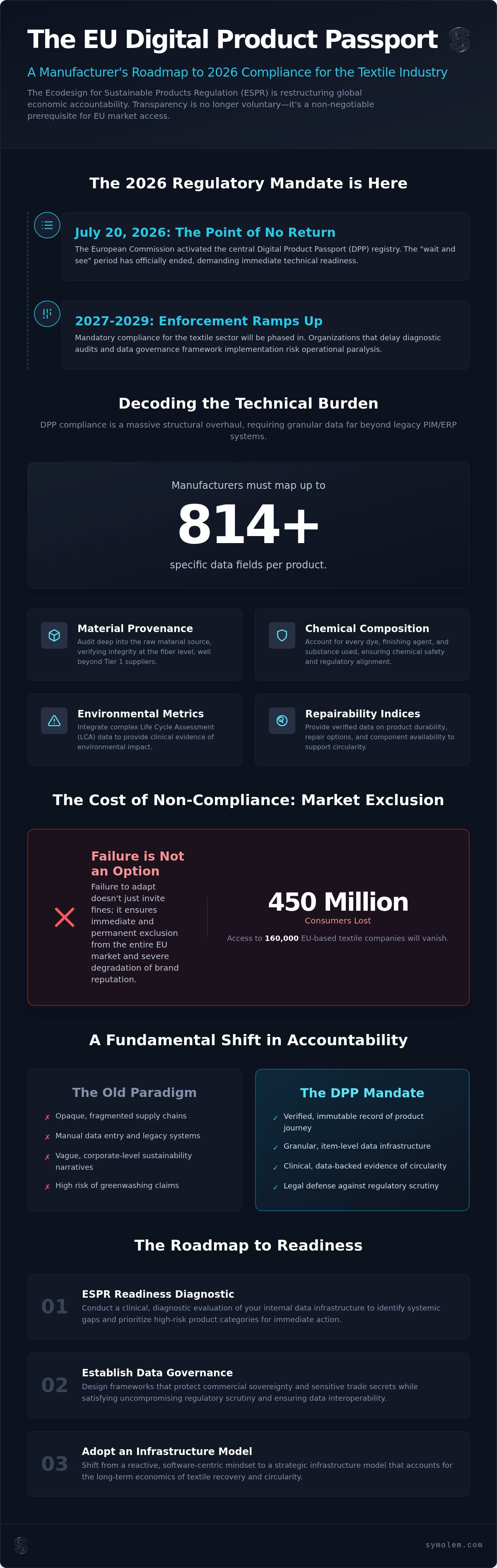
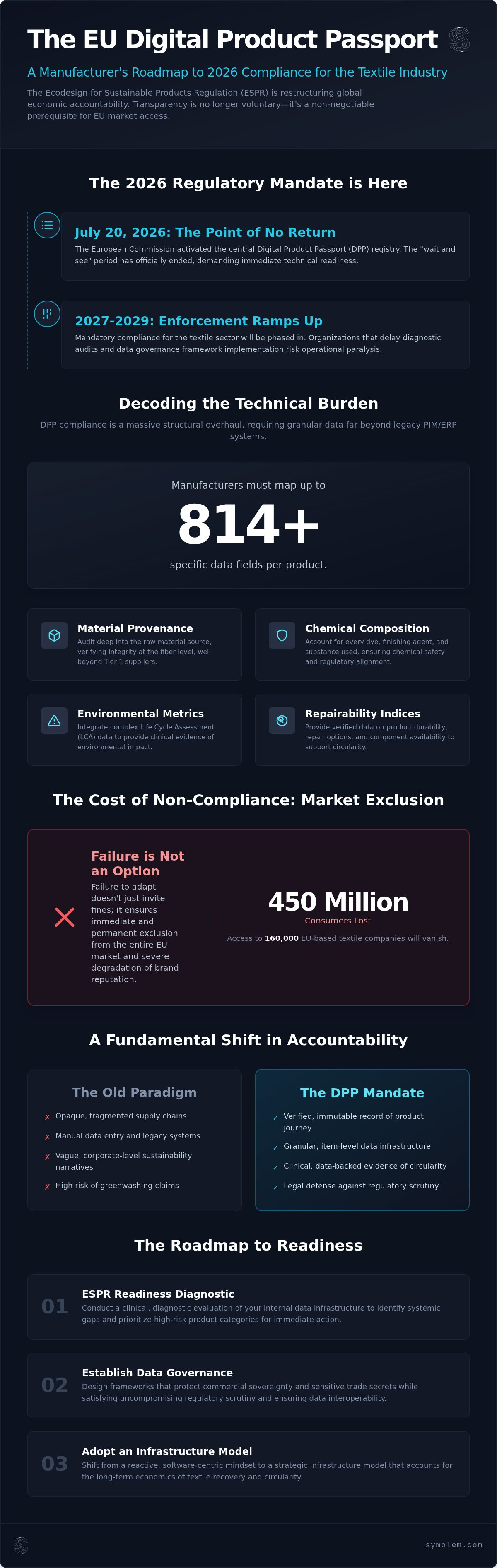
Compliance is no longer a voluntary exercise in corporate social responsibility. It's a binary state of market existence. The Ecodesign for Sustainable Products Regulation (ESPR) has fundamentally altered the legal landscape, making transparency a non-negotiable prerequisite for entry into the European market. Central to this shift is the Digital Product Passport (DPP), which functions as a verified, immutable record of a product’s material composition and environmental footprint. For leadership, DPP compliance for textile manufacturers is now a critical business and legal imperative that replaces superficial sustainability narratives with clinical, data-backed evidence of circularity. Failure to adapt by 2026 doesn't just invite fines; it ensures immediate exclusion from the EU market and a permanent degradation of brand reputation.
The Scope of ESPR for Textile Manufacturers
The regulatory net is wide but precise. Delegated acts now specifically target apparel, footwear, and industrial textiles, categories that contribute significantly to the 92 million tonnes of textile waste generated annually. This framework shifts accountability from vague corporate-level reporting to granular, item-level data. Manufacturers are the primary data anchors in this new ecosystem. They're responsible for verifying material provenance, chemical safety, and repairability indices. If you can't prove the systemic integrity of your product at the fiber level, your access to 160,000 EU-based textile companies and 450 million consumers will vanish.
Timeline of Enforcement: 2026 and Beyond
The transition is accelerating. On July 20, 2026, the European Commission activated the central DPP registry and testing environment, signaling the end of the "wait and see" period. While mandatory compliance for the textile sector is anticipated to ramp up between 2027 and 2029, the publication of specific delegated acts in 2026 creates an immediate need for technical readiness. Proactive adoption is the only hedge against operational paralysis. Organizations that delay their diagnostic audits risk being overwhelmed by the complexity of data collection when the 2027 adoption milestones arrive. Strategic architects recognize that building the necessary data governance frameworks takes time; starting in 2027 is already too late.
Decoding the Technical Burden: Mapping 800+ Data Fields for Compliance
Data is the new currency of the textile trade. While many brands rely on superficial PIM systems, true DPP compliance for textile manufacturers requires mapping up to 814 specific data fields as outlined in the Joint Research Centre’s technical milestones. This isn't a digital labeling exercise; it's a massive structural overhaul of how information flows through the global value chain. Key categories include material provenance, chemical composition, and repairability indices, all of which must be verified to satisfy the EU's Strategy for Sustainable and Circular Textiles. The technical rigor required here is uncompromising, demanding that every fiber, dye, and finishing agent be accounted for with clinical precision.
Technical Data Mapping and Supply Chain Granularity
Transparency stops being useful when it's shallow. Manufacturers must now audit deep into the raw material source, moving well beyond Tier 1 suppliers to capture the granular reality of fiber production and processing. Legacy ERP and PIM systems frequently lack the architecture to house these hundreds of fields, creating significant data gaps that lead to immediate regulatory rejection. This structural failure often stems from a lack of interoperability between supply chain partners. MRV is the process of ensuring every data point in the DPP is auditable and verified. This framework serves as the foundation for your legal defense against greenwashing claims and ensures the systemic integrity of your entire operation.
The Role of LCA in DPP Readiness
Life Cycle Assessment (LCA) provides the clinical evidence required for environmental impact reporting within the passport. Integrating this data into the product-level digital record is complex, as it necessitates a shift from secondary, industry-average data to primary manufacturing data that reflects real-world energy use and chemical outputs. Accuracy is paramount; using generic benchmarks in a regulated environment is a liability that invites scrutiny from EU authorities. For those struggling to validate their impact metrics, verifying textile sustainability claims for ESPR requires a robust MRV framework that connects physical production to digital records.
Establishing this level of technical integrity is the only way to protect your market position and ensure long-term viability. A strategic ESPR Readiness Diagnostic can help identify which of the hundreds of required data points are currently missing from your existing digital infrastructure before the 2026 mandate takes full effect.
Structural Risks: Navigating Data Sovereignty and Competitive Exposure
Transparency is a structural paradox. While the EU mandates radical openness, DPP compliance for textile manufacturers presents a significant risk to intellectual property and trade secrets. For high-end producers, the specific chemical formulations, weaving patterns, or finishing techniques used are competitive differentiators that can't be surrendered to the public domain. This tension creates a high-stakes environment where manufacturers must satisfy regulatory scrutiny without providing a blueprint for their competitors. Strategic data governance is the only solution. It requires a clinical approach to data segmentation that separates public-facing disclosures from sensitive operational intelligence.
Protecting Trade Secrets in a Transparent Market
Manufacturers must distinguish between mandatory compliance data and proprietary process data. According to FESPA's guide to the Digital Product Passport, the level of data granularity required varies depending on the stakeholder accessing the passport. Consumers might see repair instructions, but regulators require deeper material verification. Protecting your sovereignty involves utilizing decentralized data carriers and secure digital architectures that allow for tiered access. This ensures that sensitive information remains encrypted, accessible only to authorized auditors rather than the general market. Identifying these challenges of Digital Product Passport implementation early is vital for maintaining a competitive edge in a transparent economy. By anonymizing proprietary manufacturing techniques while meeting EU standards, organizations protect their market position without sacrificing their unique value proposition.
Data Governance and Supply Chain Accountability
The shift from trust to verification is absolute. Global supplier relationships now require rigorous legal agreements that define data ownership, usage rights, and liability. It's not enough to hope your Tier 2 partners provide accurate metrics; you need contractual mandates for data integrity. "Data dumping"—the act of providing unorganized, raw data without a verification layer—is a dangerous practice that invites regulatory rejection. Manufacturers must establish a strategic protection layer that audits incoming data for accuracy while scrubbing it for competitive exposure. This methodical approach ensures that your DPP compliance for textile manufacturers remains a tool for market access rather than a source of systemic vulnerability. You must ensure data security and integrity across third-party compliance platforms to prevent leaks of sensitive operational data. Verification becomes the foundation of stability in an otherwise volatile regulatory landscape.
Economic Realities: Costing Circular Infrastructure and Recovery Systems
Compliance is an infrastructure investment, not a recurring software subscription fee. The 2026 mandate forces a transition from linear waste models to circular asset management. For leadership, DPP compliance for textile manufacturers involves modeling the precise economics of recovery, sorting, and feedstock preparation at an industrial scale. This is a structural challenge that requires clinical financial diagnostic work rather than aspirational sustainability goals. Organizations that treat this as a simple digital labeling exercise will find themselves unprepared for the physical realities of textile-to-textile recycling and the capital requirements of closed-loop systems.
Infrastructure Costing and Circular Modeling
Calculating the true economics of textile-to-textile recycling at scale reveals significant capital requirements for automated sorting technology and chemical recovery systems. Manufacturers must move beyond Tier 1 oversight to understand the actual cost of reclaiming their own products from the market. Strategic advisory is essential here to design viable circular value chains that don't collapse under the weight of logistical inefficiencies or poor material purity. A thorough cost-benefit analysis of circular textile models provides the necessary data to justify these long-term capital expenditures against the immediate risk of market exclusion. While the textile sector is projected to generate over $1.59 billion in global software and IT support costs by 2030, the primary economic burden remains the labor-intensive mapping of supply chain data and the physical restructuring of recovery networks.
Navigating EPR and Financial Liability
Extended Producer Responsibility (EPR) fee structures in the EU are increasingly tied to the granularity of product data. The DPP acts as the primary evidence layer for eco-modulation, where manufacturers with high-integrity data can access lower fee tiers. Conversely, those with fragmented or unverified data face significant financial penalties and severe margin erosion. Understanding the mechanics of navigating EPR for textiles is critical for protecting the bottom line. Accurate data on material composition and durability allows manufacturers to benefit from reduced fees, turning compliance into a competitive financial advantage. Without this data-backed evidence, firms are exposed to the maximum liability of the EU's evolving waste management frameworks.
To secure your margins and ensure long-term viability, you must integrate these economic realities into your operational core. Developing a comprehensive Circular Economy Strategy Development framework is the only way to align your production infrastructure with the new regulatory reality.
The Roadmap to Readiness: Symolem’s Strategic Compliance Framework
Readiness is a structural achievement. It's the byproduct of a calculated response to systemic regulatory shifts rather than a reactive scramble for software. Achieving DPP compliance for textile manufacturers requires a clinical, phased approach that prioritizes systemic integrity over superficial fixes. The transition from linear production to circular accountability is a fundamental business transformation that demands a rigorous evaluation of current operational maturity. By integrating regulatory advisory into your core strategy, you move beyond the "wait and see" mindset and establish a resilient foundation that treats the Digital Product Passport as a vehicle for long-term market dominance.
The ESPR Readiness Diagnostic
The first step in any strategic overhaul is a comprehensive audit of existing information gaps. Manufacturers often discover that their current ERP and PIM systems are incapable of housing the 814 data fields identified in the JRC’s technical milestones. Our ESPR readiness diagnostic identifies these technical failures with diagnostic precision, mapping the exact distance between your current operations and the 2026 mandate. This process allows leadership to prioritize high-risk product categories for immediate focus, ensuring that the most critical assets are compliant before enforcement begins. Establishing this data baseline is the only way to manage the complexity of product-level accountability without paralyzing your production lines.
Strategic Advisory for Global Value Chains
Production hubs in diverse jurisdictions require more than a standardized software solution; they need a strategic architecture that accounts for varied manufacturing tiers and local infrastructure realities. Designing cost-effective circular infrastructure involves modeling the economics of recovery and feedstock preparation across international supply chains. This level of complexity requires independent expertise that understands the granular details of global operations. Our Strategic Advisory for Circular Fashion Compliance ensures that your framework is robust enough to withstand regulatory scrutiny while protecting your commercial sovereignty. By building a verified system of supply chain integrity, you secure your global market access and transform a regulatory hurdle into a stable, long-term economic advantage. Compliance is the new standard of excellence in a regulated global market.
Securing Global Market Viability Through Structural Integrity
The 2026 mandate is a binary threshold for market entry. Achieving DPP compliance for textile manufacturers requires a shift from superficial reporting to a clinical, data-backed architecture. You must map 814 technical data fields while protecting your commercial sovereignty through tiered access frameworks. This is not a digital labeling task; it's a fundamental restructuring of your economic model to account for the physical realities of textile recovery and EPR liability. Organizations that fail to build these systems now will face immediate exclusion from the European market.
Symolem provides the independent expertise needed to navigate this transition without the bias of a software vendor. Our technical mapping and policy advisory ensure your global value chain remains stable under the weight of the ESPR. Begin your transition with a diagnostic audit to identify systemic gaps before they become legal liabilities. Our Strategic Advisory for Circular Fashion Compliance is the logical step toward building a verified, resilient future. You have the capacity to turn regulatory pressure into a definitive strategic advantage.
Frequently Asked Questions
What are the specific DPP requirements for textile manufacturers in 2026?
Specific requirements involve mapping technical data across five core categories: material composition, supply chain origin, chemical substances, environmental metrics, and end-of-life instructions. Manufacturers must provide verified data at the model, batch, or item level as defined by the forthcoming delegated acts. This information must be accessible via a persistent digital identifier that remains linked to the product throughout its entire lifecycle to ensure systemic transparency across the global value chain.
How does the Digital Product Passport differ from existing physical labels?
The Digital Product Passport is a dynamic, verified digital record, while physical labels are static and limited by surface area. While a QR code or NFC tag provides the physical entry point, the passport itself houses granular, auditable data that physical tags cannot contain. This digital infrastructure allows for real-time updates and tiered access levels, ensuring that regulators, recyclers, and consumers receive different depths of information based on their specific needs.
Can manufacturers use the DPP to protect their trade secrets?
Manufacturers can protect trade secrets by utilizing decentralized data architecture and tiered access protocols. The EU framework distinguishes between publicly accessible consumer data and sensitive business-to-business information restricted to authorities or supply chain partners. By implementing a strategic data governance layer, you can satisfy regulatory scrutiny without surrendering proprietary manufacturing techniques or chemical formulations that constitute your unique competitive advantage in the global market.
What is the relationship between ESPR and the Digital Product Passport?
The Ecodesign for Sustainable Products Regulation (ESPR) is the overarching legal framework that mandates the Digital Product Passport as its primary enforcement tool. While the ESPR sets the broad performance and information requirements for products, the DPP serves as the technical mechanism for recording and sharing that data. Achieving DPP compliance for textile manufacturers is the practical method of meeting the legal obligations established under the broader ESPR mandate.
How much does it cost to implement a Digital Product Passport framework?
Total first-year compliance costs for a small brand with under 100 SKUs typically range between €2,500 and €10,000. These figures are expected to decrease to an annual range of €1,000 to €5,000 after the initial setup phase. The primary economic burden isn't technology, but the intensive labor required for supply chain data collection and the verification of technical attributes across multiple manufacturing tiers.
What happens if a manufacturer fails to meet DPP compliance by 2027?
Failure to meet compliance requirements by the 2027 enforcement milestones results in immediate exclusion from the European Union market. Products that lack a verified passport will be legally prohibited from being placed on the market, leading to severe inventory stagnation and revenue loss. Beyond the legal ban, non-compliant manufacturers face significant reputational degradation and the permanent loss of trust from EU-based retail partners who require verified transparency.
What role does Life Cycle Assessment play in DPP data mapping?
Life Cycle Assessment (LCA) provides the clinical evidence for environmental metrics within the passport's data structure. It shifts the reporting focus from industry averages to primary manufacturing data, capturing real-world energy consumption, water usage, and chemical outputs. Integrating LCA data into the digital record ensures that claims regarding a product's environmental footprint are verified and auditable, serving as a foundational element of DPP compliance for textile manufacturers.
How can manufacturers prepare for Extended Producer Responsibility (EPR) through the DPP?
Manufacturers can prepare for Extended Producer Responsibility (EPR) by using the DPP to document product durability and material purity. This granular data serves as the primary evidence for eco-modulation, allowing firms to access lower fee tiers in EU waste management systems. Accurate data governance ensures that you aren't penalized with maximum financial liabilities, turning your compliance framework into a tool for preserving margins in a circular economy.