
Financial Modeling for Textile Circularity & ESPR
The era of treating environmental impact as an externality ended on July 19, 2026, when the EU officially banned the destruction of unsold textiles. For the modern executive, financial modeling for textile circularity is no longer a theoretical exercise in sustainability reporting; it's a critical requirement for institutional solvency. You're likely aware that the shift toward circularity is inevitable, yet the path remains obscured by the lack of standardized data for Digital Product Passports and the volatility of recovery infrastructure costs. High EPR fees and the threat of regulatory penalties create a landscape where strategic guesswork becomes a terminal liability.
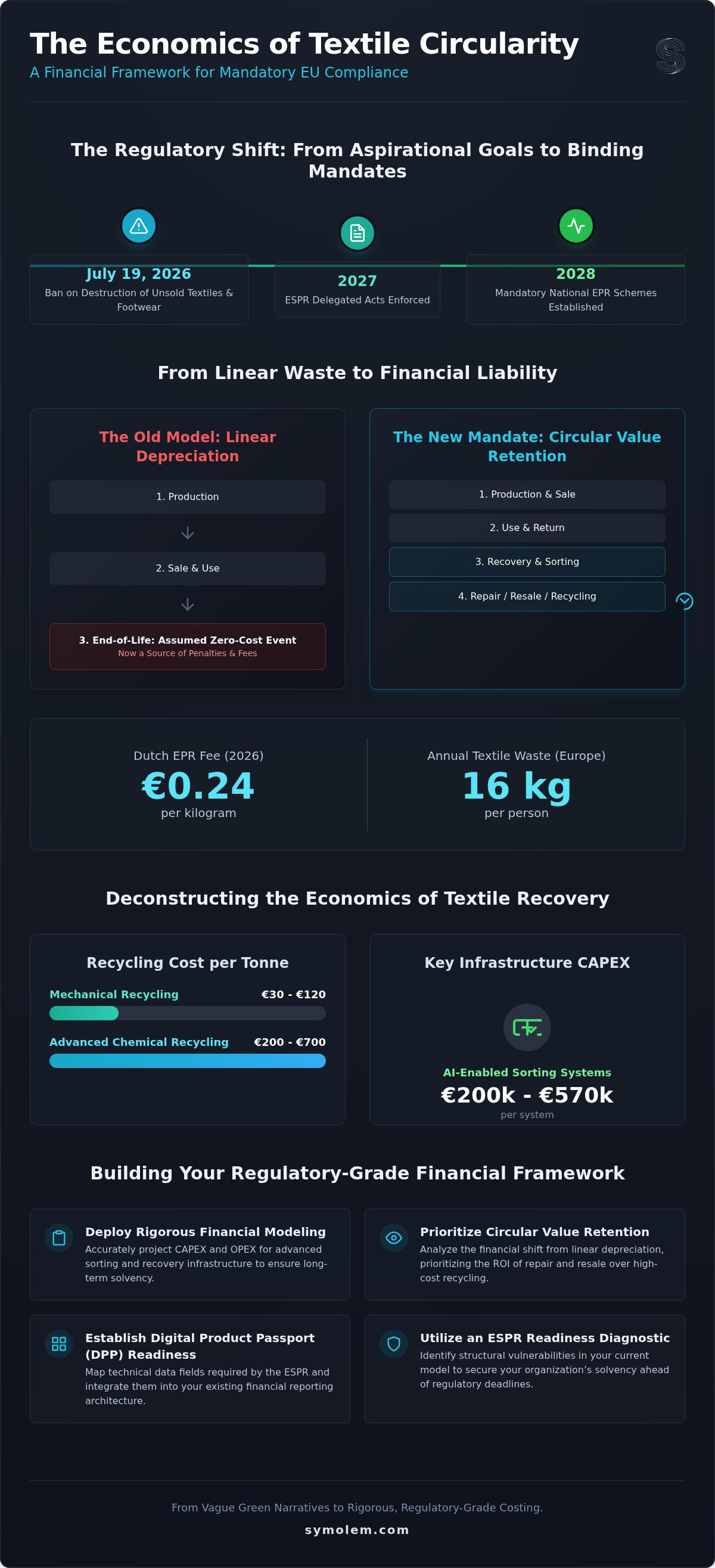
This article provides the exact economic frameworks you need to transition from vague green narratives to rigorous, regulatory-grade costing. You'll learn how to quantify the ROI of recovery systems, navigate the 0.24 euro per kilogram Dutch EPR fees, and prepare for the 2027 ESPR delegated acts. We'll unpack the mechanics of infrastructure investment, moving from the 120 euro per tonne reality of mechanical recycling to the complex data audits required for global compliance. This is your roadmap for building a robust financial framework that survives the clinical scrutiny of EU mandates.
Key Takeaways
- Transition from voluntary pilot projects to mandatory systemic compliance by integrating risk-adjusted costing required under the ESPR.
- Deploy rigorous financial modeling for textile circularity to accurately project the CAPEX and OPEX of advanced sorting and recovery infrastructure.
- Analyze the financial shift from linear depreciation to circular value retention, prioritizing the ROI of repair and resale over high-cost recycling.
- Establish Digital Product Passport (DPP) readiness by mapping technical data fields and integrating them into your existing financial reporting architecture.
- Utilize a clinical ESPR Readiness Diagnostic to identify structural vulnerabilities and secure your organization’s solvency ahead of 2027 regulatory deadlines.
The End of Aspirational Circularity: Why Financial Modeling is the New Compliance Standard
The era of the circularity pilot project has reached its expiration date. For years, fashion brands treated sustainability as a marketing elective, often siloed within communications departments rather than integrated into the balance sheet. This approach is no longer tenable. With the Ecodesign for Sustainable Products Regulation (ESPR) now in force, circularity has transitioned from a voluntary narrative to a mandatory systemic requirement. Financial modeling for textile circularity is the only mechanism capable of translating these complex regulatory demands into actionable business intelligence.
Traditional linear accounting fails because it views the end-of-life phase as a zero-cost event. In reality, the 2028 EU Waste Framework Directive mandates that every member state establish national textile EPR schemes. This creates a direct financial liability for every gram of material placed on the market. Without a risk-adjusted costing framework, companies remain blind to the structural costs of recovery, sorting, and the high-stakes penalties associated with non-compliance. The Digital Product Passport (DPP) serves as the technical ledger for this transition, providing the granular data needed to audit value retention across multiple lifecycles.
From Marketing Narrative to Regulatory Mandate
Legislative pressure is dismantling the "green premium" myth. As of July 19, 2026, large enterprises face a total ban on the destruction of unsold textiles and footwear. This isn't just an environmental policy; it's a structural disruption of inventory management and financial reporting. Modeling the impact of these regulations requires a shift from superficial ROI calculations to comprehensive risk assessments. Brands that fail to bridge the gap between current reporting and ESPR requirements face market exclusion and escalating EPR fees, such as the 0.24 euro per kilogram rate already established in the Netherlands for 2026.
The Systemic Integrity of Circular Finance
Building a solvent circular business model requires clinical precision. It's about identifying where value leaks out of the system and where regulatory exposure is highest. This diagnostic approach moves beyond ethical sentiment to focus on structural cost-efficiency. To secure your position in a regulated market, you must audit your current standing through an ESPR Readiness Diagnostic. This process maps your technical data fields against upcoming mandates, ensuring that your financial frameworks are built on a foundation of systemic integrity rather than aspirational guesswork.
Deconstructing the Economics of Textile Recovery: CAPEX, OPEX, and Residual Value
Infrastructure is the bedrock of circularity. It's not a service you buy; it's a system you build. Transitioning from linear waste to circular recovery requires a clinical understanding of capital expenditure (CAPEX) and operational expenditure (OPEX). While mechanical recycling costs between 30 and 120 euros per tonne of output, advanced chemical recycling projects demand a significantly higher investment, ranging from 200 to 700 euros per tonne. These aren't merely environmental metrics. They're hard financial data points that must be integrated into any viable financial modeling for textile circularity.
Infrastructure Costing and Modeling
Allocating capital for recovery technology requires a diagnostic assessment of regional infrastructure. Automated, AI-enabled sorting systems, which cost between 200,000 and 570,000 euros, are essential for handling the 16 kilograms of textile waste generated per person annually in Europe. Modeling the scalability of these systems depends on the availability of feedstock and the proximity to processing hubs. A robust sustainable textile infrastructure costing framework must account for these variables to ensure long-term solvency.
Operational Realities of the Circular Value Chain
The operational phase is often where circular models fail. OPEX is frequently underestimated because it doesn't account for the labor-intensive nature of repair and disassembly. The declining quality of modern textiles increases contamination rates, which directly reduces the efficiency of sensor-based sorting. To offset these costs, brands must leverage eco-modulation in EPR fees. In the Netherlands, the 2026 fee of 0.24 euros per kilogram serves as a baseline, but French eco-contributions illustrate how fee structures reward durability through lower per-item rates.
Modeling residual value is equally critical. The secondary market worth of recovered fibers is volatile and depends heavily on the purity of the output. If your financial framework doesn't account for reverse logistics and the high cost of processing mixed fibers, your circularity strategy is built on a structural failure. Accurate financial modeling for textile circularity must account for these operational variances to prevent the erosion of margins as regulations tighten.
Securing your infrastructure model is the first step toward regulatory resilience. For a clinical audit of your current position, exploring a cost-benefit analysis of circular textile models provides the data-driven clarity required to move beyond aspirational goals.
Comparative Analysis: Linear Depreciation vs. Circular Value Retention
Linear accounting is a relic. It assumes that value follows a unidirectional trajectory from production to disposal, ignoring the latent economic potential within the post-consumer phase. In a linear framework, inventory is a static asset that depreciates to zero once sold. To survive under the ESPR, financial modeling for textile circularity must reconceptualize the product as a persistent asset. This shift requires moving from simple sales-based metrics to a model that captures value retention across multiple lifecycles.
The "R-Ladder" provides a diagnostic hierarchy for this transition. Repair and refurbishment sit at the top, preserving the structural integrity and labor investment of the garment. Recycling, by contrast, is a value-destructive process that reduces a finished product to raw material feedstock. When you model the ROI of repair against the 200 to 700 euro per tonne cost of chemical recycling, the economic argument for longevity becomes undeniable. Circularity transforms inventory from a potential liability into a strategic resource, but only if the balance sheet can account for risk-adjusted variables like future carbon taxes and regulatory volatility.
Resale and Rental: Revenue Diversification or Margin Erosion?
Service-based models aren't a guaranteed profit center. Resale platforms often suffer from high Customer Acquisition Costs (CAC) and complex reverse logistics that can quickly erode margins. There's also the clinical reality of cannibalization; every second-hand sale potentially replaces the purchase of a new, higher-margin item. A robust financial framework must calculate the break-even point where the extended life of a garment offsets the loss of a primary sale, particularly as fast-fashion penalties in markets like France increase the cost of high-volume, low-durability models.
The Economics of Fiber-to-Fiber Recycling
Closed-loop supply chains offer a hedge against the price volatility of virgin polyester and cotton. While virgin fibers are currently susceptible to global supply chain disruptions and fluctuating petrochemical prices, recycled content provides long-term cost stability. Modeling the economics of textile recovery systems requires a deep understanding of these market dynamics. By securing a consistent stream of high-purity recycled feedstock, brands can mitigate the impact of future environmental "malus" fees and ensure their business model remains solvent in a resource-constrained economy. Financial modeling for textile circularity is the diagnostic tool that makes this stability possible.
Strategic Implementation: Building Your Circularity Financial Framework
Implementation is a structural overhaul. It isn't a pilot; it's a pivot. Constructing a framework for financial modeling for textile circularity requires a five-step diagnostic trajectory that aligns long-term capital allocation with the immediate reality of EU mandates. This process moves beyond the superficiality of consumer engagement to the clinical precision of data governance and systemic integrity.
The first step involves a diagnostic mapping of the current linear value chain to identify specific nodes where regulatory exposure is highest, particularly regarding the ban on destroying unsold goods. Second, technical data integration is required to ensure Digital Product Passport (DPP) readiness. This isn't a marketing task; it's a financial imperative. Third, brands must execute cost-benefit modeling of recovery infrastructure to mitigate escalating EPR fees, such as the French environmental "malus" scheduled to increase through 2030. Fourth, circularity performance indicators (CPIs) must be implemented directly into existing ERP systems to track value retention. Finally, verification and auditing of impact data through MRV (Monitoring, Reporting, Verification) ensures compliance with the Green Claims Directive.
DPP Data Mapping and Financial Transparency
The Digital Product Passport is the technical foundation of the ESPR. It requires mapping extensive technical data fields to ensure systemic transparency across the value chain. Integrating this sustainability data into traditional financial reporting allows for a real-time audit of material value retention. Many organizations underestimate the Challenges of Digital Product Passport implementation, treating it as a compliance checklist rather than a strategic ledger. Without this granular data, your financial models remain speculative and vulnerable to audit failures.
Risk Management and Regulatory Readiness
Regulatory readiness is a prerequisite for solvency. Establishing a clinical framework for assessing risk involves modeling the financial impact of the EU Green Claims Directive, where unsubstantiated environmental assertions carry heavy penalties. MRV systems provide the stability needed to justify large-scale investment in recovery infrastructure. These systems transform impact data into a verifiable asset, allowing you to prove circularity performance to regulators and investors alike. By treating impact data with the same rigor as financial data, you build a resilient business model capable of navigating future regulatory volatility.
To begin this transition, you need a technical partner who understands the mechanics of global value chains. Secure your regulatory standing today by requesting an ESPR Readiness Diagnostic to audit your current data architecture.
Navigating Regulatory Solvency with Symolem's Strategic Advisory
Circularity is a structural challenge that demands a structural solution. It's not enough to set targets; you must engineer the economic systems that make those targets viable. Symolem operates as a clinical architect for circular business models, prioritizing systemic integrity over the superficial narratives that often plague the fashion industry. Our role is to bridge the gap between abstract policy advisory and the technical implementation of financial modeling for textile circularity.
Expert-Led Diagnostics for Fashion Brands
The first step in any transition is an honest assessment of current failures. Many sustainability strategies are built on fragmented data and aspirational guesswork, leaving brands vulnerable to the 2027 ESPR delegated acts. Symolem identifies these structural failures through a diagnostic lens, auditing your value chain to uncover hidden liabilities in inventory management and recovery logistics. We move beyond "green" marketing to establish verified impact, ensuring that your circularity performance is backed by rigorous MRV data. In complex global operations, this level of technical scrutiny is the only way to secure long-term solvency.
Securing the Future of the Textile Enterprise
Independent advisory is the only defense against the increasing complexity of EU regulations. As national EPR schemes become operational by April 2028, the financial pressure on producers will only intensify. Symolem provides the intellectual rigor and professional transparency required to navigate this landscape. We build custom infrastructure costing frameworks that account for the 200,000 to 570,000 euro investment required for AI-enabled sorting systems and the volatile residual value of recovered fibers. This isn't just about compliance; it's about building a resilient enterprise that thrives under the scrutiny of a regulated market.
The cost of inaction is quantifiable. Don't wait for the 2029 compliance deadlines to discover the flaws in your financial framework. Secure your ESPR Readiness Diagnostic with Symolem to audit your regulatory standing and start building a robust foundation for financial modeling for textile circularity today.
Securing Solvency in a Circular Economy
The transition from linear depreciation to circular value retention isn't just an environmental goal; it's a legal and financial imperative. As national EPR schemes and ESPR mandates tighten their grip on the global value chain, the margin for error has vanished. You've seen how CAPEX for recovery infrastructure and the complexities of DPP mapping create new layers of operational risk. Financial modeling for textile circularity provides the diagnostic clarity needed to transform these regulatory hurdles into structural advantages.
Symolem stands as an independent architect for this transition, offering the intellectual rigor required to map 814 DPP technical fields and secure your regulatory solvency. We focus on systemic integrity rather than soft-focus narratives, providing the technical frameworks necessary for global textile operations. Don't let your business model be dismantled by a failure to prepare. Secure your ESPR Readiness Diagnostic with Symolem to audit your standing and engineer a resilient future. Building a sustainable enterprise is a complex undertaking, but with the right strategic framework, your organization can lead the systemic shift toward a truly circular reality.
Frequently Asked Questions
How do I start financial modeling for ESPR compliance?
Start with a diagnostic audit of your current data architecture to identify gaps between linear reporting and mandatory ESPR requirements. You must map your entire value chain to pinpoint exactly where recovery mandates create new financial liabilities. This baseline allows you to transition from pilot-project thinking to a systemic framework that treats regulatory compliance as a core driver of business solvency.
What are the primary CAPEX requirements for circular textile infrastructure?
Capital expenditure is concentrated in automated sorting systems and advanced fiber-to-fiber recycling technologies. These systems require significant upfront investment to handle mixed-fiber feedstock effectively at industrial scales. You must also allocate capital for the digital infrastructure needed to support traceability and data governance, ensuring that every asset is tracked from production through multiple recovery cycles.
Can circular business models be more profitable than linear ones?
Profitability in circularity is achieved through superior value retention and the mitigation of escalating regulatory costs. While linear models rely on high-volume depreciation, circular frameworks leverage resale, rental, and repair to extract multiple revenue streams from a single physical asset. Over the long term, these models reduce exposure to virgin material price volatility and the mounting costs of environmental penalties.
How much do EPR fees impact the financial model of a fashion brand?
EPR fees represent a direct shift from externalized waste to internalized operational costs. These fees are increasingly eco-modulated, meaning products with lower durability or poor recyclability face significantly higher financial burdens than their high-performance counterparts. For many brands, these costs can erode margins by several percentage points if the financial model doesn't prioritize circular design and material purity.
What data fields are required for the Digital Product Passport in 2026?
The Digital Product Passport requires the mapping of up to 236 data points in the UNTP schema covering material composition, repairability scores, and end-of-life instructions. These fields provide the transparency needed for automated sorting and recycling systems to function with clinical precision. Your financial model must account for the administrative and technical costs of maintaining this high-fidelity data across your entire global supply chain.
What happens if my financial model doesn't account for textile recovery?
Failure to integrate recovery costs leads to structural insolvency as EU regulations mandate total producer responsibility. You'll face market exclusion and compounding penalties for non-compliance with the ban on unsold textile destruction. Without financial modeling for textile circularity, your organization remains blind to the mounting liabilities of a linear business model that is no longer legally viable.
Is there a standardized framework for textile circularity ROI?
No universal standard exists, but clinical frameworks focus on risk-adjusted ROI that factors in regulatory avoidance and material security. Effective financial modeling for textile circularity uses proprietary diagnostics to measure value retention against traditional linear depreciation. This approach allows executives to justify infrastructure investment through the lens of long-term strategic stability rather than superficial, short-term gains.
How can Symolem help with infrastructure costing?
Symolem acts as a technical architect, providing custom frameworks for infrastructure costing and policy advisory. We help brands bridge the gap between regulatory theory and operational reality by auditing value chains and mapping technical data fields for DPP readiness. Our independent advisory ensures that your circularity strategy is built on systemic integrity and verified impact data rather than aspirational narratives.