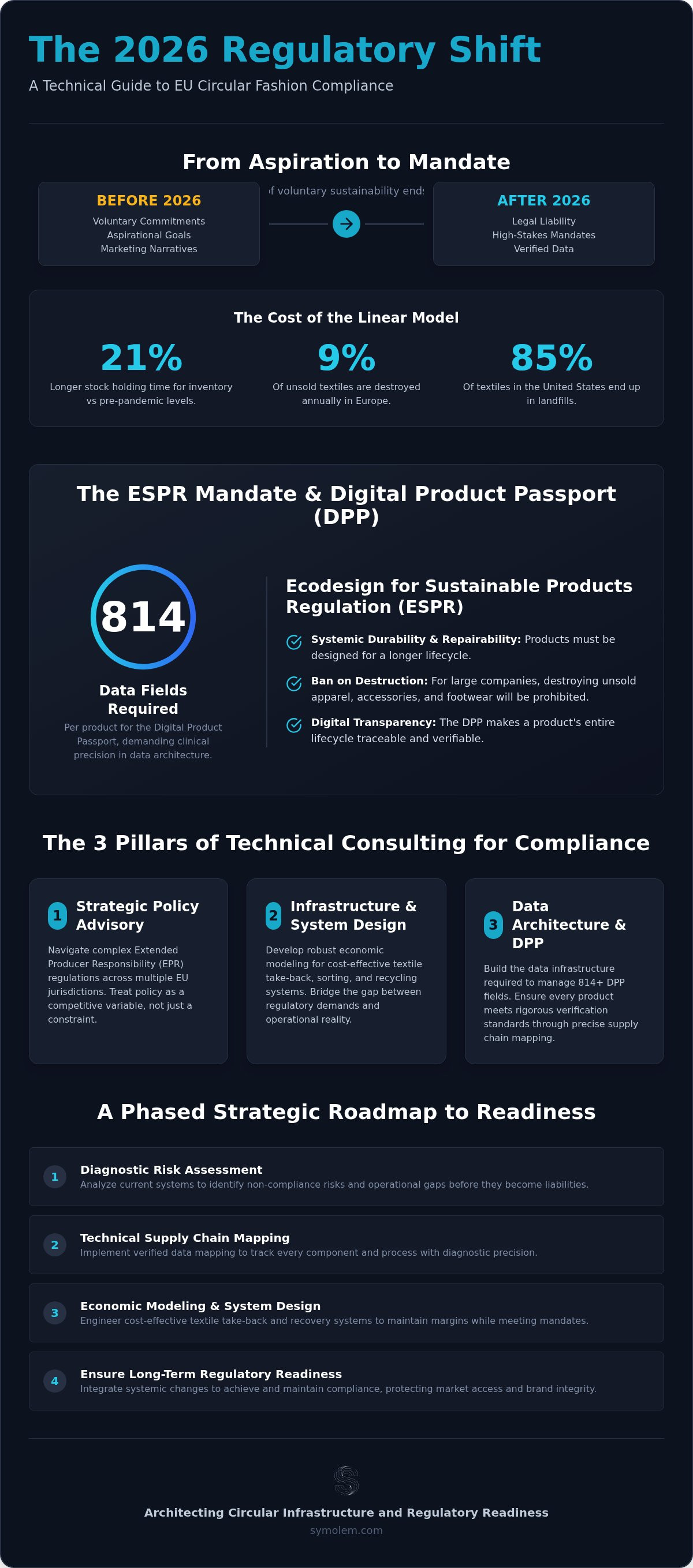
Circular Fashion Consulting Services: Where Brands Need Help
By July 19, 2026, the era of aspirational sustainability ends and the era of legal liability begins. The Ecodesign for Sustainable Products Regulation (ESPR) transforms circularity from a marketing narrative into a high-stakes structural mandate. You likely recognize that your current data architecture is insufficient to handle the 814 specific data fields required for the Digital Product Passport. Without clinical precision in your supply chain mapping, the risk of non-compliance penalties is not just a possibility; it's a mathematical certainty. Engaging expert circular fashion consulting services has become the only viable path to navigate this transition without compromising your margins or your market access.
We understand the anxiety surrounding the lack of clear economic modeling for textile take-back and recovery infrastructure. This guide provides the technical roadmap you need for ESPR readiness. You'll master the technical and economic requirements of EU textile regulations through expert-led circularity frameworks and data-driven compliance strategies. We'll examine the mechanics of verified data mapping and the design of cost-effective circular systems to ensure your business survives the 2026 regulatory shift.
Key Takeaways
- Analyze the transition from voluntary commitments to the mandatory 2026 EU regulatory landscape that treats circularity as a legal imperative.
- Master the data architecture required to manage 814 specific Digital Product Passport fields, ensuring every product meets rigorous verification standards.
- Differentiate between superficial design certifications and the systemic integration provided by professional circular fashion consulting services to ensure long-term regulatory readiness.
- Implement a phased strategic roadmap that prioritizes diagnostic risk assessment and technical mapping to avoid non-compliance penalties.
- Evaluate the economic modeling required for textile take-back systems to maintain margin stability while meeting new infrastructure mandates.
Table of Contents
- The Failure of Voluntary Circularity and the 2026 Regulatory Wall
- The Three Pillars of Technical Circular Fashion Consulting
- Evaluating Consulting Models: Structural Readiness vs. Design Certification
- A Strategic Roadmap for ESPR and DPP Compliance
- Symolem: Architecting Circular Infrastructure and Regulatory Readiness
The Failure of Voluntary Circularity and the 2026 Regulatory Wall
Voluntary circularity is dead. For a decade, the fashion industry prioritized marketing narratives over systemic redesign, treating sustainability as a peripheral concern rather than a core operational requirement. This reliance on aspirational goals resulted in record high inventory levels, with stock held 21% longer than pre-pandemic levels according to the McKinsey Global Fashion Index 2024. The traditional model is fundamentally broken. It relies on a linear sequence of overproduction and disposal, leading to the destruction of up to 9% of unsold textiles in Europe annually. This structural failure has finally met its match: the 2026 regulatory wall.
The transition from choice to mandate is absolute. Brands can't hide behind vague sustainability reports or unverified claims anymore. The concept of circular fashion is being codified into law, moving from an ethical sentiment to a clinical business requirement. This shift necessitates specialized circular fashion consulting services to audit legacy systems and implement the rigorous data architectures required for survival. Compliance is no longer about intent; it's about the ability to verify every link in the value chain with diagnostic precision.
The ESPR Mandate: Beyond Surface-Level Sustainability
The Ecodesign for Sustainable Products Regulation (ESPR) acts as a structural disruptor that will redefine market access. On July 19, 2026, the EU will enforce a ban on the destruction of unsold apparel, accessories, and footwear for large companies. This isn't about using "better" polyester or launching a small-scale resale pilot. It's about systemic durability, repairability, and the digital transparency needed to track a product's entire lifecycle. Non-readiness isn't just a PR risk. It's a legal barrier that could halt European market access entirely, resulting in immediate revenue loss and severe non-compliance penalties.
The Economic Reality of Textile Recovery
Infrastructure doesn't match ambition yet. Currently, 85% of textiles in the United States end up in landfills because the economic modeling for recovery is fundamentally flawed. Building a cost-effective circular infrastructure requires more than just environmental intent. It demands an uncompromising realism regarding the costs of sorting, repair, and textile-to-textile recycling. Strategic circular fashion consulting services provide the architectural oversight needed to bridge the gap between current operational failures and future regulatory demands.
Business viability in the EU now depends on systemic integrity. Companies must move past superficial narratives and engage in the granular work of building stable, verified value chains. Diagnostic precision is the only way to protect margins while meeting these new legal imperatives. By treating circularity as a technical challenge rather than a marketing opportunity, brands can navigate the 2026 mandate with clinical efficiency.
The Three Pillars of Technical Circular Fashion Consulting
Technical circularity is an architectural discipline. It requires the integration of legal, technical, and economic frameworks into a single, stable system. Generalist sustainability advice fails because it lacks the granular depth to survive a regulatory audit. Effective circular fashion consulting services must operate across three distinct but interconnected pillars to ensure systemic integrity. This is not about aspirational design; it's about building the infrastructure required to meet the 2026 regulatory mandate with clinical precision.
Strategic Policy and Regulatory Advisory
Policy is not an external constraint; it's a competitive variable. Navigating EPR for textiles across multiple jurisdictions requires a deep understanding of varying fee structures and operational obligations. You can't treat the EU as a monolith. Each member state interprets directives with subtle but critical differences that impact your cost of compliance. We view policy as a business strategy, mapping global requirements to local implementation with diagnostic rigor. This pillar ensures your organization isn't just reacting to laws but is strategically positioned to lead through them.
Infrastructure Costing and Systemic Design
Most brands ignore the economic reality of recovery. You cannot scale a circular model if it's a financial drain. Performing a rigorous cost-benefit analysis of circular textile models is the only way to ensure economic solvency. This involves architecting recovery systems that account for the logistical costs of collection, the technical costs of sorting, and the market value of recycled feedstock. We move away from estimates, using data-driven modeling to design infrastructure that actually works. Stability in your circular value chain depends on these granular economic details.
The Digital Product Passport (DPP) represents the final technical hurdle. Mapping up to 236 data points in the UNTP schema requires a level of data governance that most fashion brands currently lack. It's not just about collecting data; it's about establishing a robust Monitoring, Reporting, and Verification (MRV) framework that can withstand legal scrutiny. Our circular fashion consulting services build these data pipelines from the ground up, moving your organization from vague impact estimates to verified systemic transparency. Securing your market position starts with an ESPR Readiness Diagnostic to identify these critical data gaps before the 2026 deadline.
Evaluating Consulting Models: Structural Readiness vs. Design Certification
Marketing labels are a distraction. They provide a false sense of security while systemic risks remain unaddressed. Most circular fashion consulting services act as cheerleaders, prioritizing consumer sentiment over regulatory stability. This approach fails the moment a B2B audit begins. Legal compliance requires uncompromising realism and a clinical focus on verifying textile sustainability claims for ESPR. You need a technical architect, not a generalist who specializes in superficial narratives. While design certifications might satisfy a marketing department, they offer zero protection against the structural failures identified during a rigorous legal review.
The difference between a "cheerleader" and a diagnostic expert lies in their treatment of data. A generalist consultant will help you craft a story about your materials. A diagnostic expert will audit the mechanics of your value chain to find the points of failure. This shift from aspirational design to structural readiness is the only way to navigate the 2026 mandate. It requires a move away from "soft-focus" sustainability and toward a high-stakes perspective that treats circularity as a critical business and legal imperative.
The Diagnostic Gap: Why Labels Are Not Enough
A "circular label" is a branding asset, not a legal defense. Regulators under the ESPR framework demand granular proof of durability and repairability, not just a logo on a hangtag. Without a comprehensive ESPR readiness diagnostic, you are operating in a state of structural blindness. The Green Claims Directive further complicates this by criminalizing unsubstantiated environmental assertions. If your data cannot survive a diagnostic audit, your marketing is a liability. Stability in the EU market depends on the verification of every technical claim through independent scrutiny.
Building Internal Data Capacity
Resilience is built internally. Many brands mistake "off-the-shelf" SaaS compliance software for a strategy. Technology is merely the delivery mechanism for a robust data governance framework. Technical advisory focuses on building this internal capacity, ensuring your team understands the mechanics of data mapping and systemic integration. This approach transforms circular fashion consulting services from a temporary fix into a long-term strategic asset. You aren't just buying a certificate; you're auditing your entire operational logic to ensure survival in a post-2026 market. Tailored implementation frameworks provide the stability that generic software cannot match.
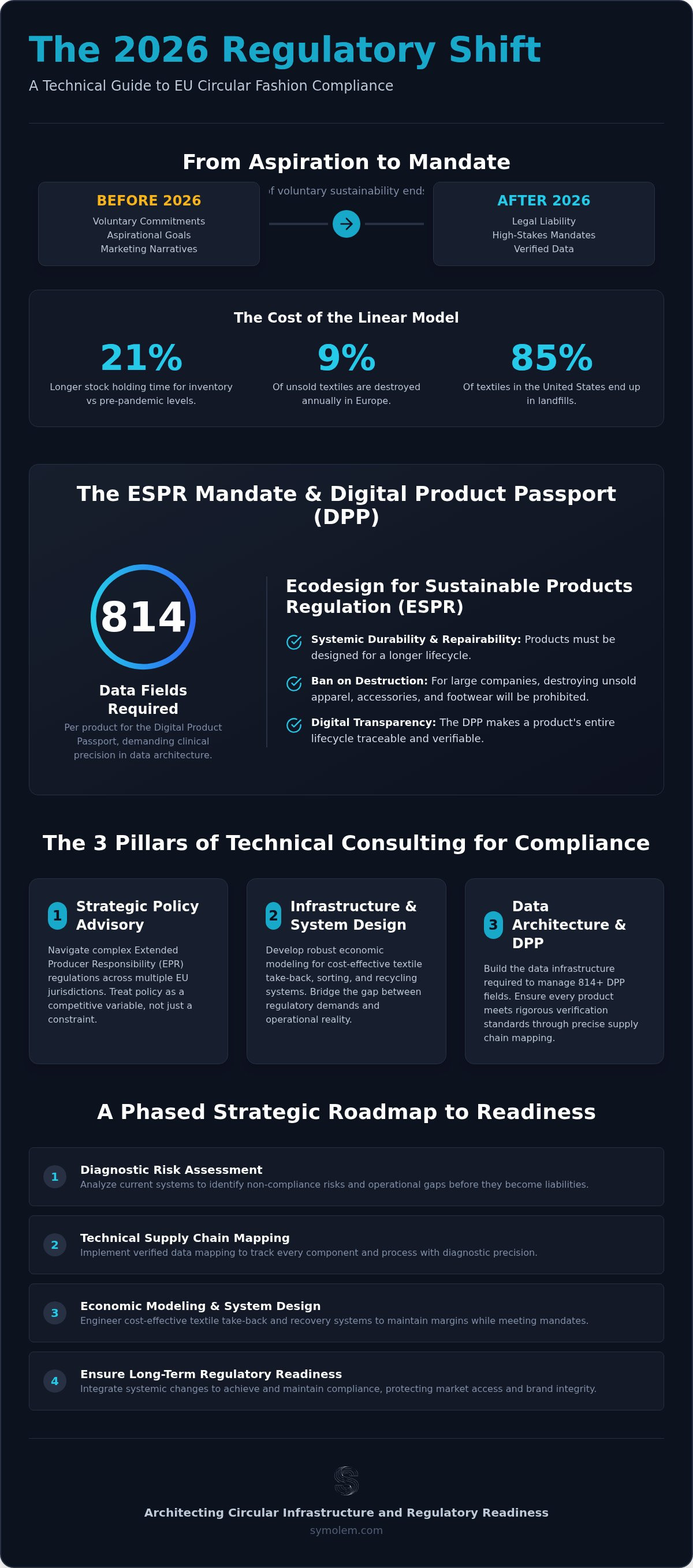
A Strategic Roadmap for ESPR and DPP Compliance
Compliance is not a destination. It's a continuous operational state. For global fashion brands, the transition to a circular model requires a methodical five-phase roadmap to replace fragmented data silos with a unified, verifiable compliance framework. Most organizations currently operate in a state of structural blindness, unaware of the specific technical gaps that will trigger non-compliance penalties in 2026. Professional circular fashion consulting services provide the architectural oversight needed to execute this transition with clinical efficiency.
- Phase 1: Diagnostic Assessment. A rigorous audit of existing data architecture to identify regulatory risks and structural gaps.
- Phase 2: Technical Mapping. The granular identification and verification of the 814 specific data points required for textiles.
- Phase 3: Economic Modeling. Designing recovery and take-back systems that are economically solvent and operationally stable.
- Phase 4: Implementation. Deploying transparency and accountability systems across the entire value chain.
- Phase 5: Continuous MRV. Establishing a permanent loop of Monitoring, Reporting, and Verification to ensure ongoing legal integrity.
Mapping the 814 Digital Product Passport Fields
The technical core of the 2026 mandate is the Digital Product Passport. Identifying and verifying 814 technical data points is a monumental task that requires absolute precision. You can't rely on estimates or secondary data when facing a regulatory audit. The challenges of Digital Product Passport implementation stem from the complexity of global value chains where data is often obscured or unverified. Our circular fashion consulting services focus on the clinical process of mapping these fields, ensuring every data point is traceable and legally defensible.
Developing a Circular Economy Strategy
Circularity demands a high-stakes strategic pivot. It requires moving from linear sales volume to circular business models that prioritize systemic integrity and product longevity. This is not a marketing choice; it's an economic imperative. Organizations must establish new KPIs that measure durability, repairability, and resource recovery rather than just unit production. This strategic shift ensures long-term business viability in a market that no longer tolerates the "take-make-waste" logic. To begin this transition, you must first understand your current standing through a comprehensive ESPR Readiness Diagnostic.
Symolem: Architecting Circular Infrastructure and Regulatory Readiness
Clarity is the only hedge against regulatory chaos. In an industry saturated with aspirational narratives and vague commitments, Symolem acts as a systemic disruptor, providing the technical rigor required to withstand the 2026 regulatory wall. We move beyond the "cheerleader" model of generalist consulting. Our focus is on the clinical reality of global value chains and the legal imperatives that now dictate market access. Professional circular fashion consulting services must prioritize structural integrity over superficial storytelling, ensuring that every claim is backed by a stable, verified data architecture. We treat circularity as a high-stakes business requirement, moving your organization from ethical sentiment toward technical reality.
The Symolem ESPR Readiness Diagnostic
The Symolem ESPR Readiness Diagnostic is the critical first step for brands facing the July 19, 2026, deadline for the ban on unsold goods destruction. This tool isn't a mere checklist. It's a clinical audit designed to identify structural failures in your current compliance framework before they trigger legal penalties. We scrutinize your existing data governance to find the specific gaps in the 814 mandatory fields required for the Digital Product Passport. Starting this audit process now is a critical business mandate. Waiting until the 2027 phase-in for textiles to address these failures is a recipe for market exclusion and severe non-compliance penalties. We provide the diagnostic precision needed to secure your market position in the European Union.
Designing Global Textile Recovery Systems
Designing global textile recovery systems requires more than just environmental intent; it requires uncompromising economic realism. We architect recovery infrastructure that is operationally stable and financially solvent for global brands. With an estimated 4% to 9% of unsold textiles in Europe destroyed annually, the current linear model represents a catastrophic structural failure. Symolem serves as a technical architect, building the systems needed for textile-to-textile recycling and repair at scale. We move your business away from the "take-make-waste" logic, establishing recovery loops that are economically defensible. Our circular fashion consulting services provide the high-level strategy and granular implementation required to transform your operations. Systemic integrity is the only path to long-term business viability. To begin your transition, contact our strategy team to initiate your ESPR Readiness Diagnostic and secure your regulatory future.
Securing Systemic Integrity Before the 2026 Mandate
The 2026 regulatory wall is an immovable reality. You've seen that the era of voluntary circularity has failed, leaving brands exposed to high inventory risks and imminent legal liability. Survival in the European market now depends on your ability to replace aspirational narratives with clinical, data-driven frameworks. This transition requires a fundamental restructuring of your business model, moving from linear production to economically solvent recovery systems. Without rigorous data mapping and independent scrutiny, your organization faces significant non-compliance penalties and market exclusion.
Engaging professional circular fashion consulting services is the only way to navigate the 814 specific data fields required for the Digital Product Passport. We provide the technical architecture and policy advisory needed to ensure your global value chain remains stable and verified. Don't wait for a regulatory audit to discover your structural failures. You can secure your regulatory readiness with a Symolem Diagnostic Assessment today. Our expertise in ESPR and EPR policy ensures your business is built for long-term resilience rather than short-term compliance. It's time to move toward a future defined by systemic integrity and economic realism.
Frequently Asked Questions
What are circular fashion consulting services, and why are they critical in 2026?
Circular fashion consulting services provide the technical and strategic architecture required to transition from linear production to systemic circularity. They're critical in 2026 because of the Ecodesign for Sustainable Products Regulation (ESPR), which mandates a ban on the destruction of unsold goods. This shift transforms circularity from an elective marketing choice into a legal necessity. Brands must now navigate complex regulatory landscapes to ensure continued market access in the European Union.
How do consulting services help with ESPR compliance for fashion brands?
Consultants identify structural failures in current supply chains through rigorous diagnostic audits. They provide the clinical oversight needed to meet ESPR requirements for product durability, repairability, and recyclability. By mapping value chains with precision, these services ensure that brands avoid non-compliance penalties and market exclusion. This process moves beyond aspirational narratives, focusing instead on the technical reality of legal mandates and the verification of systemic integrity across global operations.
What is the role of a consultant in Digital Product Passport (DPP) implementation?
A consultant acts as a technical architect who designs the data governance frameworks necessary for DPP implementation. They manage the complex task of data aggregation across fragmented supply chains to ensure every product has a verified digital record. This role involves establishing Monitoring, Reporting, and Verification (MRV) systems that can withstand legal scrutiny. Effective implementation requires a deep understanding of global value chains and the technical infrastructure needed for long-term data stability.
How much does circular fashion consulting cost for global textile manufacturers?
The cost of circular fashion consulting varies significantly based on the scale of the global value chain and the complexity of the data mapping required. Manufacturers should evaluate fees based on the depth of the technical audit and the scope of the regulatory advisory provided. While generalist advice might seem accessible, the high-stakes risk of non-compliance makes specialized technical expertise a critical business investment. Brands should request tailored assessments to understand the specific requirements for their infrastructure.
Can a consultant help map the up to 236 data points in the UNTP schema for DPP?
Yes, specialized consultants provide the clinical precision required to map and verify all up to 236 data points in the UNTP schema for the Digital Product Passport. This process involves identifying specific data points across the entire product lifecycle, from raw material extraction to end-of-life recovery. It's a monumental task that requires expert-led frameworks to ensure data accuracy and legal defensibility. Professional circular fashion consulting services build these data pipelines from the ground up, replacing fragmented silos with unified compliance systems.
What is the difference between circular design consulting and regulatory readiness advisory?
Circular design consulting focuses primarily on material selection and aesthetic durability to satisfy consumer sentiment. Regulatory readiness advisory, however, prioritizes systemic integrity and legal compliance under mandates like the ESPR. While design consulting is often aspirational, regulatory advisory is diagnostic and high-stakes. It treats circularity as a critical business imperative, focusing on the technical data architecture and economic infrastructure required to survive a B2B audit rather than just a marketing claim.
How do consultants verify textile sustainability claims for EU regulations?
Consultants use rigorous Monitoring, Reporting, and Verification (MRV) frameworks to ensure all sustainability claims are legally defensible. This process involves auditing primary data from the supply chain to eliminate the risk of greenwashing under the Green Claims Directive. By providing independent scrutiny and clinical mapping of material flows, consultants establish the transparency required for regulatory compliance. Verification isn't about intent; it's about the ability to prove durability and impact through verified technical evidence.
Why should brands prioritize economic modeling in their circularity strategy?
Brands must prioritize economic modeling to ensure that circular recovery systems are financially solvent and operationally stable. Without clinical precision in infrastructure costing, circular models often become a financial drain that collapses under scale. Modeling accounts for the logistical costs of take-back schemes, the technical costs of sorting, and the market value of recycled feedstock. This approach moves away from estimates, using data-driven logic to build infrastructure that maintains margin stability while meeting new mandates.