
ESPR Unsold Goods Reporting: Disclosure and Data Duties
The destruction ban does not cover every product, but ESPR unsold goods reporting has a broader scope. The ban initially applies to specified unsold clothing, clothing accessories and footwear. The disclosure duty covers unsold consumer products discarded as waste. Large companies must report the number and weight of those products, why they were discarded and how they were treated.
That distinction matters. A business may have to report a product it discards even if the destruction ban does not cover it. Public disclosures therefore need records linking inventory, product classification, disposal decisions and waste-treatment evidence, rather than relying on a year-end estimate.
This article explains which products fall under each obligation, what information must be disclosed and how to consolidate reporting. It also covers the inventory records and data systems fashion businesses need to organise the information and identify gaps before they affect compliance.
Key Takeaways
- Distinguish the product scope of the destruction ban from the wider annual disclosure duty for discarded unsold consumer products.
- Understand how Combined Nomenclature codes organise product categories and why classification affects consolidated reporting.
- Identify the inventory, disposal and treatment records that support a complete disclosure and document retention.
- Prepare data systems to connect discarded-product quantities, reasons and treatment routes across business records.
- See how Symolem-ID screening and Symolem Advisory evidence retrieval support retailers and fashion brands with compliance records.
Table of Contents
- ESPR disclosure obligations for discarded unsold products
- Publication format and consolidated reporting
- Preparing unsold inventory processes and documentation
- What information must be disclosed in ESPR unsold-goods reports?
- Preparing data collection and compliance systems
- How Symolem supports fashion compliance evidence
ESPR disclosure obligations for discarded unsold products
The disclosure duty and destruction ban have different scopes. Reporting requires product classification, annual figures and evidence of what happened to discarded stock.
Reporting Scope and Product-Group Extensions
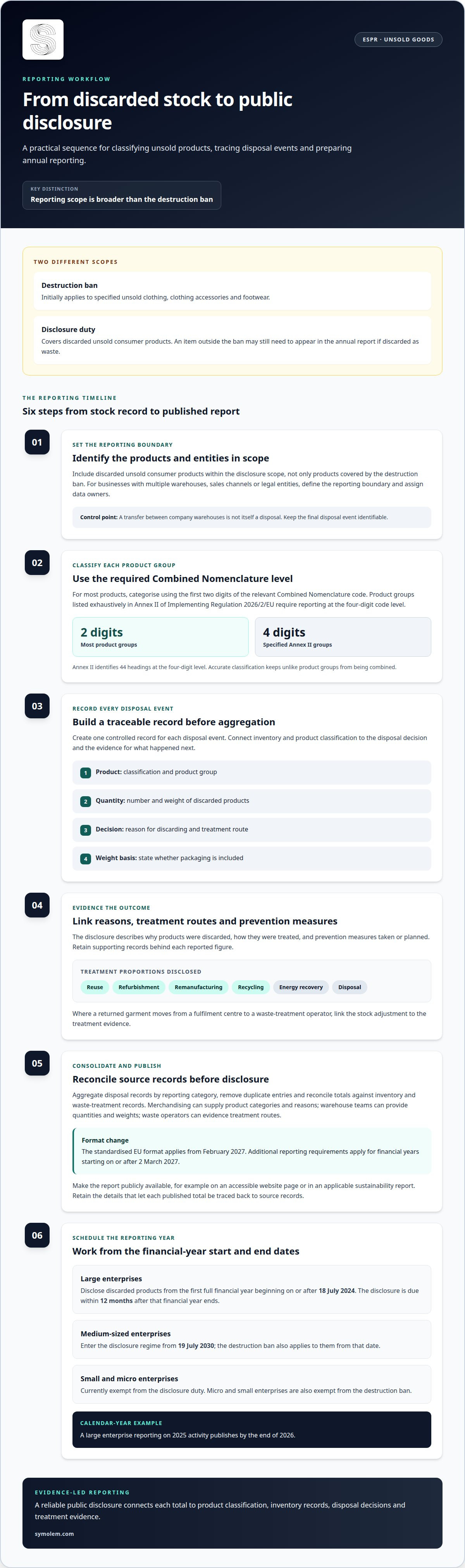
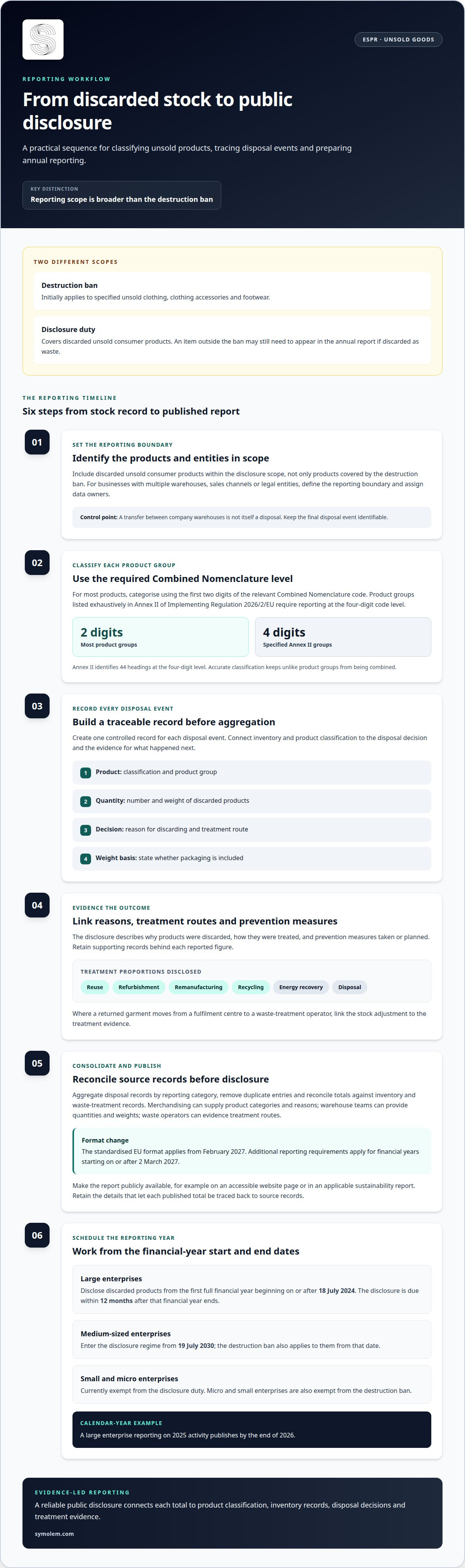
The destruction ban restricts disposal of specified unsold clothing, clothing accessories and footwear. The disclosure duty covers a wider range of discarded unsold consumer products. An item outside the ban’s initial scope may still need to appear in a company’s annual report if it is discarded as waste.
The European Union states that the destruction ban applies to medium-sized enterprises from 19 July 2030. Micro and small enterprises are exempt from the ban, while medium-sized businesses should prepare for its later application. The Commission can extend the product groups covered through delegated acts, so product scope may change.
Ten derogations permit destruction in defined circumstances, including when products are unsafe or unlawful, or damaged beyond repair. A donation-unviable route may apply if a business offers products to three suitable social economy entities in the EU without acceptance, or lists them on its website for eight weeks without finding a recipient. Keep evidence to support any derogation.
Public Reporting and Required Information
Annual public reporting means disclosing data on discarded unsold consumer products for each financial year. The report must describe both the scale of disposal and how the business handled it, rather than present a single unexplained total.
For most products, categorisation uses the first two digits of the relevant Combined Nomenclature code. Product groups listed exhaustively in Annex II of Commission Implementing Regulation (EU) 2026/2 require reporting at the four-digit code level; the annex identifies 44 headings at that level. Accurate classification keeps unlike product groups from being combined.
Disclosures cover the number and weight of discarded products, reasons for discarding them, treatment routes and prevention measures taken or planned. They also state the proportions sent for reuse, refurbishment, remanufacturing, recycling, energy recovery or disposal. Make reports publicly available, for example on an accessible website page or in an applicable sustainability report.
Reporting Start and Deadlines
Large enterprises disclose discarded products from the first full financial year beginning on or after 18 July 2024. The disclosure is due within 12 months after that financial year ends, so a calendar-year business reporting on 2025 activity publishes by the end of 2026.
Small and micro enterprises are currently exempt from the disclosure duty. Medium-sized enterprises enter the disclosure regime from 19 July 2030, alongside the destruction ban’s application to them. For financial years starting on or after 2 March 2027, additional reporting requirements apply under Implementing Regulation 2026/2/EU, with the standardised format applying from February 2027.
Publication format and consolidated reporting
A standard format turns unsold-product disclosures into structured, comparable records. Commission Implementing Regulation 2026/2/EU establishes the reporting format, with application from February 2027. Large companies must use the EU format from 2027. The change affects how businesses organise evidence: information gathered across stock systems, finance records and waste contractors must resolve into consistent report fields.
Consolidation means bringing relevant records together before publication. A retailer with multiple warehouses, sales channels or legal entities needs a defined reporting boundary, assigned data owners and a process for removing duplicate entries. A transfer between company warehouses is not itself a disposal. Keep the disposal event and its final treatment identifiable.
Create one controlled record for each disposal event, then aggregate the records by reporting category. Useful fields include product classification, quantity, weight, reason for disposal, treatment route and whether packaging is included in the reported weight. For example, if a returned garment goes from a fulfilment centre to a waste-treatment operator, link the stock adjustment to the treatment evidence.
Publish the report on an easily accessible website page or include it in an applicable sustainability report. A central data owner can reconcile consolidated figures against inventory and waste-treatment records, then retain the details behind each published total. This gives a traceable path from the summary back to each event, supported by operational records.
Set the reporting calendar around each financial year, not the date when a team begins drafting. For financial years starting on or after 2 March 2027, additional requirements apply under Implementing Regulation 2026/2/EU. The standard format also requires businesses to state whether packaging is included in discarded-product weights. This distinction matters when separate systems record apparel weight and packaging weight, because combining them without a clear basis can distort category totals.
Keep the format consistent across internal teams. Merchandising can identify product categories and disposal reasons; warehouse teams can provide quantities and weights; waste operators can evidence treatment routes. A reporting lead can resolve inconsistent classifications and missing fields before consolidation. This makes it possible to reproduce the public disclosure from source records, even when data comes from separate systems.
Preparing unsold inventory processes and documentation
Reliable records begin before a product is marked for disposal. Under Article 23 of the Ecodesign for Sustainable Products Regulation, economic operators must take reasonable measures to prevent destruction of unsold consumer products. This makes inventory disposition a controlled decision, not simply a warehouse adjustment. Assign responsibility for identifying surplus stock, recording its status and documenting the eventual outcome.
Use a consistent record for every decision. Capture the product identifier, category, quantity, weight, location, decision date and reason for its disposition. Distinguish products returned to saleable stock from those selected for repair, donation, resale or waste treatment. For example, do not record a returned coat as discarded while it is still awaiting inspection and its final status is unknown.
Document the review before disposal. The responsible team can assess whether a product remains suitable for sale, repair or another route, then record the decision and supporting evidence. If a derogation permits destruction, retain documents showing why it applies. This links the product’s condition to the decision-maker and chosen treatment route.
For a fashion brand, connect warehouse movements with finance and waste-management records. A stock write-off alone does not show what happened to the goods. Link each write-off to dispatch records and evidence from the receiving waste-treatment operator to reconcile quantities and substantiate the final route.
Retention periods depend on the record’s purpose. Keep supporting documentation for any reliance on a destruction-ban derogation. Supporting information and documentation for disclosed discarded products must be retained for five years after disclosure. Delivery and reception records, including statements from waste treatment operators, also need to remain available for five years after each disclosure.
These periods require a retention schedule tied to both disclosure dates and destruction dates. Store records so the relevant product, decision, shipment and treatment evidence can be retrieved together. When the European Commission or national authorities request further documentation about discarded products, businesses must provide it within 30 days. A clear file structure and named record owner make that response manageable.
Review exceptions as carefully as routine disposal. If products are damaged, unsafe or otherwise covered by a derogation, preserve the specific evidence supporting that conclusion. Keeping exception records separate from ordinary disposal files helps prevent permitted cases from being confused with routine destruction and makes the decision trail easier to audit.
What information must be disclosed in ESPR unsold-goods reports?
Article 24(1) of the ESPR requires annual disclosure of discarded unsold consumer products. The report must quantify what was discarded, explain why, describe its treatment and set out prevention measures taken and planned. These fields connect the disposal outcome to the decisions that produced it.
For each product category, report the number and weight of discarded goods. Classification follows the relevant Combined Nomenclature code: most products use its first two digits, while groups exhaustively listed in Annex II of Commission Implementing Regulation (EU) 2026/2 use four digits. Consistent classification makes category totals meaningful across a company’s product range.
- Quantity and weight: state discarded product counts and weights for each reportable category.
- Reason: record the stated reason, such as damage or unsold stock, using a consistent classification.
- Treatment route: show the share reused, refurbished, remanufactured, recycled, sent for energy recovery or disposed of.
- Prevention measures: describe actions already taken and measures planned to prevent future discards.
Give reported weights a clear basis. The EU reporting format requires operators to state whether packaging is included. For example, do not silently count the weight of a carton containing unsold garments as garment weight. Apply the same approach to packaging across product categories and reporting periods.
Reasons and treatment routes answer different questions. The reason explains why the business discarded stock; the route records what happened next. A damaged jacket sent for recycling therefore needs both a damage-related reason and its recycling outcome. Keep these fields separate so disposal totals do not obscure the cause.
Prevention information adds a forward-looking element to the annual figures. Describe measures taken during the reporting period and those planned, linking each to the process it addresses. For example, a change to stock allocation may target avoidable surplus, while a repair route may address suitable damaged returns. Do not present a planned measure as already completed.
Use the standardised format and retain supporting records for the disclosed figures. Reportable totals should reconcile with category-level counts, weight calculations and treatment evidence. This structure lets readers distinguish disposal volume, its causes and the share diverted to each route, rather than treating all discarded unsold products as one undifferentiated figure.
Preparing data collection and compliance systems
Reporting quality depends on the records captured when unsold consumer products leave stock. For ESPR unsold goods reporting, systems should link each discarded item or batch to its product category, quantity, weight, decision date, reason and final treatment. Without those links, teams cannot reliably reconcile warehouse movements with annual disclosure figures or explain differences between reported totals and operational records.
Map the data flow across merchandising, finance, warehouse operations and waste contractors. For clothing returned to a distribution centre, record whether it goes back into saleable inventory, enters repair or becomes discarded stock. Assign an owner to each field, including who confirms product classification and who records whether packaging is included in the weight. Clear ownership helps prevent gaps between systems.
Use a consistent event identifier to link records across separate tools. A warehouse adjustment can carry that identifier into the dispatch record, the waste operator’s receipt and the final treatment statement. The reporting process can then aggregate records by product category without losing the evidence behind each total. Retain the original event-level detail, not just annual summaries.
- Inventory source: product identifier, Combined Nomenclature category, quantity and weight.
- Disposition record: decision, reason, date and any applicable destruction-ban derogation.
- Treatment evidence: delivery and reception details, plus the waste treatment operator’s statement.
- Disclosure control: reporting period, calculation basis, approval status and publication date.
Build validation checks into the reporting workflow. Flag missing reasons, unclassified items, duplicate disposal events and weights that do not reconcile with dispatch records. ESPR verification procedures set a 10% tolerance threshold for discrepancies. A comparison within the system can identify differences early, while preserving the underlying records needed to explain them.
Retention controls should follow the disclosure event. Delivery and reception records, including waste operator statements, must be kept for five years after each disclosure. Configure the system to assign that retention period automatically, restrict premature deletion and record authorised changes. The same record structure should support retrieval if authorities request documentation within 30 days.
Finally, maintain a separate workflow for exceptions. Where a business relies on a derogation to destroy unsold goods, link the decision to its supporting evidence and destruction record. A well-controlled ESPR unsold goods reporting workflow distinguishes exceptional cases from ordinary discarded stock and helps teams report environmental outcomes accurately, including treatment routes and prevention measures for each reporting period.
How Symolem supports fashion compliance evidence
Disclosure depends on reliable operational evidence, but gaps can begin upstream. A fashion brand may have a waste contractor’s receipt yet lack a product record linking the discarded stock to its category, weight and disposition. Symolem helps businesses organise and verify compliance records and supplier evidence for use across their operations.
For retailers and marketplaces, Symolem-ID screens third-party brand ranges before purchase orders are signed. It checks products against 50+ global textile regulations in seconds and assigns each SKU a status: Cleared, Blocked or Missing Evidence. This gives buying and compliance teams a structured view of product-level gaps before orders enter the supply chain.
For fashion brands and apparel manufacturers, Symolem Advisory addresses evidence that automated checks cannot retrieve from suppliers. Its Tier 1-3 Regulations Data Retrieval work chases missing chemical laboratory tests, fibre-origin documentation, transaction certificates and packaging weights. A brand may need to coordinate fibre-origin records from a spinning mill in India, chemical test evidence from a dyeing house in Türkiye and production documentation from a CMT factory in Portugal.
Symolem’s Social Accounting & Due Diligence Advisory provides human-led audits and auditable evidence packs covering fair wages, worker welfare and human rights compliance. These records address a different evidence need from unsold-stock reporting, but can matter to fashion businesses managing overlapping retailer demands and statutory obligations. Supplier evidence retrieval and social accounting support are distinct compliance workstreams.
Symolem helps structure and retrieve compliance evidence; it does not operate waste treatment or replace a company’s inventory controls. Retailers can use pre-purchase-order screening to identify missing product evidence. Brands can use supplier evidence retrieval and social accounting support when internal teams need help obtaining and organising records across their supply chains.
Screen third-party brand compliance before signing the PO. Explore Symolem-ID or run a free product scan.
Need to retrieve missing Tier 1-3 supplier evidence or substantiate social accounting for retail stockists? Take the 5-minute Free Assessment or contact Symolem.
Frequently Asked Questions
Does the destruction ban apply to all products?
No. The initial ESPR destruction ban covers specified unsold clothing, clothing accessories and footwear, not every product category. It restricts destruction through disposal, recycling and other recovery, including energy recovery. Large enterprises are subject from 19 July 2026, while the European Union applies the ban to medium-sized enterprises from 19 July 2030. Small and micro enterprises are exempt. Derogations permit destruction in defined circumstances, such as unsafe or seriously damaged products.
What is the risk of non-compliance?
Non-compliance can expose a business to penalties set by the relevant EU Member State. Article 74 of the ESPR requires those penalties to be effective, proportionate and dissuasive, but does not set one EU-wide fine amount. Weak classification or unsupported figures can also undermine a disclosure’s credibility. Keep records that connect reported totals to product and treatment evidence, so the business can explain how it reached its figures.
Which products and companies are affected?
The disclosure covers unsold consumer products discarded as waste across product categories, not just apparel. The destruction ban has a narrower initial scope, covering specified clothing, clothing accessories and footwear. Company size determines which duties apply and when. A large fashion company, for example, may have to report discarded products beyond clothing, while the ban concerns the listed apparel and footwear groups.
Who and what will these requirements apply to?
The requirements can apply to businesses based outside the EU when they place products on the EU market. The reporting duty covers discarded unsold consumer products, while the destruction ban initially applies to specified clothing, clothing accessories and footwear. A US-based brand selling into the EU should distinguish its EU-market activity from sales confined to the United States, then identify the entity and product records related to EU sales.
Which companies must report unsold goods under the ESPR?
Large enterprises must report discarded unsold consumer products. For these obligations, a large company has 250 or more employees and annual turnover above €50 million. Medium-sized enterprises enter the disclosure regime from 19 July 2030. Small and micro enterprises are currently exempt from disclosure requirements. Company size and financial-year timing determine the applicable reporting period, so a group should establish which reporting entity holds the relevant records.
What unsold products and inventory must companies report under the ESPR?
Report unsold consumer products that the business discards as waste, rather than all stock that remains unsold. The definition includes products returned during the 14-day statutory cooling-off period if they are later discarded. A returned garment that is inspected and returned to saleable inventory is different from one sent for waste treatment. Keep the inventory status and final disposition distinct to avoid counting stock that was not discarded.
How do companies submit ESPR reports on unsold goods?
Publish the disclosure on an easily accessible website page or include it in an applicable sustainability report. Use the standardised EU format where it applies, and organise the underlying figures so each total can be reconciled to source records. For example, trace a published category total to inventory movements and treatment documents, not just a manually entered annual estimate.
How does ESPR unsold-goods reporting apply to companies selling in the United States or importing into the EU?
A company’s location does not by itself exclude it: the disclosure duty applies to products placed on the EU market, including those offered there by businesses based outside the EU. A US brand selling only within the United States is outside this EU-market trigger. If it offers goods in the EU, it should identify the relevant discarded products and reporting entity, including when stock moves through an EU importer or distributor.
Frequently Asked Questions
Talk to a consultant
Have a question about how this applies to your brand?
Ask Lavinia Fernandes directly. Tell us your products and markets and you get a straight answer on what applies and what to do first.