DPP Requirements for Luxury Goods: Data, Scope and Timing
Luxury status does not establish where a garment was made. For apparel, product origin records need to reflect the product and its supply chain; the Ecodesign for Sustainable Products Regulation, Regulation (EU) 2024/1781, includes apparel and footwear in scope, according to the European Union.
The practical question for a luxury brand is whether its product records support the origin information it provides. A product record is only as reliable as the evidence behind it, so brands may need to check records across suppliers rather than rely on a product description alone.
This article focuses on product origin records for luxury apparel and footwear. It considers why accurate product information depends on reliable supply-chain evidence, and why a luxury label does not replace the need to substantiate that information.
Key Takeaways
- For apparel and footwear, applicable product requirements depend on product-specific rules, including the product’s materials and category.
- Reliable product records depend on structured data and evidence traceable through suppliers, not simply on adding a QR code or other data carrier.
- Retailers can screen third-party ranges before purchase orders are signed, while brands can address missing evidence across Tier 1-3 suppliers.
- Symolem-ID supports pre-purchase-order compliance screening, and Symolem’s evidence-retrieval advisory helps source missing product and supplier records.
Table of Contents
Symolem
Symolem helps fashion retailers and brands turn product-compliance questions into practical decisions about evidence, supplier records and readiness. Retailers can screen third-party ranges before purchase orders, while brands can address missing documentation that may leave a product record incomplete or difficult to use. Neither task is solved by a consumer-facing QR code alone. Records must be linked to the product, supported by evidence and organised so the relevant teams can assess them.
That distinction matters in luxury supply chains, where a product may involve several materials, processing stages and suppliers. A leather item, for example, may link a brand’s product record to material specifications and supporting documents held by different organisations. For apparel, fibre and chemical evidence may sit with upstream suppliers, while the brand holds finished-product information. If records cannot be found or reconciled, the problem is evidential, not visual.
Symolem works at this operational boundary. It supports compliance screening and evidence retrieval for fashion, footwear and textiles; it does not build or issue consumer Digital Product Passports. For brands preparing records for a chosen DPP provider or retail onboarding system, Symolem verifies and structures compliance evidence and can assign a Verification ID to brand records. Retailers assessing third-party ranges can use Symolem-ID Pre-PO screening.
For retailers: assess the range before the order
Retail buying decisions often involve products made by brands and suppliers outside the retailer’s direct manufacturing control. That does not remove the need to assess the available product information and evidence. A buying team may have a product description, supplier declaration or brand assurance on file, yet lack a clear view of whether the records needed for compliance review are present for each product.
Symolem-ID is an automated pre-PO compliance screening platform for fashion retailers and marketplaces. It screens third-party brand ranges against 50+ global textile regulations in seconds and provides a per-SKU status: Cleared, Blocked or Missing Evidence. These outcomes distinguish a product that has passed the screen from one that is blocked or lacks evidence, before the purchase order is signed.
The status is a decision aid, not a substitute for the evidence behind it. A “Missing Evidence” result identifies a gap that needs resolution; it does not mean that a supplier has failed to manufacture the product correctly. A “Blocked” result signals that the SKU should not proceed through the relevant compliance gate in its current state. “Cleared” gives the buying and compliance teams a screening outcome to use in their pre-order process.
For a marketplace reviewing a third-party apparel range, the question is not simply whether a brand has supplied documents in general. Teams need to know whether available evidence supports assessment at product level and whether gaps are visible before commercial commitment. Screening makes it easier to distinguish SKUs with usable records from those needing further evidence, instead of leaving incomplete documents buried in a general brand file.
This matters when a buyer is assessing a broad range with different fibres, product constructions or suppliers. Some products may have complete evidence while others lack supporting records. A single statement about the range can conceal those differences. Per-SKU screening makes the review more precise, supporting decisions about individual products rather than treating every item as if it had the same evidence status.
Screening also helps teams assign work. Buying teams can see which products can pass the relevant gate and which need attention from compliance or the brand. Compliance counsel can focus on blocked or evidence-deficient items, while merchandising teams can avoid treating unresolved records as routine administration. This improves pre-order control, but does not provide blanket assurance about a product or its supply chain.
For brands: retrieve evidence through the supply chain
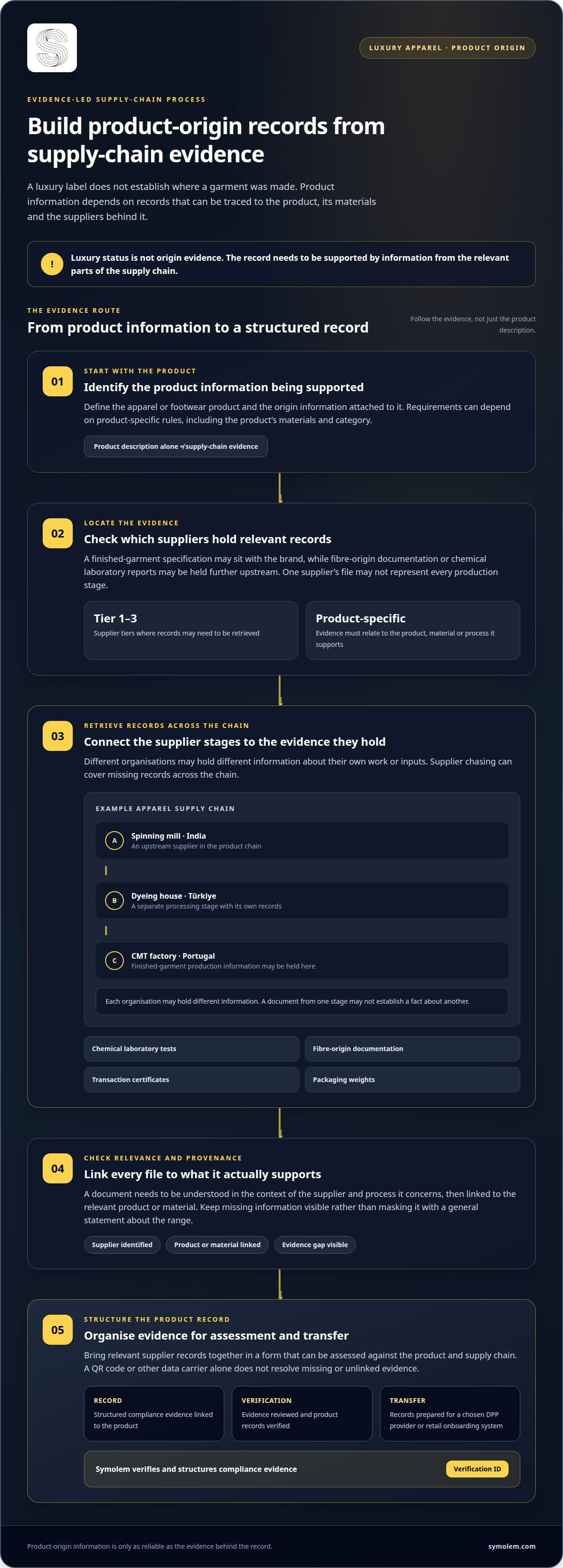
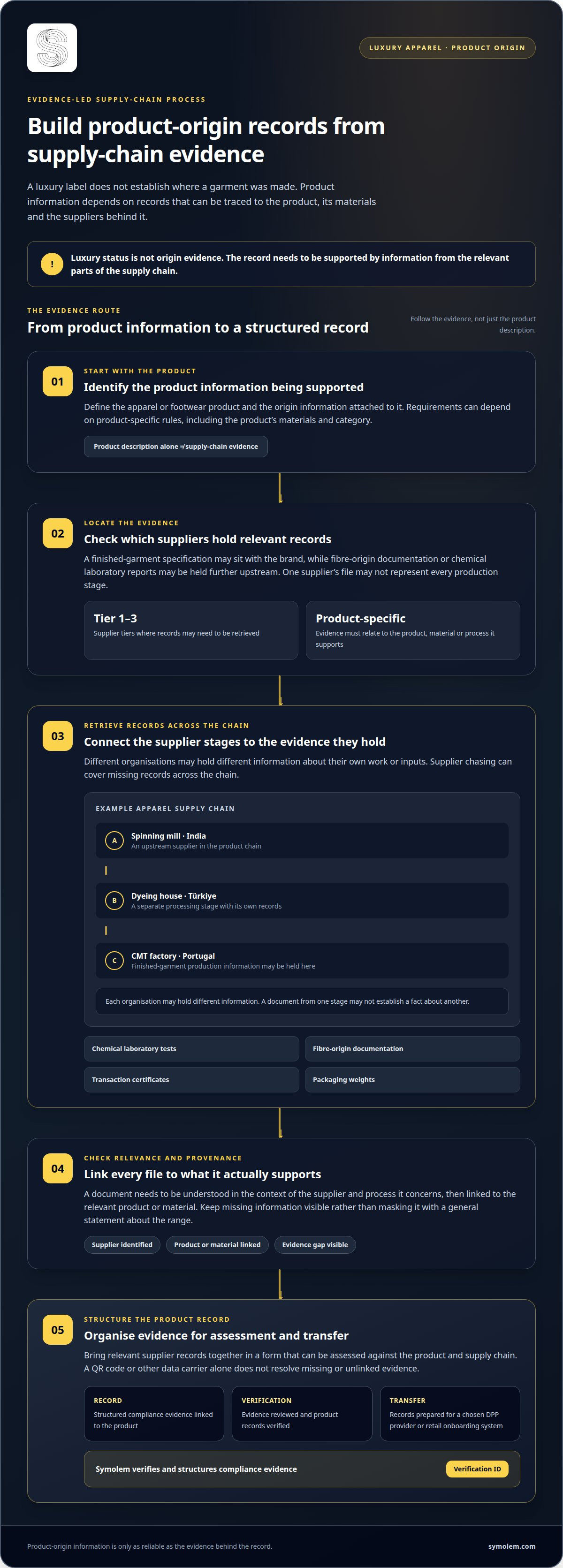
For fashion brands, the problem is often not a lack of intent to provide product information, but fragmented supporting records. A brand may hold the finished-garment specification but need to retrieve fibre-origin documentation from an upstream source, chemical laboratory reports from a manufacturing partner, or transaction certificates from a supplier further up the chain.
Symolem’s Tier 1-3 Regulations Data Retrieval Advisory addresses this evidence-retrieval burden through hands-on supplier chasing. The work can cover missing chemical laboratory tests, fibre-origin documentation, transaction certificates and packaging weights. It is designed for the practical situation in which a brand needs to assemble records across supplier tiers rather than rely on one factory’s file to represent every stage of production.
Consider an apparel product made using a spinning mill in India, a dyeing house in Turkey and a CMT factory in Portugal. Each organisation may hold different information about its own work or inputs. The brand’s finished-product record needs to bring relevant evidence together in a form that can be assessed against the product and supply chain. A document from one stage may not establish a fact about another, so retrieval must account for where the evidence comes from and what it supports.
Finding a document is not the same as building an evidence record. Each file needs to be linked to the relevant product or material and understood in the context of the supplier and process it concerns. Missing information should remain visible, rather than being obscured by a general statement about the range. Records organised around identifiable evidence give brands a stronger basis for review and transfer into their chosen systems.
The same principle applies when suppliers operate across different tiers and use their own commercial or technical documentation practices. A brand may need to coordinate information held by a direct manufacturer with records maintained by upstream suppliers. Symolem’s retrieval advisory focuses on obtaining those records through the supply chain and organising them as product-compliance evidence, rather than treating supplier outreach as a one-off request for a broad declaration.
For brands facing retailer deadlines, missing evidence can become a commercial obstacle as well as a compliance concern. A stockist may request records the brand has not yet assembled, or the brand may need to show that a product file is supported before onboarding a range. Evidence retrieval helps address this bottleneck by pursuing underlying documents and making their structure clearer for the teams assessing them.
Records need to support assessment, not just exist
Documentation is useful when its connection to the product is clear. A laboratory report with no identifiable link to the relevant material or product may be difficult to use in an assessment. A supplier document covering one production stage should not be treated as proof for another unless its contents support that conclusion. The record needs to preserve these distinctions.
Symolem’s DPP evidence work focuses on the integrity of the underlying product-compliance record. The team verifies and structures product evidence and assigns a Verification ID that can support transfer to a chosen DPP provider or retail onboarding system. This is separate from creating a consumer passport interface. The destination system handles the presentation; Symolem strengthens and organises the evidence being transferred.
This distinction helps prevent a common mistake: treating a digital presentation layer as proof. A QR code can point to product information, but it cannot resolve a mismatch between a product and its supporting documents. Nor does a digital record by itself show that supplier evidence is complete. The record must still be traceable to the relevant products and supported by documents that can withstand review.
For a brand preparing records for a DPP provider, Symolem can help assess whether evidence is assembled and structured for transfer. For a retailer, pre-order screening can show where records are missing or a SKU is blocked. Both services focus on the evidence layer: brands need assessable product records, while retailers need a clear view of whether third-party products have passed the relevant screening.
Businesses that need a broader view of their preparation can use Symolem’s ESPR and DPP Readiness Diagnostic, benchmarked against EU ESPR technical standards and UNTP data protocols. This structured readiness audit and gap analysis is distinct from retrieving individual documents or screening a retailer’s range before purchase orders. It helps a business assess its processes and records without confusing a diagnostic with issuing a consumer passport.
Choose the support that matches the gap
The appropriate next step depends on where the operational gap sits. If the immediate need is to screen third-party products before a purchase order, the relevant function is Symolem-ID. If a brand’s product records are held across suppliers and key documents are missing, the Tier 1-3 Regulations Data Retrieval Advisory addresses the evidence-chasing task. If the question is broader readiness against ESPR and DPP data protocols, the readiness diagnostic provides a structured assessment.
These services address different points in the evidence chain. Screening a product, retrieving a document or completing a readiness review does not by itself mean the product is compliant. Screening gives a status for the assessed record; retrieval pursues missing evidence; a readiness diagnostic examines preparedness. Use the function that matches the actual gap, and keep the conclusion proportionate to the work performed.
Some brands also need auditable evidence on worker welfare, fair wages and human-rights due diligence. Symolem’s Social Accounting and Due Diligence Advisory provides human-led audits and evidence packs in this area, including work relating to EU CSDDD, German LkSG and US UFLPA. This is separate from product-level DPP records, but may form part of the wider compliance information a brand organises for its commercial relationships. Evidence packs do not replace formal audits.
Retailers and marketplaces can use pre-PO screening to make third-party range review more structured. Fashion brands and manufacturers can use evidence retrieval when records are dispersed across Tier 1-3 suppliers and internal teams lack the capacity to chase every document. In both cases, the starting point is to identify whether the immediate issue is a product-level status, missing supplier evidence or a wider readiness gap, then apply the work that addresses it.
For teams translating DPP requirements for luxury goods into operating controls, the essential task is to connect product records with the evidence and suppliers that support them. Symolem provides product compliance intelligence and evidence advisory for fashion, footwear and textiles. Its role is to make product records easier to assess and supplier evidence more accessible to commercial teams, without treating a digital interface as a substitute for the records behind it.
For retailers and marketplaces: Screen third-party brand compliance before signing the PO. Explore Symolem-ID or run a free product scan.
For fashion brands: Need to retrieve missing Tier 1-3 supplier evidence or substantiate social accounting for retail stockists? Take the 5-minute Free Assessment or Book an Advisory Consultation.
A defensible response to DPP requirements for luxury goods starts with records that can be assessed, sourced and maintained across the supply chain. To discuss the evidence or screening support relevant to your business, contact Symolem.
Track Material Changes in Product Records
Record material changes as ranges are developed, rather than waiting for a retailer request. Assign clear ownership for updating product records and supplier documents when materials change. This gives teams a consistent record as products move from sourcing and production into retail systems.
For luxury goods, addressing gaps in material-change records early leaves more time to resolve them. Retailers can include checks in pre-order control; brands can organise supplier evidence alongside product development and production records. This creates a clearer handover from supply-chain documentation to compliance assessment.
When your next step is clear, align the work with the gap your business needs to address. Contact Symolem about product evidence support to discuss the relevant compliance and evidence support. A structured approach now can help your teams move forward with greater clarity.
Frequently Asked Questions
Which Supplier Records Help Support Apparel Product Information?
Brands can identify where records such as fibre composition, material origin and chemical documentation are held, and how they relate to individual products. This means checking which suppliers hold the relevant information and whether records can be matched to specific products. A brand can also assess whether its systems can exchange structured records with a chosen passport provider. Preparation supports readiness, but it does not itself establish compliance.
Which Apparel and Footwear Brands Need to Assemble Supplier Evidence?
Fashion brands placing apparel or footwear on the EU market fall within the stated product scope, regardless of where they are headquartered. The relevant distinction is the product and its market, not whether a label calls itself luxury, contemporary or mass-market. A brand based outside the EU that sells covered products there should consider how it will assemble product information and supplier evidence for the applicable rules.
How Can Brands Link Supplier Evidence to a Product?
A product identifier can connect product information to its digital record. Examples of product identifiers include a QR code, RFID tag or NFC chip on the product, its packaging or accompanying documentation. The identifier provides a route to information; it does not prove that the record is accurate or make different systems interoperable by itself. For example, a code on a shoe may point to a product record while supporting evidence remains in connected systems.
Which Textile Records Can Support Fibre Composition Claims?
The required data depends on the product-specific rules that apply. For textiles, relevant information may include fibre composition, material or product origin, and evidence relating to chemical compliance, but the applicable rules determine the final mandatory dataset. Brands should distinguish required fields from optional or commercially useful information. This helps prevent a draft dataset or voluntary passport feature from being presented as a final legal obligation.
How Can Brands Organise Supplier Evidence for Product Records?
A product record needs a product identifier, a data carrier linking the physical item to its record, and digital records that can be accessed and maintained. Interoperability matters too: systems must be able to interpret and use exchanged information, not merely display a link. A QR code can point to data, but identifiers, formats, access arrangements and evidence structure determine whether organisations can use that data across systems.
Which Operators Need to Account for Product Information Duties?
Obligations apply to products placed on the EU market once the relevant product-group rules take effect. They are not limited to brands established in the EU. Brands, importers and other operators involved in placing covered goods on that market need to account for the duties assigned to them under the applicable rules. A luxury label headquartered elsewhere cannot rely on its location to exclude apparel or footwear sold into the EU from scope.
Why Should Brands Locate Supplier Records Early?
Preparing records ahead of a product-specific deadline gives teams time to locate evidence, resolve inconsistencies and assign responsibility for keeping information current. Supplier documents may be held by different organisations, so late requests can reveal gaps when products are already moving through buying or onboarding. Early preparation also helps businesses distinguish records they already maintain from information that needs new collection or system coordination.
Which Supplier Records Could Support Textile Product Information?
Potential textile product information includes fibre composition by weight, product or material origin, and records relevant to chemical compliance. Other areas under consideration include durability, repair and end-of-life information. The precise fields and level of detail depend on the final product-specific rules, so a proposed dataset should not be treated as definitive. For example, a brand can map fibre and supplier records while keeping proposed fields distinct from mandatory ones.
For Retailers & Marketplaces: Screen third-party brand compliance before signing the PO. Explore Symolem-ID or run a free product scan.
For Fashion Brands: Need to retrieve missing Tier 1-3 supplier evidence or substantiate social accounting for retail stockists? Take the 5-minute Free Assessment or Book an Advisory Consultation.
Frequently Asked Questions
Talk to a consultant
Have a question about how this applies to your brand?
Ask Lavinia Fernandes directly. Tell us your products and markets and you get a straight answer on what applies and what to do first.