
ESPR implications for footwear brands: rules and next steps
Footwear is not a peripheral case in EU ecodesign policy. The ESPR implications for footwear brands start with a framework that entered into force on 18 July 2024 and allows the European Commission to introduce product-specific rules over time. For brands selling into the EU, the practical issue is whether product and supply-chain evidence can support those requirements as they develop.
The Digital Product Passport is part of that shift, but a live EU passport registry does not itself define every footwear-specific obligation. The registry has been online since 20 July 2026; brands still need to organise reliable records across materials, components and suppliers, rather than assume a passport can resolve missing evidence. This article explains what ESPR means for footwear, how passport requirements are developing, and why supplier partnerships matter. It also sets out how to prepare data spanning a spinning mill in India, a leather-processing site in Türkiye or a footwear factory in Portugal, so compliance work rests on traceable evidence rather than incomplete claims.
Key Takeaways
- The European Commission states that the ban on destroying unsold footwear begins for large enterprises on 19 July 2026, subject to specified exemptions.
- Understand what counts as destruction: intentionally damaging unsold products or discarding them as waste.
- Plan for alternatives such as resale, donation, repair or recycling when unsold footwear cannot be destroyed.
- Check how company size and the conditions for an exemption affect the obligations that apply to unsold stock.
Table of Contents
The ESPR ban on destroying unsold footwear
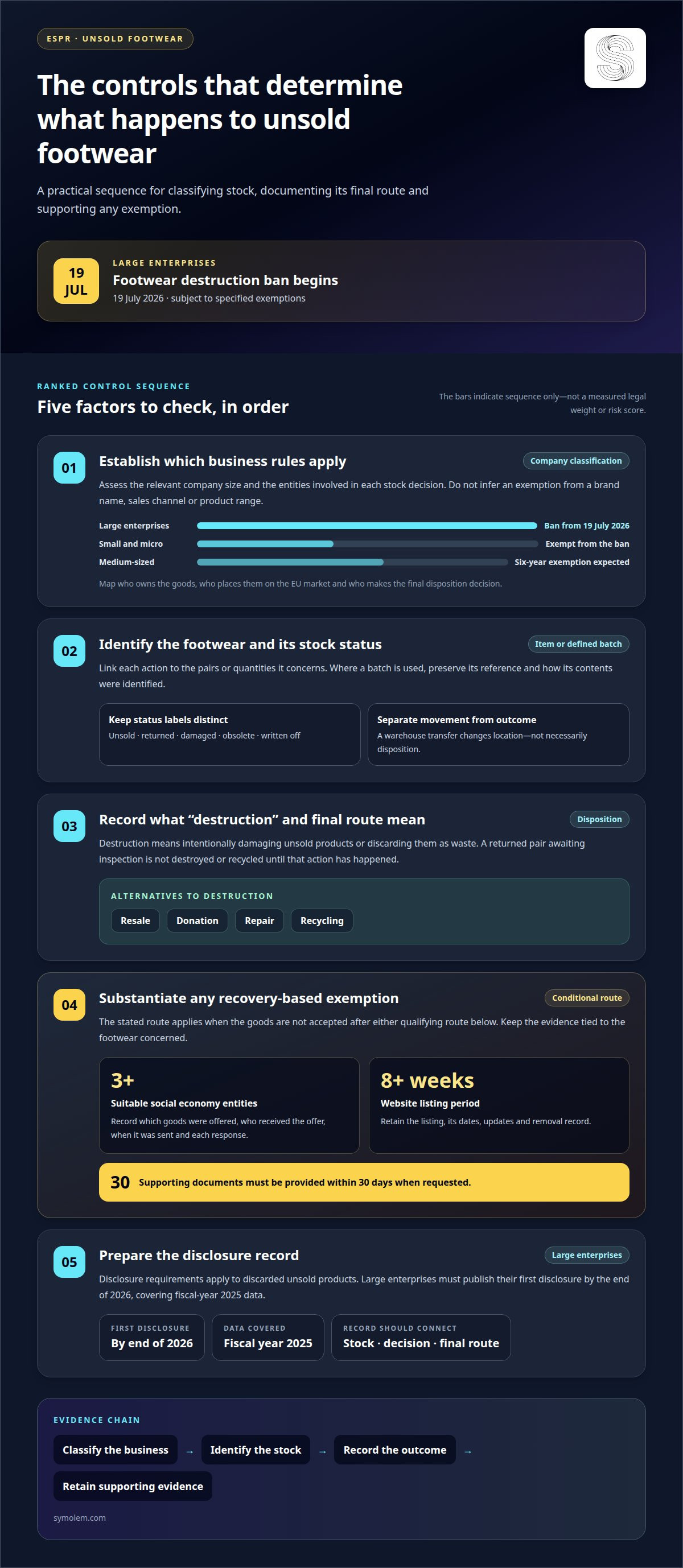
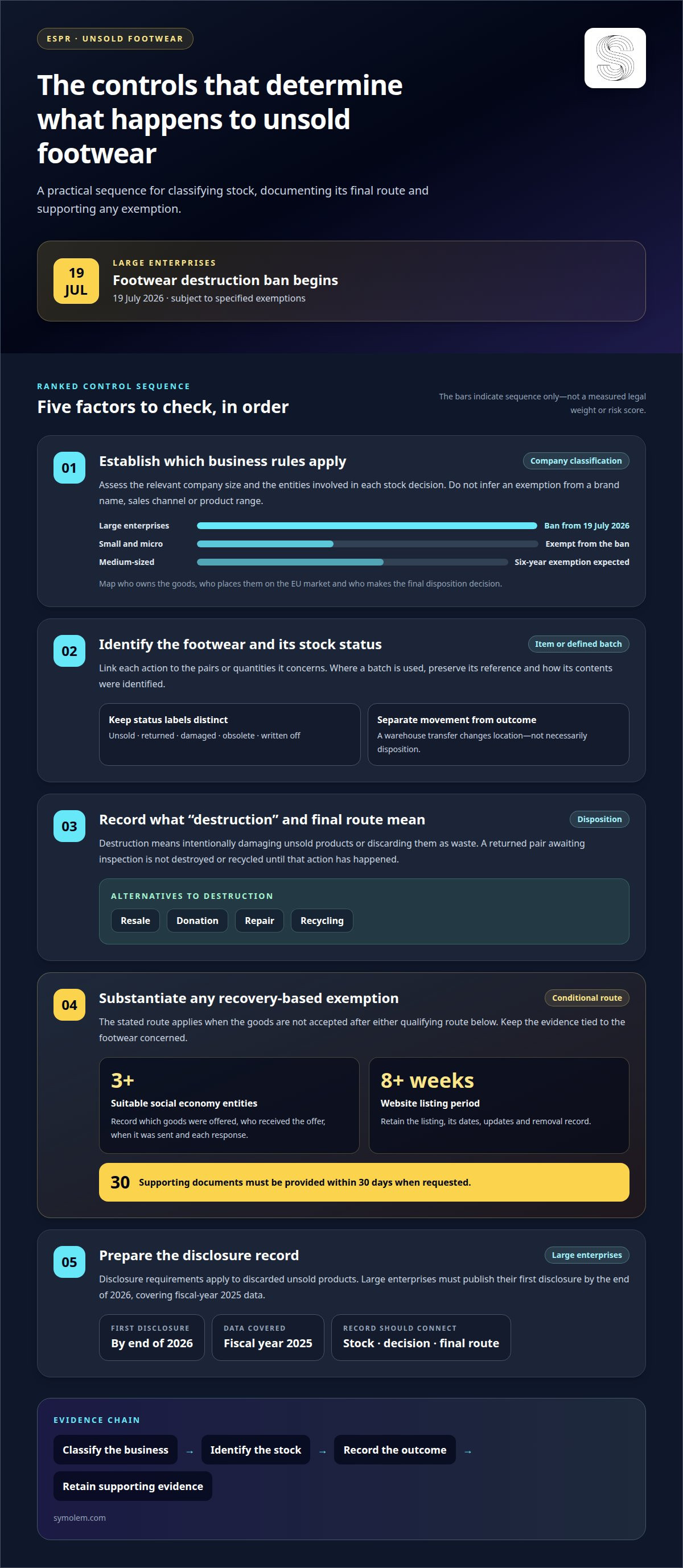
The ESPR limits when businesses may destroy unsold footwear and requires records that explain stock decisions. According to the European Commission, the ban on destroying unsold footwear begins for large enterprises on 19 July 2026. Destruction means intentionally damaging a product or discarding it as waste. That definition makes end-of-season stock decisions a compliance control, not merely a warehouse procedure.
How does ESPR compare with EU footwear rules on packaging, chemicals, textiles and producer responsibility? ESPR addresses ecodesign and the destruction of unsold products, while separate EU rules govern relevant packaging, chemicals, textiles and producer-responsibility obligations. Keep these legal controls distinct in product and stock records rather than treating them as one requirement.
How does ESPR restrict destruction of unsold footwear, and what are the disclosure requirements and exemptions? The ban applies to large enterprises from 19 July 2026, with disclosure requirements for discarded unsold products. Large enterprises must publish their first disclosure by the end of 2026, covering fiscal-year 2025 data; exemptions include rules based on company size and specific recovery attempts.
The practical question is what happened to each product or defined stock group. A pair moved between warehouses remains stock; a pair intentionally damaged or discarded as waste has a different disposition. Resale, donation, repair and recycling are alternatives to destruction. Clear records distinguish a temporary stock movement from a final decision about unsold footwear.
The ESPR implications for footwear brands include how stock decisions are recorded, reviewed and reported. Sales, finance, returns and warehouse teams may each hold part of the relevant history. A consistent process connects the stock item, its condition, the decision-maker and its final route. Without that connection, a year-end total may not explain the actions behind it.
Scope the ban to the right business and stock
Company size affects the destruction-ban provisions. Small and micro companies are exempt from the EU ban on destroying unsold textile goods, while medium-sized companies are expected to receive a six-year exemption. Large enterprises face the footwear ban from the date stated above. Assess the applicable company classification rather than inferring an exemption from a brand name, sales channel or product range.
A group structure can complicate the assessment. One entity may own the stock, another may place the product on the EU market, and a third may operate the warehouse. Map the entities involved in each relevant stock decision and document which one is responsible. This helps teams apply the correct classification without assuming that a group-wide label answers every legal question.
Consider a group selling trainers through its own website and retail partners. Unsold pairs might be held in a group distribution centre, a retailer’s warehouse or a returns facility. Identify who controls the goods and who makes the final disposition decision. Keeping these roles visible helps prevent gaps where each party assumes another organisation owns the record.
Product status also needs a consistent definition. “Unsold”, “returned”, “damaged”, “obsolete” and “written off” may appear as separate system labels, but they do not necessarily describe a final destination. Define how each status is used and when a product moves between statuses. A returned pair awaiting inspection should not be recorded as destroyed or recycled before that action occurs.
Apply the same logic to stock groups. A seasonal clearance may cover several styles, but only some pairs may be offered for donation or sent for repair. Link each action to the products or quantities it concerns. If an action covers a defined batch rather than individual pairs, preserve the batch reference and the method used to identify its contents.
Keep transfers separate from final outcomes. Moving a product from a retailer’s stockroom to a central warehouse changes its location, not necessarily its disposition. A pair returned to a supplier may also need a recorded next step, rather than a status that ends its stock trail. Separating logistics events from disposal decisions makes inventory reports more meaningful and supports later review.
Apply exemptions with evidence tied to the goods
An exemption is conditional. One identified route applies when a brand offers unsold goods to at least 3 suitable social economy entities, or lists them on its website for 8 or more weeks, and they are not accepted. A brand invoking an exemption must provide supporting documents within 30 days when requested.
Connect records of the exemption route to the footwear concerned. For an offer, retain which goods were offered, who received the offer, when it was sent and the response. For a website listing, retain the listing content and the period during which it appeared. These records make the basis for relying on the exemption visible without depending on later recollection.
For example, a brand may have unsold boots in several sizes and colours. A stock extract can identify the goods included in an offer to suitable social economy entities. Link the responses to that extract so the record shows what was offered and whether it was accepted. A general email about surplus footwear may not identify the specific stock involved.
If a listing is used, retain a copy of the offer and its dates. A screenshot or stored page record can show what consumers or potential recipients could see. Keep updates and removal records with the original listing. This creates a coherent history of the offer period and avoids relying on a live webpage that may later change.
Keep evidence of the exemption distinct from evidence about product condition. A damaged sole may explain why a pair was unsuitable for resale, but that fact alone does not establish that an exemption applies. Record inspection findings separately from donation offers or listings. The file should show both the condition of the goods and the specific route relied upon.
Prepare the supporting file when the decision is made, rather than waiting for a request. Assign responsibility for retaining stock identifiers, correspondence, listing records and recipient responses. A central location can help staff retrieve documents within the stated response period. Reviewers should be able to connect the evidence to the relevant footwear without reconstructing the decision from scattered emails.
Changes in quantity also need to be recorded. If an offer starts with a stated batch and some pairs are sold or removed during the offer period, update the inventory link. Preserve the original quantity and subsequent changes. This helps distinguish goods covered by the exemption evidence from goods that followed another route.
Prepare disclosure from operational records
Large enterprises must publish their first ESPR disclosure on unsold apparel and footwear by the end of 2026, covering fiscal-year 2025 data. The harmonised template for ESPR disclosures on discarded unsold products applies from February 2027. These requirements make historic stock data relevant, even where teams previously recorded only the quantity written off.
Start by defining the fields needed for a reliable account of stock disposition. Internal records can identify product category, quantity, status, final route and the reason recorded for that route. Link those entries to transactions, warehouse movements, return records, repair documentation, donation evidence or recycling records. The aim is to make reported information traceable to its operational source.
Fiscal-year data may be spread across finance, e-commerce, retail and logistics systems. A pair returned by a consumer could appear as a return in one system and a stock adjustment in another. Reconcile records using product or batch references and clear definitions for each status. Retain explanations of adjustments so reviewers can understand how totals were assembled.
Set a reporting boundary before calculating totals. Separate goods that remain available for sale from goods that have reached a final disposition. Define how returned pairs, transfers, donations and repair activity appear in the records. These definitions help prevent the same pair from being counted as both a warehouse transfer and a final disposal.
Reconcile source records before approving a disclosure. For example, compare warehouse quantities with the corresponding finance adjustment and disposition evidence. Investigate differences rather than forcing the figures to match. Record each correction, its reason and the person approving it so the reported figure can be explained later.
Use a reporting calendar tied to the company’s fiscal-year data and applicable disclosure template. Assign responsibility for collecting records, resolving discrepancies and approving final figures. Identify where source data comes from and which teams hold it. This is especially useful when stock decisions cross retail, returns and distribution operations.
Keep supporting material with the calculation. A disclosure total without the underlying inventory extract and disposition records offers little visibility into how the figure was produced. Store source data, reconciliation notes, approvals and exemption evidence together, or link them clearly. This makes updates and internal review more controlled as reporting arrangements mature.
Use consistent descriptions across the business. If one team records “write-off” and another records “discarded”, define how those terms map to the disposition categories used in reporting. Preserve the original source entry when applying a harmonised internal category. This makes data comparable without erasing the operational language used by the teams who created it.
Review the disclosure process against actual stock events, not just spreadsheet fields. A test case might follow a returned pair from receipt and inspection through to resale, repair, recycling or disposal. The review should reveal where a status change lacks an owner or supporting document. Fixing that process improves later reporting without adding unsupported assumptions about individual products.
Use recovery routes as distinct stock outcomes
Resale, donation, repair and recycling are alternatives to destruction, but they are distinct outcomes. Do not collapse them into a generic “recovered” category. A resale record should show that the goods returned to sale; a repair record should identify the work completed; and a recycling record should identify the route taken. These distinctions help explain what happened to unsold stock.
Base the disposition decision on the product’s condition and the available route. A pair with a replaceable component may be suitable for repair, while another may be fit for resale without intervention. A product that cannot be sold or repaired may be considered for recycling. Record the assessment and selected route rather than assuming every returned or damaged product has the same outcome.
For donations, link the goods to the receiving organisation. Retain the stock list, transfer record and evidence that the goods reached the intended recipient. If only part of an offered batch is accepted, update the quantities and record what happened to the remaining stock. This prevents an offer from being mistaken for a completed donation.
Repair records should distinguish proposed work from completed work. A pair sent for assessment has not necessarily been repaired. Record the product or stock group, the repair outcome and whether the footwear returned to sale or followed another route. This avoids reporting a planned intervention as a completed recovery outcome.
Recycling records should show the route taken, not merely that a product was labelled recyclable. Keep evidence of the stock transferred into the recycling process and the related quantity. If a batch contains more than one product type, preserve how the footwear within it was identified. This gives a clearer account of disposition than a general warehouse code.
Keep destruction controls separate from routine stock clearance. A write-off entry may serve an accounting purpose, but it does not show whether goods were intentionally damaged or discarded as waste. Require the operational record to show the physical outcome and decision basis. If destruction is considered, submit it for review under the company’s controls before processing the stock.
These ESPR implications for footwear brands make the distinction between a planned route and a completed outcome important. An offer that receives no acceptance is not a completed donation, and a repair order is not a repaired pair. Recording each stage prevents intended recovery from being mistaken for a final product disposition.
Make decisions reviewable across teams
Assign a clear owner to each part of the stock decision. Warehouse teams can document location and condition, returns teams can record inspections, and commercial teams can confirm whether goods remain suitable for sale. A designated reviewer can check that the final disposition matches the supporting record. This division of work reduces the risk that no team owns the complete account.
Use approval controls for decisions that could lead to destruction. Require the decision-maker to record the reason, quantity, product reference and proposed route. Where an exemption is relied upon, attach or link the supporting evidence. This prevents a disposal instruction from standing alone without a record of the goods and decision involved.
Maintain a route history as stock changes status. A pair may move from returned to inspected, then to repair, resale or recycling. Preserve each meaningful transition and its date in the relevant system. A single final status may be useful for reporting, but the underlying history helps explain how the product reached that outcome.
Review exceptions rather than treating them as routine. Resolve a missing stock reference, conflicting quantity or unclear disposal code before reporting. Record the correction and the evidence used. This creates an accountable process for imperfect legacy data and reduces the risk that an unsupported estimate appears in the final disclosure.
These ESPR implications for footwear brands are manageable when stock controls capture decisions as they happen. Connect product identity, condition, chosen route and supporting evidence in routine operations. Keep company-size assessments and exemption files accessible to the teams responsible for stock and reporting. Clear records let the business explain its actions without relying on broad labels or reconstructed histories.
Make stock control part of compliance governance
The next step is to connect footwear stock decisions with the records that support them. The ESPR implications for footwear brands extend beyond product design: operational teams need a consistent way to link each product range to supplier evidence, inventory decisions and relevant compliance reviews. That connection helps prevent evidence gaps from surfacing only when a retailer or internal reviewer asks for them.
Symolem is a product compliance intelligence platform and evidence advisory for fashion, footwear and textiles. Its work can include pre-purchase-order screening through Symolem-ID, Tier 1-3 retrieval of missing supplier documents, and auditable evidence on worker welfare and fair wages. Contact Symolem to discuss ESPR and identify where evidence retrieval or screening fits your operational need.
For retailers and marketplaces: Screen third-party brand compliance before signing the PO. Explore Symolem-ID or run a free product scan.
For fashion brands: Need to retrieve missing Tier 1-3 supplier evidence or substantiate social accounting for retail stockists? Take the 5-minute Free Assessment or get in touch with Symolem. Build the evidence trail into routine decisions, and your teams can act with greater clarity.
Frequently Asked Questions
What is ESPR, and why is it important?
ESPR matters because it can make product design and evidence conditions that shape market access, rather than voluntary internal preferences. For footwear businesses, its practical effects reach across design, sourcing, product data and buying decisions. Assign owners to translate each applicable requirement into product specifications and records. This clarifies who must resolve a materials issue before production, rather than after stock has been ordered.
What is the Ecodesign for Sustainable Products Regulation?
ESPR is the EU instrument that provides the basis for setting ecodesign rules for defined product groups. The framework and product-specific measures are distinct: the framework enables rules, while later measures establish the requirements relevant to a product category. Separate general policy monitoring from product-level decisions. This prevents teams from treating a broad regulation summary as a complete specification for every footwear style.
Which Fashion Products Are Affected?
Which products are affected depends on the product groups addressed by applicable EU measures and whether the goods are placed on the EU market. Organise the range by product type and keep product identifiers consistent across design, sourcing and sales systems. This helps teams identify which styles need review when a measure applies, rather than relying on broad labels such as “fashion” or “accessories” to determine scope.
Who Does ESPR Apply To in the Fashion Industry?
ESPR is relevant to economic operators involved in products placed on the EU market, including businesses based outside the EU that sell products there. Establish which entity handles each product’s market placement and which teams control its design and supporting records. A brand, importer and retailer, for example, may hold different information. Clear role allocation helps prevent evidence requests from going unanswered between organisations.
What is the EU Ecodesign for Sustainable Products Regulation (ESPR), and when does it apply?
ESPR is the EU framework for setting ecodesign requirements for product groups. It does not set one universal start date for every footwear obligation: timing depends on the measures adopted for the relevant group and their application provisions. Track those measures against the product range and sales markets. A category-specific timeline is more useful for production planning than treating the framework’s entry into force as the deadline for every product.
What ESPR ecodesign requirements could apply to footwear, including durability, repairability, and recycled content?
Potential requirements may address product performance and information, including durability, repairability and recycled content. The practical planning question is how to support each design choice with product-specific evidence. For instance, a sourcing change should prompt a review of evidence for the affected style, not automatic reuse of records from an earlier specification. Distinguish measured performance from design intentions and claims in product materials.
How will ESPR digital product passports work for footwear, and what data must brands provide?
Footwear passport data requirements depend on the applicable product-specific measures; a single generic data list cannot define every future obligation. Prepare by organising product identity and evidence records by the relevant style or production version. A digital access point is not evidence by itself. Passport information must correspond to the product and be supported by records the responsible business can retrieve.
What supply-chain traceability and sustainability information must footwear brands collect for ESPR compliance?
Required information depends on the product-specific rules that apply. For dependable records, document the source of each data item, who supplied it, which product version it concerns and when it was updated. Establish a process to resolve conflicting or incomplete entries before using the information in product communications or compliance files. This helps teams manage evidence quality without treating a broad supplier declaration as support for every product claim.
Frequently Asked Questions
Talk to a consultant
Have a question about how this applies to your brand?
Ask Lavinia Fernandes directly. Tell us your products and markets and you get a straight answer on what applies and what to do first.