DPP Requirements for Textile Importers: Who Must Comply
The DPP requirements for textile importers apply to in-scope textile apparel placed on the EU market, regardless of where the importer or brand is based. Under Regulation (EU) 2024/1781, the European Union’s Ecodesign for Sustainable Products Regulation, textile apparel is a priority product group, but the detailed textile rules are to be set through a delegated act.
That distinction matters. Importers need to identify which products may be in scope and how to gather product and supply-chain evidence, without treating proposed details as final obligations.
A digital product passport (DPP) is a structured set of product information made digitally accessible. For textile apparel, developing requirements could affect how importers obtain, verify and maintain evidence across suppliers, from fibre origins and processing stages to product records.
This article explains what a textile DPP is, which market actors may have responsibilities, and what importers can prepare before the delegated act is finalised. It distinguishes the established legal framework from details still under development, so you can organise evidence without mistaking preparation for a final compliance checklist.
Key Takeaways
- Identify whether your role as importer, brand owner or distributor brings responsibility for making passport information available for products placed on the EU market.
- Separate the ESPR framework already in force from textile-specific data and access rules that are still being developed.
- Prepare by mapping product records and supplier evidence across relevant stages, from fibre sourcing and processing to garment manufacture.
- Use the expected delegated-act timeline to prioritise data readiness without treating draft details as final requirements.
- Understand where structured readiness support or pre-purchase-order screening can help expose evidence gaps before they become operational barriers.
Table of Contents
- How should fashion brands prepare and who can support this process?
- What is a digital product passport?
- Can I prepare a DPP today before the delegated act is finalised?
- Which textile importers and other EU market actors must comply
- Preparation for textile brands and importers
- Symolem-ID: Automated Compliance Screening
How should fashion brands prepare and who can support this process?
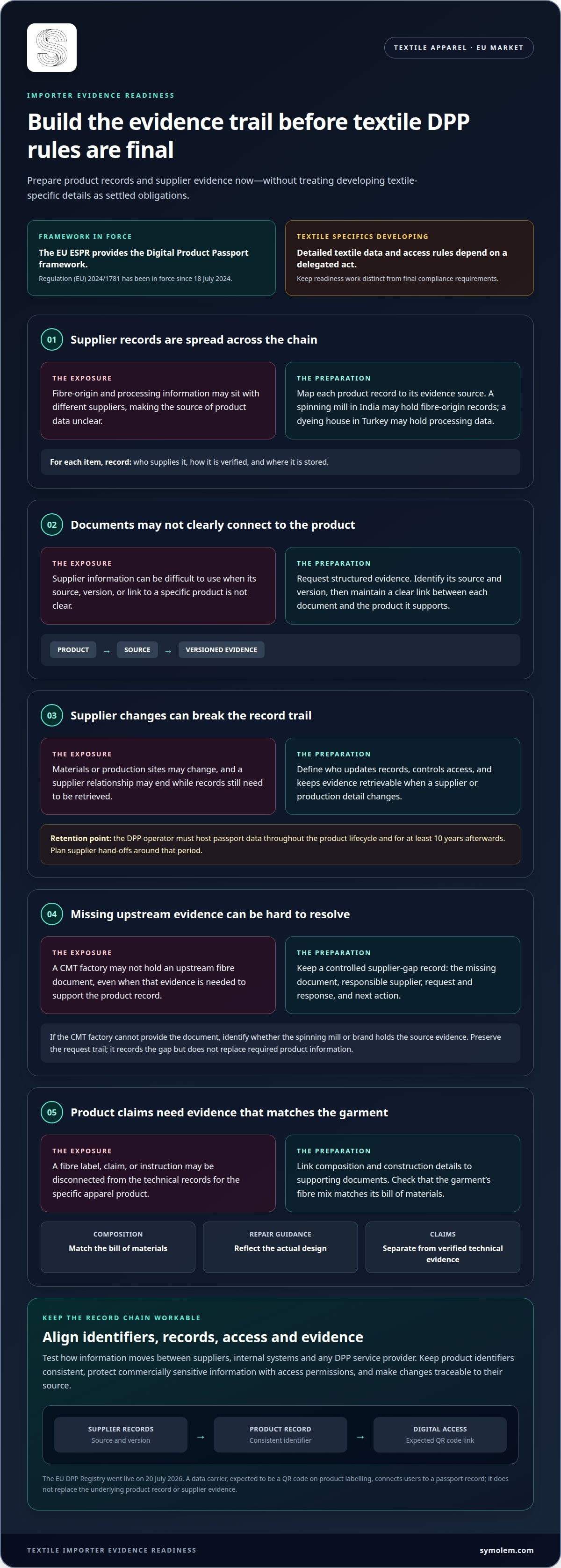
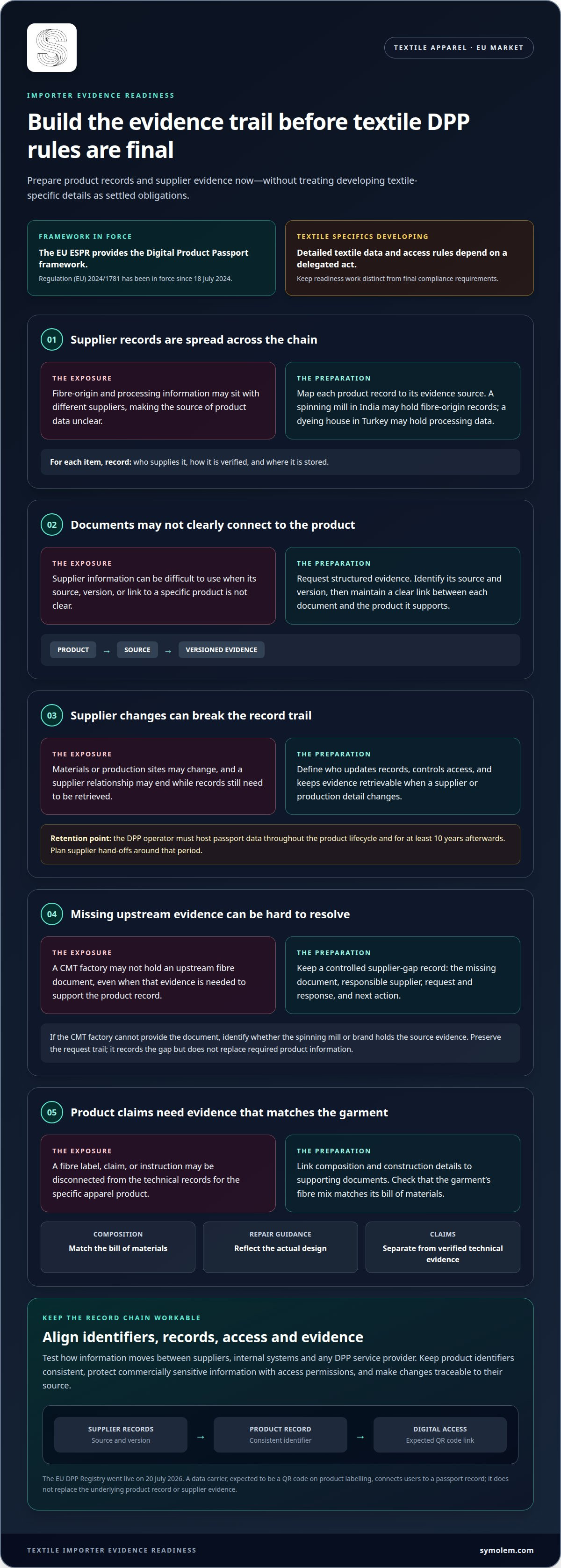
Preparation starts with records, not a finished passport. The DPP access rights and detailed textile data requirements are still under development, so brands should separate established product evidence from fields that may change. A practical first step is to map each product’s information to its source: a spinning mill in India may hold fibre-origin records, while a dyeing house in Turkey may hold processing data. Record who supplies each item, how it is verified, and where it is stored.
For U.S. importers, obtaining usable information from the brand and its suppliers is essential. Request structured evidence, identify its source and version, and keep a clear link between each document and the product it supports.
The EU DPP Registry went live on 20 July 2026. Its existence does not settle every textile-specific access rule or data field. A data carrier, expected to be a QR code on product labelling, will connect users to a passport record. The technical design should therefore keep the product identifier, digital record and supporting evidence aligned, even as detailed requirements develop. Service providers can support data storage or transfer, but brands still need to establish which records they can access and maintain.
The DPP operator must host passport data throughout the product lifecycle and for at least 10 years afterwards. That retention period makes supplier hand-offs an operational issue, not a one-time sourcing task. Define who updates records when materials or production sites change, who controls access, and how evidence remains retrievable if a supplier relationship ends. Retention procedures should cover the passport data and its supporting documents.
Durability, repairability and recyclability information may require evidence beyond a fibre label. Link material composition and construction details to documents supporting relevant claims. A garment’s fibre mix, for example, should match its bill of materials, while repair guidance should reflect the product’s actual design. Keep environmental claims distinct from verified technical evidence so unsupported claims are not presented as product facts.
Keep a controlled record of supplier gaps. Log each missing document, the supplier responsible, the request and response, and the next action. If a CMT factory cannot provide an upstream fibre document, preserve the request trail and identify whether the spinning mill or brand holds the source evidence. This creates an auditable account of the gap, but does not replace required product information.
Test how records move between suppliers, internal systems and any DPP service provider. Check that product identifiers remain consistent, access permissions protect commercially sensitive information, and changes can be traced to their source. This technical foundation can accommodate finalised textile rules without treating provisional data fields as settled regulation.
What is a digital product passport?
A digital product passport is a structured digital record linking product information to an identifiable item or model. Under the EU ESPR framework, it is intended to connect apparel information across supply-chain stages.
EU Framework and Market Responsibility
The Ecodesign for Sustainable Products Regulation, Regulation (EU) 2024/1781, provides the EU framework for Digital Product Passports. It has been in force since 18 July 2024, while textile-specific obligations depend on a delegated act. Importers placing in-scope apparel on the EU market must make a passport available; brands selling those products into the EU face requirements regardless of their home country. The commercial consequence is direct: a supplier’s location outside Europe does not remove the EU market obligation.
Product Lifecycle Information
A textile passport is intended to link information about materials, production, use and end of life. The European Commission’s Joint Research Centre is exploring data areas such as fibre composition, traceability, care instructions, substances of concern, durability and recyclability. For a cotton garment, this could mean linking fibre composition to processing records, care guidance and end-of-life information. Product claims and instructions need evidence tied to the specific apparel record, not disconnected documents scattered across the supply chain.
Identifiers, Records, and Data Carriers
A product identifier connects the physical item or model to its digital record, while a data carrier gives users access. A QR code on a textile label is expected to provide that connection. The EU DPP Registry went live on 20 July 2026; it does not replace the product’s underlying record or supplier evidence. Consistent identifiers help importers, brands and distributors associate the correct passport with the product they handle, including when product data changes across production runs.
The current Joint Research Centre proposal focuses on apparel containing at least 80% textile fibres by weight. That threshold describes a proposed scope, not a complete list of final exclusions. Products outside that proposed category should not automatically be treated as permanently exempt: textile-specific rules will determine the final product coverage. The EU Working Plan 2025-2030 identifies textile apparel as a priority product group, making product categorisation a readiness issue for importers.
U.S. textile import and labelling obligations are separate from the EU passport framework. Meeting U.S. requirements does not, by itself, make an EU digital record available for apparel placed on the EU market. Importers serving both markets should align market-specific records without treating one jurisdiction’s documentation as a substitute for another’s.
The passport’s data depth is not yet identical across every proposed model. The EU-accepted passport sample carried 67 data points, while a UNTP-conformant passport carries up to 236. These figures illustrate different data structures, not a final textile checklist. Importers should distinguish the established ESPR framework from textile-specific technical requirements as they develop.
Can I prepare a DPP today before the delegated act is finalised?
Yes. Prepare evidence and systems that can remain useful as regulations change, rather than treating draft fields as final obligations. The European Commission’s indicative timeline can inform planning, but does not replace the textile delegated act.
Expected Delegated Acts and Implementation
The delegated act will set textile-specific ecodesign for sustainable products requirements, including the detailed passport rules. The European Commission’s indicative timeline plans adoption in Q4 2027, so importers can use the period before adoption to organise product records and supplier access.
Under the ESPR, requirements normally apply at least 18 months after a delegated act takes effect. That transition period affects when regulated products must meet the new rules; it does not make early evidence mapping wasted effort. Product identifiers, supplier records and document ownership can be structured before the technical fields are finalised.
Textile Timeline and Transition Period
For textiles, the planned adoption point is Q4 2027, followed by a transition period of at least 18 months after the delegated act takes effect. The adoption date and application date are different milestones. Importers should track both, because the latter determines when products entering the EU market must meet the textile-specific requirements.
The earliest expected compliance date is around late 2028 or early 2029, but the date is not final. Use that window to locate evidence across the supply chain. For example, a brand sourcing yarn from India can identify which supplier holds fibre-origin records and how those records connect to finished apparel.
Indicative Textile DPP Timeline
The broader EU timeline also includes horizontal Digital Product Passport requirements expected in 2027 and 2029, applying approximately 18 months thereafter. These milestones do not replace the textile delegated act. They show why importers should distinguish cross-sector rules from textile-specific requirements when planning implementation.
Textile design and sourcing often span 12 to 24 months, so calendar decisions now can affect products planned for later seasons. AW28 design and sourcing is expected to begin in early 2027, before the textile delegated act is expected. Linking product development records to supplier evidence during that cycle can reduce later reconstruction work.
Prepare a controlled evidence structure now. Identify the product identifier, the records already held, the supplier responsible for missing documents and the route for updating each record. A dyeing house in Turkey may hold processing evidence, while a Portugal CMT factory may hold garment assembly records. Traceability depends on connecting these records to the correct product, not simply collecting files.
Keep a change log for assumptions, source documents and data fields. When the textile rules are adopted, map each final requirement to existing records and assign unresolved gaps to a responsible supplier or internal owner. This turns the transition to the delegated act into a defined implementation task, rather than a rushed search through disconnected supply-chain files.
Which textile importers and other EU market actors must comply
Responsibility follows the product’s role in the EU market, not simply the factory that made it. The passport obligation is product-level, so company size or revenue does not determine whether an in-scope textile product needs a passport.
An importer placing apparel on the EU market is a key responsible actor. The responsible economic operator may be the manufacturer, importer, brand owner or a fulfilment service provider acting in that role. Distributors and dealers must also ensure a passport is available for textile apparel they distribute or deal with. A retailer buying from a non-EU brand should establish who supplies the passport and maintains the relevant product record.
The DPP requirements for textile importers make product identity central to compliance planning. GTINs help connect product identity to passport records. The recommended model is one passport for each unique product variant identified by GTIN. In the example of a T-shirt line with three sizes and four colours, each size-and-colour combination is a distinct SKU, resulting in 12 passports. This approach helps prevent one product record from being applied across variants with different composition or origin information.
A GTIN does not replace the underlying evidence. For a garment made with cotton from a spinning mill in India, the product record still needs to connect its identifier with accurate fibre composition and supporting origin documentation. If a dyeing house in Turkey or a CMT factory in Portugal changes, the associated production records must remain attributable to the correct product. Retailers can use these links to identify gaps before purchase orders are signed.
Certifications can support particular evidence but should not be treated as substitutes for product-specific records. ISO 14001, for example, is an environmental management certification that may provide relevant supply-chain context. It does not, by itself, establish a garment’s fibre composition, repair information or recyclability. A passport record needs evidence tied to the product and the information it carries.
Regulation (EU) 2024/1781 requires Member States to be able to impose at least fines and time-limited exclusion from public procurement for non-compliance. Those enforcement measures make clear why market actors need defined responsibilities, retrievable records and documented product-level evidence. A brand, importer and distributor should not assume that another party’s involvement removes their own duties.
For teams putting DPP requirements for textile importers into practice, the key test is whether each in-scope product has an accountable operator and accessible passport information. Allocate responsibility for maintaining the record, supplying evidence and capturing product changes. Without clear ownership, a seemingly complete range can still include individual SKUs with missing or mismatched records.
Preparation for textile brands and importers
Build preparation around product records and supplier evidence, not assumptions about draft data fields. The Ecodesign for Sustainable Products Regulation establishes the framework, while the textile-specific delegated act will define detailed requirements. Brands can start by assigning an owner to each product record and mapping its information to the suppliers who hold the evidence.
Start with scope and product identity. Separate apparel intended for the EU market from products sold elsewhere, then link each relevant model and variant to its product identifier. The record should show which materials and production details apply to that variant. This prevents a generic brand-level file from being mistaken for evidence about a specific garment.
Supplier mapping needs to reach beyond the final factory. Fashion brands may work with 50 to 500 suppliers across multiple tiers, making requests to a single Tier 1 contact insufficient. Map Tier 1-3 relationships and identify who holds fibre-origin documents, bills of materials, chemical test reports and transaction certificates. A supplier register should record document ownership, request status and any unresolved evidence gap.
Material and chemical records need product-level alignment. Compare the bill of materials with supplier documentation, then assess relevant substances against REACH Annex XVII and the SVHC list. Flag substances of concern above declaration thresholds, and retain the supporting test or declaration with the product record. An environmental certification such as ISO 14001 may provide supply-chain context, but it does not prove a garment’s composition or substance status.
Importers have a distinct operational role when products arrive. Verify passport and batch information against incoming product records, preserve traceability, and keep documents retrievable for regulatory checks. If an invoice or shipment record identifies a batch, its supporting information must relate to that batch, not just to the wider brand range.
Useful preparation can be organised around a few controlled records:
- A product register linking apparel models and variants to identifiers and responsible operators.
- A supplier map showing which tier holds each origin, composition and production document.
- An evidence log recording document versions, requests, responses and unresolved gaps.
- A change record capturing alterations to materials, suppliers or production details.
Keep proposed fields separate from established records. When the Commission finalises textile requirements, map each obligation to evidence already held, evidence to retrieve from suppliers and gaps requiring action. This supports readiness without presenting draft technical details as settled law.
If supplier documents are missing or product records are disconnected, organise textile DPP evidence for verification before it becomes an obstacle to retail onboarding.
Symolem-ID: Automated Compliance Screening
Symolem-ID screens third-party fashion brand ranges before purchase orders are signed, checking products against 50+ global textile regulations in seconds. Retailers and marketplaces receive a per-SKU status: Cleared, Blocked or Missing Evidence. This makes supplier documentation gaps visible before they become onboarding or market-access problems.
For textile DPP preparation, Symolem’s ESPR & DPP Readiness Diagnostic assesses records against EU ESPR technical standards and UNTP data protocols. Its DPP Evidence Verification & Provider Matching service verifies product records and assigns a Verification ID for transfer to a chosen DPP provider. Symolem does not build or issue consumer passports.
Contact Symolem to discuss compliance records and evidence gaps for your products.
Make evidence ownership part of the next buying decision
For teams responsible for DPP requirements for textile importers, the next step is to assign ownership of product records and supplier evidence. Make that decision part of sourcing and buying processes, not just a future passport workflow. Clear responsibility helps prevent a missing document from surfacing only when a retailer onboards a product or reviews a range.
Retailers and marketplaces can use Symolem-ID to screen third-party brand ranges against 50+ global textile regulations before signing purchase orders. Fashion brands can use Tier 1-3 Regulations Data Retrieval Advisory to pursue missing chemical test reports, fibre-origin documents and transaction certificates. Social Accounting & Due Diligence Advisory addresses evidence on worker welfare, fair wages and human rights due diligence.
Choose the next step that matches your operational gap. Explore Symolem-ID or run a free product scan to screen third-party ranges. For supplier evidence or social accounting support, take the 5-minute Free Assessment or contact Symolem about DPP preparation. A defined evidence process gives your team a practical place to start.
Frequently Asked Questions
Does the DPP apply to non-EU brands?
Yes. A non-EU brand’s products may fall within the rules when placed on the EU market. The practical issue is allocating passport tasks between the brand and the EU-based importer. Their commercial agreement can specify who supplies product information, who maintains the record and how changes are communicated. Clear allocation helps prevent gaps between the party holding supplier evidence and the party responsible for making product information available.
How Does the DPP Work Technically?
Technically, a passport depends on a product identifier linking to a structured record that other systems can interpret. Data exchange should preserve the link between each product variant and its supporting information, rather than transferring unlabelled files alone. Before relying on an integration, identify the source system for each field and how updates are represented. A QR code or identifier alone does not guarantee interoperability between organisations.
What Data Do You Need to Start Collecting?
Begin with the records used to describe and approve each product, then check whether their contents are consistent across departments. Product development, sourcing and compliance may hold different versions of the same specification. Flag conflicting values, identify the record owner and retain the document supporting the selected value. This reveals information-control problems before teams map records to final passport fields.
What Data Must a Textile DPP Contain?
Textile-specific rules will establish the final legally required fields. Until then, brands can use proposed data categories as an internal filing structure, but should not label every proposed field a legal obligation. Record which information comes from current law, which supports a product claim and which remains an assumption for preparation. This distinction makes later regulatory mapping more precise and prevents draft concepts from being mistaken for binding requirements.
What does DPP mean for textile and apparel products?
For a textile business, a DPP is a structured product-information record, not a certification or proof of compliance by itself. Its contents need reliable evidence, and the responsible operator must ensure the record reflects the product. Passport status should not be presented as regulatory approval. Retailers may use product records during onboarding, but they make their own listing decisions.
Which textile products will require a Digital Product Passport under EU rules?
The current proposal focuses on apparel containing at least 80% textile fibres by weight, while the final product scope depends on textile-specific rules. For product teams, the practical challenge is classifying mixed-material products consistently. Maintain the material composition used for that classification and record the basis for it. This supports a defensible scope assessment when a product includes textile components alongside non-textile elements.
When do Digital Product Passport requirements take effect for textiles?
The indicative textile delegated-act adoption timeline is Q4 2027, with the earliest expected compliance date around late 2028 or early 2029. These are planning milestones, not a final application date. For operational planning, distinguish the act’s adoption from the date its requirements begin to apply. Keep product-development decisions and sourcing records available for reassessment as the legal timetable and final text take shape.
What information must a textile Digital Product Passport contain?
Do not treat a final textile field list as settled until the delegated act defines it. For internal preparation, distinguish information identifying the product from records supporting its attributes. A product description and a supplier document, for example, serve different functions even when they concern the same material. Keeping these roles separate helps teams map evidence accurately once definitive data requirements are available.
Frequently Asked Questions
Talk to a consultant
Have a question about how this applies to your brand?
Ask Lavinia Fernandes directly. Tell us your products and markets and you get a straight answer on what applies and what to do first.