
Will the UK Adopt Digital Product Passports? What to Expect
An EU product passport requirement does not automatically become UK law. Whether the UK will adopt digital product passports as a domestic requirement remains unresolved: the UK has no equivalent regime to the EU’s Ecodesign for Sustainable Products Regulation. For fashion businesses, that distinction matters, but it does not remove the need to prepare for EU-facing trade.
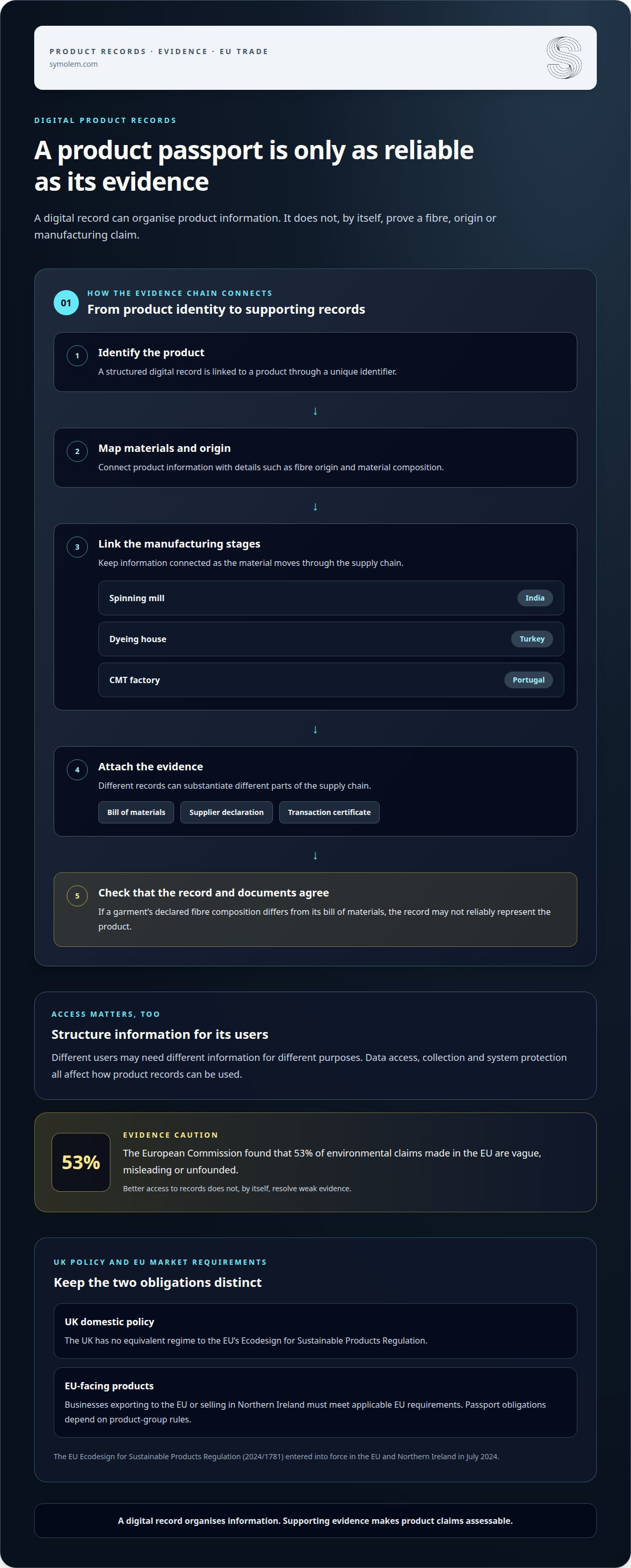
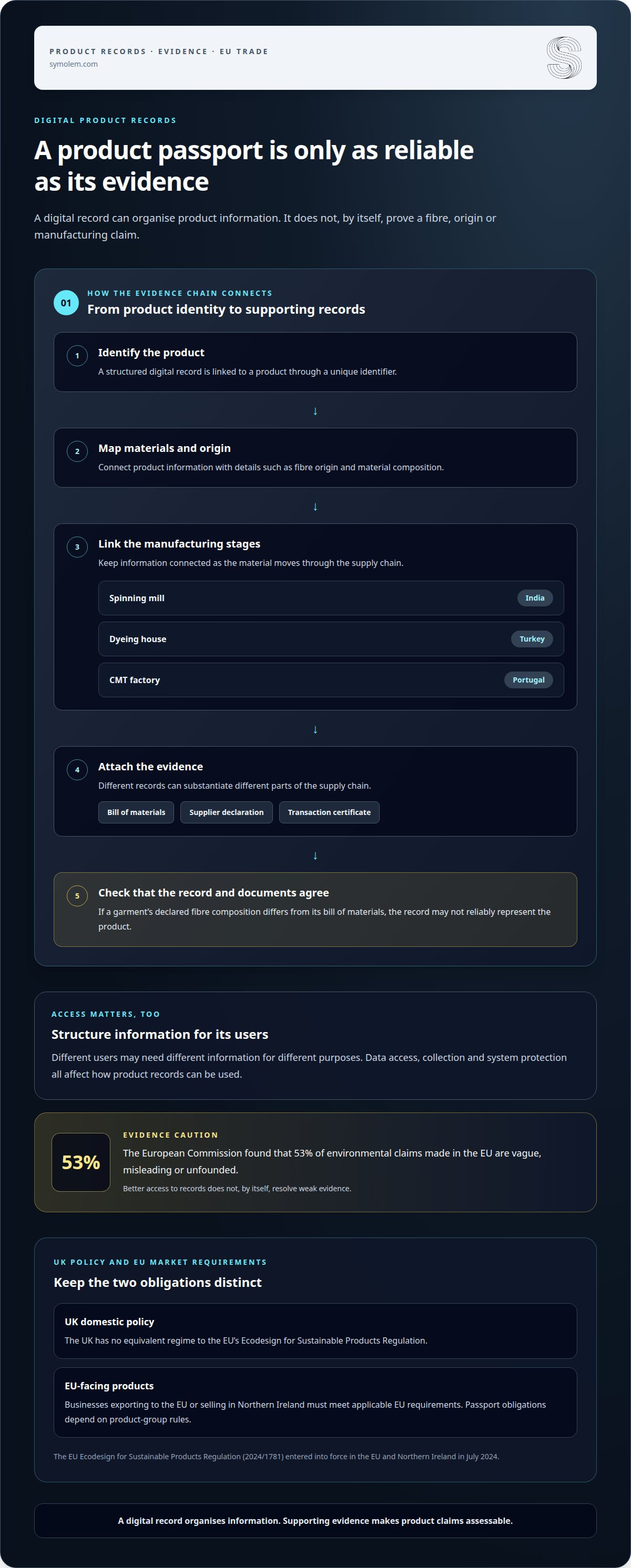
The underlying records are not abstract data fields. They can link a garment’s fibre origin, material composition and manufacturing stages, from a spinning mill in India to a dyeing house in Turkey and a CMT factory in Portugal. Their value depends on accessible evidence supporting each claim, not simply on displaying information behind a code.
This article explains what a passport may contain, how access can be structured and what EU product-group timelines could mean for UK businesses selling into EU markets. It also distinguishes current UK policy from rules already affecting products entering the EU, helping retailers and brands assess their exposure and prioritise evidence gaps.
Key Takeaways
- Separate UK policy from EU market obligations: a UK-wide passport requirement and the rules affecting EU-facing products are distinct issues.
- Understand how passport records can connect product identity with information on materials, origin and manufacturing.
- Assess data access as well as data collection: different users may need different information for different purposes.
- Track implementation by product group, since EU passport requirements follow sector-specific timelines.
- Map the evidence behind product claims across suppliers so gaps in origin, materials or production records are visible before they disrupt trade.
Table of Contents
What is a Digital Product Passport (DPP)?
A Digital Product Passport is a structured digital record linked to a product through a unique identifier. It can connect product information with evidence about materials, origin, manufacturing and lifecycle stages. According to the European Union, the Ecodesign for Sustainable Products Regulation, 2024/1781, entered into force in the EU and Northern Ireland in July 2024. The regulation establishes the framework for product-specific requirements, including passport information.
For UK businesses, the practical issue is market access. The UK has no equivalent regime to the EU ESPR framework, but businesses exporting to the EU or selling in Northern Ireland must meet applicable EU requirements. The regulation does not make a passport compulsory for every product immediately: requirements depend on product-group rules. Those rules determine when passport data must be provided and what information the records need to support.
Material traceability gives a passport operational value. A clothing brand may need to link a fibre claim to its source, then trace the material through processing and garment assembly. For example, records could connect cotton from a spinning mill in India to fabric processed at a dyeing house in Turkey and a garment completed at a CMT factory in Portugal. Information from each hand-off needs to stay linked to the relevant product.
A passport can organise this information, but a digital record alone does not prove a claim. Evidence must support the stated fibre composition, origin or manufacturing process and remain traceable to the product record. A bill of materials, supplier declaration or transaction certificate may substantiate different parts of the chain. If documents refer to different materials or production sites, the record cannot reliably represent the garment’s lifecycle.
UK sustainability and circular economy policy is developing through separate work. The UK government established an expert advisory group for circular economy strategy work in November 2024 and has introduced initiatives concerning sustainability reporting and Extended Producer Responsibility. These measures do not amount to an equivalent UK DPP regime. Businesses should therefore distinguish domestic policy developments from product requirements applying through EU or Northern Ireland market access.
Start preparation by mapping the product record to its evidence. Identify the product and material information the brand holds, then link each data point to the supplier or document that supports it. For a cotton shirt, this could mean tracing fibre composition to a bill of materials, origin information to supplier records and manufacturing stages to facility documentation. This reveals where information stops between supply-chain tiers. It also helps businesses prepare structured records that can be updated when product-group rules specify data fields, access conditions or timing.
Benefits and drawbacks of digital product records
Digital records can make product information easier to retrieve, compare and maintain across supply chains. Their usefulness depends on data quality, access controls and evidence supporting each claim.
Benefits of Product Passports
A product passport can bring relevant information together in a structured digital record, giving businesses a clearer basis for decisions. For example, a retailer reviewing a European apparel range could use consistent records to identify a product’s materials and the evidence behind its claims.
That visibility can reduce the effort of tracing information through separate files, supplier portals and email chains. A buyer could locate a garment’s fibre composition and related documents without piecing the supply chain together from disconnected records. Manufacturers can also reuse accurate information from a maintained digital record when responding to different trading partners.
Transparency has limits. A digital record can make a claim easier to find, but it cannot make an unsupported claim reliable. A stated recycled-fibre content, for example, still depends on records that substantiate the material and connect it to the product. The European Commission found that 53% of environmental claims made in the EU are vague, misleading or unfounded. Better access to records does not, by itself, resolve weak evidence.
Compliance and Trade Risks
Digital passport risks arise when sensitive supply-chain information is exposed, inaccurate records circulate or product data fails to meet applicable requirements. For UK businesses, the distinction between domestic policy and EU market obligations matters: a product record may support EU trade without creating a general UK passport duty.
Privacy and cybersecurity risks depend on what information is collected, who can access it and how systems are protected. A factory address or supplier relationship may be commercially sensitive; worker-level information could raise additional privacy concerns if included without a clear purpose. Weak access controls or compromised credentials could expose records to unauthorised people.
Compliance risk arises when a record conflicts with its supporting documents. If a garment’s declared fibre composition differs from its bill of materials, a retailer may face difficult onboarding decisions and the brand may face scrutiny over its claim. Incomplete or inaccessible records can also disrupt trade when buyers need evidence to assess products against market requirements.
These risks are possible, not automatic outcomes of using a passport. The UK could face a fragmented system if domestic digital records and EU-facing requirements use incompatible data structures. Businesses can reduce avoidable exposure by defining access rules, protecting supplier information and maintaining a clear link between each product claim and its evidence. Energy use by digital infrastructure is another consideration, as is the work of keeping records accurate when materials or suppliers change.
Digital Product Passport data access and registry
Passport access need not be the same for every user. Consumers, customs authorities and manufacturers may each need different information, so access rules shape how a digital record works in practice.
The European Commission’s central Digital Product Passport registry went live on 20 July 2026. The registry is an index of product identifiers, not a central store containing every passport’s full data. This distinction matters: the identifier helps locate a passport, while the product information remains available through its relevant data system.
Access is structured rather than universally open. Under the EU Ecodesign for Sustainable Products Regulation, Article 10 provides for regulated access to passport information, with product-group access levels set under Article 4. A consumer may need environmental or repair information, while an authority or supply-chain participant may require different records for its role.
Consumers can reach product information through a data carrier, such as a QR code or watermark. The EU approach places that carrier on the product where possible, allowing a scan to connect the item with its digital record. For example, a garment label could provide a route to relevant product information without printing every detail on the label.
The EU also provides for a public web portal where consumers can search and compare sustainability information in product passports. The portal has a different function from the registry: the registry indexes identifiers, while the portal supports public discovery. Clear access routes could help consumers find information relevant to product use, repair or disposal.
The UK has no equivalent regime to the EU ESPR framework. Its approach therefore differs from the EU’s product-group requirements, while UK businesses exporting to the EU or selling in Northern Ireland must meet applicable EU requirements. For some businesses, access to EU markets may make passport preparation a more immediate priority than domestic consumer demand.
No UK passport technology or interoperability standard is established in the information available here. The EU approach uses unique product identifiers and data carriers, while ISO/IEC 15459:2015 is identified as a standard for consistency and interoperability. A UK system seeking compatibility with EU-facing records could use aligned identifiers and structured, machine-readable data, but that remains a design consideration, not a confirmed UK requirement.
For fashion businesses, practical preparation means separating public consumer information from records intended for authorities or supply-chain partners. A QR code may provide product-level information, while underlying supplier documents require controlled access. This distinction supports transparency and circular use without making every commercial record visible to everyone.
Priority product groups and implementation timelines
EU implementation is product-specific, not governed by one deadline for every business. For UK companies, the EU timetable affects products entering that market; it does not establish a UK adoption date.
The EU timetable does not set a UK adoption date. UK businesses selling into the EU or Northern Ireland must prepare for applicable EU product-group requirements, while a domestic UK scheme would require a separate policy decision.
The European Commission’s first ESPR and Energy Labelling Working Plan was adopted on 16 April 2025 and covers 2025 to 2030. It prioritises iron and steel, aluminium, textiles and furniture for planning. Textiles therefore sit within the EU’s prioritisation work, but that does not create one universal passport deadline for every garment.
Product rules determine the sequence. A product-group delegated act sets relevant requirements, and businesses typically receive a transition period of around 18 months after its adoption before a passport becomes mandatory. A company should therefore monitor the relevant product group and the act’s adoption, rather than treating a broad EU target as its own compliance date.
EU passport requirements for priority sectors are expected from 2027, although timelines may change. Full implementation is expected by 2030, and the Commission’s first working plan is due for review in 2028. These milestones describe the EU programme, not confirmed dates for UK-wide adoption.
For textile businesses, the work starts before a QR code reaches a label. A brand may need documentation from fibre suppliers, fabric processors and garment manufacturers, then must maintain records as sourcing or product specifications change. If a retailer’s order includes several product groups, the rules that apply to each may follow different timetables.
That sequencing can be especially challenging for SMEs. They may need to chase suppliers, structure data and update systems while serving multiple markets, often without dedicated compliance teams. The workload depends on the product group, evidence already held, supplier responsiveness and the systems needed to link documents to each product record. Planning around these dependencies is more useful than assuming every product needs the same data at the same time.
A practical preparation sequence is to categorise products by relevant EU product group, identify available supplier evidence and map gaps against applicable requirements. For a clothing range, this could distinguish products with complete material documentation from those with incomplete fibre-origin evidence. That helps prioritise work as delegated acts and transition periods define the timetable.
Product origin, materials, and manufacturing information
A product passport’s value depends on the connection between an identifier, product information and supporting evidence. For clothing manufacturers, this means distinguishing a stated material claim from records that substantiate it across production processes.
Passport fields depend on the applicable product requirements. EU information can include a unique product identifier, compliance documentation, substances of concern, user manuals, safety instructions and disposal guidance. Product-group rules determine which information applies, so fashion businesses should not assume every data point applies in the same way to every garment.
For a cotton shirt, material information could identify the fibre composition and link it to relevant origin records. Manufacturing information can map the stages that turn fibre into fabric and fabric into a finished product. A bill of materials may describe the garment’s components, while supplier documents can support specific claims about materials or production.
That chain needs consistent product identification. A brand record for one shirt must not be confused with a similar style made from a different fabric or by a different supplier. A unique identifier links the relevant record to the product, and the documentation needs to match that record. If a supplier changes the composition, manufacturers need to update the associated information and evidence.
Origin claims need careful definition. A product may pass through several countries and facilities, with fibre production, spinning, dyeing and garment assembly taking place at different stages. A single country-of-origin statement cannot, on its own, describe every process or material source. A useful record specifies which origin information relates to each product component or manufacturing step.
The same discipline applies to environmental claims. A statement about recycled content, for example, should link to evidence supporting the material claim and identify the relevant product. A passport can make that information accessible, but the digital format does not validate the underlying document. Before approving purchase orders, retailers assessing a brand range need a clear link between claims, records and products.
The EU Battery Regulation provides a separate product example. According to the European Union, it requires a Digital Product Passport for industrial batteries with a capacity above 2 kWh. That threshold illustrates how requirements can be tied to product categories and specifications rather than applied through one generic record for all products.
For apparel, the practical action is to structure each product record around its identifier, composition, origin information, manufacturing stages and relevant compliance documents. Where supplier evidence is missing, the claim remains difficult to substantiate. Digital Product Passport verification helps structure and verify product compliance records for transfer into a chosen passport provider or retail onboarding system.
Symolem: Digital Passport information System
Symolem’s Digital Passport information System helps fashion businesses organise and verify product compliance records for passport readiness. It does not build or issue consumer passport apps; it supports the evidence behind product records and their transfer to a chosen provider or retail onboarding system.
For brands, Tier 1-3 Regulations Data Retrieval Advisory addresses missing supplier evidence, including chemical lab tests, fibre-origin documents, transaction certificates and packaging weights. For retailers and marketplaces, Symolem-ID screens third-party brand ranges before purchase orders are signed, identifying evidence gaps and compliance issues across textile regulations.
Turn to this work when product claims lack supporting records, supplier documentation is incomplete, or retail onboarding requires a clearer evidence trail. To discuss your product records and next steps, contact Symolem.
Build readiness around evidence, not assumptions
Whether the UK adopts digital product passports as a domestic requirement is only one part of the decision. Businesses can use this period to assign clear ownership of product information and establish how decisions will be documented as market rules develop. This creates a controlled basis for responding to change without treating a possible UK policy shift as settled.
For retailers and marketplaces, the priority is to identify compliance concerns before committing to third-party ranges. Screen third-party brand compliance before signing the PO. Explore Symolem-ID or run a free product scan.
For fashion brands, unresolved supplier evidence or social accounting requirements may need focused support. Need to retrieve missing Tier 1-3 supplier evidence or substantiate social accounting for retail stockists? Take the 5-minute Free Assessment or Book an Advisory Consultation.
Clear responsibilities and timely decisions help teams respond as requirements take shape.
Frequently Asked Questions
How should businesses prepare?
Start by assigning an owner to each product record and defining an update process. For every range, record who supplies each document, who approves changes and where the current version is stored. A useful test is to trace one product revision from its approved bill of materials to the final retail description. If a material is substituted, the process should identify which records and claims need review before the revised product is offered.
What are the requirements for businesses?
Requirements depend on the rules applying to the product and its destination market, not on a passport template chosen in isolation. Build a requirements matrix linking each product category to its applicable measure, responsible business function, required record and sales market. This helps sourcing teams distinguish a legal requirement from a buyer’s onboarding request, while recording why each data field is collected.
What are the risks of not being ready?
A readiness gap can lead to a poor decision: teams may approve a product using records for an earlier specification or a different supplier. For example, a replacement fabric may change the evidence supporting a product description while the previous file remains attached to the style. Version control, change approval and a retained audit trail help show which information informed a buying or market-access decision.
What is ESPR?
ESPR stands for the Ecodesign for Sustainable Products Regulation, the EU regulation establishing a framework for product-specific ecodesign measures and Digital Product Passports. Its requirements are introduced for particular product groups, rather than through one identical data specification for every item. The relevant question for a business is which product measure applies and what it requires, not simply whether a product is labelled “sustainable”.
What kind of information do I need to collect?
Build a collection plan around product identity, construction and evidence. For a jacket, this could include its style reference, bill of materials, component specifications, supplier records and documents supporting relevant claims. Record document ownership, issue date and product-version references to distinguish current evidence from obsolete files. Collect information required by applicable product rules rather than accumulating unrelated supplier data without a defined purpose.
What will it mean for businesses?
Digital product records can require coordination across teams that traditionally manage information separately. Product development may own specifications, sourcing may hold supplier documents, and compliance may assess whether evidence supports claims and market requirements. A named handover process reduces the risk of a product update reaching retail systems before its supporting record is reviewed. Businesses should also define who can amend records and who approves material changes.
Will the UK adopt digital product passports, and what is the government’s current position?
The UK has no equivalent regime to the EU ESPR framework, and the government’s call for evidence on digital product records did not itself establish a passport obligation. Businesses should distinguish government evidence-gathering from a binding legal requirement. Track formal policy decisions separately from retailer requests and EU market obligations, so an internal forecast is not mistaken for a statutory deadline.
What UK laws or regulations would require digital product passports?
No general UK law equivalent to the EU ESPR framework currently establishes a broad Digital Product Passport obligation. A specific UK measure could create requirements for a defined product or information type, but businesses should not infer a passport duty from general sustainability or packaging policy alone. Maintain a legal register recording the jurisdiction, product scope, responsible entity and effective requirement for each obligation relevant to the range.
Frequently Asked Questions
Talk to a consultant
Have a question about how this applies to your brand?
Ask Lavinia Fernandes directly. Tell us your products and markets and you get a straight answer on what applies and what to do first.