
Digital Product Passport Data Governance: Who Owns the Record
Compliance is a diagnostic reality, not an aspirational goal. While the EU Digital Product Passport Registry became operational on July 20, 2026, many organizations still mistake this mandate for a superficial reporting exercise rather than a fundamental shift in Digital Product Passport data governance. This transition requires a clinical approach to balancing the disclosure of 814 potential data fields against the absolute necessity of preserving proprietary manufacturing techniques. You're likely struggling with fragmented supply chain data and the very real risk that an ESPR audit could expose the technical innovations that define your competitive edge.
We'll show you how to master the structural data architecture and regulatory governance required to navigate ESPR compliance without compromising your systemic integrity. This guide unpacks the mechanics of a defensible data governance framework, providing a clear understanding of access permissions and the technical mapping needed for regulatory readiness. By moving beyond the narrative of simple sustainability, you'll learn to treat the DPP as a strategic architect would, building a system that is both compliant and competitively secure.
Key Takeaways
- Move from aspirational narratives to legally binding technical documentation by defining governance as a framework for systemic integrity and data security.
- Implement a Digital Product Passport data governance strategy that utilizes layered access permissions to protect proprietary chemical formulations and fiber blends from competitor scrutiny.
- Resolve the conflict between radical transparency and intellectual property protection through clinical data mapping and precise granularity controls.
- Ensure long-term regulatory readiness by mastering the 10-year data retention mandate and versioning protocols required for mandatory ESPR audits.
- Shift your organizational perspective from purchasing software to designing a structural architecture that secures your global market access for 2026 and beyond.
Beyond Transparency: Defining Data Governance in the DPP Era
Transparency is often confused with disclosure. In the context of the Digital Product Passport (DPP), transparency is merely the outcome; the engine is governance. Digital Product Passport data governance represents the systemic framework required to ensure data integrity, security, and accessibility across a product's entire lifecycle. It moves the conversation away from the soft-focus, aspirational sustainability stories that have historically characterized the fashion industry, replacing them with legally binding technical documentation. By 2026, this becomes a critical threshold for internal data sovereignty. Organizations that fail to establish these protocols now will find themselves locked out of the EU market as the infrastructure for verifying textile circularity claims moves from voluntary to mandatory.
The stakes are clinical. If your data cannot be verified, it does not exist in the eyes of the regulator. This shift demands a move from reactive data collection to proactive structural design. You're no longer just telling a story about a garment; you're maintaining a versioned, machine-readable record that must withstand the scrutiny of a formal audit. This requires a deep understanding of global value chains and the technical ability to map hundreds of interconnected data points without compromising the systemic integrity of your business operations.
The Legal Basis: ESPR (EU) 2024/1781
The Ecodesign for Sustainable Products Regulation (ESPR) is the legislative bedrock of this shift. It mandates that products sold within the EU carry a machine-readable record of their environmental footprint. While the overarching regulation is active, the sector-specific delegated acts for textiles are expected by 2027. These acts won't just suggest data points; they'll dictate mandatory data resolution and persistence. This means data must not only be accurate at the point of sale but must remain accessible and verifiable for at least a decade. The legal burden falls on the economic operator to prove every claim through a centralized, auditable registry.
Governance vs. Management
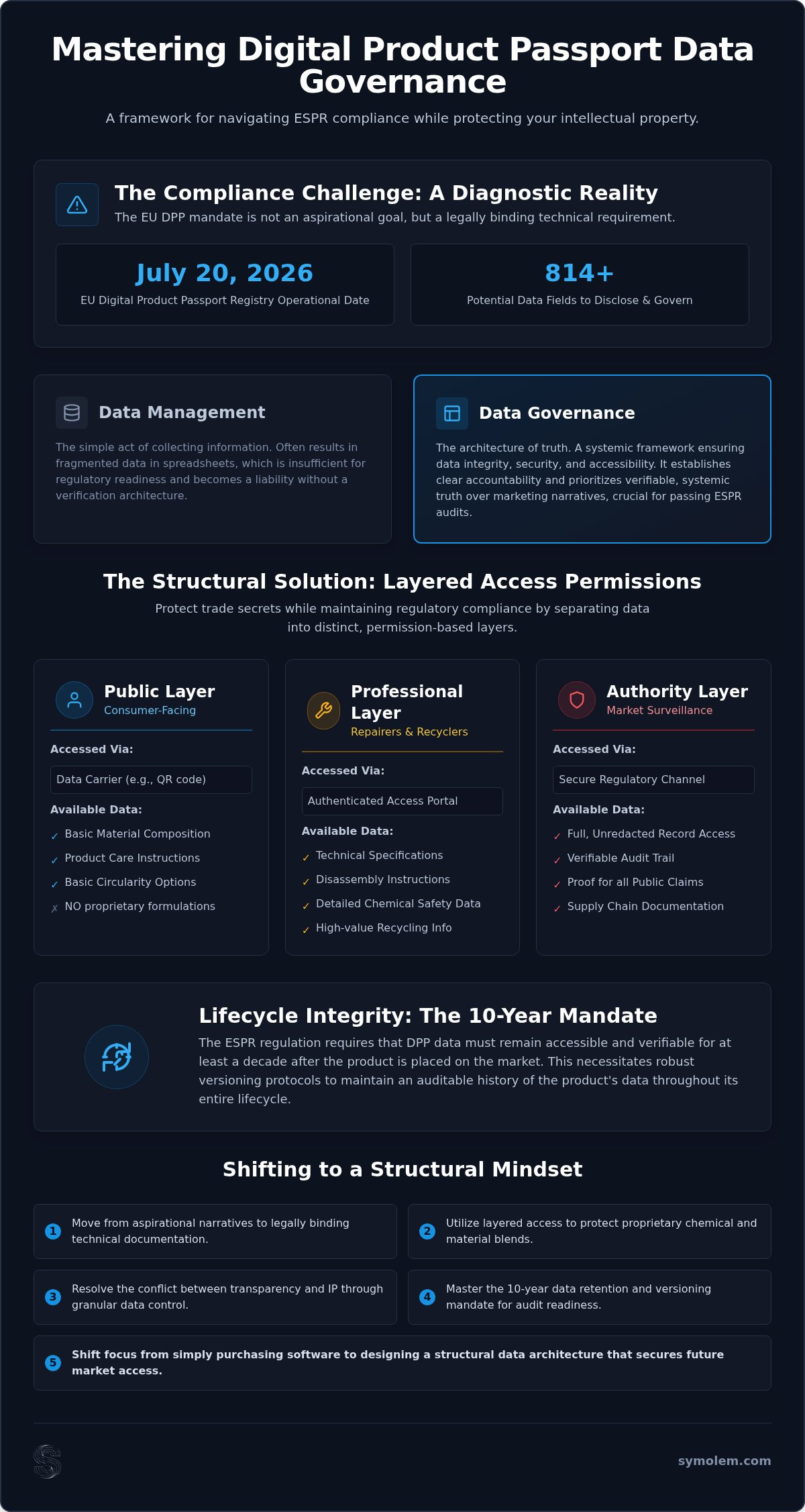
Data management is the act of collecting information. Governance is the architecture of truth. Simply gathering potential data fields into a spreadsheet is insufficient for regulatory readiness. Without a verification architecture, your data is a liability. Digital Product Passport data governance establishes clear accountability across the global textile value chain, ensuring that every tier of the supply chain provides verified evidence. It prioritizes systemic truth over marketing narrative. In an ESPR audit, a database will fail if it lacks the governance protocols to prove the origin, chemical composition, and reparability of the physical asset. Establishing this level of precision requires an ESPR Readiness Diagnostic to identify where structural failures in data collection exist before they become legal risks.
Structural Architecture: Access Layers and Data Granularity
Architecture dictates access. In a robust Digital Product Passport data governance framework, data isn't a monolithic block but a tiered system of permissions. Most brands fail here by treating the DPP as a simple QR code for marketing, ignoring the technical reality that different stakeholders require vastly different data depths. A consumer doesn't need to know the specific chemical CAS numbers of a dye lot, yet a textile recycler cannot safely process a garment without them. This structural complexity requires a clinical separation of data into distinct access layers to protect trade secrets while maintaining regulatory compliance.
Defining Access Permissions
- Public Layer: This is the consumer-facing interface, typically accessed via a data carrier. It provides essential information regarding material composition, care instructions, and basic circularity options.
- Professional Layer: Authenticated access for repairers, refurbishers, and recyclers. This layer contains technical specifications, disassembly instructions, and chemical safety data required for high-value recycling.
- Authority Layer: Full record access for market surveillance and tax authorities. This ensures that every claim made on the public label is backed by verifiable documentation within the EU Registry.
Granularity Framework for Textiles
Granularity is an economic decision. Choosing between model-level, batch-level, and instance-level data determines your long-term infrastructure costs and operational flexibility. Model-level data is the pragmatic choice for stable, high-volume identical SKUs where the environmental footprint is uniform. However, for brands utilizing recycled content, batch-level data becomes critical. It allows for tracking chemical variations or recycled lot percentages that differ between production runs. Instance-level data, which assigns a unique identifier to every individual garment, is often reserved for high-value items or circular business models like rental and resale where individual lifecycle updates are mandatory. Mapping these requirements early through an ESPR Readiness Diagnostic prevents the systemic failure of over-investing in unnecessary data serialization.
Systemic integrity relies on interoperability. Your data must flow naturally between internal ERP systems, third-party supply chain platforms, and the centralized EU infrastructure. Research initiatives like the CIRPASS-2 DPP Implementation emphasize that standardized data protocols are the only way to ensure this cross-border functionality. Without these standards, the data becomes siloed, stagnant, and ultimately useless for regulatory verification. The economic implications are stark; attempting to implement instance-level serialization for high-volume, low-margin apparel is an infrastructure failure that will erode profitability. Digital Product Passport data governance ensures that your technical architecture is built for this interconnected reality, prioritizing verification over mere collection.
The Intellectual Property Paradox: Managing Confidentiality
Transparency is a double-edged sword. While the EU mandates radical disclosure to facilitate circularity, the exposure of proprietary manufacturing techniques represents a systemic risk to competitive advantage. Digital Product Passport data governance must act as a filter, not just a conduit. It's the mechanism that balances the legal requirement for openness with the commercial necessity of secrecy. Without precise governance protocols, the very data intended to save the planet could facilitate industrial espionage, allowing competitors to reverse-engineer unique fiber blends or finishing processes with clinical precision.
The conflict is most visible in chemical formulations. A recycler needs to know if a garment contains restricted substances to ensure safe processing, but your unique dye recipe is a trade secret. Effective governance applies the "need-to-know" principle, ensuring that sensitive technical specifications remain locked within authenticated access layers. This isn't just about security; it's about the strategic design of your data architecture to ensure that regulatory compliance doesn't become a blueprint for your own obsolescence. It's a high-stakes game of data stratification where the wrong permission setting can lead to the permanent loss of intellectual sovereignty.
Stratifying Proprietary Information
Identifying what constitutes a trade secret is the first step in defensive architecture. In the textile supply chain, this often includes specific blend ratios, proprietary finishing chemicals, or the identity of sub-tier suppliers. Utilizing ESPR readiness diagnostics allows brands to map these 814+ potential data fields against their internal IP register. By establishing secure data silos, you ensure that only verified third parties with authenticated credentials can access specific datasets. This stratification prevents the leakage of high-value information into the public domain while still meeting the machine-readable requirements of the ESPR.
Legal Safeguards and Verification
Verification doesn't require public exposure. Independent auditors play a critical role in the Digital Product Passport data governance ecosystem by verifying sensitive data points without disclosing the underlying proprietary mechanics to the market. When authorities request Confidential Business Information (CBI), the governance framework must provide a clear protocol for how this data is transmitted, stored, and eventually purged. Managing the textile regulation impact on business models requires this level of diagnostic rigor. It's the only way to prove compliance with the EU's environmental mandates while protecting the structural integrity of your intellectual property from the risks of a transparent global market.
Lifecycle Integrity: Versioning, Retention, and Verification
Data is a living obligation. Within a rigorous Digital Product Passport data governance framework, a record isn't finished until the physical asset ceases to exist. Most brands treat the DPP as a static snapshot taken at the point of manufacture. This is a mistake. Regulatory reality demands a versioned lifecycle record that evolves alongside the product. Every material change, whether a repair, a refurbishment, or a component replacement, must be documented to maintain the systemic integrity of the passport. If the digital twin doesn't reflect the physical reality of the item in the secondary market, the governance system has failed.
Audit-readiness is the only metric that matters. It's not enough to possess data; you must be able to defend it under clinical scrutiny. This requires a shift from passive collection to active verification rigor. Every data point, from recycled content percentages to chemical safety certifications, must be backed by a defensible evidence chain. When an ESPR audit occurs, the regulator won't look for a story. They'll look for the underlying architecture that proves your claims are accurate, current, and verifiable across the entire global value chain.
Versioning Protocols
Versioning isn't a suggestion; it's a structural requirement for circularity. When a garment is repaired or refurbished, its environmental profile shifts, necessitating a new, resolvable version of the DPP. This isn't merely about updating a field in a database. It requires a protocol that interlinks successive versions to provide a complete, auditable trail of modifications. This ensures that recyclers at the end of the product's life have access to the most recent chemical and material data, rather than obsolete information from the initial production run. Maintaining this resolvable history is the only way to provide a complete circularity trail that satisfies EU market surveillance.
Retention and Archiving Strategy
The 10-year retention mandate isn't just a storage rule; it's a sovereignty requirement. Authorities demand that product records remain queryable and defensible long after the item leaves the shelf. This creates a technical burden for brands to maintain data integrity across a decade of IT migrations and supply chain shifts. Integrating verifying textile sustainability claims for ESPR into these retention schedules ensures that your archives are audit-ready at all times. Failure to archive retired records with this level of precision will lead to structural failures during market surveillance checks.
Archiving retired records requires more than a passive backup. It demands a system where the unique identifiers remain resolvable even if the manufacturer undergoes a merger or a platform migration. This is the mechanical reality of the Digital Product Passport data governance mandate. If an authority queries a passport for a garment produced in 2026 during a 2034 audit, the response must be instantaneous and verified. Your governance protocol must define who owns that data, who pays for its persistence, and how it remains accessible in a machine-readable format for the full duration of the legal mandate. Protect your long-term market access by establishing a Digital Product Passport Framework today.
From Data Mapping to Regulatory Readiness: The Symolem Framework
Compliance is a structural design problem, not a software purchase. While many organizations view the ESPR as a box to be checked through a SaaS subscription, the reality is that software alone cannot bridge the chasm between fragmented supplier records and a legally defensible digital record. Effective Digital Product Passport data governance requires an architectural overhaul of how information is captured, verified, and retained across the entire value chain. This is why choosing a DPP advisory partner for textiles is the first step toward 2026 readiness. You need a strategist who can map the technical mechanics of your supply chain before you ever commit to a technical platform.
The roadmap to 2026 demands a methodical, diagnostic approach that prioritizes systemic integrity over superficial narratives. It begins with a clinical audit of existing data flows to identify where proprietary information is at risk and where regulatory gaps exist. From there, the focus shifts to building a framework that ensures every one of the 814+ potential data fields is both accurate and audit-ready. This trajectory moves your organization from a state of reactive panic to a position of strategic market leadership, where compliance becomes a tool for operational excellence rather than a legal burden. By treating the DPP as a high-stakes business imperative, you secure your market access through technical precision.
The ESPR Readiness Diagnostic
The diagnostic phase is a clinical mapping of the 814+ potential technical data fields for your specific product portfolio. It identifies the structural gaps in your current supply chain data collection where information is missing, unverified, or dangerously exposed. By quantifying the economic cost of compliance against the catastrophic risk of non-compliance, we establish a clear business case for investment. This isn't about ethical sentiment; it's about the economic reality of maintaining access to the EU's single market through verified, machine-readable documentation. We identify exactly where your system fails so you can rebuild it with clinical accuracy.
Strategic Implementation
Designing a data governance architecture must be tailored to your specific business model and risk appetite. Integrating the challenges of Digital Product Passport implementation into your corporate risk register ensures that data sovereignty and IP protection are addressed at the board level. Securing long-term systemic integrity requires expert advisory that moves beyond generalist consulting. We provide the technical mapping and strategic oversight necessary to ensure your Digital Product Passport data governance framework remains robust, defensible, and fully integrated into your global operations. This is the only path to navigating the 2026 mandate without compromising the integrity of your manufacturing secrets.
Securing Market Access through Structural Design
The transition toward 2026 represents an uncompromising shift from voluntary storytelling to mandatory technical verification. Establishing a robust Digital Product Passport data governance framework is the only way to balance the radical transparency required by the EU with the clinical protection of your intellectual property. You now understand that data isn't a static snapshot; it's a versioned lifecycle record that requires a 10-year retention strategy to withstand the scrutiny of market surveillance authorities. This is a high-stakes business imperative that rewards precision and penalizes structural negligence.
Success in this landscape isn't found in a simple software purchase, but in the diagnostic mapping of 814+ technical data fields across your global value chain. Symolem provides the independent advisory and expertise in ESPR technical mapping needed to transform these regulatory burdens into a foundation for systemic integrity. By prioritizing economic reality over superficial narratives, you'll ensure your business remains both compliant and competitive. Secure your 2026 regulatory readiness with an ESPR Diagnostic. Building a defensible architecture today is the most decisive step you can take toward a resilient and transparent future.
Frequently Asked Questions
What exactly is Digital Product Passport data governance?
Digital Product Passport data governance is the structural architecture that defines how product information is collected, verified, and secured across its entire lifecycle. It moves beyond simple data management by establishing clear protocols for access permissions and data integrity. This framework ensures that every claim is backed by a defensible evidence chain, transforming the passport from a marketing asset into a legally binding technical record that satisfies EU regulatory scrutiny.
How long must DPP data be retained for textiles under EU law?
EU law mandates that Digital Product Passport data must remain accessible and resolvable for a minimum of 10 years after a product is placed on the market. This retention period applies even if the product is no longer being manufactured or sold. Companies must implement archiving strategies that ensure data persistence across a decade of potential IT infrastructure migrations and supply chain shifts, ensuring authorities can query the record at any time during this window.
Can competitors see my proprietary fabric blends through the DPP?
Not if your governance protocols utilize stratified access layers effectively. The public interface typically displays material composition and care instructions, while sensitive chemical formulations or proprietary fiber blends are restricted to authenticated professional or authority layers. Protecting these trade secrets requires a clinical mapping of data fields during the design phase to prevent the accidental leakage of intellectual property to unauthorized third parties.
What is the difference between model-level and instance-level data granularity?
Model-level granularity applies a single data record to all identical units of a specific SKU, which is the pragmatic choice for high-volume, uniform production. Instance-level granularity requires a unique identifier for every individual physical item, enabling the tracking of unique repair histories or rental lifecycles. While model-level is sufficient for most apparel, instance-level data is becoming a strategic requirement for circular business models where individual product tracking is mandatory.
Who is responsible for the accuracy of the data in the DPP?
The legal responsibility for data accuracy lies with the economic operator placing the product on the EU market. For brands manufacturing outside the EU, this obligation falls to the importer or an authorized representative. This accountability necessitates a rigorous verification architecture that audits supplier inputs before they're registered in the centralized EU Digital Product Passport Registry, as any inaccuracies can lead to immediate market exclusion.
Does the DPP require a specific technology like blockchain?
No specific underlying technology is mandated; however, the system must adhere to harmonized technical standards for interoperability. The European Commission prioritizes machine-readability and decentralized data storage over specific ledger technologies. Success depends on following the published CEN/CENELEC JTC 24 standards, such as EN 18216 and 18221, which ensure that data remains accessible and secure across diverse IT ecosystems without being locked into a single vendor's platform.
How does data governance prevent greenwashing in the textile industry?
Governance replaces aspirational narratives with legally binding technical documentation. By requiring specific, verified data points across 814+ potential fields, the system makes it impossible to claim circularity without providing a traceable evidence chain. This clinical approach to Digital Product Passport data governance forces brands to move away from superficial marketing and toward systemic environmental accountability, as every environmental claim must be backed by auditable data.
What happens if our supply chain data is incomplete by the 2026 deadline?
Products that do not meet the mandatory DPP requirements face immediate exclusion from the EU market. Incomplete data sets represent a structural failure in compliance that can lead to significant financial penalties and the mandatory destruction of non-compliant inventory. With the EU registry now operational as of July 20, 2026, the foundation for enforcement is active, and the 18-month transition periods for specific sectors leave no room for administrative delays or technical gaps.