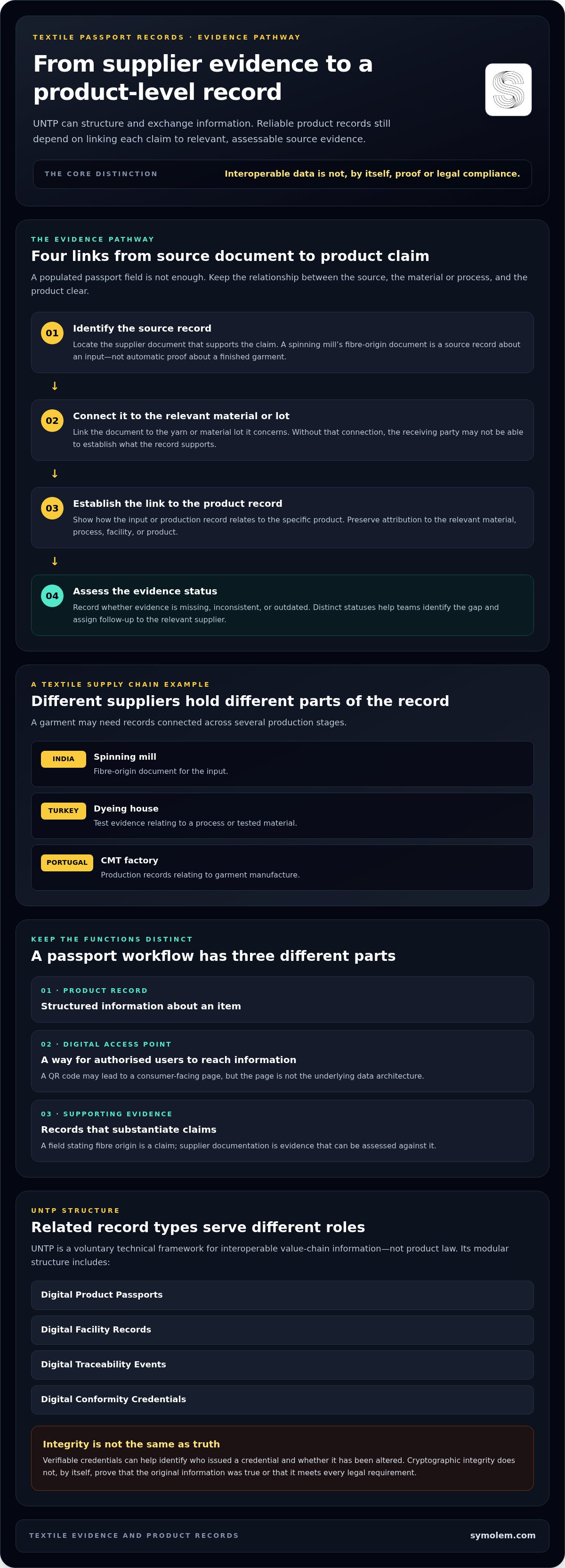
UNTP Digital Product Passports: A Strategic Explanation
A passport can be interoperable and still fail to meet legal requirements. For textile businesses, UNTP digital product passport explained in practical terms means understanding the distinction: UNTP is a technical protocol for structuring and exchanging data, not legislation that determines which product information must be disclosed. Applicable EU rules set those obligations, with the textile-specific ESPR delegated act expected in 2027.
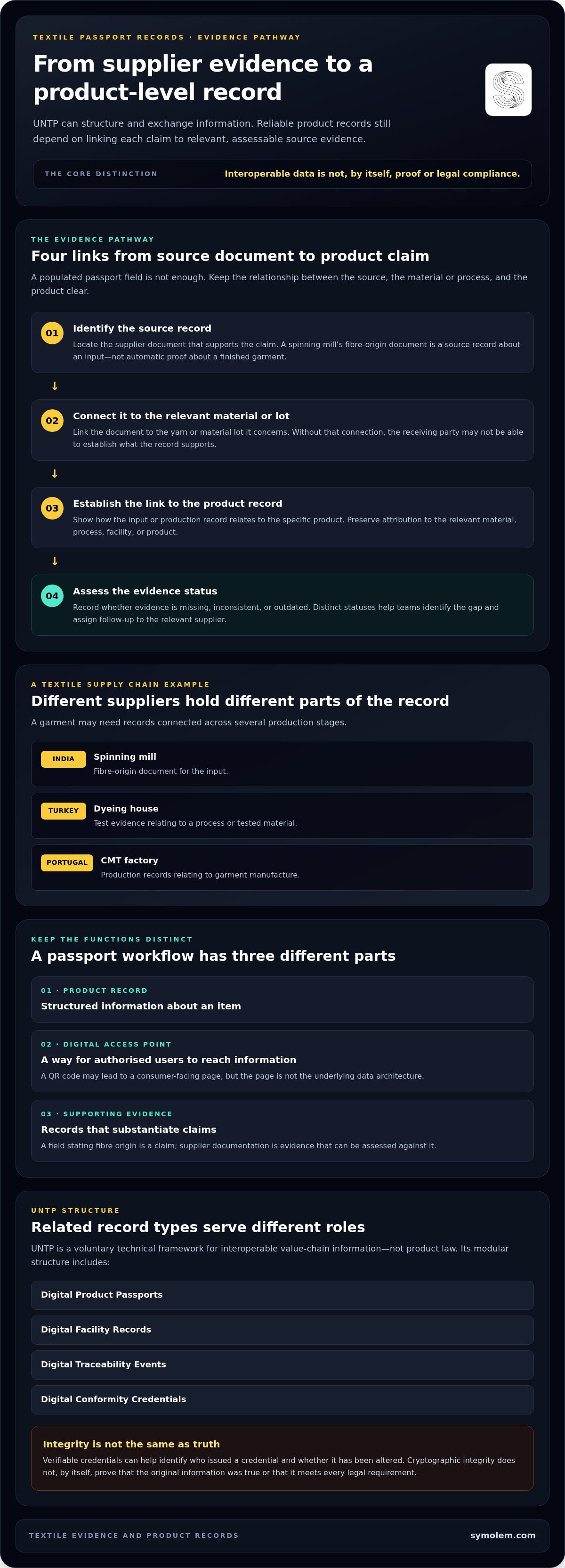
That distinction matters because passport readiness is not a software problem alone. A brand may hold a product record while fibre-origin evidence sits with a spinning mill in India, chemical test reports with a dyeing house in Turkey, and production details with a CMT factory in Portugal. Standardised exchange cannot make fragmented or unsupported records reliable.
This article explains what UNTP contributes, how it relates to EU DPP requirements, and what textile businesses need to operationalise: data ownership, evidence verification, and connections between supplier records and existing business systems. It also examines how retailers can identify evidence gaps before purchase orders are signed, while brands address missing information across Tier 1-3 suppliers.
Key Takeaways
- Distinguish the UNTP data-exchange framework from product-specific legal obligations before designing passport processes.
- The UNTP digital product passport explained here clarifies how product records, access points and supporting evidence serve different functions.
- Map product claims to their source records so teams can identify evidence gaps before data enters a passport workflow.
- Coordinate sourcing, compliance, purchasing and supplier responsibilities to make records usable across existing business systems.
- Retailers can screen evidence before purchase orders, while brands can verify product records before transferring them to a chosen DPP provider.
Table of Contents
- What Is a UNTP Digital Product Passport, and What Does It Actually Do?
- How UNTP Structures Product Information and Evidence Across a Textile Supply Chain
- UNTP vs EU DPP Requirements: Interoperability Is Not Legal Compliance
- How Textile Teams Can Prepare UNTP-Relevant Records Without Mistaking Data for Proof
- Where Symolem Fits: Verify Textile Evidence Before It Enters a Passport Workflow
What Is a UNTP Digital Product Passport, and What Does It Actually Do?
The United Nations Transparency Protocol (UNTP) is a voluntary technical framework for interoperable exchange of value-chain information, not a product law or a product-specific passport. That distinction is decisive: UNTP can help organise and transmit information, while applicable legislation determines which information businesses must provide and under what conditions.
In practical terms, “UNTP digital product passport explained” means separating three things that are often collapsed into one. A product record contains structured information about an item; a digital access point helps authorised users reach that information; and supporting evidence substantiates the claims in the record. A QR code may lead to a consumer-facing page, but the page is not the underlying data architecture, nor does the code itself establish that a claim is accurate.
How UNTP relates to a Digital Product Passport
A Digital Product Passport is structured product information made accessible to relevant value-chain actors. UNTP provides a framework for organising and exchanging information across systems, including passport information and related records such as traceability events and conformity credentials. It is not synonymous with a QR page or consumer application: those may present or provide access to information, while the protocol concerns how information can be represented and exchanged.
This architecture matters because a passport record is not evidence merely by existing. A field stating a fibre’s origin is a claim; the supporting supplier documentation is evidence that can be assessed against that claim. UNTP’s use of verifiable credentials can help identify who issued a credential and whether it has been altered, but cryptographic integrity does not, by itself, prove that the original information was true or that it meets every legal requirement.
Why textile businesses are paying attention
Textile evidence is distributed across commercial relationships and production stages. Consider a garment using yarn from a spinning mill in India, fabric processed by a dyeing house in Turkey, and cut, made and trimmed (CMT) at a factory in Portugal. The brand may need to connect product-level claims with records held by each supplier, while preserving attribution and determining which information can be shared with which business counterpart.
That is where a common exchange structure can help, but data movement alone is not the objective. If a supplier record cannot be linked to the relevant material, process, facility or product, the receiving party may be unable to establish what it supports. Teams therefore need to distinguish information that is merely present from information that is attributable, current and supported by evidence. A technical specification does not create compliance; nor does adopting a protocol replace the applicable product rules or prove that a particular record satisfies them.
How UNTP Structures Product Information and Evidence Across a Textile Supply Chain
Interoperability depends on preserving the relationship between a product, its attributes and the records that support them. A textile business therefore needs more than a set of fields exported into a passport: it needs a traceable path from the source document to the claim, and a way to identify which product or production stage that claim concerns.
In a UNTP-aligned model, identifiers help connect records to products, organisations or facilities. Product attributes express information about the item, while supporting documents and credentials provide a basis for assessing particular claims. UNTP’s modular structure includes Digital Product Passports, Digital Facility Records, Digital Traceability Events and Digital Conformity Credentials. These serve different roles; they should not be treated as interchangeable fields in one undifferentiated file.
From supplier evidence to a product-level record
Take a cotton jersey. A spinning mill’s fibre-origin document is a source record about the input; it is not automatically proof that a finished garment contains fibre from that source. The brand needs to connect the document to the relevant yarn or material lot, then establish how that input relates to the product record. Dyeing-house test evidence may support a claim about a process or tested material, while CMT production records relate to the garment’s manufacture.
Each record should be assessed for its status, not merely counted. Missing evidence means the expected source document is absent; inconsistent evidence means documents or product data conflict; outdated evidence may no longer represent the relevant product, supplier or production period. Recording these conditions distinctly helps teams assign follow-up to the right supplier and prevents an incomplete file from appearing complete simply because a passport field has been populated.
Exchange, access, and confidentiality
Different recipients have different operational needs. A retailer may need information to assess a product before a purchase order, while a supplier may need to share a production record without disclosing unrelated commercial details. UNTP supports structured information exchange, including the use of verifiable credentials, but businesses should not assume the protocol itself resolves every question of access, confidentiality or commercial entitlement.
In practice, access arrangements depend on how the exchange is implemented, the permissions applied by participating systems, and the agreements between parties. Teams should define who can view which record, for what purpose, and whether onward sharing is permitted. A credential can help preserve information about an issuer and the integrity of a record; it does not validate the underlying facts by itself or guarantee that restricted information stays confidential.
Passport interoperability can move and align records, but it cannot establish the truth of unsupported source data. That is the operational distinction behind a useful UNTP digital product passport explained for textile teams: standardised exchange improves how records connect, while evidence review determines whether the claims merit reliance. A textile evidence verification process can help structure and verify product records before they enter a chosen passport or retail onboarding workflow.
UNTP vs EU DPP Requirements: Interoperability Is Not Legal Compliance
UNTP and the EU Digital Product Passport address different questions. UNTP concerns how information can be structured and exchanged; EU obligations determine what information must be provided for products within scope and under which legal conditions. A UNTP-conformant record may support implementation, but conformity alone does not demonstrate compliance with every product-specific legal requirement.
Purpose: UNTP provides a technical framework for interoperable information exchange. The EU DPP is a regulatory mechanism for making prescribed product information accessible where applicable rules require it.
Authority: UNTP is a technical protocol, not legislation. EU DPP obligations derive from applicable EU law and the measures made under it.
Scope: UNTP is designed for cross-value-chain information exchange. EU requirements apply according to the relevant legislation and product-specific measures.
What neither establishes alone: UNTP conformity does not prove that source data is accurate or that legal duties are met. A passport record does not, by itself, establish the validity of every product claim.
What the technical framework can and cannot establish
Interoperability can make records more consistently structured and easier to exchange between systems, subject to the applicable UNTP specification. It does not settle whether a claim is supported by adequate evidence, whether a legal requirement applies to a particular product, or whether a business has fulfilled its responsibilities. Those are separate assessments.
The figures sometimes cited illustrate why counts need context: an EU-accepted passport sample carried 67 data points, while a UNTP-conformant passport can carry up to 236. These figures describe different examples and scopes. They are not universal statutory minimums, a direct comparison of equivalent datasets, or a complete checklist of textile information required by law.
How to read EU DPP obligations for textiles
The EU Ecodesign for Sustainable Products Regulation (ESPR) establishes a framework for product-specific requirements, which are set through measures applying to particular product groups. As of October 2026, the textile and apparel delegated act is expected in 2027; that timetable should not be mistaken for a complete, already applicable textile passport specification.
For any product, teams must distinguish a policy timetable from a binding requirement currently applicable to that product. Confirm the relevant legal instrument, product scope, and effective provisions against current primary sources before treating a data field as mandatory. This is the practical value of having UNTP digital product passport explained without conflating a technical exchange format with law: businesses can prepare structured records while separately assessing their actual legal obligations.
How Textile Teams Can Prepare UNTP-Relevant Records Without Mistaking Data for Proof
A new data architecture cannot repair a broken evidence chain. If fibre-origin documents are missing, a supplier name is unclear, or production records relate to a different order, formatting the available information into a passport only makes the gap easier to transmit. Preparation should therefore start with the products and claims, then establish what evidence exists, who owns it and what needs resolution.
- Identify the products. Define the product scope and connect each item to the relevant material and production records.
- Map the claims. List the origin, composition or process statements the business intends to make about each product.
- Locate source records. Trace each claim to the supplier, facility, document or test record that may support it.
- Assess the gaps. Categorise records as available, missing, inconsistent or requiring review, and assign follow-up.
- Structure for exchange. Organise verified information in a consistent format for the chosen business systems or passport workflow.
Map claims to accountable sources
For a fibre-origin claim, a spinning mill’s document is a source record; the brand’s statement about the finished garment is a product-level claim that must be connected to that source. Sourcing teams can help identify suppliers and transaction context, while compliance teams assess the claim and evidence, and product or purchasing teams maintain the relevant product mapping. The precise allocation should reflect the business’s own responsibilities and supplier arrangements.
If a record is absent, contradictory or cannot be linked to the relevant product or material, flag it for retrieval or resolution. Don’t treat an empty field as proof of a claim, or a document in a shared folder as automatically applicable.
Prepare records for structured exchange
Before transferring information, categorise it by product, supplier tier, claim and record status. Keep evidence verification distinct from data formatting and from the implementation choices of a passport provider. This separation helps teams avoid treating a technically complete record as an evidentially sound one, and makes it clearer where a supplier response, internal decision or legal assessment is still required.
Purchasing may need an evidence-gap view before commitment; compliance may need a substantiation record; sourcing may need to coordinate document retrieval across suppliers. A shared product record can support those needs without forcing every business into one universal workflow. For field-level detail, consult the relevant textile DPP data requirements guidance; the exact fields depend on the applicable requirements and product scope.
For fashion brands, retailers and marketplaces, the pre-order stage is a practical point to surface unresolved records before commercial commitment. Assess textile evidence gaps before purchase orders are committed so teams can prioritise retrieval, verification and record preparation before passport data is exchanged.
Where Symolem Fits: Verify Textile Evidence Before It Enters a Passport Workflow
A passport workflow is only as reliable as the records it receives. Symolem is a product compliance intelligence platform and evidence advisory for fashion, footwear, apparel and textiles. It audits, verifies and structures product compliance records, then assigns a Verification ID to prepare them for transfer to a chosen DPP provider or retail onboarding system. It does not issue consumer Digital Product Passports.
For textile operators, the practical meaning of UNTP digital product passport explained is this: structured exchange and evidence verification are connected tasks, but they are not the same task. A data field can be correctly formatted while its supporting document is missing, inconsistent or unrelated to the product. Reviewing records before transfer helps expose those weaknesses rather than simply carrying them into another system.
For retailers and marketplaces managing third-party ranges
Retailers often assess apparel ranges without controlling the supplier records behind each product. Symolem-ID screens third-party brand ranges against 50+ global textile regulations in seconds and provides per-SKU statuses of Cleared, Blocked or Missing Evidence before purchase orders are signed. That distinction gives buying and compliance teams a clearer basis for identifying evidence gaps before commercial commitment, rather than treating a passport record as a substitute for pre-PO checks.
Screen third-party brand compliance before signing the PO. Explore Symolem-ID or run a free product scan.
For brands and manufacturers facing supplier evidence gaps
For brands, the operational constraint is often evidence retrieval across supplier tiers. Symolem Advisory undertakes forensic retrieval of chemical lab tests, fibre-origin documentation, transaction certificates and packaging weights across Tier 1-3 suppliers. This is distinct from structuring product data: the work is to locate and assess records that can support product information before it is prepared for exchange.
Social accounting is a separate advisory workstream. It supports auditable evidence on worker welfare, fair wages and human rights due diligence, helping brands organise records for scrutiny by retail stockists and other relevant parties. Both workstreams address evidence quality, but they concern different records and responsibilities.
Once records have been reviewed, Symolem can structure product information and assign a Verification ID for onward transfer to a selected DPP provider or retail onboarding system. That does not replace the provider’s implementation or the business’s responsibility to assess applicable legal obligations. It creates a clearer hand-off between evidence review and the systems that exchange or present product information.
Need to retrieve missing Tier 1-3 supplier evidence or substantiate social accounting for retail stockists? Take the 5-minute Free Assessment or Book an Advisory Consultation.
Make Evidence Readiness the Next Operational Priority
Passport preparation is a business-control decision, not simply a data-formatting exercise. Teams that assign ownership for product claims, supplier records and unresolved gaps can make implementation decisions on a firmer basis, while avoiding the assumption that a structured record is automatically verified or legally sufficient. That is the practical value of having UNTP digital product passport explained in operational terms: it helps clarify where information exchange fits, and where evidence review and legal assessment remain essential.
Retailers and marketplaces can bring evidence gaps into view before purchase orders are signed. Screen third-party brand compliance before signing the PO. Explore Symolem-ID or run a free product scan.
Fashion brands can address supplier evidence retrieval and auditable social accounting as distinct readiness priorities. Need to retrieve missing Tier 1-3 supplier evidence or substantiate social accounting for retail stockists? Take the 5-minute Free Assessment or Book an Advisory Consultation.
Build the evidence foundation first, and your next passport decisions can be more controlled, accountable and ready for scrutiny.
Frequently Asked Questions
Is UNTP legally mandatory for textile businesses?
No. UNTP is a technical framework, not a product-specific law, so adopting it is not itself a legal duty. Whether a textile product must have a DPP depends on the legislation and product measures that apply to it; other product obligations may still apply regardless of UNTP use. The EU timetable identifies textiles for a product-specific measure, but a planned timetable is not the same as a requirement already in force. Check current primary legal sources for the product concerned.
What is the difference between UNTP and an EU Digital Product Passport?
UNTP concerns the technical structuring and exchange of product information, subject to the current specification. An EU DPP is part of the regulatory framework for product information where applicable EU measures require it. They can relate: a technical framework may support the exchange of information used in a passport. They aren't interchangeable, however. For a practical UNTP digital product passport explained, keep the protocol separate from the legal instrument that defines obligations.
Can a UNTP-conformant passport prove that textile supplier data is accurate?
No. Conformance can support consistent representation and exchange, but it cannot establish that source information is truthful, complete or current. For example, a supplier document stating fibre origin needs to be assessed for its issuer, scope, date and connection to the relevant material before a brand relies on it. Keep unresolved discrepancies visible, record who is responsible for review, and avoid presenting an unverified statement as substantiated.
What information should a textile business prepare for a UNTP-aligned passport?
There is no universal field list that applies to every textile product or implementation. Depending on the applicable rules and use case, teams may need product identifiers, material information, origin-related records and documents supporting product claims. First determine the product scope and relevant requirements, then map each field to its source and status. The separate textile DPP data requirements resource can provide field-level guidance, but it doesn't replace a product-specific legal assessment.
How does UNTP relate to GS1 Digital Link?
They address different architectural concerns and shouldn't be treated as substitutes without checking their current specifications. UNTP provides a framework for structuring and exchanging value-chain information; GS1 Digital Link relates to expressing GS1 identifiers in web-address form so they can connect to online information. How they work together depends on the implementation. For the resolver-specific explanation, see the dedicated GS1 Digital Link DPP resolver article.
Does adopting UNTP mean a company must build its own consumer passport app?
No. A data-exchange framework and a consumer-facing interface are separate implementation choices. A business can prepare product records for transfer to a selected DPP provider or retail onboarding system rather than building an app. Symolem audits evidence, verifies and structures product records, and assigns a Verification ID for transfer. It doesn't build or issue consumer-facing DPP applications.
What should a retailer do when a supplier cannot provide complete passport evidence?
Record the missing item as a gap, not as verified information. Identify the affected product, specify which supporting record is required, and assign follow-up before purchase-order commitment. Symolem-ID provides per-SKU statuses of Cleared, Blocked or Missing Evidence, helping teams distinguish products with unresolved records from those ready for review. A passport format can organise available information, but it cannot retrieve a supplier document that was never provided.