UK vs EU Digital Product Passport: ESPR Compliance Guide
UK establishment is no shield from EU product rules. If your fashion brand places products on the EU market, the ESPR can apply regardless of where your business is based. That’s the central issue behind UK vs EU digital product passport requirements: does ESPR apply to UK brands selling into the EU? Yes, but responsibilities and timing depend on the product, your supply-chain role, and the rules in force.
The distinction matters. The ESPR framework is in force, but detailed requirements for textile Digital Product Passports will be set through a product-specific delegated act. Treating every potential DPP requirement as settled law creates confusion; treating the issue as distant creates exposure. EU importers may have primary legal responsibility for products made outside the EU, while relying on UK suppliers to provide the data and evidence needed to demonstrate compliance.
This guide explains how market placement determines exposure, how responsibilities can differ between brands and importers, and what textile data systems to prepare. It also sets out a proportionate readiness plan that separates current obligations from future requirements, helping you base your EU market-access strategy on evidence rather than assumptions.
Key Takeaways
- UK vs EU digital product passport requirements: does ESPR apply to UK brands selling into the EU? Assess exposure by where products are placed on the market, not just where the brand is established.
- Map each supply-chain role against the relevant ESPR provision and product measure. Responsibilities can differ between manufacturers, importers, representatives, distributors, and fulfilment providers.
- Separate the enacted EU framework from UK digital product policy developments. Proposed textile passport fields are not settled requirements.
- Begin readiness with a product scope, role map, and inventory of existing supplier data and supporting evidence.
- Build a roadmap that assigns data governance responsibilities and tracks regulatory measures, so preparation can progress without overcommitting to draft requirements.
Table of Contents
- Does ESPR Apply to UK Brands Selling Products in the EU?
- Which UK-to-EU Supply-Chain Role Carries ESPR Responsibilities?
- How Do EU DPP Rules Differ from UK Digital Product Requirements?
- What Should UK Fashion Brands Prepare Before Textile DPP Rules Settle?
- Turn UK-to-EU ESPR Exposure into a Defensible DPP Roadmap
Does ESPR Apply to UK Brands Selling Products in the EU?
Yes. UK establishment alone doesn’t exempt products placed on the EU market. The key question is whether the product enters the EU market, not where the brand is registered or operates. The search for “UK vs EU digital product passport requirements” often comes down to this jurisdictional distinction. The actual assessment should focus on destination, product category, and applicable rules.
“Placing on the market” generally means making a product available for the first time on the EU market as part of a commercial activity, whether supplied for payment or free. A UK brand may enter scope through different routes, such as direct sales to EU customers or supply through an EU-based business. The route can affect which economic operators have particular responsibilities, but it doesn’t remove the need to assess the product’s EU-market status.
ESPR is a framework regulation that entered into force on 18 July 2024. It establishes the structure for product sustainability rules, with specific requirements introduced through product measures, including delegated acts. The framework is in force, but requirements aren’t identical for every product. The fields and duties for a textile Digital Product Passport depend on the applicable EU measure. The EU Digital Product Passport provides broader context, but product-level compliance decisions should be based on the relevant legal measure.
Quick scope test
- Destination market: Where is the product first made available?
- Product category: Is a product-specific ESPR measure applicable?
- Economic role: What role does each business play in the supply chain?
- Applicable measure: Which requirements are currently in force for that product?
When does a UK fashion brand enter ESPR scope?
A brand’s UK address and a product’s regulatory status are separate questions. If products are offered or supplied in the EU, assess them against the rules for that category and route to market. Don’t assume every ESPR obligation applies to every garment today. First identify the relevant measure, then map the duties it establishes to each business role.
Does ESPR apply to UK-only sales or Northern Ireland?
Products sold only in Great Britain aren’t placed on the EU market solely because the brand also sells in the UK. Assess those sales under the applicable Great Britain rules. Northern Ireland requires separate treatment: under current Windsor Framework arrangements, EU product requirements apply to goods sold there. For UK vs EU digital product passport requirements, the route and destination remain central. Check the rules relevant to the product and consult the EU regulatory landscape overview for wider legislative context.
Which UK-to-EU Supply-Chain Role Carries ESPR Responsibilities?
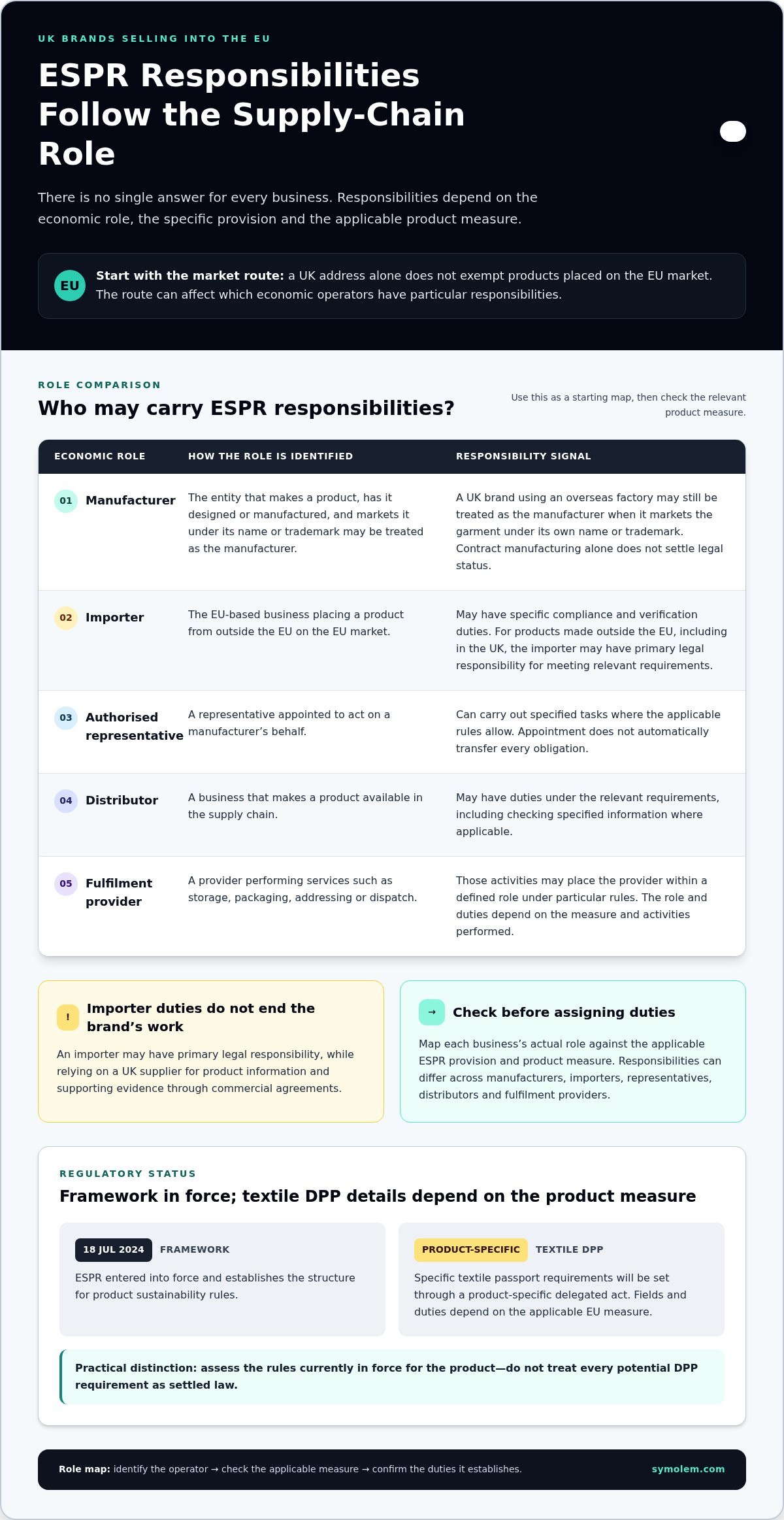
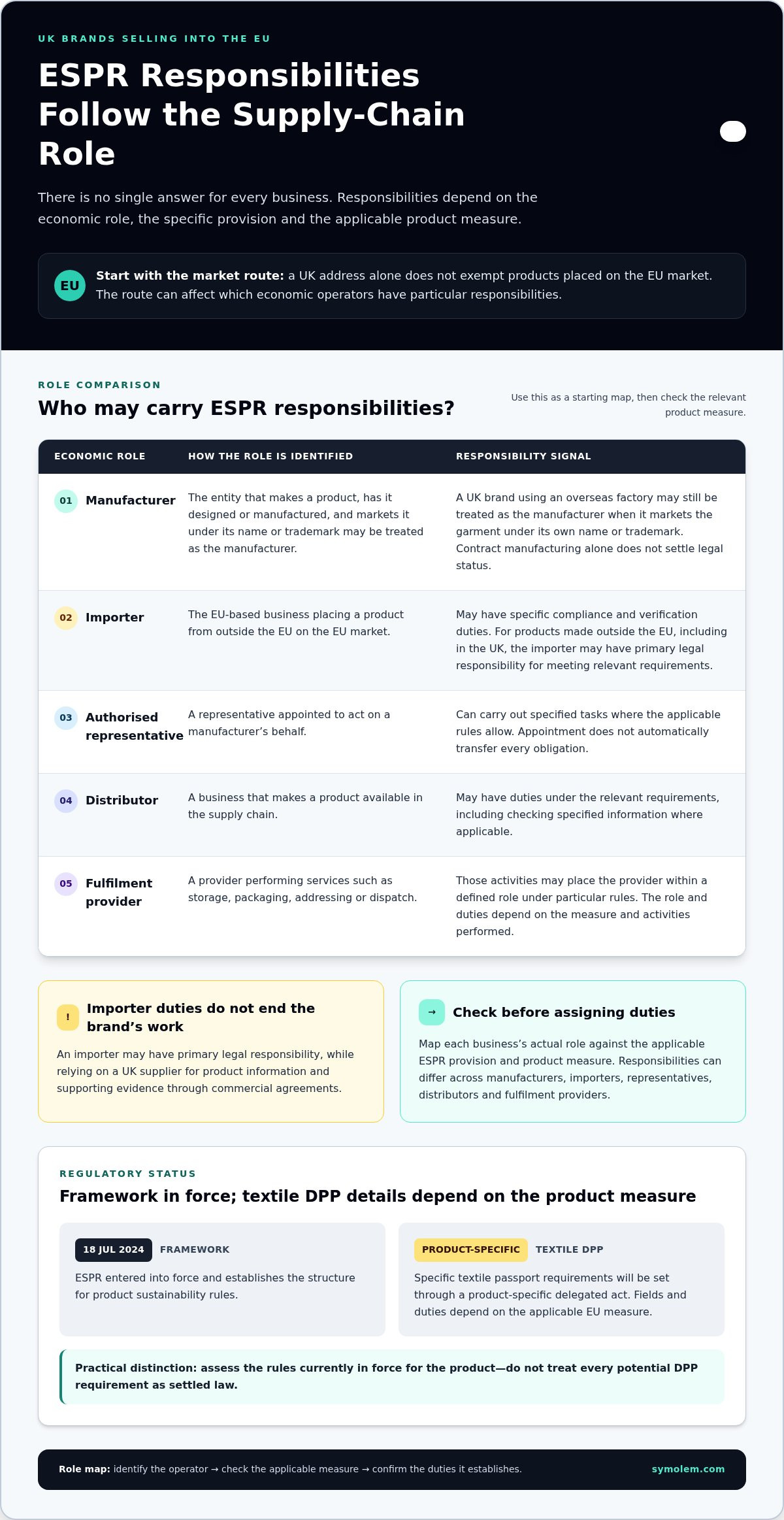
There isn’t one universal answer. ESPR responsibilities attach to defined economic roles and depend on the specific provision and product measure. The importer of a product manufactured outside the EU, including in the UK, may have primary legal responsibility for meeting relevant requirements. That doesn’t mean the brand’s work ends there: importers may rely on UK suppliers to provide product information and supporting evidence through commercial agreements.
Use this role map as a starting point, then check the applicable measure:
- Manufacturer: The entity that makes a product, has it designed or manufactured, and markets it under its name or trademark may be treated as the manufacturer.
- Importer: The EU-based business placing a product from outside the EU on the EU market may have specific compliance and verification duties.
- Authorised representative: An appointed representative can carry out specified tasks on a manufacturer’s behalf where the applicable rules allow. Appointment doesn’t automatically transfer every obligation.
- Distributor: A business making a product available in the supply chain may have duties under the relevant requirements, including checking specified information where applicable.
- Fulfilment provider: Storage, packaging, addressing, or dispatch services may place a provider within a defined role under particular rules. The role and duties depend on the measure and activities performed.
Who is the manufacturer when a UK brand uses an overseas factory?
Contract manufacturing and legal manufacturer status aren’t necessarily the same. If a UK brand has a garment made by an overseas factory and markets it under its own name or trademark, the brand may be treated as the manufacturer under relevant product rules. The factory’s production role doesn’t, by itself, settle the legal allocation. Review the applicable definitions alongside the ESPR responsible operator and obligations guide before assigning duties.
What changes when an EU importer or distributor is involved?
Consider a UK brand selling own-name garments through an EU importer. The importer may have specified legal duties, while the brand still needs to organise the information and supplier evidence that support those duties. A distributor’s role is different and may involve separate checks. Neither commercial practice nor a contract alone proves the statutory allocation.
Separate two workstreams: product information, which must be presented or made available as the applicable measure requires, and supplier evidence, which substantiates claims about materials, production, or other product attributes. Define who collects each record, who validates it, who transmits it across company boundaries, and who retains it. The exact assignment depends on the applicable provisions.
For brands asking, “UK vs EU digital product passport requirements: does ESPR apply to UK brands selling into the EU?”, role mapping is the next practical step. An ESPR Readiness Diagnostic can help structure that assessment around products, actors, and evidence flows.
How Do EU DPP Rules Differ from UK Digital Product Requirements?
The EU has an enacted framework; the UK is exploring policy options. The Ecodesign for Sustainable Products Regulation (ESPR) entered into force on 18 July 2024 and establishes a framework for Digital Product Passports (DPPs), but it doesn’t impose identical passport requirements on every product group. Product-specific measures determine which products need a passport, what it must contain, and how it must be applied.
For UK vs EU digital product passport requirements, the key question is whether ESPR applies to UK brands selling into the EU. Products placed on the EU market may be subject to relevant EU measures regardless of the brand’s UK location. By contrast, the UK’s Digital Product Records policy is still at the evidence-gathering stage. The UK Government launched a call for evidence on 27 July 2026 to explore the possible implementation of Digital Product Records. That is policy exploration, not a binding UK DPP mandate.
What does ESPR establish for Digital Product Passports?
ESPR provides the legal framework for product passports, including provisions for digital access to product information and the development of product-specific rules. Measures such as delegated acts set those rules, so the textile passport’s exact data fields and duties depend on the measure that applies. The EU DPP registry became operational on 20 July 2026, but its operation doesn’t mean every product category already has an active passport obligation.
A QR code, data carrier, or software feature isn’t, by itself, proof of legal compliance. A technical system can help display or organise information, but compliance depends on whether the relevant product measure’s requirements are met, including applicable content, access, and data integrity provisions.
Is the UK introducing an equivalent Digital Product Passport mandate?
As of October 2026, the UK has not adopted an equivalent DPP mandate. Its call for evidence signals that the Government is examining Digital Product Records, but consultation and policy development aren’t the same as enacted law. Don’t describe the UK and EU regimes as aligned or divergent on detailed obligations without current evidence. The UK policy position may develop separately.
Keep four layers distinct in readiness planning: binding legal requirements, voluntary standards, technical architectures, and software functions. A standard or system can support implementation, but neither automatically creates nor satisfies a legal duty. For textiles, track the EU delegated act and its transition period: adoption is expected between 2026 and 2027, followed by at least 18 months before mandatory compliance. Treat the timing and final requirements as measure-dependent, not as a settled date for every brand.
What Should UK Fashion Brands Prepare Before Textile DPP Rules Settle?
Prepare the data structure, not a speculative final passport. A proportionate readiness plan helps UK fashion brands respond to applicable EU requirements while avoiding costly system changes based on draft fields that may change.
Start with a defined sequence:
- Scope products: Identify product categories and variants sold into the EU, including SKU-level differences in material composition or construction.
- Map roles: Record which entities act as manufacturer, importer, distributor, or other relevant operator for each route to market.
- Inventory data: Identify existing product records, supplier information, and evidence already held across the business.
- Trace evidence: Connect each material or product claim to its source, such as a supplier record or supporting document, and flag gaps.
- Assign governance: Name data owners, validation steps, update responsibilities, and controls for maintaining records.
Which product and supplier data should teams map first?
Build an inventory around identifiers, product variants, materials, supplier tiers, and available supporting evidence. For each field, record its source, internal owner, validation status, and update frequency. This makes known values distinct from assumptions and highlights where a supplier response or regulatory interpretation is still outstanding.
Keep evidence provenance with the data. For example, a fibre-composition value should link to the record or document that supports it, not appear as an isolated spreadsheet entry. Treat potential textile DPP fields as planning categories, not mandatory requirements until the applicable EU measure establishes them.
How can brands prepare without overbuilding for draft rules?
Prioritise reusable, interoperable records and traceable evidence before commissioning product-specific system changes. Maintain a change log linking each new EU measure to affected products, data fields, suppliers, and processes. When a requirement is confirmed, teams can identify gaps and revise the relevant workflow instead of rebuilding the entire data model.
Timing needs active verification. The textile-specific delegated act is expected to be adopted between 2026 and 2027, with a transition period of at least 18 months. That points to a later compliance window than 2027 alone, but the final adoption date, transition provisions, and technical requirements must be checked against current EU measures.
For UK vs EU digital product passport requirements, readiness begins with a clear product scope and evidence map, not a premature technology decision. Explore Symolem’s ESPR Readiness Diagnostic to assess regulatory exposure, roles, and product-data gaps.
Turn UK-to-EU ESPR Exposure into a Defensible DPP Roadmap
A defensible roadmap connects legal interpretation to product records and operational ownership. It shouldn’t start with a technology purchase. First establish which products are exposed, which rules apply, who is accountable, and what evidence can support each requirement.
What should a practical compliance roadmap contain?
Build the roadmap around affected product groups and named owners. For each relevant requirement, identify the product records and supporting evidence it depends on, the teams or suppliers responsible for them, and the process for reviewing and updating them. This makes missing information visible without confusing an incomplete record with a confirmed legal breach.
A controlled review process is essential. Record the source and status of each regulatory requirement, then set review triggers for adopted delegated acts, official guidance, or changes to product scope. When a measure is adopted, assess its effect on product variants, supplier data, evidence requirements, and existing workflows before changing systems or assigning new tasks.
- Establish scope: Identify EU-bound products and the measures that may apply.
- Allocate roles: Document the relevant economic operators and accountable internal owners.
- Assess data: Compare current product and supplier records with applicable requirements.
- Govern evidence: Track provenance, validation, ownership, and updates.
- Monitor measures: Review regulatory developments and record decisions about their impact.
This is where policy interpretation, technical data mapping, and implementation planning intersect. Legal analysis identifies the applicable duties; data mapping connects those duties to specific product information and evidence; implementation planning determines who will collect, validate, maintain, and share it. If any link is missing, a passport architecture may look complete while the underlying compliance record remains weak.
When can specialist ESPR and DPP advisory add value?
A readiness diagnostic can identify gaps across product scope, supply-chain roles, and existing data, then help prioritise what needs resolving first. DPP frameworks translate applicable obligations into a workable structure for data, evidence, and governance. The goal isn’t to treat draft requirements as settled, but to build a system that can adapt as relevant measures are adopted.
For teams asking, “UK vs EU digital product passport requirements: does ESPR apply to UK brands selling into the EU?”, the answer becomes actionable when exposure is connected to clear owners, reliable evidence, and a monitored implementation plan. Symolem’s ESPR readiness and DPP advisory work can support that process. Discuss a tailored regulatory-readiness roadmap with Symolem.
Make Your EU Market-Access Plan DPP-Ready
For UK fashion brands, EU market placement determines ESPR exposure, while product measures and supply-chain roles shape the specific obligations. The practical question, “UK vs EU digital product passport requirements: does ESPR apply to UK brands selling into the EU?”, has a direct answer: UK establishment alone does not exempt products placed on the EU market.
Exposure is only the starting point. Separate current requirements from future textile-specific rules, map who carries each responsibility, and connect product information to traceable supplier evidence. A structured roadmap helps teams prepare without treating proposals as settled law or investing prematurely in the wrong solution.
Symolem is an independent advisory firm focused on textiles, circularity, sustainability, climate impact, and policy. Its ESPR Readiness Diagnostics and Digital Product Passport frameworks help translate regulatory analysis into product-data and governance priorities. Map your ESPR exposure and build a defensible DPP roadmap with Symolem.
Start with a clear scope, accountable owners, and evidence you can stand behind. That foundation makes the next regulatory change easier to assess and act on.
Frequently Asked Questions
Does ESPR apply to products sold only in Great Britain?
Not simply because they’re sold in Great Britain. Products supplied only in England, Scotland, and Wales aren’t placed on the EU market on that basis alone, so assess them under the applicable Great Britain rules. If the same products are also offered or supplied in the EU, assess that route separately against relevant EU requirements. Northern Ireland requires separate analysis under the Windsor Framework, which applies EU product requirements to relevant goods sold there.
Are Digital Product Passports already mandatory for EU textiles?
No. As of October 2026, a textile-specific delegated act defining the applicable passport requirements has not yet taken effect. The act is expected to be adopted between 2026 and 2027, followed by a transition period of at least 18 months. Until the relevant measure applies, don’t treat anticipated textile data fields as universal legal duties. The ESPR framework is in force, but product-specific obligations depend on the applicable measure.
Who is responsible for ESPR compliance when a UK brand sells through an EU importer?
The EU-based importer may have primary legal responsibility for ensuring compliance with applicable ESPR requirements for products made outside the EU. Exact duties depend on the provision and product measure, so don’t assume one allocation covers every obligation. In practice, the importer may need the UK brand to provide product information and supplier evidence. Define who collects, validates, shares, and retains each record, then document those responsibilities in the supply-chain process.
Does a UK fashion brand need an EU representative under ESPR?
Not automatically just because it sells into the EU. Whether an authorised representative is required, and what tasks that representative may perform, depends on the applicable product rules and the role assigned under them. An appointment doesn’t automatically transfer every manufacturer or importer obligation. Identify the relevant product measure first, then assess its representative provisions alongside the brand’s own role and any other applicable EU product legislation.
Will the UK introduce Digital Product Passport requirements?
The UK has not adopted an equivalent DPP mandate as of October 2026. On 27 July 2026, the Government launched a call for evidence to explore implementing Digital Product Records. That is policy exploration, not a binding requirement. UK brands should distinguish this developing policy work from enacted EU ESPR obligations and monitor official developments before treating any proposed UK approach as settled law.
What data should UK fashion brands prepare for an EU textile Digital Product Passport?
Start by mapping product identifiers, material and fibre information, supplier details, production-step origins, and available evidence. Recycled content, repairability, and end-of-life information may also be relevant to future textile passport requirements, but final fields depend on the applicable EU measure. Track each data item’s source, owner, validation status, and update process. This builds reusable records without mislabelling anticipated fields as current legal requirements.
Can one Digital Product Passport meet both UK and EU requirements?
Not by assumption. A shared data structure could support multiple markets, but it must be assessed against each market’s binding requirements. The EU’s applicable product measure determines the legal content and requirements for an EU passport. The UK has not adopted an equivalent DPP mandate as of October 2026, and its Digital Product Records policy remains under consideration. UK vs EU digital product passport requirements point to related but distinct questions that need separate assessments.