The 2026 EU Ecodesign Regulation for Textiles: A Strategic Compliance Mandate
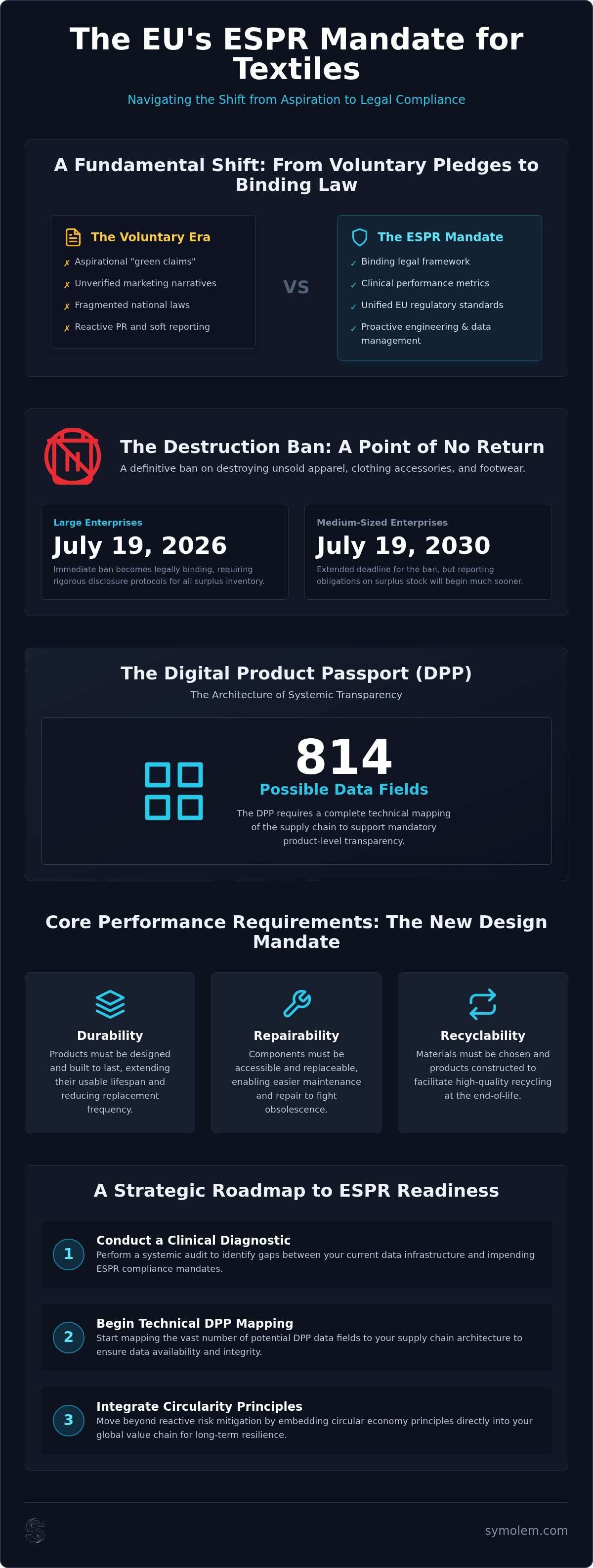
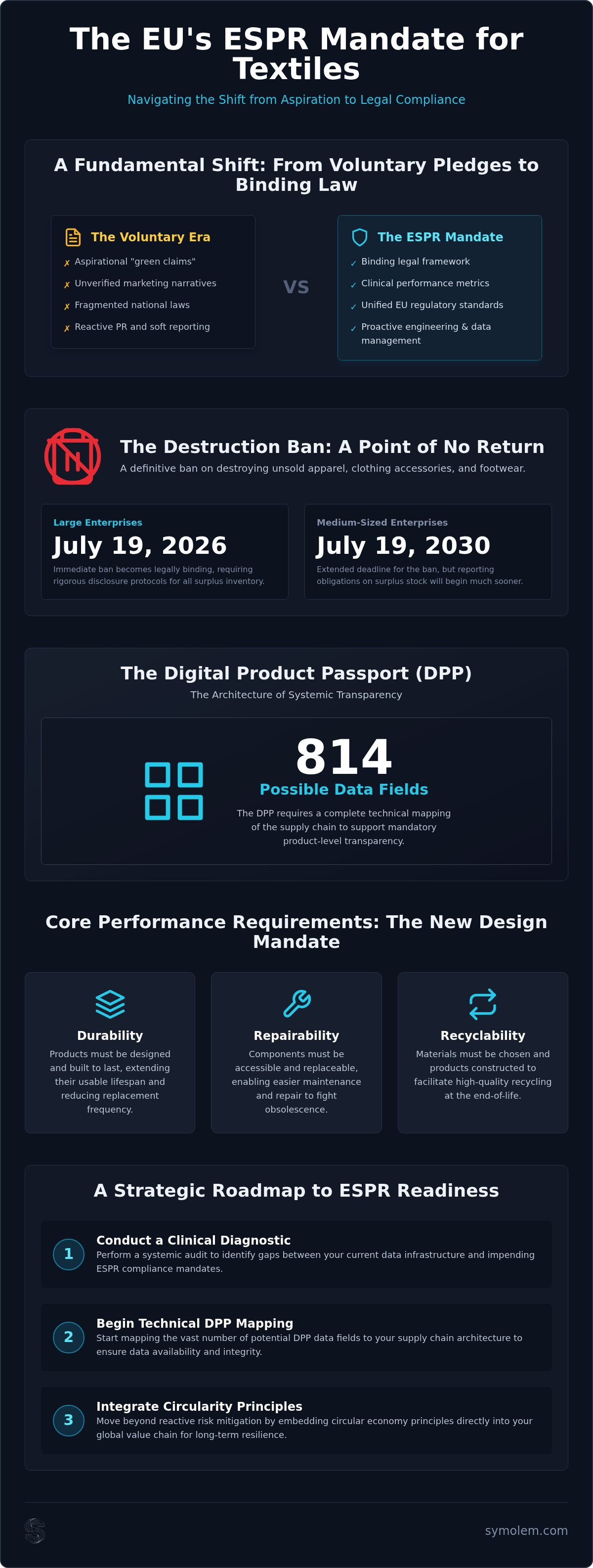
The EU ecodesign regulation for textiles isn't a soft-focus sustainability initiative; it's a fundamental re-architecting of the global value chain through high-stakes legal mandates. As of July 19, 2026, large enterprises face an immediate ban on destroying unsold apparel and footwear, signaling a definitive end to the era of unchecked production waste. You're likely already feeling the pressure of fragmented data across your supply chain and the paralyzing complexity of the 814 possible Digital Product Passport (DPP) data fields. This regulatory shift demands more than just superficial reporting. It requires a systemic audit of your entire operational infrastructure to avoid impending legal penalties.
We'll help you navigate these complex legal and technical requirements of the ESPR with clinical precision and strategic foresight. This article provides a clear diagnostic of existing regulatory gaps, a technical roadmap for DPP implementation, and a framework for systemic alignment with EU circularity standards. By moving beyond the confusion of compliance deadlines, you can establish the structural integrity required to thrive in a circular economy. The following sections unpack the mechanics of the new mandate, from mapping technical data fields to calculating the cost of circular infrastructure.
Key Takeaways
- Recognize that the EU ecodesign regulation for textiles represents a shift from voluntary reporting to a binding legal framework that mandates specific product-level performance standards.
- Prepare for the July 2026 ban on destroying unsold apparel and footwear, which requires large enterprises to implement rigorous disclosure protocols for surplus inventory.
- Begin the technical mapping of the 814 possible Digital Product Passport data fields to ensure your supply chain architecture supports mandatory transparency requirements.
- Conduct a clinical diagnostic of your current operations to identify systemic gaps between existing data infrastructure and impending ESPR compliance mandates.
- Move beyond reactive risk mitigation by integrating circular economy principles directly into your global value chain to build long-term strategic resilience.
Table of Contents
- The Structural Shift: Why the ESPR is a Business Mandate, Not an Aspiration
- Core Performance Requirements: Durability, Recyclability, and the Destruction Ban
- The Digital Product Passport: Architecture of Systemic Transparency
- Diagnostic Frameworks: Identifying Gaps in Regulatory Readiness
- Strategic Implementation: Integrating ESPR into Global Value Chains
The Structural Shift: Why the ESPR is a Business Mandate, Not an Aspiration
The Ecodesign for Sustainable Products Regulation (ESPR) is a hard reset for the global fashion industry. It replaces the predecessor Ecodesign Directive, which focused narrowly on energy-related products, with a broad mandate for systemic circularity. This isn't a suggestion. It's a binding legal framework that treats product design as a matter of economic and environmental security. The linear "take-make-waste" model has reached its logical conclusion, resulting in systemic instability and resource depletion. The EU ecodesign regulation for textiles serves as the diagnostic tool to identify these failures and the architectural blueprint to correct them. It moves beyond simple efficiency to mandate durability, repairability, and recyclability at the core of every product's design.
The End of the Voluntary Era in Textiles
Marketing narratives no longer suffice. For decades, brands navigated the sustainability landscape using aspirational language and unverified "green claims" that lacked technical depth. The EU ecodesign regulation for textiles terminates this era of voluntary disclosure. It replaces soft-focus narratives with clinical performance metrics that brands must verify and report. By overriding fragmented national laws, the ESPR creates a unified regulatory reality where non-compliance results in immediate market exclusion and heavy legal penalties. Systemic integrity is now a prerequisite for commerce. This shift demands a move from reactive PR to proactive engineering and data management.
Scope and Timelines for Global Fashion Brands
2026 represents the point of no return for large-scale operators. On July 19, 2026, the ban on destroying unsold apparel, clothing accessories, and footwear becomes legally binding for large enterprises. This mandate exposes the structural inefficiencies of overproduction and forces brands to confront the reality of their inventory management systems. The "Responsible Operator"—the person or entity placing the product on the EU market—must now account for every unit with absolute transparency. While medium-sized enterprises have until July 19, 2030, to comply with the destruction ban, the broader reporting obligations regarding surplus stock and environmental footprints will arrive much sooner. Effective board-level planning now requires ESPR readiness diagnostics to identify data gaps and infrastructure needs before these deadlines hit. The timeline is fixed; the only variable is your level of preparation.
Core Performance Requirements: Durability, Recyclability, and the Destruction Ban
Overproduction is no longer a hidden operational cost; it's a legal liability. The EU ecodesign regulation for textiles introduces a definitive ban on the destruction of unsold apparel, clothing accessories, and footwear, effective July 19, 2026, for large enterprises. This mandate targets the structural waste inherent in linear business models. Destruction, defined as the intentional rendering of a product unusable, is prohibited except under narrow technical exemptions such as health and safety risks or significant damage. It's a move designed to force brands into a state of uncompromising realism regarding their inventory strategies.
Managing Unsold Goods: The New Economic Reality
Legal compliance hinges on disclosure. Brands can't simply discard excess inventory in silence. They must now disclose the volume of discarded products and the specific reasons for their disposal, creating a data-driven audit trail for regulators. This reporting requirement forces a clinical transparency that many global value chains currently lack. Medium-sized enterprises have until 2030 to comply with the ban itself, but the obligation to report surplus stock levels begins much sooner. Mapping these requirements requires a rigorous ESPR readiness diagnostic to align design cycles with impending legal standards.
Ecodesign Parameters for Textile Longevity
Engineering for circularity requires a fundamental redesign of the product lifecycle. The EU ecodesign regulation for textiles mandates a shift toward durability, repairability, and fibre-to-fibre recyclability. According to the European Parliament's legislative overview, these standards are designed to decouple economic growth from resource consumption. Durability isn't a vague marketing claim. It's a measurable performance metric involving tensile strength, color fastness, and dimensional stability. Products must be designed for disassembly to facilitate repair and high-quality recycling. Recycled content mandates further complicate material sourcing, requiring verified chains of custody that prove the origin of secondary raw materials. If your design process ignores these technical parameters, your products face eventual exclusion from the EU market.
The Digital Product Passport: Architecture of Systemic Transparency
The Digital Product Passport (DPP) is the technological enforcement arm of the ESPR. It's not a mere QR code. It's a machine-readable ledger that codifies a product's entire lifecycle from raw material extraction to end-of-life processing. By mid-2026, the EU DPP Registry is expected to go live, requiring every textile product sold in the EU to carry a unique data carrier. This shift replaces the ambiguity of marketing-led sustainability claims with a rigid framework of verifiable, standardized data. The EU ecodesign regulation for textiles demands a transition toward systemic transparency that few current supply chains are equipped to support.
Technical Data Mapping for DPP Compliance
Mapping the 814 possible data fields represents a massive technical diagnostic challenge for global value chains. You can't simply rely on supplier self-reporting or unverified spreadsheets. Mandatory attributes encompass material composition, recycled content percentages, and repairability scores, while voluntary fields may cover social auditing data or specific chemical disclosures. Effective implementation requires adopting technical standards like the GS1 Digital Link to ensure global interoperability across different scanning systems and databases. Brands must build rigorous impact measurement and verification (MRV) systems to audit supplier-provided data with clinical precision. Without this granular mapping, the DPP becomes a legal liability rather than a tool for compliance.
Interoperability and Data Security
Data integrity is the new currency of market access. The DPP architecture must ensure that information is accessible to market surveillance authorities, recyclers, and consumers while maintaining strict security protocols for proprietary business information. This requires a sophisticated approach to issuer credentials and decentralized data storage to prevent data tampering. You'll need to navigate the challenges of Digital Product Passport implementation by aligning your internal IT infrastructure with the EU's evolving technical specifications. The goal isn't just to display data; it's to create a secure, interoperable ecosystem that proves the circularity of every garment. Failure to achieve this technical alignment will result in products being blocked at the border by automated customs systems that verify DPP validity in real-time. This is a high-stakes transition from narrative-based branding to data-driven operational reality.
Diagnostic Frameworks: Identifying Gaps in Regulatory Readiness
Reactionary compliance is a failure of leadership. The EU ecodesign regulation for textiles demands a clinical diagnostic of existing operational structures to identify exactly where they diverge from legal requirements. This isn't about incremental change; it's about a total systemic alignment. Most brands currently operate with significant data fragmentation across their global value chains. This fragmentation isn't just an inefficiency. It's a liability that will lead to legal penalties and market exclusion as the 2026 deadlines approach. Establishing a comprehensive textile circularity strategy requires moving beyond surface-level narratives toward a rigorous, diagnostic framework.
The ESPR Readiness Diagnostic Methodology
Truth is found in the audit. A structured diagnostic methodology identifies the friction points between current operations and future mandates. First, we map the regulatory scope across the entire product portfolio to determine which categories face immediate enforcement under the 2026 unsold goods ban. This is followed by a technical audit of existing data management systems to see if they can support the high-stakes transparency of the Digital Product Passport. Finally, we conduct financial modeling to cost the required circular infrastructure. You can't manage what you can't measure; you can't comply with what you haven't costed. This methodical approach ensures that board-level planning is based on economic reality rather than aspirational goals.
Supply Chain Transparency and Verification
Verification is the only defense against regulatory scrutiny. Achieving verifying textile sustainability claims for ESPR requires visibility that extends far beyond Tier 1 suppliers. You must secure machine-readable data from raw material origins to prove compliance with durability and recycled content mandates. Implementing robust MRV (Monitoring, Reporting, and Verification) systems ensures that every data point in your Digital Product Passport is backed by technical evidence. This rigor transforms compliance from a risk into a strategic advantage. It's a shift from trusting supplier self-reporting to enforcing a system of verified material integrity. Without this granular visibility, your supply chain remains a black box that invites legal and financial exposure.
Identify your vulnerabilities before they become legal liabilities. Book your ESPR Readiness Diagnostic today to secure your position in the EU market.
Strategic Implementation: Integrating ESPR into Global Value Chains
Strategy is not a luxury. It's the difference between market leadership and obsolescence. Integrating the EU ecodesign regulation for textiles into your global value chain requires a move from defensive risk mitigation to proactive strategic resilience. This isn't just about avoiding penalties. It's about re-architecting your business to thrive in a resource-constrained reality. Board-level planning must now center on ESPR readiness diagnostics to ensure every capital investment aligns with the technical requirements of the new mandate. Symolem acts as the technical architect in this process, providing the systemic integrity needed to transition from linear fragility to circular stability.
Beyond Compliance: The Competitive Advantage of Circularity
The ESPR redefines value creation. In the new regulatory landscape, a product's worth is tied to its technical longevity and the machine-readable transparency of its data carrier. Brands that internalize this reality will find a distinct competitive advantage over those clinging to the "take-make-waste" paradigm. Leveraging a rigorous cost-benefit analysis of circular textile models allows firms to identify where infrastructure investments yield the highest returns in material recovery. This foresight is critical as we approach the broader 2026-2030 regulatory horizon. With the Packaging and Packaging Waste Regulation (PPWR) general application arriving in August 2026 and the EU Deforestation Regulation (EUDR) effective in December 2026, the era of isolated compliance is over. Success now depends on a unified strategy of systemic integrity.
The Roadmap to 2026 Readiness
The time for speculation has ended. Immediate action for brands selling into the EU market involves a multi-layered implementation framework that moves beyond surface-level audits. You must secure technical data from the deepest tiers of your supply chain, finalize your Digital Product Passport architecture, and establish the reverse logistics required for cost-effective textile recovery. Collaborating with strategic advisors ensures these frameworks aren't just theoretically sound but operationally viable within your existing global operations. The transition from linear risk to circular opportunity is a technical challenge that requires precision mapping and expert-led advisory. By finalizing your roadmap now, you secure your license to operate in the world's most sophisticated consumer market. Don't wait for enforcement to force your hand.
Securing Structural Integrity in a Circular Economy
The window for speculative planning has closed. The EU ecodesign regulation for textiles demands a transition from superficial sustainability narratives to a rigid framework of verified performance metrics and machine-readable data. By 2026, the cost of data fragmentation will manifest as immediate legal penalties and total market exclusion for those who fail to align with the new mandate. You must move beyond reactive compliance. Success in this landscape depends on the clinical mapping of your global value chain and the strategic integration of circular infrastructure. This is a high-stakes architectural reset that requires a partner who values systemic truth over marketing sentiment. It's time to treat circularity as the business-critical imperative it has become.
Secure your position in the EU market with a Symolem ESPR Readiness Diagnostic. Our methodology combines expert-led technical data mapping with strategic advisory on global circular infrastructure, ensuring your brand maintains an uncompromising focus on regulatory rigor. We provide the clarity needed to navigate the 814 possible DPP data fields with precision. Build your roadmap today to ensure your brand's operational stability in the European market.
Frequently Asked Questions
What is the primary objective of the EU ecodesign regulation for textiles?
The primary objective of the EU ecodesign regulation for textiles is to institutionalize circularity through binding product-level performance standards. It replaces voluntary sustainability claims with mandatory requirements for durability, repairability, and recyclability. This framework aims to decouple economic growth from resource consumption by forcing a systemic redesign of the global textile value chain. Every product placed on the EU market must eventually meet these clinical performance criteria to ensure long-term environmental and economic stability.
Does the ESPR apply to UK-based fashion brands selling into the EU?
Yes, the ESPR applies to any entity placing textile products on the EU market, including UK-based brands. Regulatory compliance is tied to market access rather than the geographical location of a brand's headquarters. UK operators must act as the "Responsible Operator" or appoint an authorized representative to ensure every product meets the mandatory ecodesign and Digital Product Passport requirements. Failure to align with these standards results in immediate exclusion from the world's most sophisticated consumer market.
When does the ban on destroying unsold textiles take effect for large brands?
The ban on destroying unsold apparel, clothing accessories, and footwear becomes legally binding for large enterprises on July 19, 2026. This mandate forces brands to confront the structural failures of overproduction with uncompromising realism. Medium-sized enterprises are granted a transition period until July 19, 2030, to comply with the destruction ban. However, all impacted firms must begin disclosing the volume and reasons for discarded products much earlier to satisfy mandatory transparency obligations.
What specific data categories are required for the textile Digital Product Passport?
The Digital Product Passport requires standardized data across material composition, recycled content percentages, and verified durability metrics. It encompasses a technical mapping of up to 814 possible data fields to ensure systemic transparency. These machine-readable attributes must also include repairability scores and end-of-life processing instructions. Achieving this level of granular detail requires a transition from narrative-led marketing to a rigorous, data-driven operational reality supported by robust impact measurement systems.
Are small and micro-enterprises exempt from the ESPR ecodesign requirements?
Micro-enterprises are currently exempt from the ban on destroying unsold textiles and footwear to reduce administrative burdens. Small enterprises also receive specific exemptions and longer transition periods under the current delegated acts. However, the broader EU ecodesign regulation for textiles eventually creates a market-wide expectation for circularity that impacts every participant in the value chain. Brands must monitor evolving delegated acts to determine exactly when their specific enterprise size falls under full regulatory scope.
How does the ESPR relate to the Extended Producer Responsibility (EPR) schemes?
The ESPR and Extended Producer Responsibility (EPR) schemes function as interconnected pillars of the EU's circular economy strategy. While the ESPR mandates how a product is designed and documented, EPR schemes focus on the financial and operational responsibility for a product's end-of-life management. By June 2027, all Member States must establish mandatory EPR schemes for textiles. This systemic alignment ensures that product design and waste management infrastructure work in tandem to facilitate high-quality textile recovery.
What are the penalties for non-compliance with the EU ecodesign regulation?
Non-compliance results in immediate market exclusion and severe financial penalties enforced by individual EU Member States. Products that lack a valid Digital Product Passport or fail to meet ecodesign standards will be blocked by automated customs systems at the border. Penalties are designed to be effective, proportionate, and dissuasive, often calculated as a percentage of the operator's annual turnover. The high-stakes nature of these legal mandates treats regulatory failure as a critical business and financial risk.
How can a fashion brand conduct an ESPR readiness diagnostic?
A fashion brand can conduct an ESPR readiness diagnostic by partnering with a technical advisor to perform a clinical audit of their existing operations. This process involves mapping the regulatory scope across the product portfolio and identifying gaps in data management systems. It also requires financial modeling to cost the necessary circular infrastructure for global recovery. Symolem provides these expert-led diagnostics to ensure brands move from fragmented data to systemic integrity before the 2026 deadlines arrive.