Textile Impact Measurement and MRV: Verification Rigor for ESPR Compliance
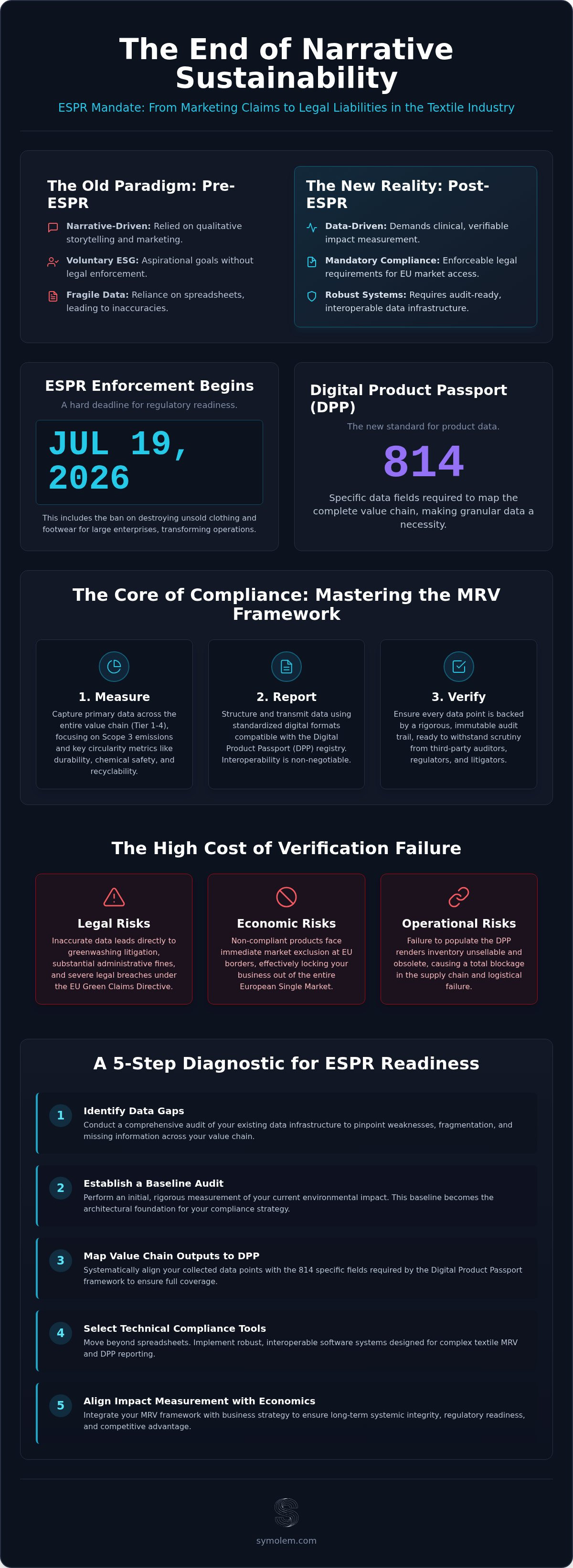
The era of narrative-driven sustainability is dead. As of July 19, 2026, the EU's Ecodesign for Sustainable Products Regulation (ESPR) has transformed environmental claims from marketing assets into enforceable legal liabilities. For large enterprises, the ban on destroying unsold clothing and footwear is no longer a distant proposal; it's a structural mandate. Achieving compliance requires more than superficial audits or aspirational goals. It demands a rigorous, clinically precise framework for textile impact measurement and MRV that can withstand the scrutiny of regulators and litigators alike.
You likely recognize that fragmented supply chain data and the high cost of inaccuracy create a volatile environment where one unverified claim can trigger systemic failure. This article provides the technical roadmap to master MRV requirements and ensure your data is ready for the Digital Product Passport (DPP) registry. We'll unpack the mechanics of the Apparel & Footwear PEFCR methodology, the strategic alignment of impact data with business economics, and the diagnostic steps necessary to secure continued market access. By moving beyond sentiment and into systemic integrity, your organization can turn regulatory pressure into a definitive competitive advantage.
Key Takeaways
- Understand why the shift from voluntary ESG to mandatory ESPR compliance makes clinical verification a prerequisite for continued EU market access.
- Master the structural mechanics of textile impact measurement and MRV to replace fragile spreadsheets with robust, audit-ready data systems.
- Learn how to map complex value chain outputs to the 814 specific data fields required by the Digital Product Passport (DPP) framework.
- Implement a five-step diagnostic process to identify data gaps and establish a baseline audit before selecting technical compliance tools.
- Align impact measurement with business economics to ensure long-term systemic integrity and regulatory readiness for the 2026 mandates.
Table of Contents
- The End of Narrative Sustainability: Why MRV is Now a Legal Mandate
- Structural Mechanics of Textile MRV: Beyond the Spreadsheet
- Interfacing MRV with Digital Product Passports (DPP)
- Establishing a Compliant MRV Framework: A 5-Step Diagnostic
- Strategic Advisory: Navigating the Verification Rigor of 2026
The End of Narrative Sustainability: Why MRV is Now a Legal Mandate
Sustainability narratives are collapsing under the weight of diagnostic scrutiny. For decades, the textile industry relied on qualitative storytelling and soft-focus marketing to project an image of environmental stewardship. This era has ended. As of July 19, 2026, the Ecodesign for Sustainable Products Regulation (ESPR) has codified environmental accountability into a hard legal requirement. Market access is no longer a baseline assumption; it's a privilege earned through the clinical verification of every environmental claim your organization makes.
At the center of this structural upheaval is textile impact measurement and MRV. In the context of the modern global value chain, MRV is the systematic process of measuring environmental impact, reporting findings through standardized digital formats, and verifying that data via rigorous third-party audits. It's a technical infrastructure designed to replace vague "best effort" claims with legally defensible evidence. The shift from voluntary ESG reporting to mandatory regulatory compliance in 2026 represents a total rejection of superficiality in favor of systemic integrity.
The Regulatory Catalyst: ESPR and the Demand for Rigor
The ESPR mandates a fundamental transition in how value chain data is managed. It moves the needle from aspirational reporting to a mandatory framework where every metric must be backed by a scientific audit trail. For large enterprises, the July 2026 deadline for banning the destruction of unsold clothing and footwear is just the first tremor in a larger seismic shift toward circularity. Intellectual rigor must now replace aspirational language. If your impact data lacks structural integrity, your market access will evaporate.
Establishing a baseline for this new reality requires an ESPR readiness diagnostic. This diagnostic serves as the architectural foundation for any compliant MRV framework. Without it, companies risk building their compliance strategy on fragmented data that will inevitably fail under the pressure of EU market surveillance authorities. You can't fix what you haven't accurately mapped.
Consequences of Verification Failure
The risks of failing to implement robust textile impact measurement and MRV are no longer just reputational. They are existential. In a landscape defined by the EU Green Claims Directive, the margin for error has disappeared.
- Legal risks: Inaccurate data leads directly to greenwashing litigation and substantial administrative fines. Regulators are now equipped with the tools to treat data discrepancies as serious legal breaches.
- Economic risks: Non-compliant products face immediate market exclusion at the border. The cost of being locked out of the European Single Market far outweighs the investment in rigorous measurement systems.
- Operational risks: Without verified impact data, your organization cannot populate the Digital Product Passport (DPP). This failure creates a total block in the supply chain, rendering inventory unsellable and logically obsolete.
Structural Mechanics of Textile MRV: Beyond the Spreadsheet
Spreadsheets are an operational liability. In the multi-tiered complexity of a global textile value chain, relying on manual data entry is a recipe for systemic failure. Effective textile impact measurement and MRV requires a transition to digitized, interoperable systems capable of mapping Scope 3 emissions with clinical precision. This mapping must extend from Tier 1 assembly through to Tier 4 raw material extraction, capturing the granular reality of every processing stage. The structural core of this framework rests on three non-negotiable pillars: Measurement through primary data, Reporting in standardized digital formats, and Verification via immutable audit trails.
Modern MRV must also evolve beyond carbon accounting. To meet ESPR mandates, measurement frameworks must integrate circularity performance indicators. Metrics for physical durability, chemical safety, and fiber-to-fiber recyclability are no longer secondary considerations. They are the primary data points that determine a product's legal viability. Engaging a strategic advisor to architect these data flows ensures that your MRV framework is built for longevity rather than just immediate checkboxes.
Primary Data vs. Secondary Averages
Relying on industry average databases for legal compliance is a terminal failure. While secondary data was acceptable for voluntary ESG reports, it lacks the specificity required for "legally defensible" evidence under the ESPR. Regulators now demand primary impact data extracted directly from supplier networks. This requires a robust Life Cycle Assessment (LCA) methodology that utilizes actual energy bills, water consumption logs, and chemical inventories. Without this granular level of detail, your impact measurement is merely an educated guess, leaving your organization exposed to regulatory friction.
Verification Rigor: The Third-Party Mandate
Independent verification is the final safeguard against systemic inaccuracy. Under new EU standards, "self-certification" is functionally obsolete. Verification must be conducted by accredited third parties who can forensically audit the entire chain of custody. This process ensures that the data populating your Digital Product Passport is accurate, consistent, and untampered.
Establishing a chain of custody that survives such scrutiny is a complex architectural task. It requires a clear link between physical goods and their digital twins. Prioritizing verifying textile sustainability claims for ESPR is the only way to insulate your business from the rising tide of greenwashing litigation. Only through rigorous, third-party validation can a brand prove its circularity claims and maintain its license to operate in the European market.
Interfacing MRV with Digital Product Passports (DPP)
The Digital Product Passport is the vessel; MRV is the fuel. Without high-fidelity data, the DPP remains an empty digital shell, incapable of meeting the stringent transparency requirements dictated by the ESPR. For textile producers, this involves mapping textile impact measurement and MRV outputs to as many as 814 potential data fields. This isn't a simple data upload exercise. It's a complex technical alignment that ensures the "digital twin" accurately reflects the physical product's environmental reality across its entire lifecycle. Verification rigor is the only mechanism that guarantees the authenticity of this data, protecting brands from the legal fallout of "dirty" data entering the centralized EU registry.
Effective Digital Product Passport implementation has become an absolute economic necessity in the 2026 landscape. As the July 19, 2026, operational date for the EU DPP registry arrives, the focus must shift from theoretical compliance to technical execution. Brands that fail to integrate their measurement systems with the DPP architecture will find themselves locked out of the market, regardless of their sustainability intentions. The passport acts as the gatekeeper; if the fuel is unverified, the vessel won't move.
Data Governance for the DPP
Data interoperability is the primary hurdle for global supply chains. Your MRV systems must speak the same language as the centralized EU registry to avoid friction. This requires adopting standardized protocols like the GS1 Digital Link and utilizing verifiable credentials to secure data exchanges between tiers. You must protect proprietary technical data, such as specific chemical formulations or supplier identities, while simultaneously meeting the broad transparency mandates of the ESPR. A structured governance framework allows for this balance, ensuring that only the necessary, verified data points are surfaced to consumers and regulators without compromising intellectual property.
From Measurement to Passport: The Technical Bridge
Automating the flow from impact measurement to consumer-facing transparency is the only way to manage the sheer volume of required data. Manual entry is too slow and prone to systemic error. Verification timestamps play a critical role here. Real-time data, captured at the point of production, beats historical reporting because it provides an immutable record of impact at a specific moment in time. This technical bridge transforms textile impact measurement and MRV from a back-office auditing task into a front-end strategic asset. By securing the data pipeline now, you ensure that your products remain visible, compliant, and commercially viable in an increasingly transparent global market.
- Systemic Automation: Reduces the administrative burden of maintaining up to 236 data points in the UNTP schema per SKU across thousands of products.
- Real-time Verification: Increases the legal defensibility of the DPP during market surveillance audits by providing time-stamped proof.
- Cost Mitigation: Rigorous MRV reduces the long-term cost of DPP maintenance by preventing data rework and compliance bottlenecks.
Establishing a Compliant MRV Framework: A 5-Step Diagnostic
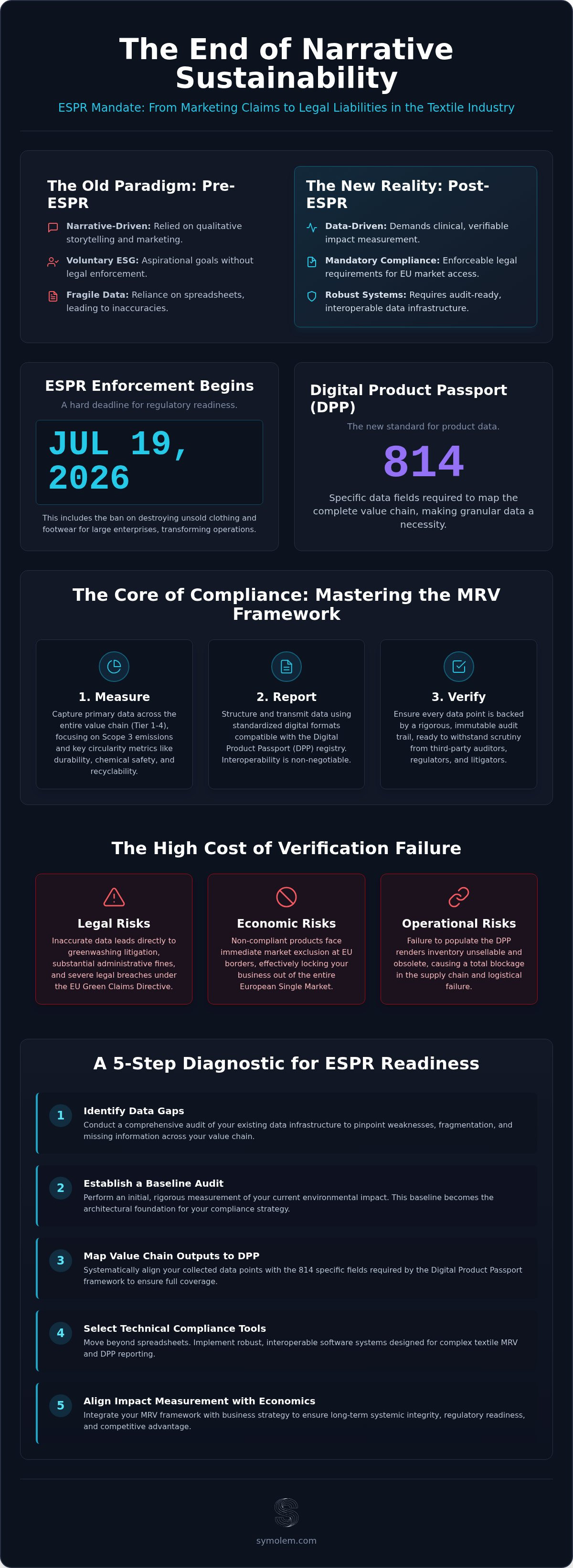
Framework design must precede tool selection. Many organizations rush to purchase software before they understand the structural gaps in their own value chains, leading to systemic misalignment and wasted capital. A robust textile impact measurement and MRV framework isn't a plug-and-play solution; it's a diagnostic architecture that ensures every data point is accurate, verifiable, and legally defensible. To secure market entry in 2026, brands must follow a methodical trajectory toward verification rigor.
- Step 1: Baseline Audit. Identify existing data gaps and quantify your current regulatory exposure across all product categories.
- Step 2: Supplier Engagement. Mandate primary data disclosure through updated legal contracts. You can't verify what your suppliers won't disclose.
- Step 3: Impact Quantification. Apply rigorous Life Cycle Assessment (LCA) methodologies to your core product lines to establish a scientific performance baseline.
- Step 4: Reporting Integration. Align your internal data flows with both ESPR and CSRD standards to ensure interoperability.
- Step 5: External Verification. Secure the third-party assurance required to validate your claims before they enter the Digital Product Passport registry.
The Economics of MRV Infrastructure
Building a measurement system is an operational expense, not a marketing cost. You must account for the true economics of data collection across global value chains, which includes the overhead of supplier training, data cleaning, and third-party auditing fees. A comprehensive cost-benefit analysis of circular textile models must include these MRV overheads to remain realistic. Viewing verification rigor as a non-negotiable operational expense is the only way to protect long-term margins against the risk of non-compliance fines.
Avoiding Common MRV Implementation Failures
The "Data Dump" trap is the most frequent cause of implementation failure. Collecting massive amounts of information without a clear verification strategy creates a liability rather than an asset. Similarly, the "Silo" failure occurs when sustainability data is kept separate from core business operations, preventing it from informing strategic decisions. Navigating the complexities of the 2026 EU regulatory landscape requires technical advisory that bridges the gap between policy and infrastructure. To ensure your framework is built on clinical precision rather than guesswork, initiate your ESPR Readiness Diagnostic with Symolem today.
Strategic Advisory: Navigating the Verification Rigor of 2026
Compliance is no longer a matter of administrative box-ticking. It's a structural challenge that requires a technical architect to bridge the gap between abstract policy and operational reality. Symolem serves as this architect, moving beyond generic consulting to provide the diagnostic precision and policy readiness necessary for the 2026 mandates. In an environment where textile impact measurement and MRV outcomes determine market access, the integrity of your verification framework is your most valuable asset. An independent advisory firm is essential for unbiased verification, providing the clinical distance required to ensure your data survives the scrutiny of market surveillance authorities.
The Symolem Approach to MRV
Our methodology begins with a policy-first strategy. We align your internal measurement systems with the evolving mandates of the EU and UK, ensuring that your data remains compliant as regulations shift and expand. This involves technical data mapping that prepares your organization for the Digital Product Passport by addressing the 814 specific data fields required for textiles. We don't just recommend tools; we design the underlying infrastructure. This ensures that your circular systems are cost-effective and backed by immutable data, rather than aspirational narratives that collapse under forensic audit.
Next Steps for Fashion Leadership
The window for reactive planning has closed. Leadership now requires a proactive, diagnostic approach to identify measurement gaps before they become legal liabilities. Initiating an ESPR Readiness Diagnostic is the primary step in mapping your path toward systemic integrity. This diagnostic provides the clarity needed to understand where your current data fails and how to reconstruct it for the 2026 landscape. It's a technical necessity for any brand that intends to maintain a license to operate in the European Single Market.
Beyond the immediate requirements of the ESPR, leaders must also prepare for the financial implications of Extended Producer Responsibility. Navigating EPR for textiles is critical for understanding future financial obligations and how they interface with your existing textile impact measurement and MRV framework. By securing independent advisory, you gain the unbiased perspective necessary for rigorous verification. This independent scrutiny is what separates legally defensible data from the risk of greenwashing litigation. To begin architecting your compliance infrastructure and securing your position in the circular economy, contact Symolem for a strategic compliance consultation.
Securing Systemic Integrity in the 2026 Regulatory Landscape
The transition from aspirational sustainability to clinical legal compliance is final. Market access under the ESPR mandates a total rejection of fragmented data in favor of a robust textile impact measurement and MRV framework. By moving beyond spreadsheets and into a structured diagnostic architecture, your organization can insulate itself from the high-stakes risks of greenwashing litigation and systemic market exclusion. Verification is no longer a choice; it's a prerequisite for survival.
Symolem acts as the strategic architect for global textile value chains, providing the independent advisory and intellectual rigor necessary to navigate this complexity. Our expertise in mapping 814 DPP data fields ensures your compliance infrastructure is both technically sound and legally defensible. Don't wait for the July 2026 enforcement deadline to reveal your structural gaps. Secure your market access with a Symolem ESPR Readiness Diagnostic and transform regulatory pressure into a definitive competitive advantage. You have the opportunity to lead the industry toward a truly circular future.
Frequently Asked Questions
What is the difference between ESG reporting and MRV for textiles?
ESG reporting is typically a high-level, voluntary disclosure of corporate sustainability goals. In contrast, textile impact measurement and MRV is a technical, clinical process designed to produce audit-ready evidence for specific products. While ESG focuses on narrative, MRV focuses on structural integrity. It requires a systematic chain of measurement, reporting, and verification that transforms environmental claims into legally defensible data points suitable for regulatory scrutiny.
Is MRV mandatory for UK brands selling into the EU in 2026?
Yes. Any brand placing products on the EU market must comply with ESPR mandates, including the ban on destroying unsold goods starting July 19, 2026. UK brands aren't exempt from these requirements if they wish to maintain market access. Compliance depends on the product's destination, not the brand's headquarters. Failing to implement rigorous MRV will result in immediate exclusion from the European Single Market and potential litigation under the Green Claims Directive.
How much does it cost to implement a textile MRV framework?
The cost of implementing an MRV framework is an operational investment in your core business infrastructure. It includes expenses for primary data collection, supplier training, and mandatory third-party audits. While specific fees vary based on supply chain complexity, brands should view these as non-negotiable costs of market entry. Investing in a strategic diagnostic early prevents the much higher costs associated with non-compliance fines and inventory blockages.
Can we use secondary data for our Digital Product Passport?
Relying exclusively on secondary data averages is a terminal strategy for Digital Product Passport compliance. The ESPR and the Green Claims Directive demand primary data that reflects the actual impact of your specific value chain. While secondary databases can provide a temporary baseline, they lack the scientific precision required for legal defensibility. Your digital twin must be fueled by verified, primary evidence to survive market surveillance audits.
What role does third-party verification play in ESPR compliance?
Third-party verification provides the independent assurance necessary to validate environmental claims. Under the ESPR, self-certification is functionally obsolete for high-stakes impact data. Accredited auditors must forensically examine your data trails to ensure they're accurate, consistent, and untampered. This rigor acts as a final safeguard against greenwashing litigation, ensuring that the data populating your DPP registry is authentic and structurally sound before it reaches the consumer.
How does MRV impact the economics of textile recovery systems?
MRV transforms textile recovery from a speculative activity into a data-backed economic system. By accurately measuring the durability, chemical safety, and recyclability of fibers, MRV allows brands to quantify the residual value of their inventory. This data is essential for designing cost-effective circular infrastructure. Without rigorous measurement, the economics of resale and recycling remain opaque, preventing the strategic alignment of impact with business profitability.
What are the specific MRV requirements for Scope 3 emissions in fashion?
Scope 3 requirements in fashion demand granular mapping across Tier 1 to Tier 4 suppliers. You can't rely on industry averages for raw material extraction or wet processing. Textile impact measurement and MRV must capture actual energy consumption and chemical usage at every stage of the value chain. This level of clinical precision is necessary to meet the reporting standards of the CSRD and the technical requirements of the DPP.
How often must textile impact data be updated for regulatory compliance?
Textile impact data must be updated frequently enough to ensure the Digital Product Passport reflects the current reality of the product batch. While some metrics are static, others related to production energy or recycled content may fluctuate. Regulatory compliance requires that data is verified and time-stamped at the point of production. Static, historical reporting is insufficient for a landscape that prioritizes real-time transparency and systemic accountability.