Textile Environmental Footprint Advisory: Navigating the 2026 Regulatory Mandate
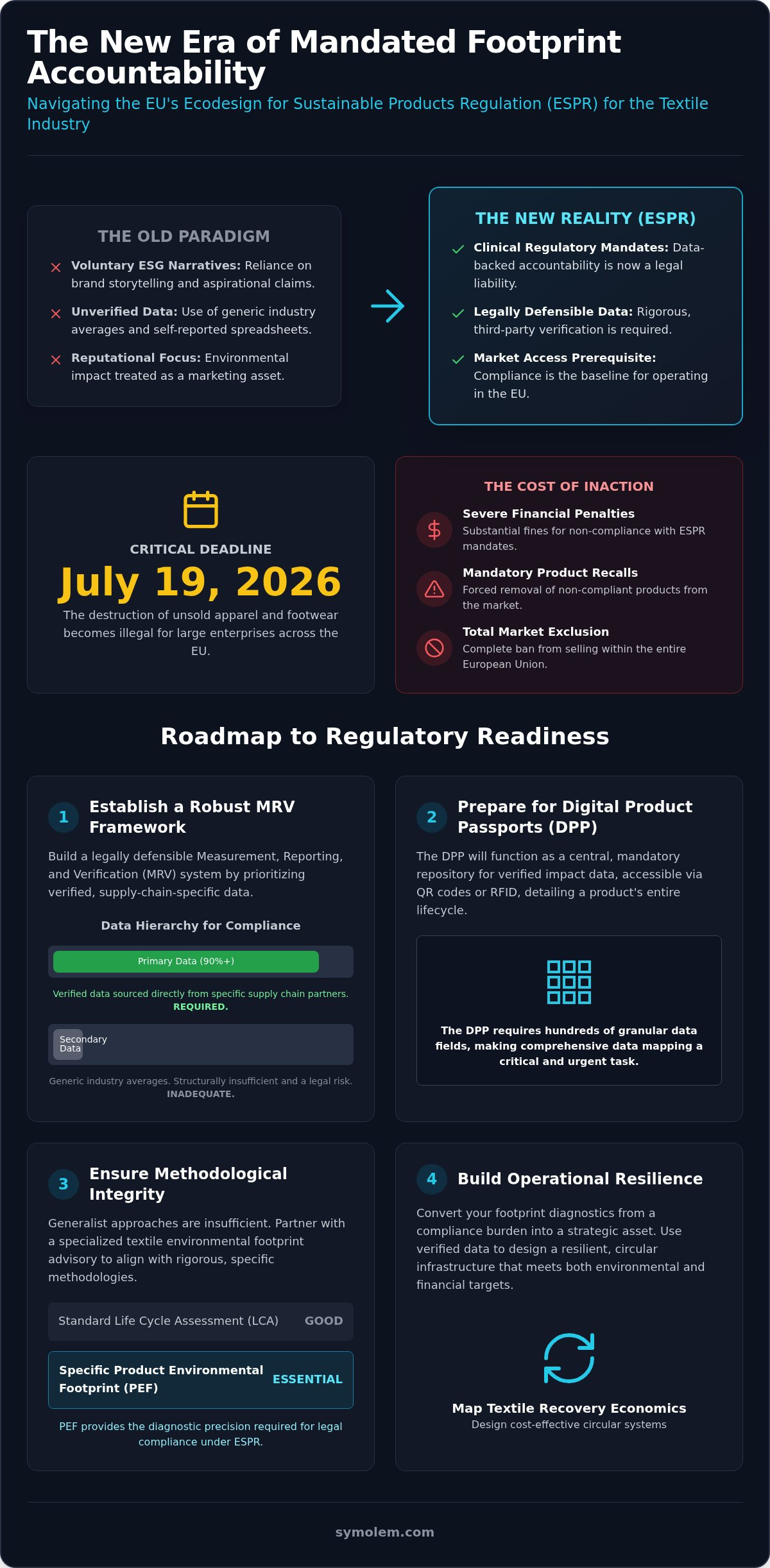
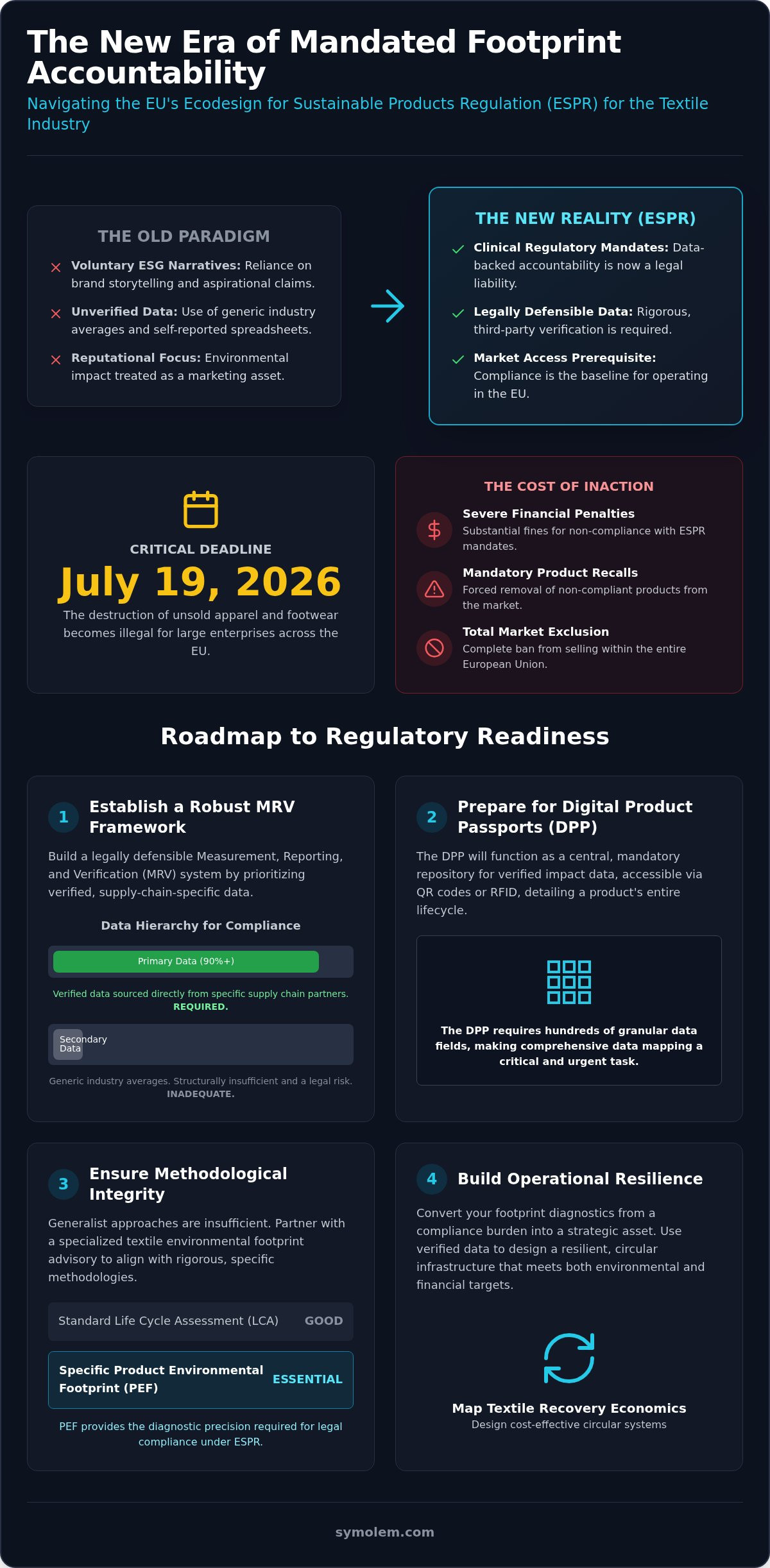
By July 19, 2026, the destruction of unsold apparel becomes illegal for large enterprises across the European Union. This isn't a suggestion for better brand storytelling; it's a hard pivot toward mandatory, data-backed accountability that treats environmental impact as a legal liability. Most brands currently operate on fragmented supply chain data that lacks the verification rigor required for the hundreds of data fields expected in Digital Product Passports. Engaging a specialized textile environmental footprint advisory is no longer an elective strategy for the progressive few. It's a critical business imperative for any entity that intends to maintain market access in a landscape defined by clinical, diagnostic scrutiny.
You likely feel the mounting pressure of regulatory uncertainty as deadlines for California’s SB 707 and EU delegated acts converge. We recognize that the high cost of inaccurate impact measurement represents a systemic risk to your operational resilience and long-term stability. This article provides a verified roadmap for regulatory readiness, moving beyond superficial narratives to build legally defensible impact reporting. You'll master the technical and strategic requirements of footprinting to design cost-effective circular infrastructure. We'll unpack the mechanics of data mapping, infrastructure costing, and the structural shifts required to survive a regulated global market.
Key Takeaways
- Transition from voluntary ESG narratives to clinical regulatory mandates as the EU ESPR redefines market access through strict data verification.
- Establish a robust MRV framework that prioritizes primary supply chain data over generic secondary averages to ensure impact reporting is legally defensible.
- Evaluate the methodological integrity of your compliance strategy by aligning with a specialized textile environmental footprint advisory that differentiates between standard LCA and specific PEF requirements.
- Convert footprint diagnostics into operational resilience by mapping the economics of textile recovery and designing circular infrastructure that meets environmental and financial targets.
- Identify structural compliance gaps through a targeted ESPR readiness diagnostic to build a technical architecture capable of supporting mandatory Digital Product Passport data fields.
Table of Contents
- Beyond Voluntary Disclosure: The New Era of Mandated Footprint Accountability
- The Technical Architecture of Textile Impact Measurement and MRV
- Diagnostic Scrutiny: Evaluating Methodological Integrity in Footprint Advisory
- Strategic Integration: Converting Footprint Data into Operational Resilience
- Strategic Advisory for Systemic Integrity: The Symolem Framework
Beyond Voluntary Disclosure: The New Era of Mandated Footprint Accountability
The era of voluntary sustainability is dead. For decades, fashion brands operated within a vacuum of aspirational ESG narratives, relying on soft-focus imagery and unverified claims to suggest environmental stewardship. The Ecodesign for Sustainable Products Regulation (ESPR), which entered into force on July 18, 2024, has effectively dismantled this paradigm. It redefines the "environmental footprint" from a marketing asset into a clinical, technical requirement for market entry. Failure to meet these standards results in more than just reputational damage; it triggers legal consequences including severe financial penalties, mandatory product recalls, and total exclusion from the EU market. Generalist consultants often lack the technical depth to navigate these shifts, failing to grasp how the Environmental impact of the fashion industry is now being codified into granular data requirements. This is where a specialized textile environmental footprint advisory becomes essential, providing the diagnostic precision needed to bridge the gap between intent and legal compliance.
The ESPR as a Market Access Filter
Under the new EU framework, every brand must identify a "Responsible Operator" within the Union who remains legally liable for a product's compliance. This role demands a shift from self-reported, often anecdotal data to rigorous, third-party verified systems. If your current textile impact measurement and MRV protocols rely on secondary industry averages or unverified supplier spreadsheets, they are structurally insufficient. The regulation mandates a level of transparency that exposes fragmented supply chains, requiring brands to map every node of production with clinical accuracy to satisfy upcoming Digital Product Passport (DPP) audits. This transition from storytelling to data verification is the only way to maintain market access.
The Cost of Inaction in 2026
The timeline for adjustment is narrow. By July 19, 2026, large enterprises will face an outright ban on the destruction of unsold apparel and footwear, a move that fundamentally challenges existing inventory models. Delayed data mapping creates an economic vacuum. Without a clear understanding of your environmental metrics, you risk stranded assets and catastrophic supply chain disruptions. Many current reporting models are built on structural failures, prioritizing superficial aesthetics over the hard data required for systemic integrity. Compliance is not an option. It is the baseline. Engaging with a textile environmental footprint advisory now is the only way to ensure your infrastructure can withstand the regulatory scrutiny of the coming decade.
The Technical Architecture of Textile Impact Measurement and MRV
Data is the new currency of compliance. In the context of 2026 mandates, MRV (Measurement, Reporting, and Verification) functions as a technical audit of a product's entire lifecycle. A specialized textile environmental footprint advisory moves beyond superficial estimates to map the granular data fields required for fiber-to-shelf transparency. This requires a strict hierarchy where primary data, sourced directly from specific supply chain partners, supersedes secondary industry averages. While secondary data provides a starting point, it lacks the specificity needed to survive regulatory scrutiny or to accurately perform a Life Cycle Assessment (LCA) for textiles. Relying on averages is a structural risk that can lead to miscalculated impacts and subsequent legal exposure.
Digital Product Passport Integration
The Digital Product Passport (DPP) acts as the central repository for this verified impact data. Footprint metrics must populate the DPP data carrier, whether through QR codes or RFID tags, to ensure seamless access for regulators, recyclers, and consumers. Data interoperability across global supply chain tiers remains a significant hurdle for most legacy systems. Many brands struggle with fragmented software stacks that cannot communicate, highlighting the challenges of Digital Product Passport implementation in complex, multi-national operations. Establishing a unified technical architecture is the only way to ensure that data flows from the dyeing facility to the retail shelf without losing its integrity or verification status.
Verification Rigor and Audit Trails
Impact claims require immutable proof. Establishing a verifiable chain of custody for environmental metrics is no longer a luxury; it's a prerequisite for market entry. Verification Rigor is the bridge between data and legal defense. Independent technical audits must replace internal self-assessments to eliminate bias and ensure systemic accuracy. Without an exhaustive audit trail, a brand's environmental claims are merely liabilities waiting for a regulatory challenge. To begin identifying these technical vulnerabilities and structural gaps, brands should prioritize an ESPR Readiness Diagnostic to map their current data capabilities against future mandates. This diagnostic serves as the first clinical step in transitioning from opaque supply chains to transparent, compliant value cycles.
Diagnostic Scrutiny: Evaluating Methodological Integrity in Footprint Advisory
Methodological integrity determines legal survival. The transition from marketing-led sustainability stories to verifiable impact data requires a clinical diagnostic approach that most internal teams are not equipped to handle. A specialized textile environmental footprint advisory scrutinizes the underlying mechanics of your data, identifying where superficial frameworks fail to meet the rigorous standards of the EU’s Ecodesign for Sustainable Products Regulation. Relying on average data sets is a dangerous gamble in a regulated market. Global averages flatten the nuances of your supply chain, hiding both risks and opportunities for circularity. If your advisory doesn't demand site-specific primary data, it isn't providing compliance; it's providing a false sense of security. Systemic integrity must replace the industry's historical reliance on vague environmental claims.
Standard Life Cycle Assessments (LCAs) have historically served as the industry benchmark, yet they frequently rely on generic secondary data that obscures the actual impact of specific production sites. The EU’s Product Environmental Footprint (PEF) methodology shifts the focus toward a more standardized, comparable set of metrics designed to eliminate greenwashing through technical uniformity. Choosing the wrong methodology isn't just a technical error; it's a strategic failure that can lead to market exclusion when your data fails to align with the technical requirements of the Digital Product Passport. Your footprint is the foundation of your legal defense; it must be built on data that can withstand an audit.
Methodological Gaps in Standard LCAs
Traditional LCAs often operate as a black box, where supplier-provided data is accepted without rigorous interrogation or site-specific verification. This lack of transparency is fundamentally incompatible with the mandate for verifying textile sustainability claims for ESPR. If your data doesn't account for the specific energy mix of a spinning mill or the precise chemical load of a finishing plant, it's effectively useless for high-stakes regulatory reporting. A clinical textile environmental footprint advisory identifies these gaps, replacing unverified assumptions with a technical architecture that maps real-world impacts across every tier of the value chain.
PEF (Product Environmental Footprint) Alignment
PEF methodology is designed to influence product design and material selection by penalizing high-impact choices across 16 specific environmental categories. This framework demands a level of granularity that standard sustainability frameworks simply don't provide, forcing brands to evaluate their materials through a lens of economic and environmental reality. It requires a move toward systemic integrity, where every material choice is backed by a verifiable audit trail. A footprint is only as strong as its weakest data point.
Strategic Integration: Converting Footprint Data into Operational Resilience
Efficiency is the byproduct of precision. While technical compliance secures market access, strategic integration of footprint data ensures long-term profitability within a circular economy framework. A textile environmental footprint advisory does not stop at data collection; it translates diagnostic findings into a structural blueprint for operational resilience. This involves moving beyond carbon metrics to evaluate the true economics of textile recovery and circularity. By analyzing the cost-benefit analysis of circular textile models, brands can identify where material innovation and design shifts yield the highest return on investment while simultaneously mitigating regulatory risk.
From Data to Infrastructure
Regulatory mandates like the ESPR and California’s SB 707 require a fundamental redesign of recovery systems. Infrastructure costing is the critical missing link in most sustainability strategies. You must calculate the financial requirements of collection, sorting, and pre-processing before the full weight of EU regulations hits your balance sheet. This isn't a theoretical exercise; it's a clinical assessment of global value chains. Successfully navigating EPR for textiles requires a strategy that aligns physical logistics with verified footprint data to avoid the high costs of inefficient, unverified recovery loops.
Supply Chain Re-Architecture
Fragmented supply chains are a structural failure. To reduce Scope 3 emissions and satisfy Digital Product Passport requirements, brands must re-architect their relationship with suppliers. This means moving away from transactional procurement toward a model that incentivizes high-fidelity impact data sharing. A specialized textile environmental footprint advisory provides the technical framework to audit these relationships, ensuring that every tier of the supply chain contributes to a legally defensible impact report. Map your footprint to your cost-base, not just your carbon-base. This alignment allows for precision in material selection, ensuring that lower-impact fibers also support the economic viability of your circular infrastructure.
To begin the transition from diagnostic data to tangible circular infrastructure, brands should engage in Circular Economy Strategy Development to ensure their operational models are built for a regulated global market.
Strategic Advisory for Systemic Integrity: The Symolem Framework
Symolem acts as a clinical architect in a landscape historically defined by superficial narratives. While generalist consultants often provide broad sustainability advice that lacks technical depth, our framework prioritizes diagnostic precision and granular data mapping. We treat the 2026 mandates as a critical business and legal imperative rather than a voluntary ethical exercise. A specialized textile environmental footprint advisory provides the structural clarity needed to navigate the complex data fields expected for Digital Product Passports. We move beyond ethical sentiment to focus on infrastructure costing and systemic integration, ensuring your circular economy strategy remains both legally defensible and economically viable. Truth and scrutiny are valued over comfort; we identify structural failures within your value chain to build a more resilient operational baseline.
The ESPR Readiness Diagnostic
Mapping your organization against the 2026 EU mandate is the first clinical step toward operational resilience. Our ESPR readiness diagnostic identifies structural compliance gaps by auditing your current data capabilities against specific product category requirements. This process transitions your brand from passive risk management to active strategic advantage. By identifying technical data field requirements early, you avoid the high cost of inaccurate measurement and fragmented supply chain reporting that often leads to market exclusion. We ensure that every material choice and recovery loop is backed by a verifiable audit trail, allowing your organization to satisfy the hundreds of technical data points required by regulators. This diagnostic is a technical audit of your future market access.
Securing Your Market Position
Independent advisory is the only way to ensure defensible reporting in a transparent market. Internal self-assessments are often blinded by established industry norms and lack the clinical scrutiny required by EU regulators to eliminate greenwashing. Symolem provides the independent technical scrutiny needed to build a legacy of systemic integrity. We help you design cost-effective circular infrastructure that accounts for the true economics of global value chains, specifically focusing on the financial realities of collection and sorting. This methodical approach builds a case through logical layers, leading your brand toward a clear, strategic endpoint. Secure your market access with a Symolem ESPR Readiness Diagnostic to ensure your operations are built for the future of mandated accountability.
Securing Market Access in a Regulated Future
Compliance is the new baseline for global textile operations. The transition from aspirational storytelling to clinical data verification requires a fundamental re-architecture of supply chain reporting and infrastructure costing. Truth is your only defense. By prioritizing methodological integrity and primary data, brands can transform regulatory pressure into a durable strategic advantage. You've seen how fragmented data and unverified claims represent structural failures that jeopardize market access. Navigating these complexities requires more than a generalist perspective; it demands a specialized textile environmental footprint advisory that understands the granular mechanics of global value chains.
Symolem serves as an independent advisory for global textile policy, providing technical expertise in DPP data mapping and acting as strategic architects of circular infrastructure. We help you move beyond risk management toward systemic integrity. The 2026 mandates are approaching quickly, but they also provide a unique opportunity to build a more resilient, transparent business model. You don't have to navigate this transition alone. Begin your ESPR Readiness Diagnostic with Symolem today to ensure your organization is prepared for the next era of accountability. Your commitment to technical precision today will define your market leadership tomorrow.
Frequently Asked Questions
What is textile environmental footprint advisory and why is it urgent in 2026?
Textile environmental footprint advisory is a technical diagnostic service that aligns supply chain data with mandatory regulatory frameworks like the EU ESPR and California’s SB 707. It becomes urgent in 2026 as legal deadlines converge. By July 19, 2026, large enterprises face an outright ban on destroying unsold apparel. Brands must transition from voluntary ESG storytelling to clinical, verified reporting to maintain market access and avoid severe financial penalties in a regulated global economy.
How does the ESPR affect the environmental footprinting requirements for UK brands?
UK brands selling into the EU market must comply with ESPR regardless of their domestic jurisdiction. The regulation acts as a market access filter, requiring a designated Responsible Operator within the Union to be legally liable for product compliance. This means UK entities must adopt rigorous third-party verified MRV systems. Failure to align footprinting data with EU standards will result in product recalls and total exclusion from one of the world's largest consumer markets.
What are the specific data fields required for a textile Digital Product Passport?
A textile Digital Product Passport requires granular transparency across hundreds of data fields; some technical frameworks identify up to 814 specific points of interest. These fields cover material composition, chemical usage, and repairability alongside verified impact metrics. Data must be interoperable across the entire value chain, from raw fiber production to the retail shelf. Populating these fields requires a technical architecture that moves beyond spreadsheets toward immutable, verified data carriers like QR codes or RFID tags.
Can we use existing LCA data for ESPR compliance?
Existing Life Cycle Assessment (LCA) data is only sufficient if it utilizes site-specific primary data rather than generic industry averages. Most traditional LCAs rely on black box supplier information that lacks the verification rigor required by the ESPR. To ensure compliance, brands must align their data with the Product Environmental Footprint (PEF) methodology. Relying on secondary data sets creates a structural risk, as regulators demand clinical accuracy to eliminate greenwashing and ensure systemic integrity.
How much does a comprehensive textile environmental footprint audit cost?
The cost of a comprehensive audit varies based on supply chain complexity, the number of product categories, and the depth of existing data mapping. Brands should view this as a strategic investment in market access rather than a simple administrative expense. Costs are typically influenced by the level of technical scrutiny required to verify primary data across multiple tiers. You should evaluate the financial impact of non-compliance, such as market exclusion, when budgeting for high-stakes regulatory readiness.
What is the difference between PEF and traditional textile footprinting?
PEF (Product Environmental Footprint) provides a standardized, technical framework for footprinting that replaces the variability of traditional methods. While traditional footprinting often allows for subjective boundary setting, PEF mandates uniformity across 16 specific environmental categories. This standardization ensures that environmental claims are comparable and legally defensible. It moves the industry away from storytelling toward a clinical measurement of impact that directly influences material selection and product design under EU law.
What happens if our footprint data is found to be inaccurate under EU law?
Inaccurate footprint data triggers severe legal and financial consequences under the new EU mandate. Regulators can impose heavy fines, mandate product recalls, and implement a total ban on the sale of non-compliant goods. Beyond the immediate economic loss, inaccurate reporting creates a state of legal liability for the designated Responsible Operator. This clinical level of scrutiny means that unverified or average data is no longer a safe harbor for brands operating in the European market.
How does Symolem’s advisory differ from a standard sustainability consultancy?
Symolem prioritizes diagnostic precision and technical data mapping over the broad, aspirational advice typical of generalist consultancies. We act as clinical architects of compliance, focusing on infrastructure costing and the true economics of circularity. Our specialized textile environmental footprint advisory identifies structural failures within global value chains rather than offering superficial ESG narratives. By focusing on the technical requirements of the Digital Product Passport, we ensure your organization’s reporting is legally defensible and built for long-term operational resilience.