Textile Circularity Strategy Consultant: Navigating the 2026 Regulatory Mandate
By July 19, 2026, the era of aspirational sustainability in the textile industry ends. The European Commission's mandate to establish the Digital Product Passport registry, combined with the Article 25 ban on destroying unsold goods, transforms circularity from a marketing narrative into a hard legal requirement. You've likely felt the mounting pressure of ESPR and EPR regulations, realizing that your current data systems are woefully inadequate for the up to 236 data points in the UNTP schema required for compliance. The anxiety surrounding these shifts isn't just about ethics; it's about the survival of your market access, a reality that necessitates the expertise of a textile circularity strategy consultant to decode complex legal frameworks.
We'll show you how to architect a technically rigorous, compliance-ready circular business model that survives the 2026 regulatory shift. This guide unpacks the mechanics of verifiable compliance roadmaps, technical data frameworks for DPP, and the precise costing of circular infrastructure. We're moving beyond superficial narratives toward clinical, diagnostic precision in global value chain management. By the end of this analysis, you'll have a clear framework for transforming regulatory risk into systemic stability and long-term economic resilience.
Key Takeaways
- Transition from aspirational narratives to technical rigor by mapping 814 mandatory data fields required for the 2026 Digital Product Passport rollout.
- Secure continued market access by aligning supply chain data with the Ecodesign for Sustainable Products Regulation requirements before the July 2026 deadline.
- Partner with a textile circularity strategy consultant to architect a verifiable compliance roadmap that replaces linear waste with cost-effective, systemic recovery.
- Utilize an ESPR Readiness Diagnostic to identify structural failures and build a diagnostic framework that survives the EU ban on destroying unsold textiles.
- Move beyond superficial sustainability claims toward a data-driven infrastructure that treats circularity as a critical business and legal imperative.
Table of Contents
- The Structural Failure of Linear Fashion: A Diagnostic Overview
- Mapping the 2026 Regulatory Landscape: ESPR and DPP Integration
- The Economics of Circularity: Infrastructure and Cost Modeling
- Building a Verifiable Circular Framework: Implementation Strategy
- Strategic Advisory for Systemic Integrity: The Symolem Approach
The Structural Failure of Linear Fashion: A Diagnostic Overview
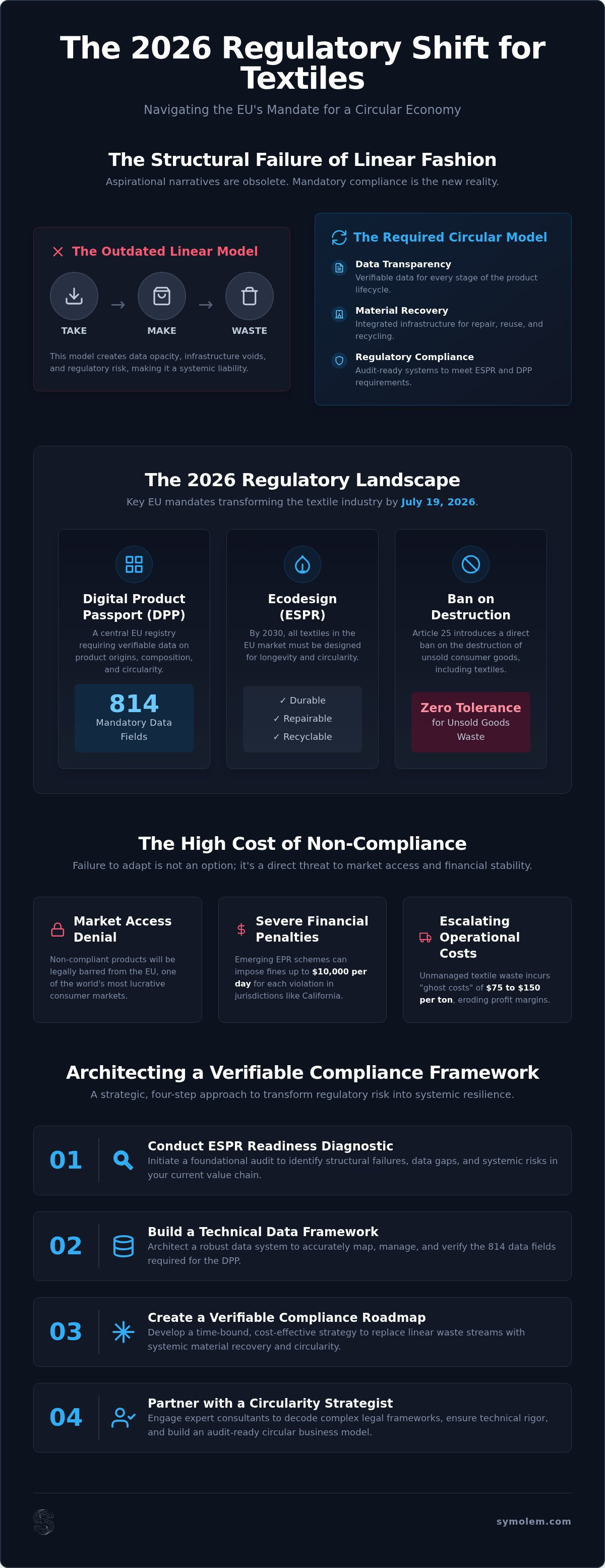
Linear fashion is a systemic liability. The traditional "take-make-waste" model has reached its logical conclusion, hitting a regulatory wall that will dismantle un-integrated supply chains by 2026. True circular fashion is not a marketing goal; it's the rigorous integration of material recovery, data transparency, and regulatory compliance. Organizations currently rely on fragmented systems that cannot support the weight of incoming EU mandates. This structural failure stems from three specific points of collapse: chronic data opacity, massive infrastructure voids, and widening policy gaps. A textile circularity strategy consultant serves as the technical architect required to bridge these divides, moving beyond generalist advice to build verifiable, audit-ready systems.
The transition from linear economics to circular integrity isn't a gradual shift but a forced pivot. As the EU regulatory cliff approaches, brands that fail to map their material flows will find themselves legally barred from the world's most lucrative markets. This isn't about ethics; it's about the clinical reality of market access. Without a robust strategy, the "ghost costs" of unmanaged textile waste, which currently range from $75 to $150 per ton, will become an unbearable weight on the balance sheet. Solving this requires a deep understanding of global value chains and the ability to audit every node for compliance readiness.
Why Soft Sustainability Narratives are Obsolete
Aspirational CSR reports are dead. The shift from voluntary corporate social responsibility to mandatory ESG reporting means that "green" marketing provides zero protection against ESPR enforcement. If you can't verify the durability, repairability, and recyclability of a garment through hard data, your marketing narrative is a legal risk. The 2026 rollout demands clinical precision. Regulatory bodies don't care about your brand's "journey"; they care about the up to 236 data points in the UNTP schema required for the Digital Product Passport. A textile circularity strategy consultant ensures that your data architecture is built for scrutiny rather than storytelling.
Identifying Systemic Risks in Global Value Chains
Most brands suffer from a fundamental disconnect between product design and end-of-life infrastructure. We see products designed for a circularity that doesn't exist in the physical world, creating a void where recovery systems should be. This misalignment exposes companies to massive financial penalties under emerging EPR schemes, especially in jurisdictions like California where non-compliance can cost $10,000 per day. Identifying these risks requires a methodical approach. Initiating an ESPR readiness diagnostic is the foundational first step in mapping these failures and establishing a baseline for systemic integrity.
Mapping the 2026 Regulatory Landscape: ESPR and DPP Integration
The regulatory grace period has ended. By July 19, 2026, the European Commission will have established the central registry for the Digital Product Passport (DPP), a move that forces every textile entity to confront its data deficiencies. This isn't a suggestion. It's a structural mandate under the Ecodesign for Sustainable Products Regulation (ESPR) that requires a clinical transition from opaque supply chains to verifiable transparency. The EU Strategy for Sustainable and Circular Textiles sets a clear trajectory: by 2030, all textile products on the EU market must be durable, repairable, and recyclable. Achieving this requires more than just better materials. It demands a textile circularity strategy consultant who can navigate the technical architecture of delegated acts and ensure legal accountability through the 'Responsible Operator' mandate.
The 'Responsible Operator' is a pivotal legal requirement. This entity, based within the EU, assumes full liability for the product's compliance, from material composition to end-of-life management. This isn't a role for generalists. It requires a deep audit of supply chain nodes to ensure that every claim made in the DPP is substantiated by immutable data. Failure to appoint or support a Responsible Operator with accurate data results in immediate market exclusion. The timeline is aggressive, with textile-specific delegated acts expected to finalize the technical requirements by the end of 2026.
Digital Product Passport: Beyond the QR Code
A QR code is merely the interface. The real challenge lies in the backend data mapping of approximately 814 mandatory fields required for textile DPPs. This architecture must adhere to GS1 Digital Link and UNTP standards to ensure global interoperability across disparate systems. The complexity of Digital Product Passport implementation stems from the need to harmonize data from Tier 4 suppliers through to retail. It's a diagnostic undertaking that identifies where data breaks down and where systemic integrity is lost. Without this technical mapping, the passport remains an empty shell, incapable of meeting EU scrutiny.
Extended Producer Responsibility (EPR) and Market Access
EPR is no longer just a waste management fee. It's a strategic lever. Through eco-modulation, regulators will penalize non-circular designs with significantly higher fees, while rewarding products that facilitate easy disassembly and recycling. These schemes vary across EU member states, creating a fragmented landscape that is difficult to navigate without a structured guide to 2026 regulations. Navigating these fragmented schemes requires the clinical eye of a textile circularity strategy consultant to model the economic impact of design choices on long-term market access. For brands operating at scale, these costs can shift from minor line items to major financial risks. If you need to evaluate your current risk profile, our ESPR Readiness Diagnostic provides a clear, technical baseline for action.
The Economics of Circularity: Infrastructure and Cost Modeling
Linear models are leaking capital. The belief that circularity is inherently more expensive is a diagnostic error based on short-term accounting and a failure to price in regulatory risk. When you factor in the $75 to $150 per ton disposal cost and the catastrophic penalties of $10,000 to $50,000 per day for non-compliance in jurisdictions like California, the ROI of a circular transition becomes undeniable. This shift requires a textile circularity strategy consultant who understands the granular mechanics of cost modeling for physical recovery systems. We don't just see a change in cost; we see a fundamental shift in revenue. Moving from transactional "one-and-done" sales to service-based models, such as rental, repair, and resale, unlocks multiple revenue cycles from a single product unit.
Transitioning to these models represents a structural pivot in how value is captured. By integrating lifecycle services, brands can extract value from the same material asset across multiple stages, effectively decoupling growth from resource extraction. This systemic disruption requires a sophisticated methodology for costing infrastructure at scale, ensuring that capital allocation supports long-term stability rather than short-term fixes. A consultant acts as the architect for this new economic reality, mapping the shift from "cost-per-unit" to "revenue-per-lifecycle" with clinical precision. It is an exercise in engineering a balance sheet that can withstand the volatility of resource scarcity and the rigidity of EU law.
Infrastructure Costing for Global Value Chains
Building a circular loop isn't free. It requires significant capital for automated sorting hubs and chemical recycling facilities that can process the 92 million tons of textile waste generated annually. The economics of reverse logistics often fail because they lack the scale and data integration required to make collection profitable. To navigate these complexities, brands must leverage a cost-benefit analysis of circular textile models to determine where to invest in physical infrastructure versus where to partner with existing recovery networks. This diagnostic approach ensures that capital is not wasted on fragmented solutions that cannot handle the throughput required for compliance.
Eco-Modulation: Turning Compliance into Competitive Advantage
Eco-modulation isn't just a tax; it's a competitive tool. By designing for durability and repairability, brands can systematically lower their mandatory EPR fees, creating a direct impact on product margins. This requires rigorous Monitoring, Reporting, and Verification (MRV) systems to prove performance to regulators. A textile circularity strategy consultant maps these financial levers, ensuring that every design choice is an economic calculation aimed at reducing liability and capturing the 9.2% CAGR projected for the circular fashion market through 2033. High-performing circular designs effectively subsidize their own market access, while linear competitors are taxed out of profitability.
Building a Verifiable Circular Framework: Implementation Strategy
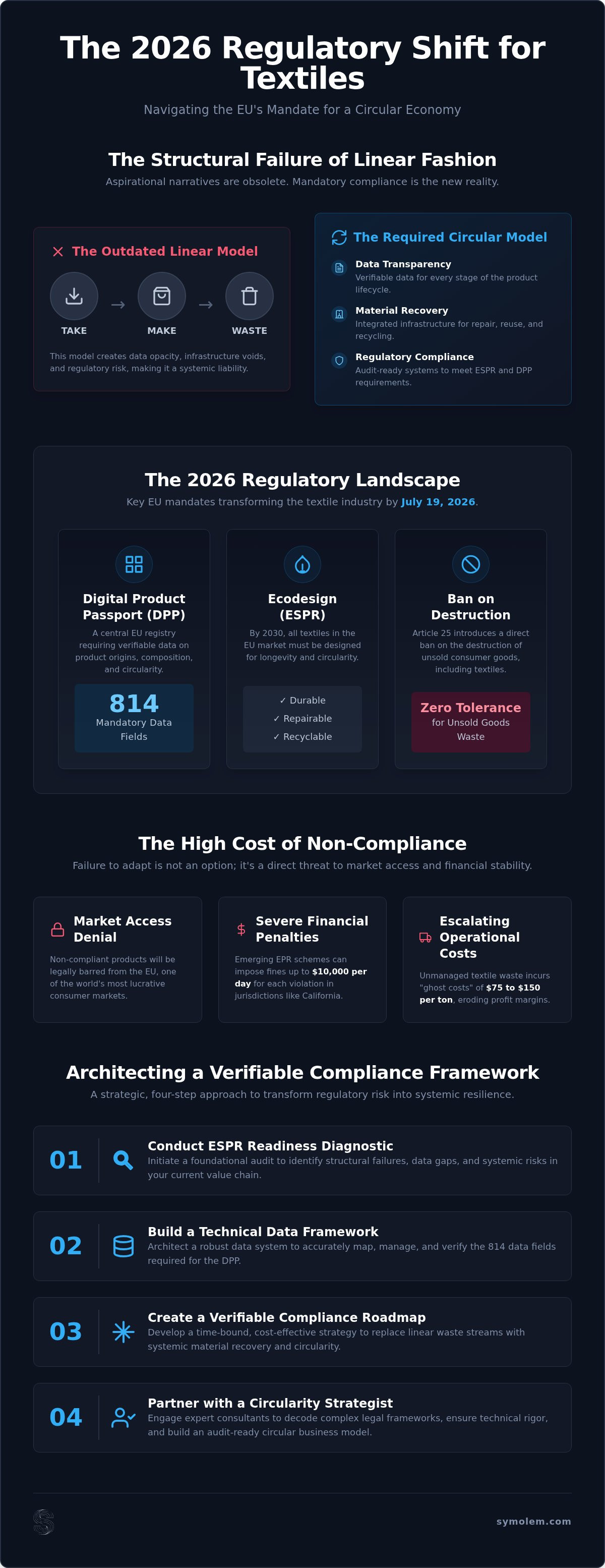
Implementation is not a workshop. It's a rigorous engineering project that demands systemic transformation across every tier of the value chain. To survive the 2026 mandate, organizations must move beyond aspirational goals toward a verifiable circular framework. This process begins with a technical gap analysis against ESPR requirements, identifying exactly where current operations fail to meet the new legal threshold. A textile circularity strategy consultant acts as the lead architect in this transition, mapping supply chain data to the 814 mandatory DPP fields and redesigning product life cycles for maximum durability. The final stages involve implementing robust MRV systems to ensure every claim is audit-ready, followed by the integration of circular performance into core financial and operational reporting.
This five-step trajectory replaces fragmented sustainability efforts with a clinical, diagnostic roadmap. By July 19, 2026, when the EU Digital Product Passport registry is officially established, the time for planning will have passed. Success requires the immediate deployment of systems that can track, verify, and report on material flows with absolute precision. Failure to establish these frameworks doesn't just result in a fine; it results in a total loss of market access. The complexity of these requirements necessitates a structured approach that prioritizes data integrity over superficial narratives.
Data Mapping and Technical Readiness
Data is the currency of compliance. Most brands currently lack the granularity required to populate the Digital Product Passport, particularly at Tier 3 and Tier 4 of the supply chain. Bridging these gaps requires a diagnostic approach to supplier data collection, moving away from self-reported surveys toward verifiable credentials and immutable data sets. Trust is not assumed; it is built through verifying textile sustainability claims for ESPR. Without this level of verification rigor, your DPP will fail the first regulatory audit, exposing the organization to market exclusion and significant financial penalties.
Operationalizing Circular Business Models
Systemic integrity requires a shift in internal metrics. You cannot manage a circular business using linear KPIs. Transitioning to circular performance indicators means measuring revenue per lifecycle, material recovery rates, and the financial impact of durability on long-term margins. This operational shift must extend to procurement strategies, where buyers are incentivized to select materials based on their end-of-life recyclability rather than just upfront cost. The expertise of a textile circularity strategy consultant is essential for aligning these internal structures and ensuring that circularity is not a siloed sustainability project but a core business function. If your data systems cannot support this level of scrutiny, you need an ESPR Readiness Diagnostic to identify your structural vulnerabilities.
Strategic Advisory for Systemic Integrity: The Symolem Approach
Symolem operates as a systemic disruptor. We reject the soft-focus narratives that have historically plagued the fashion industry, positioning ourselves instead as technical architects who build the structural integrity required to withstand the 2026 regulatory shift. The foundation of our approach is the ESPR Readiness Diagnostic, a clinical assessment that identifies specific data gaps and infrastructure voids before they trigger market exclusion. By prioritizing systemic integrity over superficial marketing, we ensure that your business model is not only compliant but also economically resilient against the mounting pressures of EU law. This diagnostic process is the only way to move from speculative sustainability to verifiable, audit-ready operations.
Our focus remains fixed on the granular details of infrastructure costing and regulatory policy. We bridge the gap between high-level sustainability goals and the technical reality of global operations, providing the diagnostic precision needed to map 814 mandatory data fields for the Digital Product Passport. Engaging a textile circularity strategy consultant from Symolem means moving beyond generalist advice toward a technically rigorous framework that treats circularity as a critical business and legal imperative. We don't offer comfort; we offer the truth about your supply chain's readiness for the 2026 cliff, identifying the exact points of failure that threaten your market access.
Why Independent Advisory Matters in 2026
Generalist consultants often promise seamless integration across multiple industries, yet they frequently lack the niche policy focus required for the textile sector's unique challenges. Symolem provides the value of uncompromising realism, challenging established industry norms that prioritize short-term fixes over long-term stability. Our expertise is rooted in the clinical mapping of material flows and the technical requirements of transparency systems. This specialized knowledge is vital for navigating EPR for textiles, where the difference between compliance and exclusion often rests on the accuracy of your eco-modulated fee modeling. We act as an independent voice of clarity in a landscape cluttered with superficial narratives.
Next Steps: Your Path to Regulatory Readiness
The transition to a circular economy is a forced pivot that requires immediate action. To secure your market access, the first step is a comprehensive diagnostic that audits your current supply chain against ESPR and DPP requirements. We provide a structured roadmap for the Digital Product Passport rollout, ensuring your data frameworks are audit-ready and interoperable. Contact Symolem for a technical consultation to begin building a verifiable, compliance-ready business model. As your textile circularity strategy consultant, we'll architect a framework that survives the 2026 mandate and positions your brand as a leader in systemic integrity. There's no room for hesitation; the regulatory clock is already ticking.
Securing Market Access Through Systemic Integrity
The 2026 regulatory shift isn't a distant possibility; it's a hard business reality. By July 19, 2026, the EU Digital Product Passport registry will be active, transforming how material data is tracked across every global value chain. Organizations that fail to move from aspirational narratives to technically rigorous frameworks face immediate market exclusion and staggering daily penalties. Engaging a textile circularity strategy consultant provides the clinical oversight required to bridge the gap between current operational failures and the strict requirements of ESPR and eco-modulated EPR fees.
Symolem provides the specialized expertise needed to map 814 mandatory DPP fields and architect cost-effective circular infrastructure. We don't offer soft-focus solutions. We deliver the diagnostic precision and policy expertise required for systemic stability in a complex landscape. By prioritizing data trust and verification rigor, you transform regulatory risk into a long-term competitive advantage. Building a resilient, circular future is the most effective way to ensure your brand thrives in this new economic landscape. Secure your 2026 regulatory future with a Symolem ESPR Readiness Diagnostic.
Frequently Asked Questions
What does a textile circularity strategy consultant actually do?
A textile circularity strategy consultant acts as a technical architect for global value chains, moving beyond aspirational goals to build verifiable compliance frameworks. They conduct deep-tier audits, map supply chain data for regulatory alignment, and design cost-effective recovery systems. Their role is diagnostic; they identify structural vulnerabilities in linear models and implement systemic remedies that ensure long-term market access under mandates like the ESPR.
How do ESPR regulations affect UK fashion brands selling in the EU?
UK brands must achieve full compliance with ESPR to maintain access to the EU market, as these regulations apply to all products sold within the territory regardless of the producer's origin. This includes adhering to the Article 25 ban on destroying unsold textiles and appointing an EU-based Responsible Operator. Failure to meet these technical standards results in immediate market exclusion, making regulatory readiness a critical legal and economic imperative for British exporters.
What are the core data fields required for a textile Digital Product Passport?
The textile Digital Product Passport requires approximately 814 mandatory data fields that cover the entire product lifecycle. Core fields include detailed material composition, durability metrics, repairability scores, and the presence of substances of concern. Additionally, the DPP must track ownership history and provide clear instructions for end-of-life recovery. These fields must be mapped using interoperable standards like GS1 Digital Link to ensure data transparency across the value chain.
Can circularity strategy reduce the cost of EPR compliance?
Yes, a robust circularity strategy directly reduces Extended Producer Responsibility (EPR) costs through the mechanism of eco-modulation. Regulators utilize these fees to penalize non-circular designs while rewarding products that demonstrate superior durability and recyclability. By architecting products that facilitate easy disassembly and material recovery, brands can systematically lower their mandatory contributions. This transforms compliance from a flat tax into a strategic financial lever that protects product margins.
How long does a typical ESPR readiness diagnostic take?
The duration of an ESPR readiness diagnostic depends on the complexity of the supply chain and the existing state of data maturity. A comprehensive audit typically spans several weeks as it requires meticulous mapping of Tier 1 through Tier 4 suppliers. This diagnostic identifies structural gaps in data collection and material traceability, providing a clinical baseline for the subsequent implementation of compliance frameworks and Digital Product Passport integration.
What is the difference between circularity strategy and general sustainability consulting?
Circularity strategy focuses on the technical and economic architecture of material loops, whereas general sustainability consulting often deals with broad CSR goals and carbon footprinting. A textile circularity strategy consultant prioritizes systemic integrity and regulatory compliance, utilizing clinical data mapping and infrastructure costing to solve specific structural failures. While generalists may focus on aspirational narratives, circularity strategists build the audit-ready frameworks required to survive the 2026 EU regulatory cliff.
Is a Digital Product Passport mandatory for all textiles by 2026?
The European Commission is required to establish the central Digital Product Passport registry by July 19, 2026. While the full rollout across all textile categories will occur in phases through delegated acts, the technical infrastructure must be ready for the initial implementation. Large companies are already facing disclosure requirements for the 2025 financial year, making immediate data mapping a strategic necessity to avoid the risks associated with retroactive compliance.
How can brands cost circular infrastructure effectively?
Effective infrastructure costing requires a clinical shift from transactional accounting to lifecycle value modeling. Brands must factor in the avoided costs of textile waste disposal, currently estimated between $75 and $150 per ton, alongside the potential revenue from resale and rental models. By utilizing a rigorous cost-benefit analysis, organizations can determine the capital requirements for sorting and recycling hubs while identifying where collaborative recovery networks offer superior economic stability.