Technical Advisory for Textile Circularity: Navigating the 2026 Regulatory Mandate
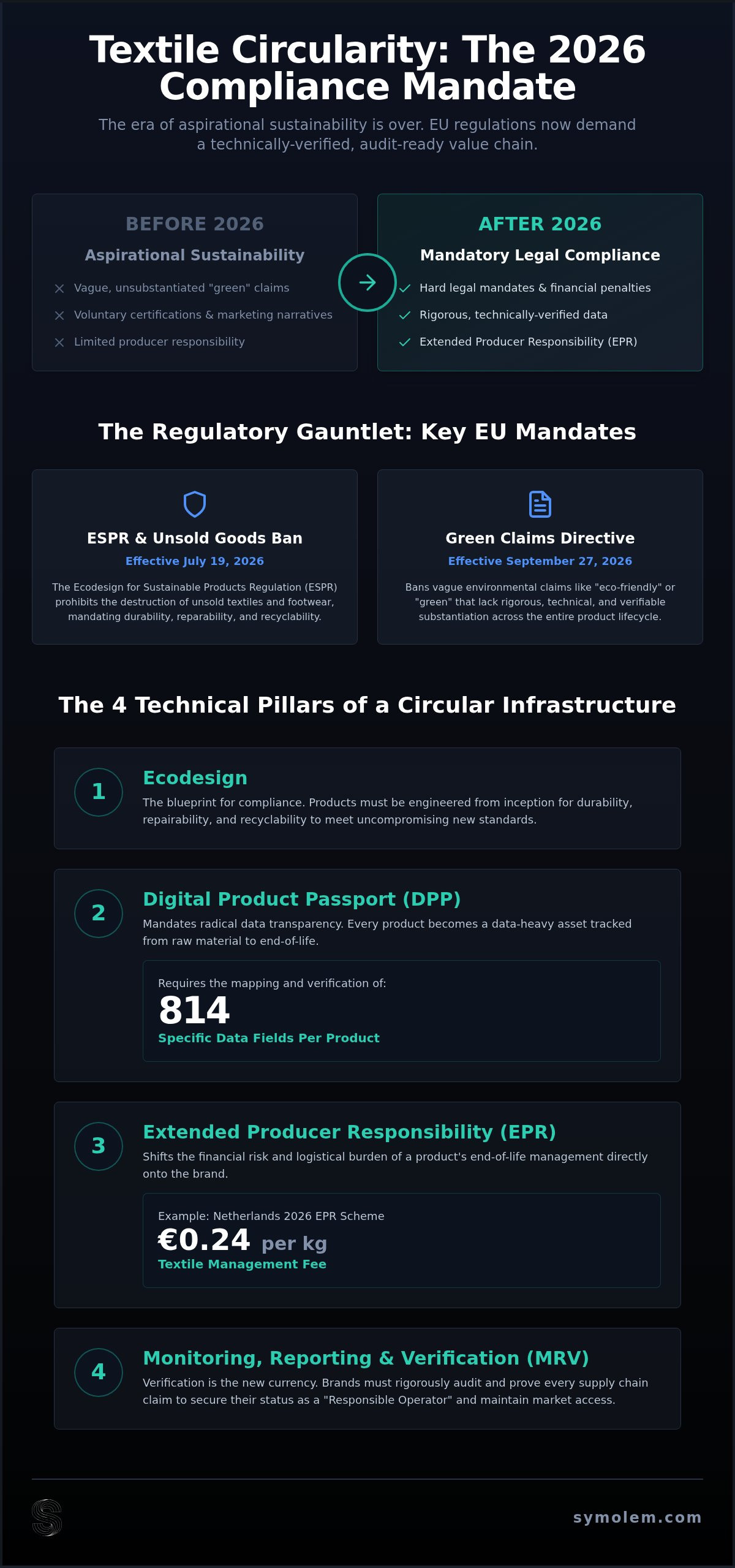
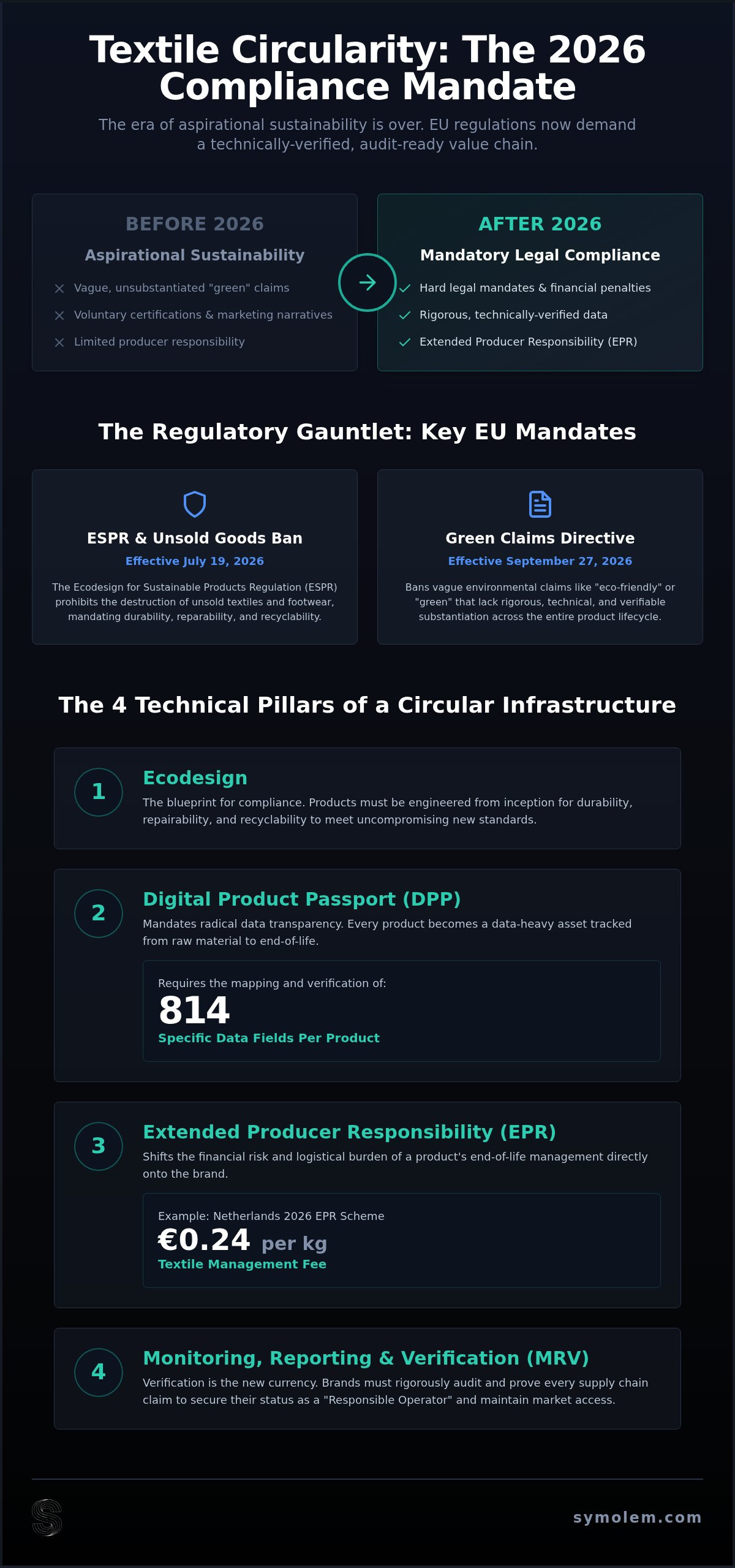
Aspirational sustainability is dead. On July 19, 2026, the EU ban on the destruction of unsold textiles transformed circularity from a marketing narrative into a hard legal mandate. This shift demands more than just a change in rhetoric; it requires a rigorous, ground-up re-engineering of your value chain to accommodate the up to 236 data points in the UNTP schema required for the Digital Product Passport and the complex economics of Extended Producer Responsibility schemes. Seeking a technical advisory for textile circularity is no longer a luxury for the forward-thinking. It's a diagnostic necessity for those who intend to remain commercially viable in a landscape where non-compliance is a tangible financial liability.
The regulatory ground is shifting, leaving no room for the vague environmental claims that the Green Claims Directive will ban starting September 27, 2026. This article provides the technical roadmap and infrastructure costing models you need to move from speculative pilots to a verified, audit-ready circular system. We'll analyze the specific mechanics of data mapping, evaluate the financial impact of the €0.24 per kg Netherlands EPR fee, and establish a framework for systemic integrity that satisfies both EU and UK standards.
Key Takeaways
- Identify why 2026 represents a definitive shift from voluntary sustainability to mandatory legal compliance under the EU Ecodesign for Sustainable Products Regulation.
- Analyze the four technical pillars—Ecodesign, DPP, EPR, and MRV—required to build a systemic and legally defensible circular value chain.
- Utilize technical advisory for textile circularity to master the mapping of 814 specific data fields required for Digital Product Passport integration.
- Quantify the economic realities of circularity by evaluating the true costs of textile recovery infrastructure against emerging operational fees and EPR mandates.
- Establish a rigorous framework for impact measurement and MRV to secure your status as a "Responsible Operator" within the global textile market.
Table of Contents
- The Transition from Aspirational Sustainability to Technical Compliance
- The Technical Pillars of Circular Textile Infrastructure
- Evaluating the Economics of Textile Recovery Systems
- Mapping the Technical Requirements for Digital Product Passport (DPP) Integration
- Strategic Implementation: Integrating Circularity into Global Value Chains
The Transition from Aspirational Sustainability to Technical Compliance
Aspirational sustainability has failed. For years, the textile industry relied on voluntary certifications and vague marketing narratives to project an image of environmental stewardship. This era of soft-focus sentimentality ended on July 19, 2026, when the EU Ecodesign for Sustainable Products Regulation (ESPR) officially prohibited the destruction of unsold textiles and footwear. Circularity is no longer a choice or a marketing pillar. It's a hard legal requirement for market access. The shift from "doing better" to "being compliant" marks a violent correction in how global value chains must operate. A rigorous technical advisory for textile circularity serves as the diagnostic architect for this new reality, replacing ethical storytelling with structural business integrity.
The 2026 regulatory mandate represents a hard deadline for readiness. Many brands have discovered that their existing sustainability initiatives lack the clinical precision required to withstand a regulatory audit. Circularity isn't a peripheral project; it's a fundamental re-engineering of the product lifecycle. If your business model can't account for the granular mechanics of textile recycling processes or the recovery of raw materials, it's a liability. The industry's reliance on superficial narratives has created a structural fragility that the 2026 mandates will ruthlessly expose.
The Legal Imperative of ESPR and EPR
The ESPR framework introduces uncompromising standards for product durability, reparability, and recyclability. It's paired with Extended Producer Responsibility (EPR) schemes that shift the financial risk of a product's end-of-life management directly onto the brand. In the Netherlands, for instance, the 2026 textile management fee of €0.24 per kg serves as a tangible economic penalty for waste. Non-compliance doesn't just result in fines. It leads to total market bans across the EU. These regulations treat every garment as a data-heavy asset that must be tracked from inception to recovery. Engaging a technical advisory for textile circularity allows brands to bridge the gap between their current operational failures and these new legal mandates.
Moving Beyond the Sustainability Story
The Empowering Consumers for the Green Transition Directive (ECGTD) will apply across all EU Member States from September 27, 2026. It effectively bans "green" or "eco-friendly" claims that lack rigorous, technical substantiation. Qualitative goals are being replaced by quantitative metrics and verified data. To survive, brands must transition from aspirational storytelling to rigorous Impact Measurement and Monitoring, Reporting, and Verification (MRV). This requires auditing every supply chain claim against 814 specific data fields. Verification is the new currency of the textile market, and technical advisory is the only way to mint it with precision.
The Technical Pillars of Circular Textile Infrastructure
Circularity is not a concept. It is a structural engineering requirement. The transition to a compliant textile model rests on four technical pillars: Ecodesign, the Digital Product Passport (DPP), Extended Producer Responsibility (EPR), and Monitoring, Reporting, and Verification (MRV). These pillars do not function in isolation. They form an interconnected, legally defensible value chain where product design dictates data requirements, data informs financial liability, and verification secures market access. Without a unified data architecture, these pillars collapse into a series of fragmented, non-compliant initiatives.
Interoperability is the critical friction point. Global value chains currently operate on siloed data systems that cannot support the 814 specific data fields mandated for the textile DPP. A robust technical advisory for textile circularity provides the necessary bridge, translating high-level EU policy into granular operational frameworks. This process involves mapping the economics of textile recovery against current manufacturing capabilities to identify where structural adjustments are mandatory for 2026 readiness.
Ecodesign Requirements for Apparel
Ecodesign is the blueprint for compliance. It mandates specific technical standards for durability, repairability, and recyclability that must be integrated at the fiber level. This includes the elimination of hazardous substances, such as the PFAS bans taking effect in France and Denmark in 2026, and the new REACH restrictions on PFHxA substances applying from October 10, 2026. Manufacturers must adopt frameworks for disassembly, ensuring that garments can be mechanically or chemically separated without compromising material purity. These specifications are not suggestions; they are the baseline for legal market entry.
Monitoring, Reporting, and Verification (MRV)
MRV is the mechanism of truth. It establishes a rigorous protocol for substantiating impact claims, moving beyond self-reported estimates to third-party verified data. In an environment where the Green Claims Directive penalizes unsubstantiated labels, data integrity across multi-tier supplier networks is non-negotiable. This requires a systematic audit of every tier in the supply chain to ensure that the data feeding into the DPP is accurate and legally defensible. Engaging a technical advisory for textile circularity ensures that these verification protocols are not just compliant, but optimized for long-term systemic stability. Brands should consider an ESPR Readiness Diagnostic to identify critical gaps in their current verification protocols before the 2026 deadlines arrive.
Evaluating the Economics of Textile Recovery Systems
Circularity is a financial restructuring. It is not an ethical sentiment. For brands operating in 2026, the transition to a circular model is a cold calculation of primary product margins against the rising costs of recovery infrastructure and operational fees. The Sustainable Textile Policy Landscape has evolved into a system of financial penalties for linear waste. If your recovery costs exceed your margin, your business model is structurally obsolete. A specialized technical advisory for textile circularity provides the diagnostic rigor necessary to model these costs before they become liabilities on a balance sheet.
Generalist consultants often fail to grasp the granular reality of textile-specific recovery economics. They overlook the logistical friction of reverse supply chains and the variable costs of chemical versus mechanical recycling. Technical advisory acts as a strategic architect, integrating circularity costs directly into the product lifecycle. This ensures that compliance is not an added tax but a built-in operational standard.
Infrastructure Costing and Modeling
Infrastructure requirements represent a significant capital expenditure (CAPEX) that brands must justify through long-term systemic stability. Modeling the financial impact of EPR fees is critical; for instance, the Netherlands management fee of €0.24 per kg is just one example of the eco-modulated costs emerging across EU member states. Brands must utilize a cost-benefit analysis of circular textile models to evaluate the ROI of these investments. This modeling must account for:
- Variable EPR fees based on product durability and recyclability metrics.
- The CAPEX required for automated sorting and advanced disassembly technologies.
- Operational costs associated with multi-tier data collection for the Digital Product Passport.
The ROI of Regulatory Readiness
Regulatory readiness is a competitive advantage. Brands that integrate technical circularity early avoid the panicked, high-cost pivots that follow a market ban or a massive non-compliance fine. Beyond mere avoidance, digitized supply chain management creates efficiency gains by reducing waste and optimizing material flows. This level of technical integration future-proofs brand value against the rising tide of climate litigation. When circularity is treated as a core business function, it becomes a driver of systemic resilience rather than a drain on resources. Engaging a technical advisory for textile circularity ensures that your economic modeling is as rigorous as the regulations you are required to meet.
Mapping the Technical Requirements for Digital Product Passport (DPP) Integration
The Digital Product Passport (DPP) is the ultimate arbiter of market access. It's not a label. It's a comprehensive data architecture that mirrors the physical product throughout its lifecycle. By 2026, apparel brands must disclose granular details across 814 specific data fields, ranging from raw material chemistry to repairability metrics. This level of transparency exposes the structural failures of current supply chain management where data is often fragmented, unverified, or entirely absent. A specialized technical advisory for textile circularity is essential for implementing Digital Product Passports that meet the diagnostic rigor of the ESPR.
Data governance remains a critical structural hurdle. In a circular value chain, the question of who owns the data is as important as the data itself. Brands must establish clear protocols for data sovereignty to ensure that proprietary manufacturing techniques are protected while meeting mandatory transparency requirements. This requires a shift from transactional supplier relationships to integrated data ecosystems where systemic integrity is the shared objective.
Granular Data Mapping for Manufacturers
Mapping data across multi-tier supplier networks requires clinical precision. Most brands possess visibility into their tier 1 facilities, yet the 2026 mandate requires verified data from tier 2 and tier 3 suppliers where the most significant environmental impacts occur. The technical architecture of a DPP must utilize interoperable standards, such as GS1 and the United Nations Transparency Protocol (UNTP), to ensure data can be exchanged across different platforms without friction. Technical advisory for textile circularity facilitates this by identifying data gaps and implementing automated collection systems. These systems must be designed to aggregate data without compromising supplier confidentiality, utilizing decentralized identifiers to verify claims without exposing sensitive commercial secrets.
Overcoming Implementation Challenges
Implementation is not a static event. Addressing the challenges of Digital Product Passport implementation requires a move away from "snapshot" reporting toward a living document model. The DPP must be updated as a product moves through repair, resale, and eventually, recycling. This lifecycle tracking requires secure, verifiable credentials that prevent data tampering and ensure the audit trail remains intact for regulatory scrutiny. Technical advisory provides the strategic architecting needed to integrate these credentials into existing ERP systems, ensuring that the DPP remains a reliable source of truth from production to recovery.
To secure your position in the 2026 market, you must move beyond pilots to scalable data infrastructure. Contact Symolem to establish a robust Digital Product Passport Framework tailored to your global value chain.
Strategic Implementation: Integrating Circularity into Global Value Chains
Implementation is where aspirational theory meets the friction of global logistics. The ESPR framework introduces the role of the "Responsible Operator," a designation that carries significant legal and financial accountability for product compliance across the entire lifecycle. This role requires more than oversight; it demands a clinical command of every node in the value chain. Executing a comprehensive textile impact measurement and MRV strategy is the only way to validate that your global operations align with these new mandates. Without a verified data trail, your status as a responsible operator is legally indefensible.
Designing circular infrastructure is particularly complex in emerging markets where the majority of textile production occurs. With the Asia Pacific region accounting for over 22% of the recycled textile market share in 2026, brands can't afford to ignore the technical limitations of their manufacturing hubs. Systemic integrity must be built into the local infrastructure, ensuring that recovery and recycling processes meet EU standards before goods ever reach a European port. Symolem’s diagnostic approach serves as the logical remedy for compliance anxiety, providing the technical architecture needed to bridge these geographical and regulatory divides through a technical advisory for textile circularity.
The ESPR Readiness Diagnostic
Compliance begins with a brutal assessment of current failures. An effective implementation starts with conducting a deep-dive gap analysis of existing supply chain visibility to identify where data is unverified or missing. This diagnostic process allows brands to prioritize technical interventions based on the immediate regulatory risk of specific product categories or manufacturing regions. The result is a structured 2026-2030 circularity roadmap that moves beyond reactive fixes toward long-term systemic stability. Without this diagnostic foundation, any attempt at circularity is merely a temporary patch on a failing system.
Technical Advisory as a Competitive Advantage
Technical rigor is the ultimate differentiator in a transparent market. Moving from defensive compliance to strategic leadership allows brands to capture value that their less-prepared competitors will lose to fines and market exclusions. This high-stakes transition builds a level of investor and consumer trust that can't be replicated through marketing alone. When your circular claims are backed by audited, technical data, you secure a position of strength in a volatile global economy. Engaging a technical advisory for textile circularity ensures that your brand is viewed as a systemic architect rather than a regulatory laggard. Secure your market access and establish your roadmap by initiating an ESPR Readiness Diagnostic today.
Architecting Systemic Integrity for 2026 and Beyond
The transition from aspirational sustainability to technical compliance is final. Market access in 2026 depends on your ability to navigate the complex interplay of ESPR mandates, eco-modulated EPR fees, and the clinical data requirements of the Digital Product Passport. Circularity is no longer an ethical narrative; it's a structural business requirement that demands uncompromising realism and a verified data architecture. Brands that fail to re-engineer their value chains now will face tangible financial liabilities and total market exclusion.
Securing your position requires a specialized technical advisory for textile circularity to bridge the gap between high-level policy and granular operational reality. Symolem provides independent, expert-led diagnostics and strategic advisory for global ESPR compliance. We specialize in the technical mapping of 814 DPP data fields to ensure your supply chain claims are audit-ready and legally defensible. You have the opportunity to transform regulatory pressure into a strategic advantage by building a resilient, circular infrastructure today. Request a Technical Compliance Diagnostic to verify your readiness and lead the transition toward systemic integrity.
Frequently Asked Questions
What is the specific role of a technical advisor in textile circularity?
A technical advisor acts as the strategic architect who translates high-level regulatory mandates into granular operational frameworks. Unlike generalist consultants, they focus on the mechanical and economic realities of material recovery and data sovereignty. Their role involves mapping complex value chains, auditing multi-tier supplier data, and re-engineering products to meet strict Ecodesign standards. This technical advisory for textile circularity ensures that every garment produced is a compliant, data-heavy asset rather than a legal liability.
How does technical circularity differ from traditional fashion sustainability?
Technical circularity replaces aspirational storytelling with clinical, diagnostic verification. While traditional sustainability relies on voluntary goals and qualitative narratives, technical circularity is a hard legal requirement for market entry. It demands quantitative metrics, such as specific durability scores and chemical transparency, that are verified through third-party Monitoring, Reporting, and Verification (MRV) protocols. This shift moves the industry from "doing less harm" to maintaining systemic integrity within a strictly regulated, closed-loop economy.
What are the main technical requirements for ESPR compliance in 2026?
Compliance requires adherence to the Ecodesign for Sustainable Products Regulation, which mandates product durability, reparability, and the presence of a Digital Product Passport. As of July 19, 2026, large enterprises are prohibited from destroying unsold textiles and footwear. Brands must also eliminate hazardous substances, including PFAS, and ensure their products are designed for disassembly. These technical specifications are non-negotiable baselines for entering the EU market, requiring a total overhaul of existing manufacturing and disposal processes.
How many data fields are actually required for a textile Digital Product Passport?
There are 814 specific data fields currently identified for textile products within the Digital Product Passport framework. These fields cover the entire product lifecycle, including raw material chemistry, manufacturing locations, and end-of-life recovery instructions. Managing this volume of data requires a robust digital architecture that ensures interoperability across global supply chains. A technical advisory for textile circularity is essential for mapping these fields accurately to prevent data gaps that could trigger regulatory audits or market bans.
Can technical advisory help reduce the cost of EPR compliance?
Strategic technical advisory reduces financial liability by optimizing product design to trigger lower eco-modulated fees. In jurisdictions like the Netherlands, where the 2026 management fee is €0.24 per kg, brands can mitigate costs by increasing recyclability and durability metrics. By modeling these costs during the design phase, advisors help brands avoid the "compliance tax" associated with linear waste. This proactive approach integrates end-of-life economics into the primary product margin, ensuring long-term profitability in a regulated market.
What is the first step in a textile circularity technical diagnostic?
The initial step is a comprehensive gap analysis of current supply chain visibility, specifically targeting tier 2 and tier 3 suppliers. Most brands lack the granular data required for 2026 mandates, making it critical to identify where information is unverified or missing. This diagnostic evaluates existing ERP systems against the 814 mandatory DPP fields to establish a baseline for technical readiness. This process allows brands to prioritize interventions based on regulatory risk and build a legally defensible implementation roadmap.
How does Symolem ensure data accuracy in complex global supply chains?
Symolem ensures data integrity through a rigorous Impact Measurement and MRV framework that utilizes third-party auditing and technical verification. We move beyond self-reported supplier estimates by implementing standardized data collection protocols that satisfy the diagnostic rigor of the ESPR. By mapping every data point to specific regulatory requirements, we create a transparent audit trail. This methodical approach eliminates the structural failures inherent in fragmented supply chains, providing brands with verified data that withstands legal scrutiny.
Is technical advisory necessary for small to medium-sized fashion brands?
Technical advisory is critical for SMEs because regulatory thresholds for ESPR and EPR schemes are rapidly expanding to include medium-sized operators. While large enterprises face the earliest deadlines, the systemic shift toward circularity affects the entire ecosystem, including sub-contractors and smaller labels. SMEs often lack the internal data infrastructure to manage 814 DPP fields, making external expertise necessary to maintain market access. Early technical integration prevents the high-cost pivots that occur when smaller brands are suddenly locked out of major markets.