Mapping DPP Data Fields for Apparel: 2026 Compliance
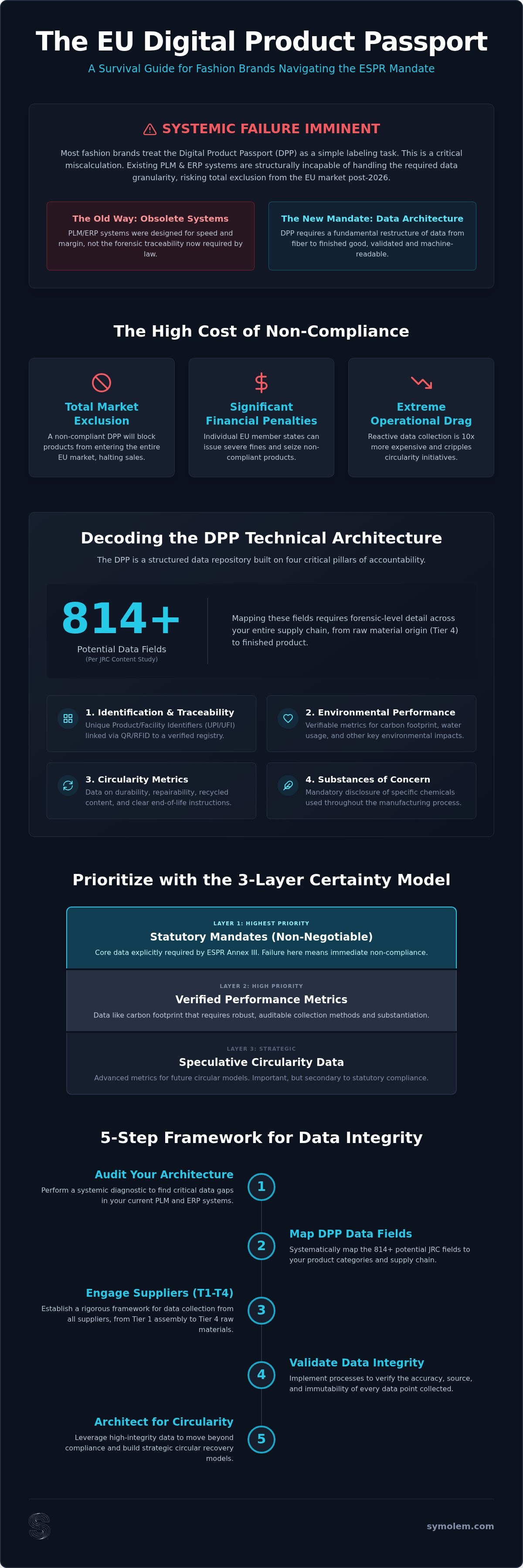
The current approach to EU compliance is a systemic failure in the making. Most fashion brands are treating the Digital Product Passport as a secondary labeling requirement rather than a fundamental restructuring of their data architecture. This clinical negligence ignores the reality that mapping DPP data fields for apparel requires a level of granular visibility that current PLM and ERP systems simply cannot sustain. The cost of technical non-compliance is not just a fine; it is the total exclusion from the EU market as the 2026 deadlines solidify.
You recognize that your supply chain data is fragmented and that the final delegated acts for the Ecodesign for Sustainable Products Regulation remain a moving target. This guide provides the authoritative framework needed to architect data integrity across the 814 potential fields identified by the Joint Research Centre. We will move through a methodical diagnostic of data categories, establish a rigorous framework for supplier collection, and define the technical requirements for a compliant, circular value chain. Understanding these mechanics is no longer optional for brands that intend to exist past 2027.
Key Takeaways
- Identify why standard PLM systems are structurally incapable of meeting ESPR mandates and how to audit your existing data architecture for systemic gaps.
- Master the technical architecture of the Digital Product Passport by mapping DPP data fields for apparel across the 814 categories defined by the JRC Content Study.
- Implement a 3-Layer Certainty Model to prioritize non-negotiable Annex III statutory mandates over speculative circularity performance metrics.
- Execute a five-step forensic mapping framework to bridge critical data silos between Tier 1 and Tier 4 suppliers before the 2026 enforcement window.
- Leverage high-integrity data to transition from defensive compliance toward a strategic cost-benefit analysis of circular textile recovery models.
Table of Contents
- Beyond the Spreadsheet: The Systemic Crisis of Apparel Data Mapping
- Decoding the Technical Architecture: The Core DPP Data Categories
- Statutory vs. Performance Data: The 3-Layer Certainty Model
- The Mapping Framework: 5 Steps to Data Integrity
- From Compliance to Circularity: Architecting Your DPP Strategy
Beyond the Spreadsheet: The Systemic Crisis of Apparel Data Mapping
Readiness is a myth. Most apparel executives believe their existing Product Lifecycle Management (PLM) systems can pivot to meet the EU's new mandates. They're wrong. Current systems were designed for design speed and margin optimization, not forensic traceability. Mapping DPP data fields for apparel is not a clerical task; it's a structural overhaul of how a brand validates its existence in the market. It requires shifting from aspirational marketing narratives to clinical, verifiable data points that can survive a regulatory audit. Without a rigorous ESPR readiness diagnostic, brands are essentially guessing which parts of their supply chain will fail first.
The Regulatory Cost of Data Fragmentation
Data fragmentation is now a legal liability. If a brand cannot verify the chemical compliance of a Tier 3 dyehouse or the fiber origin of a Tier 4 mill, the product is legally non-compliant. Under the Digital Product Passport (DPP) framework, "unknown" supply chain nodes are no longer acceptable risks. They are immediate triggers for market exclusion. This fragmentation creates severe economic bottlenecks:
- Enforcement Penalties: Incomplete records can lead to product seizures and significant financial fines under individual EU member state enforcement acts.
- Circular Stagnation: Inaccurate material data makes textile recovery impossible, as recyclers cannot safely process garments with unverified chemical or fiber content.
- Operational Drag: Reactive data collection after a product is flagged is ten times more expensive than proactive, diagnostic supply chain forensics.
Why ESPR Article 7 Changes the Game
Article 7 of the Ecodesign for Sustainable Products Regulation (ESPR) introduces the concept of the "Responsible Operator." This entity is legally accountable for the integrity of every data point within the passport. This shifts transparency from a voluntary PR exercise to a mandatory, machine-readable requirement. It's a move toward systemic accountability where the data must be as durable as the garment itself. For global apparel value chains, this means that the era of plausible deniability regarding supplier behavior is over. The "Responsible Operator" must ensure that every data carrier is linked to a verified, immutable record of the product's journey from fiber to finished good. This transition requires a high-level strategic pivot that treats data architecture as a core business infrastructure rather than a back-office utility.
Decoding the Technical Architecture: The Core DPP Data Categories
The Digital Product Passport is not a static document. It is a structured, machine-readable repository of product-specific circularity metrics that must be interoperable across the entire EU market. Mapping DPP data fields for apparel requires a deep alignment between the high-level legal mandates of ESPR Annex III and the granular technical specifications of the Joint Research Centre (JRC) Content Study. This intersection defines the technical architecture of the passport, grouping over 800 potential data points into four critical pillars: Identification, Performance, Circularity, and Substances. Each pillar represents a layer of accountability that brands must architect before the 2026 enforcement window closes.
Product Identification and Traceability Fields
Verification begins with identity. Every garment must be assigned a Unique Product Identifier (UPI) and every production site a Facility Identifier (UFI). These are not mere internal SKU numbers; they are standardized strings that must be accessible via machine-readable carriers such as QR codes or RFID tags utilizing the GS1 Digital Link standard. This creates a direct link to the EU's official DPP requirements for apparel, ensuring that the geographic origin of raw materials is distinct from manufacturing sites. It's a level of forensic detail that exposes every node in the value chain to regulatory scrutiny. If the carrier fails to resolve to a verified registry, the product is effectively invisible to the EU market.
Environmental Performance and Circularity Metrics
The passport demands hard numbers. Carbon and water footprint data must be mapped at the SKU level, moving away from industry averages toward primary data collection from specific production batches. Brands must document durability, repairability, and recyclability scores according to the specific JRC methodology. This includes calculating recycled content by mass and providing verifiable credentials for the chain of custody. Success in this area depends on verifying textile sustainability claims for ESPR through a rigorous MRV (Monitoring, Reporting, and Verification) process. Without this verification rigor, circularity scores are merely speculative and legally indefensible. The data must prove the product's performance, not just describe it.
Architecting this data repository is a high-stakes engineering challenge. It requires a strategic redesign of supply chain relationships and a transition toward real-time data exchange. For brands struggling to reconcile their current data silos with these mandates, securing an ESPR Readiness Diagnostic is the first step toward building a data map that is as resilient as the regulations it serves.
Statutory vs. Performance Data: The 3-Layer Certainty Model
Uncertainty is not an excuse for inaction. Many fashion brands stall their implementation because the final delegated acts for textiles are still being refined, yet the core legal framework of the ESPR is already active. Mapping DPP data fields for apparel requires a strategic prioritization based on legal certainty rather than waiting for a perfect data set. We categorize these requirements into a 3-layer model: Layer 1 consists of statutory mandates already codified in ESPR Annex III; Layer 2 covers textile-specific fields proposed in the JRC preparatory studies; and Layer 3 involves the evolving methodological horizon where the European Commission will define future performance metrics. This tiered approach allows brands to build a resilient architecture that survives regulatory evolution.
Layer 1: Immediate Data Priorities for 2026
Compliance begins with the non-negotiables. Layer 1 encompasses data points that are already legally mandated for any product passport under the ESPR framework, regardless of the specific textile delegated act. This includes the identification of substances of concern, basic product identifiers, and ownership data. Establishing a data governance framework for these fields is an immediate requirement. By addressing the challenges of Digital Product Passport implementation early, brands can secure the foundation of their data architecture before the more complex, industry-specific requirements are finalized. These fields are the bedrock of legal market access.
Navigating Layers 2 and 3: Strategic Hedging
The second and third layers require intellectual agility and a willingness to build for future-state requirements. Layer 2 includes proposed metrics such as microplastic shedding rates, fiber-to-fiber recyclability percentages, and durability scores, which are currently being evaluated by the JRC. While not yet finalized law, these fields represent the likely future of textile compliance and should be integrated into your data map now. Layer 3 represents the methodological horizon, where the Commission will determine how to measure complex environmental impacts over time. Mapping these fields requires building flexible data architectures that can pivot as delegated acts are signed. This is where policy advisory becomes critical; brands must interpret methodological shifts to ensure their systems don't become obsolete before they even launch. Failure to hedge against these layers results in a "compliance debt" that will be expensive to clear in 2027.
- Layer 1 (Statutory): Substances of concern, UPI/UFI identifiers, and compliance documentation.
- Layer 2 (Proposed): Recycled content mass, repairability scores, and microplastic shedding data.
- Layer 3 (Horizon): Future PEF (Product Environmental Footprint) alignment and evolving circularity indicators.
The Mapping Framework: 5 Steps to Data Integrity
The illusion of compliance is more dangerous than total ignorance. Many brands believe that purchasing a software license solves the Digital Product Passport requirement, yet software is useless without a rigorous data architecture. Mapping DPP data fields for apparel requires a methodical, five-step framework that prioritizes systemic integrity over superficial reporting. This is not a project for the marketing department; it is a high-stakes engineering and legal mandate.
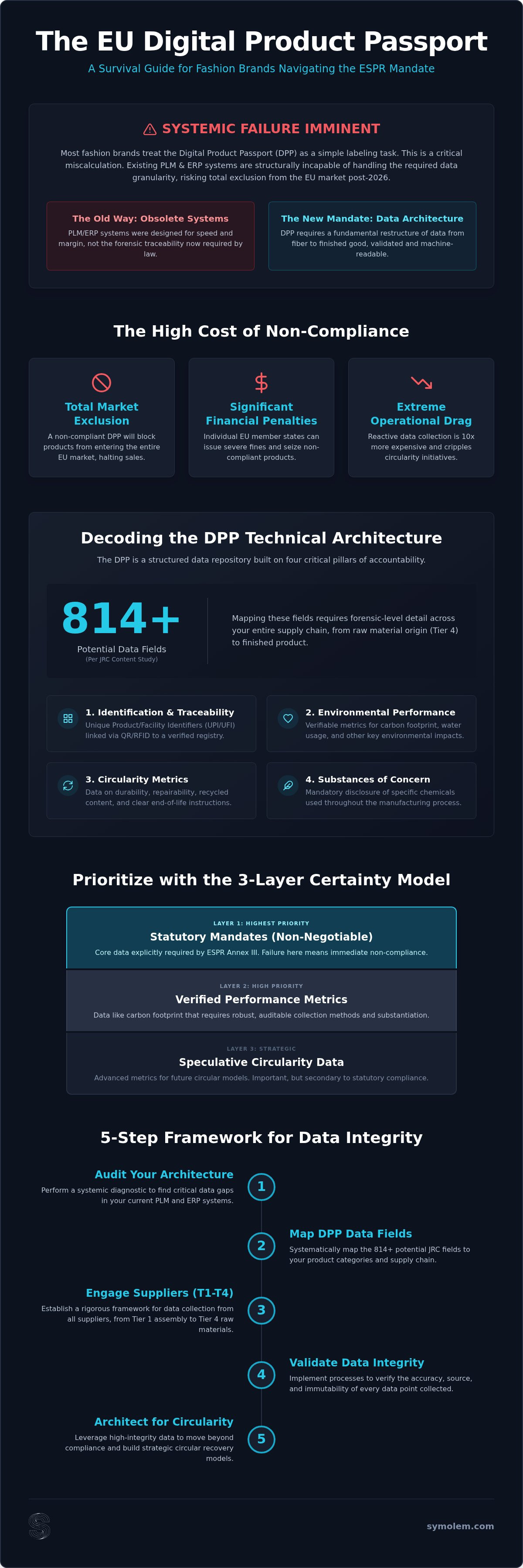
Step 1: Conduct a Compliance Diagnostic. You must identify existing data silos within your PLM and ERP systems to understand where information is missing or unverified. Start with an ESPR Readiness Diagnostic to establish your baseline. Step 2: Execute Supply Chain Forensic Mapping. Move beyond Tier 1 and reach into Tier 4 to uncover the raw material origins. Step 3: Define Technical Field Attributes. Every field must have a defined data type, a verified source, and a specific verification method. Step 4: Implement Verifiable Credentials. Utilize trust frameworks to ensure data cannot be tampered with. Step 5: Audit for Regulatory Readiness. Continuously cross-reference your map against the latest ESPR drafts and JRC studies.
Supply Chain Forensic Mapping
Supplier self-assessments are a relic of the past. They lack the verification rigor required by the EU's new transparency standards. Forensic mapping demands primary data collection directly from manufacturing hubs in emerging markets. This involves standardizing data formats across global vendor bases to ensure interoperability. You don't need a survey; you need a verifiable audit trail that connects a specific batch of cotton to a specific finished garment. This level of granularity is the only way to mitigate the legal risks of "unknown" supply chain nodes.
Verifiable Credentials and Data Security
Transparency does not mean the surrender of intellectual property. Decentralized identifiers and verifiable credentials allow brands to meet transparency mandates while protecting sensitive trade secrets. By utilizing these trust frameworks, you ensure that data is persistent, machine-readable, and immutable. This architecture prevents data corruption and ensures that the information remains accessible for the entire lifecycle of the product. If your data isn't machine-readable by 2026, your product doesn't exist in the eyes of EU customs. To secure your market position, schedule an ESPR Readiness Diagnostic today.
From Compliance to Circularity: Architecting Your DPP Strategy
Compliance is the baseline, not the destination. While the immediate pressure focuses on avoiding market exclusion, mapping DPP data fields for apparel is actually the first step toward a rigorous cost-benefit analysis of circular textile models. Brands that view the Digital Product Passport solely through the lens of regulatory defense are missing the structural opportunity. High-integrity data allows you to transition from treating compliance as a sunk cost to utilizing data as a strategic asset. It's the infrastructure required to optimize textile recovery, refine circular logistics, and justify the investment in localized recycling systems.
The shift from linear to circular systems depends on the granular visibility of material flows. When you map technical attributes such as fiber composition and chemical treatments at the SKU level, you aren't just checking a box for a customs official. You're building a dataset that enables automated sorting and high-value recycling. This data persistence ensures that the economic value of a garment is preserved beyond its first point of sale, turning a liability into a feedstock for future production cycles.
Integrating Mapping with Business Model Innovation
Accurate data mapping is the engine of financial efficiency in the era of Extended Producer Responsibility (EPR). Successfully navigating EPR for textiles relies on your ability to prove the circularity of your products to reduce eco-modulated fees. If your field mapping is incomplete, you'll be forced to pay the highest penalty rates by default. By architecting your data to reflect durability and recyclability, you can cost the infrastructure for circularity with clinical precision. This allows for a strategic realignment of your business model where profitability is decoupled from raw material extraction.
Symolem: Your Partner in Technical Regulatory Readiness
Symolem acts as the technical architect for global fashion brands facing these systemic shifts. We provide the expert-led advisory necessary to navigate the 814 potential data fields of the DPP, moving far beyond the capabilities of generic software solutions. Our approach is diagnostic and structured, ensuring your compliance roadmap is grounded in economic reality rather than aspirational narratives. We help you build the frameworks for impact measurement and regulatory alignment that current systems lack.
The 2026-2027 compliance window is narrowing. Securing your market position requires an immediate transition from fragmented spreadsheets to a rigorous data architecture. Contact Symolem to initiate your ESPR Readiness Diagnostic and begin the forensic mapping of your value chain. Don't wait for the delegated acts to finalize; the structural requirements for data integrity are already here.
Securing Your Market Position in the Circular Economy
The shift toward mandatory transparency is an irreversible structural change. Mapping DPP data fields for apparel is the only way to ensure your products remain visible and legal within the EU market. You've seen that standard PLM systems are inadequate and that waiting for the final delegated acts is a recipe for systemic failure. By adopting a 3-layer certainty model and a forensic mapping framework, you can transform these regulatory burdens into a foundation for business model innovation. This transition from defensive compliance to strategic data governance is what separates the survivors from the casualties of the 2026 enforcement window.
Symolem provides independent, authoritative policy advisory and technical expertise in ESPR and DPP frameworks to help you navigate this transition with clinical precision. Don't leave your data integrity to chance. Architect your compliance strategy with a Symolem ESPR Readiness Diagnostic and secure your 2026-2027 roadmap today. By acting now, you can lead the industry toward a transparent and profitable circular future.
Frequently Asked Questions
How many data fields are required for a textile Digital Product Passport?
While initial ESPR planning suggests approximately 14 to 35 core data fields per garment, the full JRC Content Study identifies 814 potential data points. Mapping DPP data fields for apparel requires a granular diagnostic to determine which of these apply to specific product categories. Most brands focus on identifiers and material composition, yet the complete technical map encompasses substances of concern, environmental footprints, and circularity metrics that must be verified at the SKU level.
What is the timeline for apparel manufacturers to comply with DPP mapping?
The Digital Product Passport becomes mandatory for textile products sold in the EU between 2026 and 2027. The legal basis is the ESPR, which entered into force on July 18, 2024. Apparel manufacturers must finalize their data architecture now to ensure machine-readability before enforcement begins. Delaying implementation until the final delegated acts are signed creates a structural risk that existing PLM systems won't handle the complex data load required for compliance.
Who is the "Responsible Operator" for DPP data under ESPR?
The Responsible Operator is typically the brand or importer that first places the textile product on the EU market. This entity carries the legal liability for the accuracy and persistence of the passport data. Accountability cannot be outsourced to software providers or third-party suppliers. If the data carrier fails or the registry contains verified inaccuracies, the Responsible Operator faces the financial penalties and market exclusion protocols defined by individual EU member state laws.
Does the DPP require data from Tier 4 suppliers?
Yes, the DPP requires forensic data collection reaching back to Tier 4 suppliers to verify raw material origins. Mapping DPP data fields for apparel is impossible without documenting the chain of custody from fiber production through to finished assembly. Brands can't rely on Tier 1 self-assessments; they must implement technical frameworks that secure primary data from every node. This ensures that fiber-to-fiber recyclability and chemical compliance are verifiable and legally defensible.
What is the difference between a QR code and the GS1 Digital Link for DPP?
A QR code is merely the physical data carrier, whereas the GS1 Digital Link is the technical standard that makes the code machine-readable and interoperable. The GS1 standard allows a single scan to resolve to different destinations based on the user's role, such as a consumer view or a recycler's technical data sheet. Compliance requires that the identifier, such as a GTIN, is embedded within a web-compatible URL that follows these specific EU-approved protocols.
How can brands protect commercially sensitive data in a public passport?
The ESPR framework allows for tiered access rights to protect trade secrets and commercially sensitive information. While certain identifiers and environmental metrics are public, granular supply chain costs or proprietary chemical formulations are restricted to market surveillance authorities or specific circularity actors. Brands must architect their data repositories to distinguish between public disclosures and restricted technical documentation. This ensures transparency doesn't compromise competitive advantage or intellectual property during the mapping process.
What are the penalties for incorrect data mapping in the EU?
Penalties for non-compliance include significant financial fines, product seizures, and total exclusion from the EU market. Each member state defines specific enforcement measures, but the underlying risk remains constant: the inability to sell inventory. Incorrect data mapping or the failure to provide a machine-readable carrier results in a product being legally invisible. This systemic failure triggers immediate regulatory intervention and can lead to a complete shutdown of European distribution channels.
Will the UK adopt similar Digital Product Passport requirements?
The UK has not yet confirmed a mandatory Digital Product Passport, but alignment with EU standards is a strategic necessity for global trade. Any UK brand selling into the European market must comply with the ESPR regardless of domestic legislation. It's likely that the UK will eventually adopt similar frameworks to avoid technical barriers to trade and to maintain industrial competitiveness. Ignoring the DPP because of Brexit is a high-stakes gamble that ignores global value chain realities.