Forensic Textile Circularity Audit Service: Navigating the 2026 Regulatory Mandate
Sustainability is no longer a marketing luxury; it's a legal liability. As of July 19, 2026, the era of destroying unsold apparel has officially ended for large enterprises under the Ecodesign for Sustainable Products Regulation (ESPR). You likely realize that your current supply chain data is too fragmented to withstand the clinical scrutiny of the now-active Digital Product Passport registry. This systemic failure in transparency isn't just an operational bottleneck. It's a high-stakes regulatory risk that demands a forensic textile circularity audit service to move beyond aspirational narratives and into the realm of verified, audit-ready data.
This article provides a rigorous framework for shifting from superficial "green" claims to an infrastructure that ensures both compliance and economic viability. You'll gain a clear roadmap for regulatory readiness, strategies for mapping complex data fields for Digital Product Passports, and a method for building cost-effective circular systems. We'll unpack the mechanics of the 2026 landscape, moving from diagnostic precision to strategic implementation. By the end of this analysis, you'll understand how to transform circularity from a cost center into a resilient business imperative that survives the impending 2027 delegated acts.
Key Takeaways
- Identify the specific legal obligations of a "Responsible Operator" to ensure your organization is prepared for the 2026 mandate prohibiting the destruction of unsold textiles.
- Learn how a forensic textile circularity audit service transforms fragmented supply chain data into the verified technical fields required for the Digital Product Passport registry.
- Assess the physical longevity and repairability of your product lines to meet the strict ecodesign requirements mandated by the EU’s evolving regulatory landscape.
- Calculate the true ROI of circular infrastructure by shifting from a linear model to a strategy rooted in rigorous infrastructure costing and systemic integrity.
- Deploy an ESPR Readiness Diagnostic to move beyond superficial reporting and establish a long-term roadmap for both regulatory compliance and economic resilience.
Table of Contents
- The End of Aspirational Sustainability: Why Circularity Audits are the New Strategic Baseline
- The Technical Scope of a Textile Circularity Audit
- Regulatory Alignment: Mapping Audits to ESPR Requirements
- The Economic Reality: Auditing the Viability of Circular Infrastructure
- Beyond Box-Ticking: Implementing a Strategic Compliance Framework with Symolem
The End of Aspirational Sustainability: Why Circularity Audits are the New Strategic Baseline
The era of voluntary sustainability is dead. For decades, the textile industry relied on aspirational narratives and opaque ESG reporting to signal environmental stewardship, yet these frameworks lacked the technical rigor required for genuine accountability. A textile circularity audit service represents the necessary shift from these soft-focus stories to a forensic examination of material flows, product durability, and recovery potential. It's a diagnostic tool designed to verify systemic integrity rather than just checking boxes.
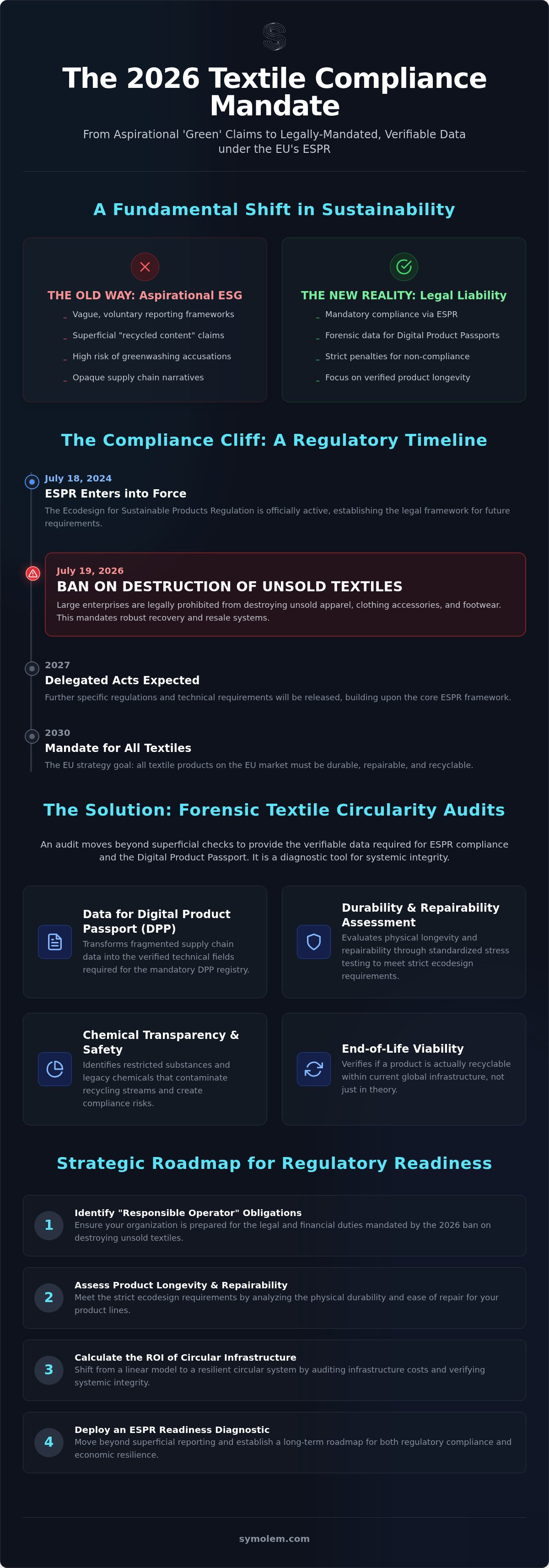
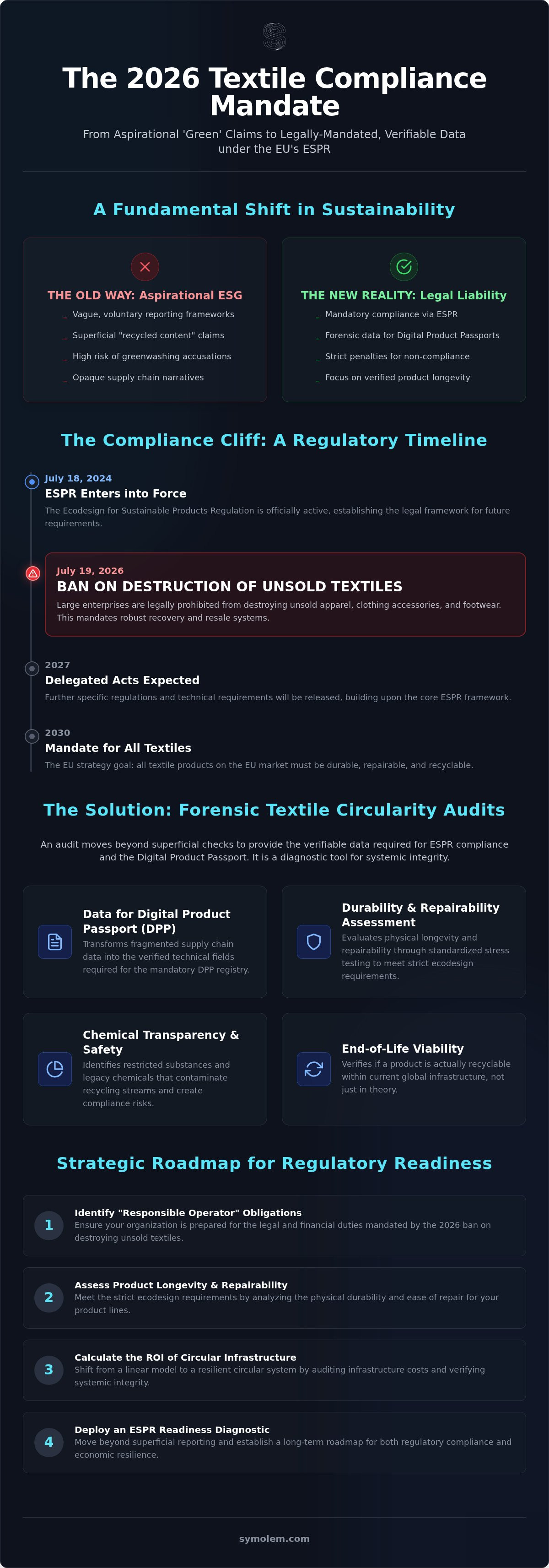
The Ecodesign for Sustainable Products Regulation (ESPR) has fundamentally altered the legal landscape. Unlike traditional ESG metrics, which often prioritize investor sentiment, the ESPR mandates specific, technical performance standards that products must meet to enter the EU market. This regulation, which entered into force on July 18, 2024, establishes a clear trajectory toward a circular fashion economy where durability and repairability are not optional design choices but legal requirements. Brands that fail to treat these requirements as a core business imperative risk total market exclusion.
From Greenwashing to Forensic Verification
Marketing claims no longer withstand regulatory scrutiny. The Green Claims Directive now demands that environmental assertions be backed by clinical, diagnostic precision. Superficial "recycled content" tags don't survive the scrutiny of a modern audit that maps full lifecycle accountability. By employing third-party advisory, brands can move beyond the "recycled" label to understand the structural reality of their supply chains. This process requires a shift from anecdotal evidence to a data-driven framework where every material input and output is meticulously documented and verified.
The 2026 Compliance Mandate: ESPR and EPR
2026 represents a compliance cliff. On July 19, 2026, large enterprises face a strict ban on the destruction of unsold apparel, clothing accessories, and footwear. This isn't just a waste management issue; it's an economic crisis for brands without established recovery systems. Extended Producer Responsibility (EPR) further compounds this by shifting the financial burden of waste directly onto the brand. Auditing your recovery infrastructure now is the only way to mitigate these costs before enforcement hits full scale. To navigate this shift, organizations must deploy an ESPR Readiness Diagnostic: A Strategic Mandate for Textile Compliance in 2026. This diagnostic serves as the evidence base for regulatory alignment, ensuring that your circular strategy is both legally sound and economically viable.
The Technical Scope of a Textile Circularity Audit
Precision is the only defense against regulatory failure. A comprehensive textile circularity audit service investigates the physical and chemical properties of a garment with diagnostic rigor, moving beyond visual inspections to evaluate durability and repairability through standardized stress testing. These assessments ensure products survive multiple lifecycles, directly aligning with the EU Strategy for Sustainable and Circular Textiles which mandates that by 2030, all textile products placed on the EU market are durable, repairable, and recyclable. If your product isn't built to last, it isn't compliant.
Chemical transparency remains a structural bottleneck in global value chains. Audits must meticulously identify restricted substances and legacy chemicals that contaminate recycling streams, effectively rendering recovered materials unusable for high-value textile-to-textile recovery. If a product contains persistent organic pollutants or complex, unseparable fiber blends, its circular status is a dangerous economic fiction. Determining end-of-life viability requires verifying if a product is actually recyclable within the current global infrastructure, rather than relying on theoretical possibilities that don't exist at scale.
Mapping Data Fields for Digital Product Passports
Data fragmentation kills compliance. Mapping technical data fields across Tier 1 to Tier 4 suppliers is a monumental task that requires a unified architectural approach to supply chain visibility. Manufacturers often struggle with the Challenges of Digital Product Passport Implementation: A Strategic Framework for 2026, particularly when reconciling disparate data sets from global partners. To ensure security and trust, verifiable credentials must be utilized as the gold standard for DPP data, providing an immutable record of a product’s journey that regulators can trust.
Measuring Impact and Verification Rigor
Estimates are no longer acceptable in a regulated market. The industry is shifting from vague impact projections to an uncompromising system of Measurement, Reporting, and Verification (MRV). Integrating a robust Life Cycle Assessment (LCA) strategy into the audit process ensures that data isn't just collected but verified against the EU Environmental Footprint (PEF) methodology. This level of scrutiny prevents the use of generic global averages that often hide granular supply chain inefficiencies. For brands seeking to secure their market position against impending audits, conducting an ESPR Readiness Diagnostic is the logical first step in establishing this technical baseline.
Regulatory Alignment: Mapping Audits to ESPR Requirements
Liability under the Ecodesign for Sustainable Products Regulation (ESPR) rests squarely with the "Responsible Operator". This entity, typically the brand or importer placing products on the EU market, carries the legal burden of ensuring every garment meets strict circularity criteria. A forensic textile circularity audit service provides the necessary evidence base to validate these claims, transforming opaque supply chain activities into verifiable data. Without this audit-ready framework, the Responsible Operator faces significant legal and financial exposure as regulators shift from education to clinical enforcement. Liability follows the data; if you can't prove it, it didn't happen.
The prohibition on destroying unsold consumer products is the most immediate hurdle for large enterprises. Starting July 19, 2026, these companies must not only cease this practice but also publish their first disclosure reports covering the 2025 financial year. The audit process must therefore map inventory flows with clinical precision, identifying structural failures in demand forecasting and end-of-life recovery that lead to surplus. This isn't a mere reporting exercise. It's a fundamental restructuring of how value is managed across the product lifecycle to avoid the "compliance cliff" of 2026.
The Role of the Digital Product Passport (DPP)
The Digital Product Passport (DPP) serves as the central nervous system of this new regulatory era. It's the technical vehicle through which transparency is delivered to regulators, recyclers, and consumers alike. Implementing a DPP framework requires mapping hundreds of technical data fields, a task that is central to an ESPR Readiness Diagnostic: A Strategic Mandate for Textile Compliance in 2026. By establishing this digital infrastructure now, brands ensure their products remain visible and compliant throughout the 2026-2030 regulatory roadmap, which will eventually expand to include medium-sized enterprises by July 2030.
Extended Producer Responsibility (EPR) Readiness
Financial liability in the textile sector is increasingly tied to material choices through eco-modulation fees. Under Extended Producer Responsibility (EPR), brands are charged based on the durability, repairability, and recyclability of their products. Auditing for EPR readiness allows organizations to calculate these fees accurately and implement design changes that reduce their financial burden. Successfully Navigating Textile EPR: 2026 Compliance Framework requires a deep understanding of how global value chains interact with localized recovery systems. This strategic alignment ensures that circularity isn't just a compliance requirement but a driver of long-term economic resilience.
The Economic Reality: Auditing the Viability of Circular Infrastructure
Circularity is an economic design problem, not a moral one. Most legacy recovery models are fiscally illiterate. They ignore the granular reality of collection costs, which currently fluctuate between $180 per ton in urban centers and $300 per ton in rural areas. A textile circularity audit service identifies these systemic leaks before they trigger a financial crisis. By auditing the actual economics of recovery, organizations move from treating "green" as a cost center to viewing "circular" as a resilient business model. Waste reduction and resource efficiency aren't just ethical goals; they're the primary ROI of a system built on clinical data.
Identifying structural failures in current recovery models is the first step toward designing resilient alternatives. Many brands rely on fragmented recycling partnerships that lack the scale to handle the volume of unsold goods mandated by the 2026 ESPR ban. An audit exposes these vulnerabilities, providing the diagnostic precision required to restructure the supply chain for stability. This process ensures that every material flow is not only transparent but also economically viable within the context of global market fluctuations.
Cost-Benefit Analysis of Circular Models
Survival in the 2026 landscape depends on a Cost-Benefit Analysis of Circular Textile Models: A 2026 Strategic Mandate. Large enterprises must account for the immediate inventory liabilities created by the ban on destroying unsold apparel, clothing accessories, and footwear. Meanwhile, medium and small operators must navigate the high costs of circular infrastructure without the benefit of massive scale. Strategic auditing provides the diagnostic precision needed to model these financial impacts. It allows brands to design recovery systems that are both legally compliant and economically solvent.
Global Value Chain Strategy
Circularity fails at the border if it isn't designed for global logistics. A garment's lifecycle often spans multiple continents, making the "loop" a complex chain of economic operators including fiber producers, manufacturers, and reverse logistics specialists. Auditing these operators is the only way to ensure systemic integrity across the value chain. This process bridges the gap between high-level EU policy and the granular reality of global profit. To transition from superficial narratives to a robust, audit-ready framework, organizations should prioritize Circular Economy Strategy Development as a core business function.
Beyond Box-Ticking: Implementing a Strategic Compliance Framework with Symolem
Compliance is not a passive exercise in box-ticking. It is a structural requirement for market access. Most high-volume certification giants treat verification as a transactional commodity, yet this approach fails to address the granular complexities of the 2026 regulatory mandate. Symolem prioritizes systemic integrity over superficial marketing narratives. By utilizing our textile circularity audit service, organizations move beyond the limits of traditional ESG reporting to establish a clinical, diagnostic baseline that withstands legal scrutiny. We don't just identify failures; we architect the technical and economic remedies required for long-term survival.
The Symolem approach is characterized by intellectual rigor and uncompromising realism. We function as a strategic partner rather than a generalist consultant, providing a clear trajectory from diagnostic discovery to implementation. This transition is essential for brands that recognize circularity as a business imperative rather than a sentiment-driven initiative. Our expert-led diagnostics bridge the gap between abstract EU policy and the technical reality of global value chains.
The Symolem Forensic Diagnostic Process
Our methodology follows a methodical, three-step trajectory designed to ensure total regulatory alignment:
- Step 1: Regulatory Gap Analysis. We deploy a comprehensive ESPR Readiness Diagnostic to identify specific vulnerabilities in your current operations and supply chain data.
- Step 2: Technical Data Mapping. We specialize in mapping the hundreds of mandated data fields required for Digital Product Passport (DPP) Frameworks, ensuring every credential is verifiable and secure.
- Step 3: Strategic Infrastructure Design. We move into Circular Economy Strategy Development, auditing the true economics of recovery systems and designing infrastructure that is both resilient and cost-effective.
Securing Your Competitive Advantage in 2026
Early adopters of rigorous auditing protocols will dominate the EU market. By the time the 2027 delegated acts for textiles are fully operational, brands with established systemic integrity will have secured their supply chains against disruption. Verified data is the new brand equity. It's the only way to prove compliance to regulators while building trust with a sophisticated consumer base. Don't wait for the 2026 compliance cliff to realize your data is insufficient. Contact Symolem to begin your forensic circularity audit and secure your organization’s position in the circular economy.
Securing Market Access in the Post-Linear Era
The 2026 regulatory landscape doesn't reward intent; it demands proof. As the Ecodesign for Sustainable Products Regulation (ESPR) moves from policy to enforcement, the distinction between market leaders and those facing exclusion will depend entirely on technical data integrity. We've explored how a forensic textile circularity audit service serves as the critical diagnostic for mapping Digital Product Passports and auditing the true economics of recovery systems. This isn't just about avoiding fines. It's about building a stable, systemic framework that survives the shift from linear waste to circular value.
Symolem provides the independent strategic advisory needed to navigate these global textile policy shifts with clinical precision. We specialize in the technical implementation of ESPR and DPP frameworks, prioritizing economic reality over aspirational narratives. By establishing an audit-ready infrastructure now, you ensure your organization remains resilient against impending delegated acts. Secure your 2026 market access with a Symolem Forensic Audit and lead the industry with verified integrity. You've the opportunity to transform compliance into a permanent competitive advantage.
Frequently Asked Questions
What is a textile circularity audit service?
A textile circularity audit service is a forensic examination of material flows, durability, and recovery potential within a product's lifecycle. It moves beyond superficial ESG reporting to provide a clinical assessment of a garment's physical longevity and chemical transparency. This diagnostic process verifies whether a product can actually be repaired, reused, or recycled within existing global infrastructure, ensuring that circularity claims are backed by technical evidence rather than marketing sentiment.
Is a circularity audit mandatory under EU ESPR regulations?
Circularity audits aren't explicitly named as a single mandatory certificate, but they're the necessary evidence base for ESPR compliance. The regulation mandates that products meet specific ecodesign requirements regarding durability and recyclability to access the EU market. Without a rigorous audit, a "Responsible Operator" can't verify the technical data fields required for the Digital Product Passport or prove they've ceased the destruction of unsold goods as required by the 2026 mandate.
How does a circularity audit support the Digital Product Passport (DPP)?
The audit functions as the primary data-gathering mechanism for the Digital Product Passport. It identifies and maps the technical data fields, such as fiber composition and chemical additives, that must be digitally accessible to regulators and recyclers. By conducting a forensic audit, brands ensure that the information within the DPP is verified and audit-ready, preventing the inclusion of fragmented or inaccurate supply chain data that could lead to regulatory rejection.
What is the difference between a sustainability audit and a circularity audit?
Traditional sustainability audits often focus on social labor practices or high-level carbon footprints, which can be aspirational or general. A circularity audit is a specialized diagnostic that prioritizes systemic integrity and material recovery. It specifically evaluates technical metrics like tensile strength for durability, repairability scores, and the economic viability of reverse logistics. While sustainability audits check for "less harm," circularity audits verify the structural capacity for a closed-loop system.
How much does a textile circularity audit cost for a fashion brand?
Costs vary significantly based on the complexity of the global value chain and the volume of SKUs analyzed. General environmental audits in the U.S. often range from $6,000 for small facilities to over $40,000 for complex operations, but textile-specific circularity diagnostics require deeper technical mapping. Brands should view this as a strategic investment in market access rather than a simple expense, as the cost of non-compliance under ESPR far exceeds the price of forensic verification.
Can small fashion brands afford an ESPR readiness diagnostic?
Small brands can and must prioritize readiness, though the scope of their diagnostic may be more targeted than that of a multinational enterprise. While the ban on destroying unsold goods initially targets large enterprises in 2026, it extends to medium enterprises by July 19, 2030. Early investment in a diagnostic framework allows smaller operators to build circularity into their core business model, avoiding the high costs of retrofitting fragmented supply chains once regulations hit full scale.
How long does a full textile circularity audit take to complete?
A comprehensive textile circularity audit service typically spans several weeks to several months, depending on the transparency of Tier 1 through Tier 4 suppliers. The process involves initial gap analysis, physical product testing, and the mapping of complex data fields for the Digital Product Passport. Because the 2026 mandate requires disclosure of 2025 financial year data, brands should initiate the audit process immediately to ensure their reporting frameworks are robust before the first legal deadlines arrive.
What data fields are required for a textile audit in 2026?
The audit must capture technical data fields essential for the DPP and ESPR disclosure. This includes fiber composition, the presence of restricted substances, durability metrics, and the quantity of unsold products discarded annually. While the specific delegated acts for textiles are expected in 2027, the 2026 mandate already requires large companies to publish their first disclosure reports. These reports must utilize standardized templates to ensure transparency across the EU environmental footprint methodology.