Extended Producer Responsibility Fashion Advisory: Navigating the 2026 Regulatory Mandate
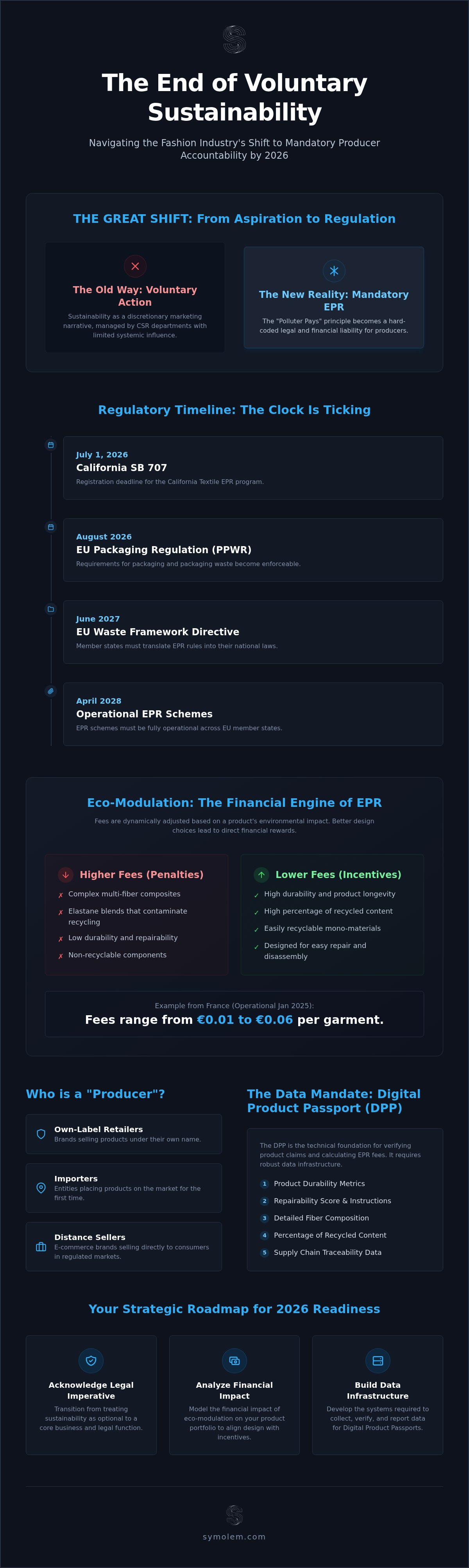
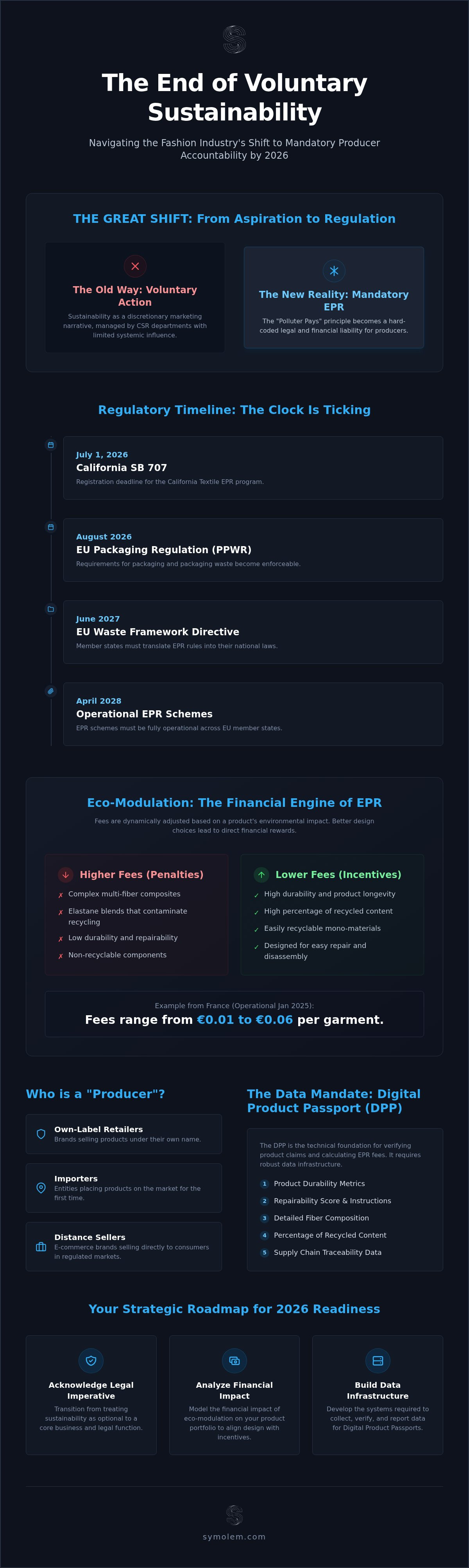
The era of voluntary sustainability is dead. For decades, the global fashion industry treated circularity as a discretionary marketing narrative, a peripheral concern managed by CSR departments with limited budgets and negligible systemic influence. You understand that this era of plausible deniability is collapsing under the weight of the 2026 regulatory mandate, where the "polluter pays" principle transitions from an ethical sentiment into a hard-coded legal and financial liability. This Extended Producer Responsibility fashion advisory serves as a clinical diagnostic for brands facing the July 1, 2026, California SB 707 registration deadline and the August 2026 EU Packaging and Packaging Waste Regulation requirements.
We provide the intellectual rigor and strategic framework necessary to master this structural shift from aspirational goals to mandatory textile accountability. By engaging with this analysis, you'll secure a clear compliance roadmap that replaces opaque regulatory timelines with predictable infrastructure costing and verified data frameworks. We will examine the mechanics of eco-modulation fees, the technical requirements for Digital Product Passports, and the specific architectural interventions required to transform regulatory compliance into a durable strategic advantage through circular design.
Key Takeaways
- Define the transition from discretionary sustainability to mandatory producer accountability as a critical business and legal imperative.
- Analyze the technical mechanics of eco-modulation fees to align circular design choices with direct financial incentives.
- Leverage this Extended Producer Responsibility fashion advisory to bridge the data infrastructure gap required for Digital Product Passport (DPP) verification.
- Evaluate the structural costs of textile recovery systems to move beyond superficial narratives and toward systemic economic reality.
- Utilize the ESPR Readiness Diagnostic to establish a clinical, data-driven roadmap for navigating the 2026 regulatory deadlines.
Table of Contents
- The End of Voluntary Circularity: Defining the 2026 EPR Mandate
- Decoding Eco-Modulation: The Technical Mechanics of EPR Fees
- The Infrastructure Gap: Costing the Transition to Circularity
- Regulatory Readiness Roadmap: A Strategic Framework for 2026
- Symolem’s Advisory Mandate: Architecture for a Circular Future
The End of Voluntary Circularity: Defining the 2026 EPR Mandate
Voluntary circularity is a failed experiment. For too long, the fashion industry has operated under a facade of aspirational targets and marketing-led sustainability reports that lack structural integrity. This era of discretionary choice ends in 2026. The transition from "waste management" as a public utility to "producer accountability" as a corporate liability is now a legal reality. This Extended Producer Responsibility fashion advisory emphasizes that the shift is absolute; brands can no longer outsource the consequences of their production cycles to municipalities or taxpayers.
Extended Producer Responsibility (EPR) is the mechanism driving this shift. It's a legal obligation that requires producers to take financial and operational responsibility for their products at the end of their lifecycle. For global brands, this Extended Producer Responsibility fashion advisory clarifies a fundamental truth: voluntary participation in recycling schemes is no longer a viable strategy for market access. Under the revised EU Waste Framework Directive (Directive (EU) 2025/1892), member states must translate these rules into national law by June 2027, with operational schemes required by April 2028. The window for strategic adjustment is closing rapidly.
The Legal Reality of the ESPR and EPR Nexus
The Ecodesign for Sustainable Products Regulation (ESPR) functions as the technical foundation for EPR fee structures. It's not enough to simply pay into a scheme. The amount you pay is now dictated by the physical properties of your inventory. The "Polluter Pays" principle is being applied with clinical precision to textile durability, repairability, and fiber composition. If your design cycle prioritizes obsolescence over longevity, your eco-modulation fees will reflect that failure. Non-compliance carries severe risks, including outright market bans across EU member states and financial penalties that scale with the volume of non-compliant goods placed on the market. These are not mere administrative fines; they are existential threats to margin integrity.
Who is a "Producer" Under 2026 Rules?
The 2026 mandates redefine the "Producer" as the "Responsible Operator" within the supply chain. This designation applies to any entity placing a product on the market for the first time, which includes own-label retailers, importers, and distance sellers. For UK-based brands selling into the European Union, Article 14 obligations create a significant hurdle. These brands must appoint a legal representative or register with a Producer Responsibility Organization (PRO) in every member state where they operate. The administrative burden is immense. Success requires a methodical approach to navigating EPR for textiles, ensuring that data infrastructure is robust enough to satisfy the complex reporting requirements. Failure to map these liabilities now will lead to systemic failure when the 2027 transposition deadlines arrive.
Decoding Eco-Modulation: The Technical Mechanics of EPR Fees
Eco-modulation is the fiscal heart of the new regulatory regime. It's a system designed to penalize structural failure and reward systemic integrity. This Extended Producer Responsibility fashion advisory identifies eco-modulation as the primary mechanism for translating design choices into balance sheet liabilities. Producer Responsibility Organizations (PROs) function as the central architects of this system. They collect fees from producers based on inventory volumes and redistribute those funds to finance the collection, sorting, and processing infrastructure required for a legitimate transition to circularity.
Fee structures are not uniform. They are dynamic. In France, where EPR for textiles is already operational as of January 2025, eco-modulated fees typically range from €0.01 to approximately €0.06 per garment. Reductions are granted only when specific thresholds for durability, recyclability, and recycled content are verified. Conversely, "disruptive" materials like elastane blends and complex multi-fiber composites increase financial liability because they contaminate the recycling stream and inflate sorting costs. Criteria for these fee reductions are based on clinical metrics:
- Durability: Verified through standardized physical testing for pilling, abrasion, and colorfastness.
- Recyclability: Prioritizing mono-materiality and the absence of hazardous chemicals or non-separable trims.
- Recycled Content: Requiring certified percentages of post-consumer or pre-consumer waste within the fiber composition.
Data as the New Currency of Compliance
Compliance is no longer a qualitative claim; it is a rigorous data-mapping exercise. The intersection of EPR reporting and the Digital Product Passport (DPP) necessitates that brands verify hundreds of specific data fields to justify fee reductions. This is a technical necessity, not an administrative choice. Without a robust data infrastructure, brands will inevitably overpay for their waste footprint. Identifying these vulnerabilities early through an ESPR readiness diagnostic is the only way to maintain margin integrity in a high-stakes regulatory environment.
The Economic Impact of Material Selection
The true cost of virgin polyester is decoupling from its market price. When eco-modulation penalties are factored into the unit cost, the perceived economic advantage of low-cost virgin synthetics evaporates. Strategic design must prioritize longevity and repairability to minimize these externalized costs. Eco-modulation is a dynamic financial lever for circularity. To secure a clear compliance roadmap, brands must integrate Policy and Regulatory Advisory into their core procurement and design strategies to ensure long-term stability.
The Infrastructure Gap: Costing the Transition to Circularity
Current textile recovery systems are fundamentally broken. They were built for disposal, not recovery. Europe generates over 6 million tonnes of textile waste annually, yet the existing sorting and recycling capacity is a fraction of what's required to meet the 2026 mandates. This isn't a minor bottleneck; it's a systemic failure. This Extended Producer Responsibility fashion advisory highlights that the "polluter pays" principle forces a radical re-evaluation of inventory. You aren't just selling products anymore. You're managing assets across their entire lifecycle.
Moving from a linear "take-make-waste" model to a circular one requires a rigorous cost-benefit analysis of circular textile models. Brands face a binary choice: pay escalating eco-modulated fees into general Producer Responsibility Organizations (PROs) or invest in proprietary or shared recovery infrastructure. While the latter requires significant upfront capital, it offers the only path toward long-term margin stability and material security. Relying on municipal waste systems is a high-risk strategy that ignores the specific technical requirements of textile-to-textile recycling.
Capital Expenditure vs. Operational EPR Fees
Strategic financial modeling must weigh immediate operational EPR fees against long-term capital expenditure in circular supply chains. Linear business models are increasingly burdened by the risk of "stranded assets", inventory that cannot be legally or economically disposed of under new regulations. In the U.S., the Regulatory Readiness Roadmap provided by industry authorities underscores the necessity of building robust collection networks. For global value chains, this challenge is amplified in emerging markets where the physical infrastructure for textile sorting is often non-existent or informal, creating significant reporting gaps.
Strategic Advisory for Circular Infrastructure Design
Transitioning from a diagnostic phase to implementation requires mapping the physical flow of goods with clinical precision. You must audit reverse logistics networks and integrate advanced sorting technologies to ensure compliance with the complex data fields required for Digital Product Passports. Circular infrastructure is the physical manifestation of regulatory readiness. Without the physical means to recover and process textiles at scale, your compliance strategy is nothing more than a theoretical exercise that leaves your brand vulnerable to escalating fees and market exclusion.
Regulatory Readiness Roadmap: A Strategic Framework for 2026
Compliance isn't an administrative choice. It's a structural realignment. This Extended Producer Responsibility fashion advisory provides the clinical framework required to transition from reactive crisis management to proactive market leadership. The 2026 mandates demand more than a revised sustainability report; they require a total audit of how data and materials flow through your organization. You don't have the luxury of time.
- Step 1: Gap Analysis. Conduct a comprehensive ESPR and EPR diagnostic to identify where existing operations fail to meet 2026 legal requirements.
- Step 2: DPP Readiness. Map supply chain data across the up to 236 data points in the UNTP schema required for Digital Product Passport (DPP) verification.
- Step 3: Portfolio Redesign. Rationalize product lines using eco-modulation fee models to eliminate high-liability fibers and complex multi-material blends.
- Step 4: Governance for MRV. Establish internal systems for rigorous Measurement, Reporting, and Verification to ensure systemic data integrity.
- Step 5: Core Integration. Embed circularity into the profit-and-loss statement, moving it from the periphery of CSR into the center of corporate strategy.
The UK vs. EU Compliance Landscape
UK-based brands face a complex, bifurcated reality. While the UK government continues its EPR consultations, the EU's mandatory schemes are moving toward full implementation with clinical speed. Brands with significant EU market exposure can't afford to wait for domestic clarity. You must act as if the most stringent regulations apply across your entire global footprint to avoid the fragmentation of supply chain data. Managing risk as a "responsible operator" across multiple jurisdictions requires a unified data architecture that can absorb divergent national requirements without systemic failure.
Verification Rigor and MRV
The era of self-certified sustainability is over. Third-party verification is now a technical necessity for justifying fee reductions and maintaining market access. The Green Claims Directive has effectively criminalized vague environmental narratives, making verifying textile sustainability claims for ESPR the only legitimate defense against greenwashing litigation. MRV systems must provide a clinical, audit-ready trail of every material choice. To begin this transition, initiate your ESPR Readiness Diagnostic to map your current liabilities against the 2026 mandate.
Symolem’s Advisory Mandate: Architecture for a Circular Future
Symolem is a systemic disruptor. We reject the soft-focus language of traditional sustainability consulting in favor of clinical, diagnostic precision. This Extended Producer Responsibility fashion advisory represents our commitment to treating the 2026 regulatory mandate as the critical business and legal imperative it is. While others offer aspirational narratives, we provide the technical and strategic architecture required to survive a fundamental redesign of fashion economics. We prioritize systemic integrity over superficial storytelling, focusing exclusively on the structural concepts of stability, verification, and economic reality.
Our mandate is to help brands cost the true economics of textile recovery. Existing models often ignore the granular details of global value chains, leading to unpredictable eco-modulation fees and infrastructure costing errors. We identify high-level failures, unpack the underlying structural reasons for those failures, and then introduce proprietary frameworks as the logical remedy. This methodical approach ensures that your brand isn't just compliant but is strategically positioned to leverage circularity as a competitive advantage in a landscape where "waste" is a priced liability.
Diagnostic Precision over Generalist Consulting
Generalist ESG consultants often fail to grasp the specific, technical nuances of textile-specific regulations. They lack the technical rigor required to map the up to 236 data points in the UNTP schema necessary for Digital Product Passport (DPP) readiness. Our focus remains entirely on structural integrity and systemic integration, ensuring that every data point is verified and audit-ready. We don't offer SaaS software as a standalone product because we understand that a tool without a rigorous strategic framework is a liability, not an asset. The first critical step for any brand is our ESPR readiness diagnostic, which maps your current operations against the 2026 mandate with clinical precision.
Strategic Implementation Frameworks
Implementation is the physical manifestation of strategy. We design cost-effective circular infrastructure for global clients, ensuring that business models are policy-literate and capable of absorbing the "polluter pays" principle. This involves mapping the physical flow of goods, auditing reverse logistics, and establishing the governance required for ongoing MRV (Measurement, Reporting, and Verification). We help you move beyond the inventory record to manage assets across their entire lifecycle. The window for voluntary adjustment is closed; the era of mandatory accountability is here. To secure your position in the new regulatory landscape, engage Symolem for your ESPR Readiness Diagnostic and begin the process of structural realignment today.
Securing Systemic Integrity in a Regulated Market
The window for discretionary sustainability has closed. The 2026 mandates represent a fundamental shift in the fashion industry's economic architecture, moving from peripheral CSR goals to central legal liabilities. This Extended Producer Responsibility fashion advisory has outlined the clinical necessity of data-driven compliance, the technical mechanics of eco-modulated fees, and the critical infrastructure gap that threatens margin integrity. Success in this new landscape requires more than superficial narratives. It demands technical rigor in mapping up to 236 data points in the UNTP schema and an uncompromising focus on the structural reality of textile recovery.
Symolem operates as an independent advisory firm with deep expertise in textile policy and regulatory mapping. We prioritize systemic integrity, providing the architectural strategy needed to navigate divergent global requirements without operational failure. By treating compliance as a strategic imperative rather than an administrative burden, your brand can transform regulatory pressure into a durable market advantage. It's time to move beyond the storytelling phase. Secure your regulatory future with a Symolem ESPR Readiness Diagnostic and establish the structural foundation required for long-term stability. The era of accountability is here. It's time to build.
Frequently Asked Questions
What are the primary EPR requirements for fashion brands in 2026?
Primary requirements include mandatory producer registration and financial accountability for post-consumer waste. By July 1, 2026, brands selling into California must register with a Producer Responsibility Organization under SB 707. In the EU, brands must prepare for national transposition of the Waste Framework Directive. This Extended Producer Responsibility fashion advisory notes that these requirements transition circularity from a voluntary marketing claim to a hard-coded legal liability for inventory management.
How much will EPR fees cost my fashion brand?
Fees vary by jurisdiction and product composition. California's initial registration fee is $1,000 for the 2026 to 2027 cycle. In France, fees currently range from €0.01 to €0.06 per item depending on eco-modulation criteria. Brands utilizing complex fiber blends or non-recyclable trims will face the highest penalties. Accurately costing these liabilities requires a clinical audit of your entire product portfolio to avoid unpredictable financial exposure as mandates scale.
Does EU EPR legislation apply to UK-based brands?
EU legislation applies to any brand placing products on the EU market, regardless of their headquarters. UK-based brands must appoint a legal representative or register with national PROs in every member state where they operate. Failure to meet these "responsible operator" obligations results in immediate market exclusion. Strategic Extended Producer Responsibility fashion advisory is essential for UK firms to navigate this regulatory divergence and maintain their European revenue streams.
What is the difference between EPR and the Digital Product Passport (DPP)?
EPR is the regulatory framework that dictates financial and operational liability for a product's end-of-life. The Digital Product Passport (DPP) is the technical data vehicle used to verify compliance. While EPR sets the "polluter pays" fees, the DPP provides the up to 236 data points in the UNTP schema required to justify fee reductions through eco-modulation. One is the legal mandate; the other is the granular verification system that makes the mandate functional.
How does eco-modulation affect product design and pricing?
Eco-modulation turns design choices into direct financial levers. Products engineered for durability, repairability, and mono-materiality receive lower fee rates, while "disruptive" materials like elastane blends incur significant penalties. This system forces a redesign of the unit cost model. Pricing strategies must now reflect the true economic cost of textile recovery, effectively ending the era of low-cost, high-impact synthetic production through targeted fiscal pressure.
What happens if a brand fails to comply with EPR regulations by 2027?
Non-compliance triggers severe legal and economic consequences. In California, intentional violations of SB 707 can result in fines of up to $50,000 per day. In the EU, failure to comply with national EPR schemes leads to market bans and the seizure of non-compliant inventory. Beyond immediate penalties, brands lose their status as "responsible operators," creating a systemic barrier to market access that software alone cannot remedy.
Can a brand manage EPR compliance through software alone?
Software is a diagnostic tool, not a comprehensive compliance strategy. While data management is necessary, it cannot replace the structural and architectural interventions required to redesign supply chains. Symolem does not sell SaaS because regulatory readiness requires expert-led strategic advisory to map complex value chains and cost circular infrastructure. Success depends on systemic integration and policy-literate business models, which move far beyond the capabilities of standalone reporting platforms.
What is the role of a Producer Responsibility Organization (PRO) in fashion?
A Producer Responsibility Organization (PRO) acts as the administrative and operational bridge between brands and waste management infrastructure. PROs collect eco-modulated fees, coordinate textile collection and sorting, and report compliance data to regulators. For example, Landbell USA was approved as the PRO for California in February 2026. Producers must join these organizations to satisfy their legal obligations for financing the physical recovery of their products.