
Extended Producer Responsibility for Fashion: Advisory Essentials
Voluntary sustainability is dead. The era of narrative-driven recycling has been replaced by a clinical, legal mandate that treats every garment as a future liability on your balance sheet. You recognize that the current patchwork of global regulations, from California's SB 707 registration deadlines to the EU's eco-modulated fee structures, is no longer a peripheral concern for your ESG team; it's a core structural risk. As civil penalties for non-compliance in California now reach up to $50,000 per day, the cost of fragmented oversight has become untenable.
This Extended Producer Responsibility fashion advisory provides the rigorous framework necessary to transition from reactive compliance to a unified, architected system of economic accountability. We'll unpack the hidden costs of textile recovery infrastructure, the technical requirements for eco-modulation data, and the precise steps to achieve regulatory readiness before the 2026 enforcement waves. By moving beyond superficial narratives, we'll establish a diagnostic path toward systemic integrity that aligns your global value chain with the uncompromising reality of the polluter-pays principle.
Key Takeaways
- Internalize costs. Treat EPR as a mandatory financial instrument that internalizes end-of-life liability rather than a simple regulatory fee.
- Align jurisdictions. Map the technical friction between the EU's harmonized textile rules and California’s SB 707 to ensure global operational compliance.
- Reduce fees. Utilize eco-modulation criteria to prioritize product durability and repairability, which directly minimizes per-unit financial exposure.
- Map data. Secure your reporting infrastructure by integrating the up to 236 data points in the UNTP schema required for Digital Product Passport verification and regulatory auditing.
- Audit exposure. Access an Extended Producer Responsibility fashion advisory to execute an ESPR Readiness Diagnostic and identify hidden costs in circular infrastructure.
The EPR Mandate: Moving Beyond the 'Polluter Pays' Narrative
The era of voluntary circularity is over. For decades, the global fashion industry has operated under a model of socialized waste, where the environmental and financial costs of textile disposal were offloaded onto public infrastructure and developing nations. Extended Producer Responsibility (EPR) terminates this arrangement. It's a mandatory economic instrument that internalizes the end-of-life management of textiles, shifting the fiscal burden directly onto the producer's balance sheet. This isn't a suggestion; it's a structural pivot from aspirational marketing to rigid, state-mandated financial accountability.
By 2026, the regulatory climate will have shifted from fragmented experimentation to a unified enforcement mechanism. Brands can no longer rely on passive compliance. The complexity of the emerging EU regulatory landscape for textiles demands a sophisticated Extended Producer Responsibility fashion advisory that treats compliance as a strategic business imperative rather than a reporting exercise. Passive observation of these shifts is no longer a viable strategy; it's a recipe for systemic obsolescence.
The Systemic Failure of Voluntary Recycling
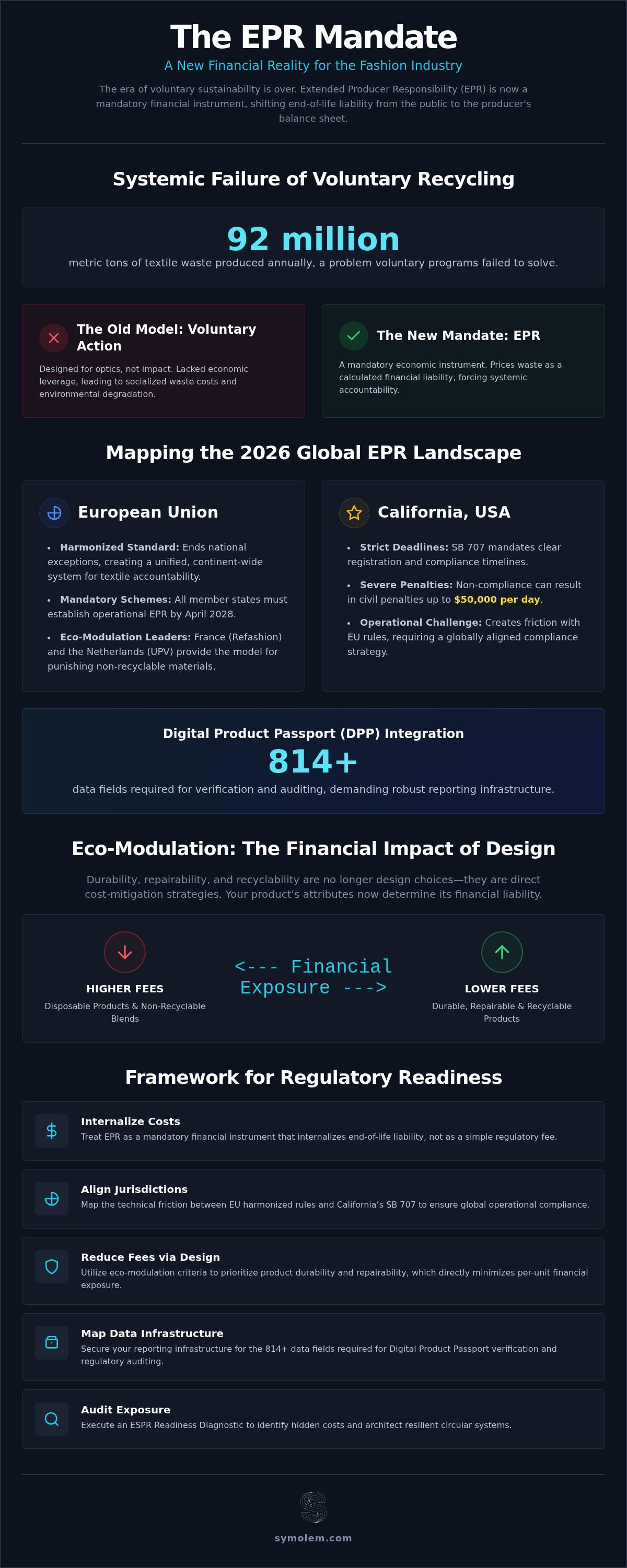
Traditional circularity has failed to move the needle on the 92 million metric tons of textile waste produced annually. Voluntary programs were designed for optics, not impact. They lacked the economic leverage to force a change in production volumes or material choices. EPR addresses this systemic failure by pricing the external costs of environmental degradation. It forces a transition from narrative-driven sustainability, which prioritizes brand perception, to structural accountability, which prioritizes systemic integrity. Under this framework, waste is no longer an unfortunate byproduct but a calculated financial liability that must be audited and managed with clinical precision.
EPR as a Component of the EU ESPR Framework
The Ecodesign for Sustainable Products Regulation (ESPR) provides the technical teeth for EPR mandates. It establishes a direct, causal link between a product's physical attributes and its mandatory financial contributions. Durability, repairability, and recyclability are no longer design choices; they're cost-mitigation strategies. For many brands, 2026 represents a cliff edge where the lack of a comprehensive textile industry regulatory risk management strategy will result in immediate, significant margin erosion. Compliance is no longer about checking boxes; it's about architecting a product lifecycle that can survive a rigorous economic audit. This Extended Producer Responsibility fashion advisory emphasizes that the relationship between design and tax liability is now linear. The more disposable the product, the higher the mandatory financial contribution.
Mapping the 2026 Global EPR Landscape for Fashion
Compliance is no longer a regional checkbox. It's a global structural challenge. By 2026, the divergence between European mandates and emerging North American regulations will create a friction point for any brand operating across borders. This isn't just about paying fees; it's about managing the compliance fragmentation that occurs when one jurisdiction demands fiber-to-fiber recycling while another focuses on landfill diversion. An Extended Producer Responsibility fashion advisory must provide a clinical map of these overlapping requirements to prevent catastrophic operational bottlenecks.
European Harmonization: France, Netherlands, and Beyond
France has long been the diagnostic laboratory for textile EPR. Through Refashion, the French model has evolved from simple volume-based fees to sophisticated eco-modulation that punishes non-recyclable blends. The Netherlands followed with its UPV (Uitgebreide Producenten Verantwoordelijkheid) in 2023, placing a surgical focus on high-quality fiber-to-fiber recycling. However, the true shift occurs with the EU Directive (EU) 2025/1892. This mandate, which came into force in October 2025, requires all Member States to establish operational EPR schemes by April 2028. This effectively ends the era of national exceptions and forces a unified, continent-wide standard for textile end-of-life accountability. Brands must now align with a EU regulatory landscape for textiles that is increasingly harmonized and uncompromising.
The US Frontier: California SB 707 and the Ripple Effect
The United States has entered the fray with clinical speed. California’s SB 707, the Responsible Textile Recovery Act, serves as the domestic blueprint. Producers must register with the state's approved Producer Responsibility Organization (PRO), Landbell USA, by July 1, 2026. Failure to comply carries civil penalties ranging from $10,000 to $50,000 per day, a high-stakes reality that makes technical precision mandatory. While California leads, U.S. Textile EPR Laws are expanding. New York’s Senate Bill S3217 and Washington’s House Bill 1420 signal a legislative trajectory that will soon cover the most significant consumer markets in the country.
Managing these disparate deadlines requires more than rudimentary tracking. It demands a technical architecture that can ingest data from multiple value chains and output verified compliance reports for each specific PRO. Without a centralized Extended Producer Responsibility fashion advisory, brands risk redundant infrastructure costs and conflicting design mandates. Establishing a unified diagnostic baseline is the only way to navigate this landscape without significant margin degradation. To secure your position, consider engaging with Symolem to execute a comprehensive ESPR Readiness Diagnostic.
Eco-Modulation: The Financial Impact of Circular Design
Design choices are no longer aesthetic preferences; they're financial liabilities. Eco-modulation is the mechanism that translates environmental performance into hard currency by scaling fees based on a product's circularity profile. Under the European Union's EPR Framework, this isn't a simple discount program. It is a clinical penalty system. Products engineered for durability and repairability receive fee reductions, while those utilizing hazardous substances or non-recyclable multi-material blends are hit with aggressive surcharges. This economic reality makes an Extended Producer Responsibility fashion advisory essential for protecting margins against the rising cost of disposability.
The financial delta between a compliant mono-material garment and a high-impact synthetic blend will soon represent a significant percentage of total product margin. This shift necessitates a rigorous cost-benefit analysis of circular textile models to determine where design intervention yields the highest ROI. In the 2026 regulatory environment, the "polluter pays" principle is applied with diagnostic precision, ensuring that the most complex products to recover carry the heaviest financial burden.
Costing the Infrastructure of Recovery
Compliance requires a deep understanding of the true economics of textile recovery. Brands must model the logistical friction of reverse supply chains, from the energy intensity of sorting technologies to the yield differences between mechanical and chemical recycling. Many organizations mistakenly view EPR as a static fee estimation exercise. In reality, it is a strategic mandate for infrastructure investment. By 2026, leading firms will shift capital from paying administrative penalties toward building captive recovery systems. This transition mitigates the volatility of eco-modulated fees and secures access to high-quality recycled feedstock in an increasingly competitive market.
Design for Compliance: Technical Requirements
Profitability in 2026 depends on meeting strict fiber-to-fiber recyclability targets. Any Extended Producer Responsibility fashion advisory must highlight the risk of 'forever chemicals' and other hazardous additives that trigger the highest-tier penalties. These surcharges are designed to be punitive enough to force material substitution. Furthermore, brands must align their design mandates with broader CSDDD implementation for fashion brands to ensure that circularity doesn't come at the cost of human rights or supply chain transparency. Systemic integrity requires a unified technical architecture that treats design, compliance, and costing as a single, interconnected workflow.
Implementing EPR Strategy: From Diagnostic to Data Mapping
Execution is the only metric that matters in the 2026 regulatory environment. Moving from a general awareness of mandates to a state of systemic readiness requires a methodical, five-step implementation framework. An Extended Producer Responsibility fashion advisory must prioritize structural diagnostics over superficial reporting to ensure that every garment in your inventory is accounted for within a verified recovery stream. This is a technical transition that transforms your supply chain into a closed-loop economic system.
The first step is to conduct a rigorous navigating EPR for textiles audit to identify jurisdictional exposure. This diagnostic identifies which products fall under specific mandates like California's SB 707 or the EU’s updated Waste Framework Directive. Following this, brands must map technical data fields for EPR reporting, ensuring seamless integration with the emerging Digital Product Passport (DPP) infrastructure. A specialized Extended Producer Responsibility fashion advisory ensures that data mapping aligns with both current and future reporting requirements. The third pillar involves establishing verification rigor through Impact Measurement and MRV systems, which serve as the legal defense against greenwashing litigation. Step 4 requires a clinical redesign of the value chain to favor durable, mono-material products that minimize eco-modulated fees. Finally, brands must make the strategic choice to either partner with vetted PROs or architect independent recovery infrastructure.
The Digital Product Passport (DPP) Intersection
EPR compliance is functionally impossible without the data transparency provided by the Digital Product Passport. The scale of the challenge is significant. You must map up to 236 data points in the UNTP schema required for textile circularity, ranging from chemical composition to disassembly instructions. Addressing the challenges of Digital Product Passport implementation is a prerequisite for accurate EPR reporting. Without this granular data architecture, your eco-modulated fees will be calculated based on worst-case assumptions by regulators, leading to significant margin erosion.
Verification Rigor and MRV
Verification is the antidote to regulatory scrutiny. Monitoring, Reporting, and Verification (MRV) systems provide the clinical evidence needed for verifying textile sustainability claims for ESPR. This isn't about marketing; it's about preparing for third-party audits that will scrutinize your EPR performance data with diagnostic precision. In 2026, data accuracy is a legal requirement that determines your standing in the global market. Secure your regulatory standing by initiating a Policy and Regulatory Advisory engagement with Symolem today.
Symolem Advisory: Architecting Resilient Circular Systems
Precision is the only defense against regulatory friction. As the global shift toward mandatory accountability accelerates, brands require more than just general guidance; they need a technical architect capable of mapping the specific economic impacts of circularity. Symolem provides a specialized Extended Producer Responsibility fashion advisory designed to navigate the high-stakes transition from voluntary recycling to rigid, state-mandated financial accountability. We move beyond the soft-focus language of traditional consulting to deliver clinical, diagnostic precision for global value chains.
Our ESPR Readiness Diagnostic serves as the foundational audit for identifying regulatory exposure. Unlike generic sustainability reporting, our approach focuses on the true economics of textile recovery and the technical requirements of eco-modulation. We provide independent, expert-led infrastructure costing that allows brands to model their financial liabilities with accuracy. This level of scrutiny ensures that your circular strategy is built on structural design and economic reality rather than superficial narratives that crumble under legislative audit.
Strategic Advisory for Global Compliance
Navigating the 2026 landscape requires a unified framework that satisfies both the EU's harmonized mandates and the emerging US state requirements. Symolem’s Policy and Regulatory Advisory provides customized roadmaps for brands operating across these disparate jurisdictions, ensuring that systemic integrity is maintained at every node of the supply chain. By establishing a rigorous data baseline, we help organizations ensure compliance with the EU Green Claims Directive fashion through verified EPR data. This integration prevents the legal and reputational risks associated with unsubstantiated environmental claims in an increasingly transparent market.
The Symolem Edge: Integrity Over Narrative
We prioritize truth over comfort. Our commitment to mapping the technical implementation of transparency means we focus on the up to 236 data points in the UNTP schema and the granular mechanics of the Digital Product Passport. We don't act as cheerleaders for the industry; we act as strategic disruptors who understand that long-term stability requires a fundamental restructuring of textile economics. To secure your position in the circular economy, engage with us for a comprehensive ESPR readiness diagnostic. This technical audit is the first step in architecting a resilient system that can withstand the clinical scrutiny of the 2026 regulatory wave.
Architecting the Circular Balance Sheet
The transition from voluntary recycling to mandatory economic accountability is an absolute business reality. By 2026, the convergence of EU mandates and US state laws will punish brands that rely on narrative over structure. This Extended Producer Responsibility fashion advisory has established the clinical necessity of internalizing end-of-life costs through eco-modulation and rigorous data mapping. Passive observation is no longer a viable strategy; it's a structural failure that will lead to margin erosion and severe legal penalties.
Symolem offers the intellectual rigor needed to build resilient systems. We provide global policy advisory and independent economic modeling for circular infrastructure to ensure your organization is prepared for the 2026 cliff edge. With expertise in mapping up to 236 data points in the UNTP schema for Digital Product Passports, we help you transform regulatory risk into a stable operational framework. Secure your systemic integrity; book an ESPR Readiness Diagnostic with Symolem today. You can move beyond reactive compliance toward a future of verified systemic integrity and market leadership.
Frequently Asked Questions
What is the primary difference between EPR and a traditional waste tax?
Extended Producer Responsibility is an economic instrument that internalizes the full lifecycle cost of a product, whereas a waste tax is typically a flat fee applied at the point of disposal. EPR creates a direct financial link between design choices and end-of-life liabilities. It forces producers to fund and manage recovery systems, incentivizing circularity rather than just generating public revenue.
How does the EU ESPR impact existing EPR obligations for fashion brands?
The ESPR provides the technical criteria that underpin EPR obligations by mandating specific design standards. It effectively sets the performance baseline for eco-modulation. Brands must meet ESPR's durability and material transparency requirements to avoid the highest tier of EPR fees, making the two regulations functionally inseparable in a unified, architected compliance strategy that prioritizes systemic integrity.
What are eco-modulated fees and how can they be minimized?
Eco-modulated fees are scaled financial contributions based on a product's environmental performance, such as recyclability or repairability. To minimize these costs, brands must prioritize mono-material construction and eliminate hazardous additives that trigger punitive surcharges. Engaging an Extended Producer Responsibility fashion advisory is critical for mapping these specific design attributes to fee reductions across different global jurisdictions.
Is California's SB707 applicable to brands based outside the United States?
Yes, SB 707 applies to any producer selling textiles into California, regardless of their global headquarters' location. If a brand meets the $1,000,000 annual aggregate global turnover threshold and places products on the California market, they're required to register with the state's Producer Responsibility Organization by July 1, 2026. Failure to comply results in significant daily civil penalties.
How do Digital Product Passports (DPP) assist with EPR compliance?
Digital Product Passports serve as the primary verification layer for EPR reporting by providing granular data on material composition and disassembly instructions. They ensure that eco-modulated fees are calculated based on verified technical data rather than conservative regulatory estimates. This transparency is essential for proving compliance during third-party audits and avoiding the financial risks associated with data gaps.
What is the role of a Producer Responsibility Organization (PRO) in 2026?
In 2026, Producer Responsibility Organizations act as the operational and administrative intermediaries between brands and state regulators. They manage the collection, sorting, and processing of textile waste while collecting the necessary fees from producers. PROs also aggregate the performance data required to demonstrate that jurisdictional recycling and recovery targets are being met with diagnostic precision.
Can a brand opt-out of a PRO and manage its own recovery infrastructure?
Most jurisdictions require brands to join a state-approved PRO, but some frameworks allow producers to establish independent recovery systems if they meet strict performance standards. However, managing independent infrastructure requires significant capital investment and rigorous MRV systems. You must prove that the alternative system achieves equivalent or superior environmental outcomes compared to the collective PRO model to maintain compliance.
How should brands prepare for the 2026 textile EPR deadlines in Europe?
Preparation requires an immediate transition from voluntary reporting to a clinical diagnostic of your regulatory exposure. Brands should initiate an ESPR Readiness Diagnostic to identify data gaps and map jurisdictional requirements across the EU and US. This Extended Producer Responsibility fashion advisory process ensures that design and supply chain operations are aligned with the technical requirements of the upcoming 2026 mandates.