EU Sustainability Legislation for Fashion: Navigating the 2026 Regulatory Landscape
The era of voluntary sustainability reporting has officially collapsed. It's replaced by a rigid regime of legal enforcement that treats environmental impact as a critical financial liability rather than a marketing asset. For years, the industry relied on fragmented initiatives and soft-focus goals, but the arrival of comprehensive EU sustainability legislation for fashion marks a definitive shift toward mandatory, audited accountability. This isn't a suggestion for better practice; it's a structural overhaul of how value is created and verified across the global textile supply chain.
You likely recognize that the complexity of these overlapping directives creates a significant risk of non-compliance and subsequent litigation. This article provides a clinical analysis of the binding mandates reshaping the industry, offering a strategic roadmap for systemic compliance that moves beyond superficial narratives. We'll deliver a definitive list of regulations, a precise implementation timeline, and a technical framework for integrating data infrastructure into your business strategy. We'll unpack the mechanics of the regulatory landscape to ensure your organization transitions from reactive panic to structural integrity.
Key Takeaways
- Shift from voluntary reporting to mandatory legal compliance under the 2026 EU sustainability legislation for fashion to mitigate systemic litigation risks.
- Conceptualize the Digital Product Passport as a complex data ecosystem rather than a superficial label to ensure technical and operational readiness.
- Evaluate how upcoming EPR eco-modulation mandates will transform product circularity into a direct driver of corporate compliance costs.
- Secure the integrity of environmental claims through rigorous third-party verification to meet the liability standards of the CSDDD and Green Claims Directive.
- Prioritize a strategic diagnostic approach to map data infrastructure needs before deploying technical solutions or software.
Table of Contents
The 2026 EU Regulatory Mandate: From Voluntary to Mandatory
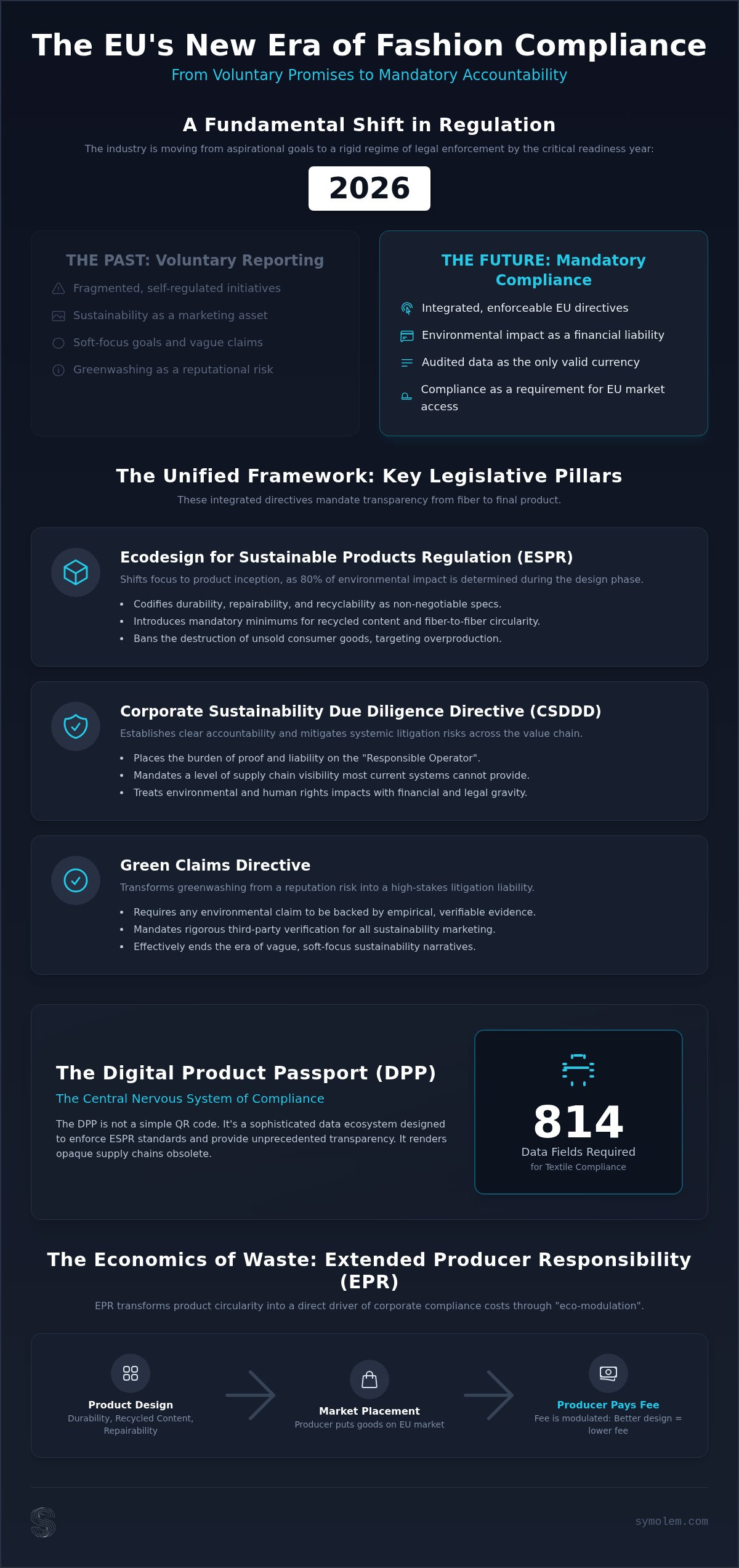
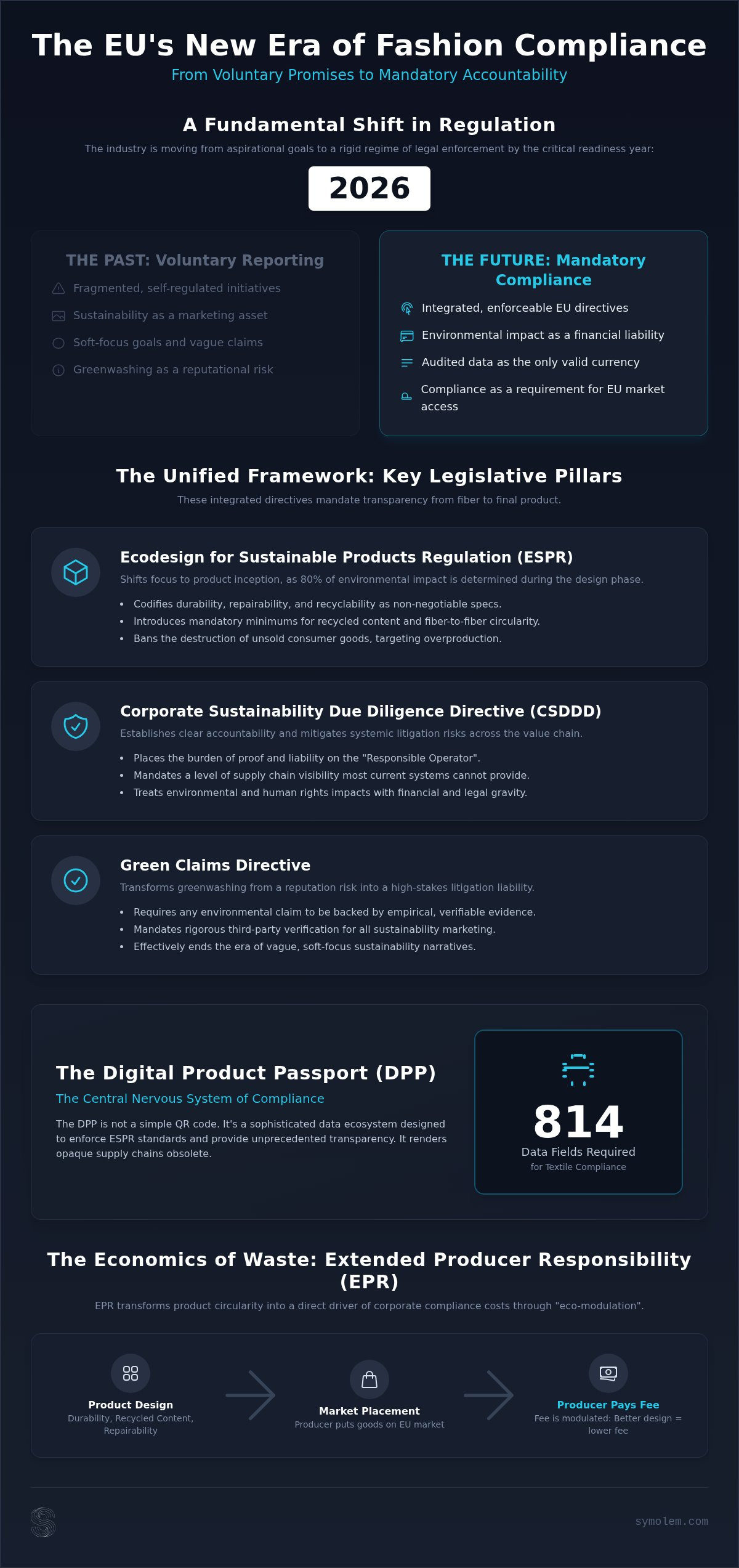
The era of optionality is dead. For decades, the fashion industry operated within a vacuum of self-regulation, using the broad concept of sustainable fashion to define its own metrics of success. That period has ended. The European Union has transitioned from the aspirational vision of the Green Deal to the implementation of binding, enforceable delegated acts that treat environmental impact as a legal and economic imperative. This shift moves the industry away from marketing narratives and toward a regime of audited compliance where technical data serves as the only valid currency.
2026 represents the critical readiness year for global value chains. While the Omnibus I Simplification Package has streamlined certain reporting timelines to ensure administrative feasibility, it hasn't diluted the underlying requirements. It's a strategic pause intended to allow brands to build the necessary data infrastructure before the full weight of enforcement begins. Organizations that fail to utilize this window for structural redesign will find themselves locked out of the European market as the EU sustainability legislation for fashion transforms from a policy proposal into a hard market barrier.
The End of Aspirational Sustainability
The EU Strategy for Sustainable and Circular Textiles serves as the master blueprint for this transformation. It's a diagnostic tool designed to identify and eliminate the structural failures of the current linear model. Under this strategy, greenwashing is no longer just a reputation risk; it's a high-stakes litigation liability. New directives mandate that any environmental claim must be backed by empirical evidence, effectively ending the era of vague, soft-focus sustainability marketing. Brands must now prove their claims through a verifiable trail of evidence that spans the entire product lifecycle.
Key Legislative Pillars for 2026
Three core directives form the unified framework for the 2026 landscape: the Ecodesign for Sustainable Products Regulation (ESPR), the Corporate Sustainability Due Diligence Directive (CSDDD), and the Green Claims Directive. These aren't isolated rules. They function as an integrated ecosystem that mandates transparency from the fiber level to the point of sale. Central to this is the designation of the Responsible Operator. This legal role places the burden of proof and liability squarely on the entity placing the product on the EU market, requiring a level of supply chain visibility that most current systems cannot provide. Compliance isn't a reporting exercise; it's a requirement for market access.
ESPR and the Digital Product Passport (DPP): Product Architecture
Design is no longer a creative suggestion. It's a rigid technical requirement. The Ecodesign for Sustainable Products Regulation (ESPR) serves as the primary architectural mandate within the broader framework of EU sustainability legislation for fashion, shifting the focus from end-of-pipe solutions to the point of product inception. Research indicates that 80% of a product's environmental footprint is determined during the design phase. Consequently, the EU is moving to codify durability, repairability, and recyclability as non-negotiable specifications for any textile entering the internal market.
The Digital Product Passport (DPP) is the mechanism for enforcing these standards. It's a mistake to view the DPP as a mere digital label or a consumer-facing QR code. It is a sophisticated data ecosystem. Implementation requires mapping a staggering up to 236 data points in the UNTP schema for textile compliance, a task that demands a granular understanding of global value chains. This ledger will track everything from chemical composition to recycled content, creating a level of transparency that renders opaque supply chains obsolete.
Ecodesign Requirements for Textiles
The ESPR introduces mandatory minimums for fiber-to-fiber circularity and recycled content. It aims to dismantle the "take-make-waste" model by enforcing performance requirements that ensure garments remain in the economy for as long as possible. A critical priority for 2026 is the ban on the destruction of unsold consumer goods, a practice that the EU identifies as a structural failure of overproduction. Read our analysis on EU Ecodesign Regulation for Textiles: Critical Requirements to understand how these EU laws for sustainable textile consumption are designed to force a systemic pivot toward longevity.
Digital Product Passport Implementation
Managing the DPP requires a robust technical infrastructure capable of securing verifiable credentials across multiple tiers. Organizations must navigate the challenges of Digital Product Passport implementation, particularly regarding data governance. The objective is to provide total transparency to regulators and recyclers without compromising sensitive trade secrets. Because EU sustainability legislation for fashion treats data as a legal asset, brands must prioritize an ESPR Readiness Diagnostic to map these complex requirements before the 2026 deadline.
Extended Producer Responsibility (EPR): The Economics of Waste
Waste is now a corporate financial liability. The fragmented landscape of Extended Producer Responsibility (EPR) is undergoing mandatory harmonization across all EU member states by 2027. This shift transforms waste management from a localized administrative burden into a centralized economic lever within the broader framework of EU sustainability legislation for fashion. It's no longer sufficient to pay a nominal fee to a third-party provider; brands must now account for the entire lifecycle cost of every unit placed on the market.
The current failure of textile recovery isn't just an environmental issue. It's a structural economic deficit. Existing infrastructure lacks the capacity to process the current volume of post-consumer waste, necessitating a massive investment in sorting and recycling technologies at scale. This requirement is a core component of the EU Strategy for Sustainable and Circular Textiles, which seeks to internalize the costs of end-of-life management into the initial product price. By 2026, brands must have a clear understanding of these economic pressures to avoid sudden, punitive cost increases.
Eco-Modulated Fees Explained
Eco-modulation is the mechanism that links design to dollars. Under this system, EPR fees aren't flat. They're adjusted based on the circularity of the product. High-durability garments with high recycled content attract lower fees, while low-quality, non-recyclable items face punitive financial penalties. This creates a direct financial incentive to meet the design standards discussed in previous sections. For a detailed breakdown of these fee structures, see our strategic advisory on navigating EPR for textiles.
Infrastructure and Value Chain Costs
Building a circular value chain requires precise economic modeling. Brands must account for the costs of collection, sorting, and fiber-to-fiber recycling before these regulations become fully enforceable. This isn't merely about paying a fee to a Producer Responsibility Organization (PRO). It's about securing access to limited recycling capacity in a competitive market. Our cost-benefit analysis of circular textile models illustrates how early investment in infrastructure can mitigate future compliance shocks and ensure long-term operational stability.
Accountability and Transparency: CSDDD and Green Claims
Verification is the new standard of truth. The Corporate Sustainability Due Diligence Directive (CSDDD) establishes a legal regime that extends liability far beyond a brand's direct operations, reaching deep into the systemic failures of Tier 2 and Tier 3 suppliers. This isn't a reporting exercise. It's a mandate for active mitigation of human rights and environmental risks. Under this directive, the "adverse impact" of a global value chain becomes a direct legal liability for the parent organization, necessitating a level of oversight that traditional procurement models are fundamentally unequipped to provide.
The Green Claims Directive functions as the enforcement arm for market communication. It demands that every environmental statement undergoes rigorous third-party verification before it's presented to the consumer. This creates a critical intersection with the Corporate Sustainability Reporting Directive (CSRD), where high-level corporate disclosures must now align with granular, product-level impact measurement. The industry is moving rapidly from aspirational marketing narratives to verifying textile sustainability claims for ESPR through empirical evidence and audited data trails.
Supply Chain Due Diligence Rigor
CSDDD mandates the integration of due diligence into standard operating procedures. It's no longer acceptable to claim ignorance of labor violations or environmental degradation at the fiber or processing level. Organizations must identify, prevent, and remediate risks across their entire footprint. This requires a transition from superficial auditing to systemic impact measurement. Failure to demonstrate a proactive mitigation strategy can lead to severe civil liability and administrative sanctions, making EU sustainability legislation for fashion a matter of corporate survival rather than just compliance.
The Death of Vague Green Claims
Vague terminology is now a legal liability. Banned terms such as "eco-friendly," "natural," and "sustainable" are being phased out in favor of specific, LCA-backed data. The 2026 enforcement of the Empowering Consumers Directive will treat unsubstantiated claims as unfair commercial practices. Every claim must be supported by a comprehensive Life Cycle Assessment (LCA) that accounts for the specific product's reality rather than industry averages. To ensure your communication strategy survives this shift, initiate a Policy and Regulatory Advisory engagement to audit your current claims against the new verification standards.
Strategic Readiness: The Symolem Diagnostic Framework
Software is a tool, not a strategy. Many organizations are currently rushing to procure SaaS platforms promising automated compliance, yet these solutions often fail because they're applied to fundamentally broken systems. Achieving alignment with the EU sustainability legislation for fashion requires more than a digital interface; it demands a rigorous, strategic diagnostic process that identifies structural vulnerabilities before they become legal liabilities. Symolem functions as a strategic architect, moving beyond superficial reporting to rebuild the technical and economic foundations of the textile value chain. The trajectory from gap analysis to systemic implementation is a prerequisite for survival in the 2026 regulatory landscape.
Designing cost-effective circular infrastructure for global operations isn't an overnight task. It requires a clinical understanding of how policy shifts impact economic reality. We prioritize systemic integrity over quick fixes, ensuring that every data point and operational change serves the long-term stability of the business. By mapping the mechanics of the new directives, we enable brands to transition from a state of reactive panic to one of controlled, strategic readiness.
The ESPR Readiness Diagnostic
The ESPR Readiness Diagnostic is the essential first step for any brand seeking market access. It begins with a comprehensive mapping of the 2026 to 2030 regulatory roadmap against your specific product portfolio to identify immediate high-risk areas. We then conduct a technical data audit, specifically focused on the up to 236 data points in the UNTP schema required for Digital Product Passport (DPP) compliance. Finally, we facilitate Circular Economy Strategy Development to mitigate the financial pressures of eco-modulated EPR fees and ESPR design mandates, ensuring your product architecture is optimized for both compliance and cost-efficiency.
Architecting the Future of Fashion
Compliance is the floor, not the ceiling. Understanding the textile regulation impact on business models allows forward-thinking organizations to treat these mandates as the ultimate competitive advantage. By securing the supply chain through verifiable impact measurement (MRV), brands can prove their circularity claims with an authority that competitors cannot match. This level of transparency builds systemic resilience against future policy shifts. The next logical step for any executive is to engage an independent advisor to audit current frameworks and ensure that the transition to a regulated market is handled with intellectual and technical rigor.
Systemic Integrity as a Market Mandate
The transition from aspirational sentiment to audited legal reality is final. Navigating the 2026 landscape of EU sustainability legislation for fashion requires a fundamental shift in how brands perceive their global value chains. It's no longer a matter of storytelling; it's a technical requirement involving the mapping of 814 DPP data fields and the economic optimization of circular infrastructure. Organizations that fail to internalize these costs and data requirements now will find themselves structurally obsolete as the market moves toward mandatory transparency.
Successful adaptation demands an independent advisory that operates with clinical precision and a deep understanding of global policy. You shouldn't rely on superficial software fixes to solve deep-seated structural gaps. Instead, you must build a framework rooted in systemic integrity and uncompromising realism. Secure your 2026 regulatory standing with a Symolem ESPR Readiness Diagnostic. By prioritizing strategic readiness today, you transform regulatory pressure into a definitive competitive advantage for the future.
Frequently Asked Questions
What is the most urgent EU sustainability regulation for fashion brands in 2026?
The Ecodesign for Sustainable Products Regulation (ESPR) is the most immediate priority because it establishes the foundational design requirements for market access. By 2026, the ban on destroying unsold textiles becomes a hard legal constraint. This regulation forces a systemic shift from overproduction to circularity. Brands must prioritize a diagnostic audit to identify portfolio risks before these delegated acts become fully enforceable. Compliance is a prerequisite for any entity operating within the internal market.
Does ESPR apply to UK-based fashion brands selling into the EU?
Yes, the ESPR and broader EU sustainability legislation for fashion apply to any brand placing products on the EU market. UK-based or non-EU companies aren't exempt from these mandates. They must appoint a Responsible Operator within the EU to assume legal liability for product compliance. Failing to align with these technical standards results in immediate market exclusion. Geography doesn't provide a shield against the rigorous data requirements of the Digital Product Passport.
What data is required for the textile Digital Product Passport (DPP)?
The textile Digital Product Passport (DPP) requires the mapping of 814 specific data fields to ensure total transparency. This includes granular information on fiber composition, chemical presence, and material origin. It also tracks durability metrics, repairability scores, and end-of-life processing instructions. Managing this data ecosystem requires a robust technical infrastructure. Brands must move beyond superficial spreadsheets toward verified credentials that can be audited by regulators and accessed by recyclers across the value chain.
How does the Corporate Sustainability Due Diligence Directive (CSDDD) affect smaller suppliers?
Smaller suppliers are impacted through the trickle-down effect of contract clauses and auditing requirements. While the CSDDD primarily targets large enterprises, those organizations are legally liable for their entire tier structure. This forces them to mandate rigorous environmental and human rights standards for every supplier. Small-to-medium enterprises must demonstrate systemic compliance to remain viable partners. The directive effectively turns supply chain transparency into a non-negotiable condition of global trade and operational stability.
When do the new EU Green Claims Directive rules come into force?
Enforcement of the Green Claims Directive is expected to align with the 2026 deadline for the Empowering Consumers Directive. This timeline forces brands to immediately audit their communication strategies. Every environmental claim must be backed by third-party verified Life Cycle Assessment (LCA) data. Vague marketing terms are being replaced by empirical evidence. Organizations don't have the luxury of time; they must transition to a verification-first model to avoid high-stakes litigation risks and administrative penalties.
What are the penalties for non-compliance with EU textile regulations?
Penalties for non-compliance are designed to be punitive and market-distorting. They include significant financial fines, often calculated as a percentage of global annual turnover, and the mandatory recall of non-compliant products. Beyond financial loss, the EU can impose temporary or permanent bans on market access. The reputational damage of being legally labeled as a non-compliant operator creates a systemic risk that can destabilize investor confidence and long-term business viability in the European market.
How can fashion brands prepare for mandatory EPR schemes?
Preparation for mandatory EPR schemes requires a clinical analysis of product circularity and end-of-life economics. Brands must utilize eco-modulation to their advantage by designing for durability and recyclability, which directly reduces their financial burden. It's essential to model these costs now to avoid future margin erosion. Securing access to sorting and recycling infrastructure is also critical. Early strategic planning ensures that compliance costs are internalized without disrupting the overall business model or profitability.
What is the difference between CSRD and CSDDD for the fashion industry?
The Corporate Sustainability Reporting Directive (CSRD) focuses on transparency through audited disclosures of environmental and social impact. In contrast, the CSDDD is a mandate for action, requiring brands to identify and mitigate risks across their entire value chain. While CSRD tells the story of a brand's impact, CSDDD establishes the legal liability for that impact. Both are pillars of the EU sustainability legislation for fashion, working together to ensure that reporting is backed by systemic due diligence.